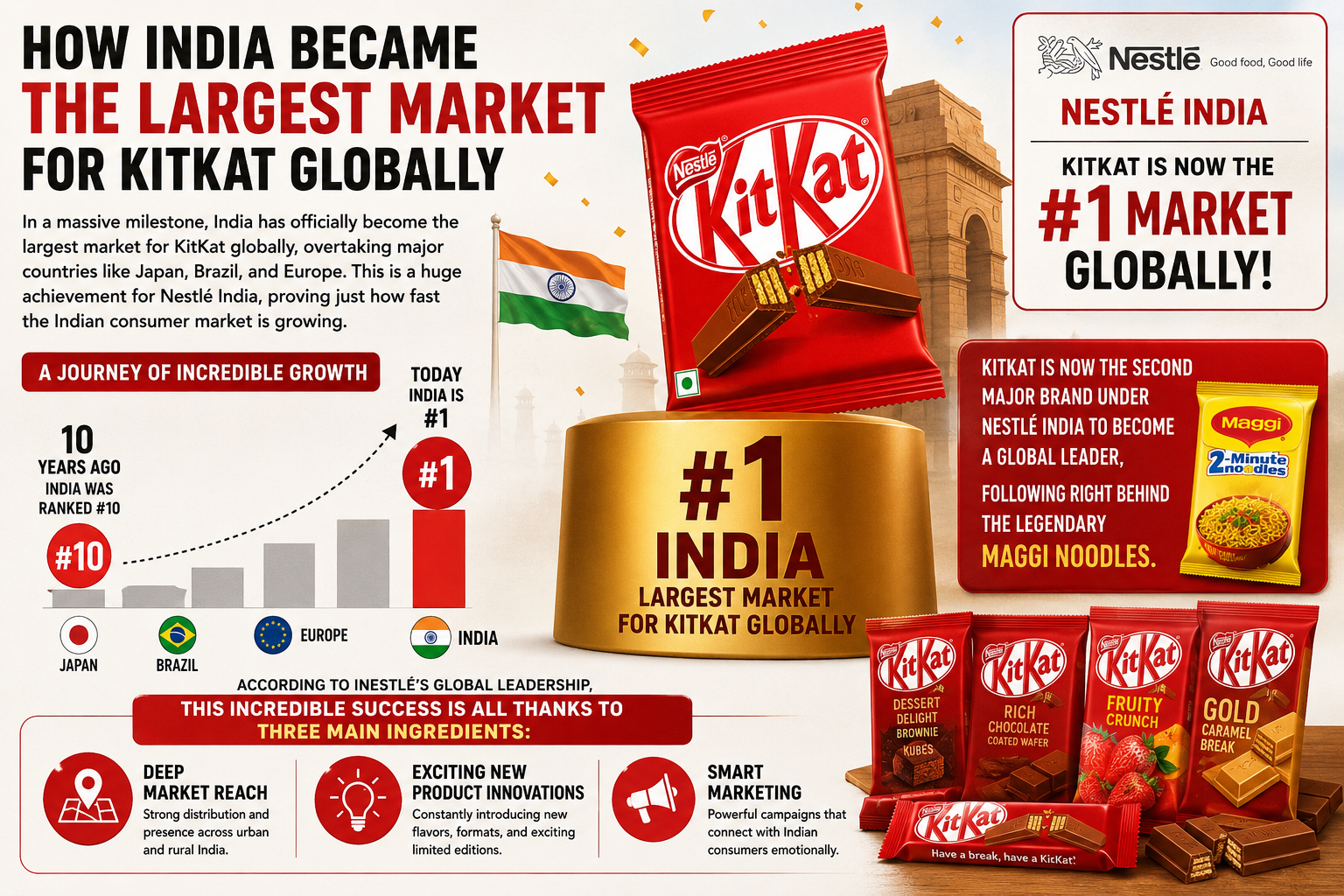
In a massive milestone, India has officially become the largest market for KitKat globally, overtaking major countries like Japan, Brazil, and Europe. This is a huge achievement for Nestlé India, proving just how fast the Indian consumer market is growing.
Just ten years ago, India ranked down at number 10 for KitKat sales. Today, it has jumped all the way to the top spot.
KitKat is now the second major brand under Nestlé India to become a global leader, following right behind the legendary Maggi noodles. According to Nestlé’s global leadership, this incredible success is all thanks to three main ingredients: deep market reach, exciting new product innovations, and smart marketing.
The Strategic Rise: From Number 10 to Global Number 1
The journey of KitKat in India is a masterclass in long-term brand building, distribution expansion, and market adaptation. For the past two to three years, India steadily held the position of the second-largest market for the brand. However, fueled by an exceptional surge in demand and relentless market execution, it has clinched the ultimate crown.
The Official Verdict from Corporate Leadership
Confirming this historic milestone, Nestlé India Chairman and Managing Director Manish Tiwary stated:
“India is now the largest market for KitKat globally, and the brand has accelerated its market share growth over the last few years.”
This growth momentum was particularly visible during the financial year 2026 (FY26). According to the company’s financial disclosures, Nestlé India’s confectionery product group delivered high double-digit growth in both value and volume. This stellar performance was backed by robust underlying transaction growth across its key brands, with KitKat serving as the primary locomotive pulling the portfolio forward.
To put this scale into perspective, one only needs to look back at Nestlé India’s annual report for FY25. The company revealed that it had produced and distributed a staggering 3,950 million fingers of KitKat within the country. This massive volume came on the back of the brand successfully doubling its market share, effectively making it the fastest-growing brand within the entire chocolate category in India.
Decoding the Growth Engines: How Nestlé Conquered India
Such a massive corporate triumph does not happen by accident. India becoming the largest market for KitKat globally is the direct result of a multi-pronged strategy executed by Nestlé India’s management.
According to Jagatheesan Gopichandar, Director of Confectionery and Cereals at Nestlé India, the phenomenal performance was fundamentally driven by a “strong increase in core penetration and also entry into new consumer demand spaces.”
Nestlé broke down traditional consumption barriers by looking at the Indian consumer through a lens of distinct segments, ensuring there was a KitKat for every occasion, budget, and flavor profile.
                                             NESTLÉ KITKAT INDIA GROWTH STRATEGY
         ┌─────────────────────────┼─────────────────────────┐
         ▼                         ▼                         ▼
Product Innovation       Premiumization Drive      Infrastructure Setup
(Celebreak, Pops, Duos)  (Salted Caramel, Hazelnut) (Visicooler Expansion)
1. Micro-Targeting Consumer Demand Spaces
Traditionally, chocolates in India were viewed either as occasional treats or festival gifts. Nestlé systematically dismantled this narrative by identifying and creating new “demand spaces” for daily life:
The Gifting Arena: Nestlé introduced KitKat Celebreak, explicitly targeting the massive festive and celebratory gifting culture in India, competing directly with traditional sweets and established premium chocolate players.
The Snacking & Nibbling Space: To capture consumers who want a quick, bite-sized sweet treat while working, driving, or relaxing, the company launched KitKat Pops. This format moved the brand away from the rigid “finger” structure into a loose, shareable format.
2. The Premiumization Drive vs. Mainstream Innovation
India is a uniquely complex market where a brand must simultaneously appeal to value-conscious rural consumers and trend-seeking, affluent urban consumers. Nestlé managed this duality masterfully:
The Premium Portfolio: To cater to evolving urban palates demanding sophisticated flavor profiles, Nestlé accelerated its luxury offerings with the KitKat Delights range. This included indulgent variants such as Salted Caramel and Hazelnut.
Mainstream Disruptions: On the mass-market side, the brand kept excitement alive with mainstream innovations like KitKat DUO and quirky, refreshing flavor profiles such as KitKat Lemon and Lime, breaking the monotony of standard milk chocolate profiles.
Aggressive Marketing and Infrastructure Scaling
An innovative product line is only as good as its visibility and availability. To sustain the high double-digit growth seen in FY26, Nestlé India executed aggressive marketing investments and structural distribution upgrades.
High-Octane Advertising and Cultural Relevance
Nestlé India significantly boosted its advertising spends across digital, television, and experiential media formats. By rolling out strategic partnerships, cricket-centric campaigns, and youth-focused digital content, the brand reinforced its famous “Have a Break, Have a KitKat” tagline, seamlessly weaving it into the high-stress, fast-paced lifestyles of modern Indian consumers.
The Visicooler Revolution
One of the biggest operational hurdles in India’s tropical climate is maintaining chocolate quality across small, unorganized retail outlets (kirana stores) in semi-urban and rural areas. Heat damage can easily ruin the consumer experience.
To combat this, Nestlé made massive strategic investments in its visicooler programme. These commercial glass-door refrigerators were deployed heavily across both urban hubs and deep rural networks. This infrastructure push achieved two critical goals:
It kept the chocolate perfectly tempered, preventing melting and blooming.
It offered premium, eye-level shelf placement, acting as a permanent in-store advertisement that accelerated impulse purchases.
The Big Picture: Nestlé's Double-Engine Dominance in IndiaWith KitKat securing the global top spot, Nestlé India now boasts a rare double-engine dominance in the global FMCG arena. The confectionery milestone closely mirrors the historic success of Maggi, which considers India its absolute largest market worldwide.
| Brand Portfolio | Global Market Standing in India | Key Performance Indicator / Scale |
| Maggi | No. 1 Market Globally | Over 5 Billion Serves Sold Annually |
| KitKat | No. 1 Market Globally | 3,950+ Million Chocolate Fingers |
This data paints a vivid picture of India’s economic muscle. When an economy can support the world’s largest consumer base for both a savory culinary staple like Maggi and an indulgent sweet confectionery like KitKat, it proves that the Indian consumer story is expanding symmetrically across both essential and discretionary spending categories.
The Rich History of an Iconic Global Brand
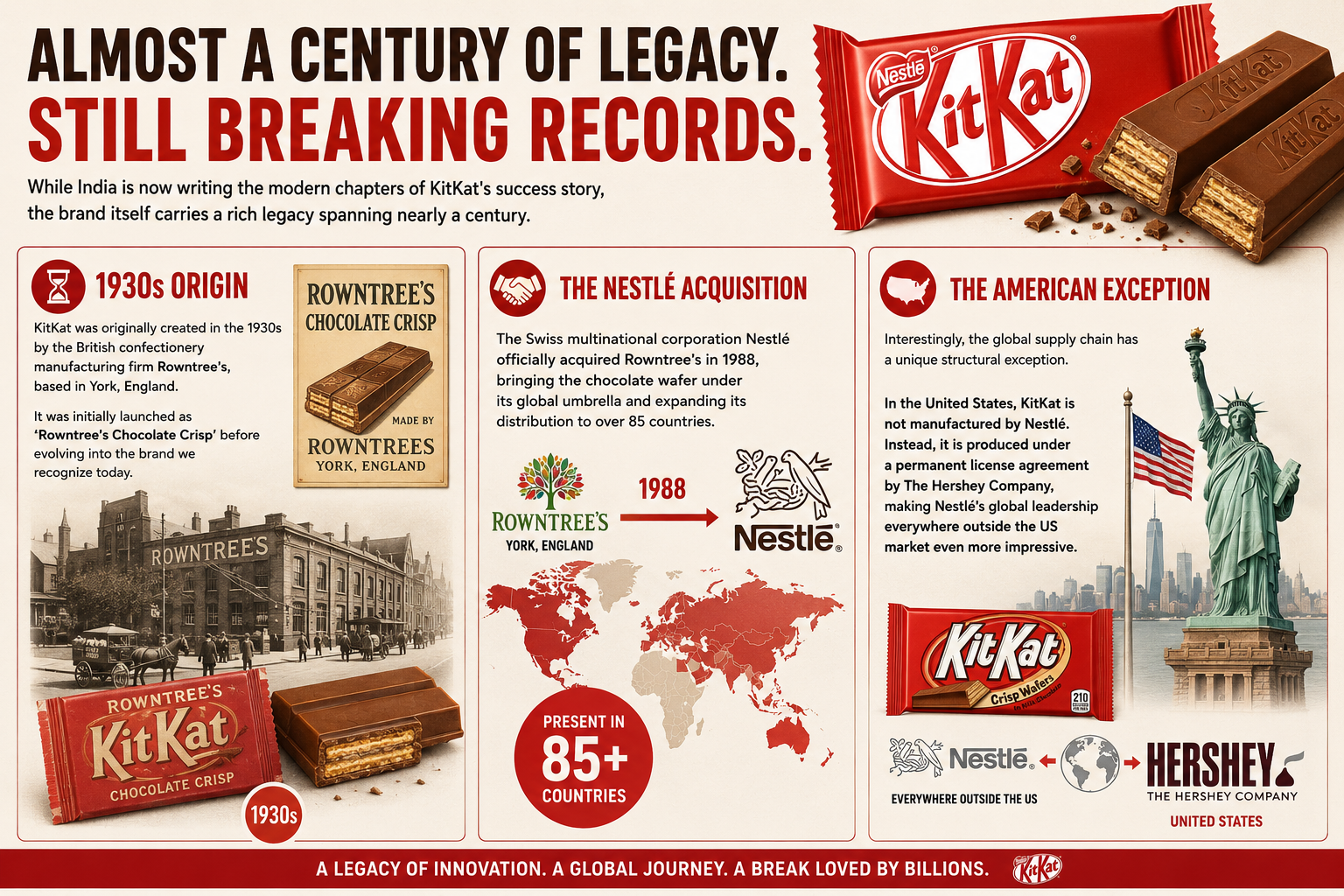
While India is now writing the modern chapters of KitKat’s success story, the brand itself carries a rich legacy spanning nearly a century.
1930s Origin: KitKat was originally created in the 1930s by the British confectionery manufacturing firm Rowntree’s, based in York, England. It was initially launched as ‘Rowntree’s Chocolate Crisp’ before evolving into the brand we recognize today.
The Nestlé Acquisition: The Swiss multinational corporation Nestlé officially acquired Rowntree’s in 1988, bringing the chocolate wafer under its global umbrella and expanding its distribution to over 85 countries.
The American Exception: Interestingly, the global supply chain has a unique structural exception. In the United States, KitKat is not manufactured by Nestlé. Instead, it is produced under a permanent license agreement by The Hershey Company, making Nestlé’s global leadership everywhere outside the US market even more impressive.
What the Future Holds for India’s Confectionery Landscape
India becoming the largest market for KitKat globally signals to the global corporate world that the purchasing power of the Indian consumer is no longer just a future projection—it is an active, present reality. The success of Nestlé India shows that entering the market requires localized innovation, robust climate-controlled distribution, and a willingness to respect the diverse economic tiers of the country.
As Nestlé India moves deeper into the latter half of 2026, the company shows no signs of slowing down its sweet run. With expanding rural internet penetration, a booming quick-commerce sector delivering chocolates to urban doorsteps in under ten minutes, and continuous experimentation in the premium food lab, KitKat’s multi-billion finger empire in India is poised to scale even greater heights. For global market strategists, the lesson is clear: if you want to lead globally, you must win in India.