
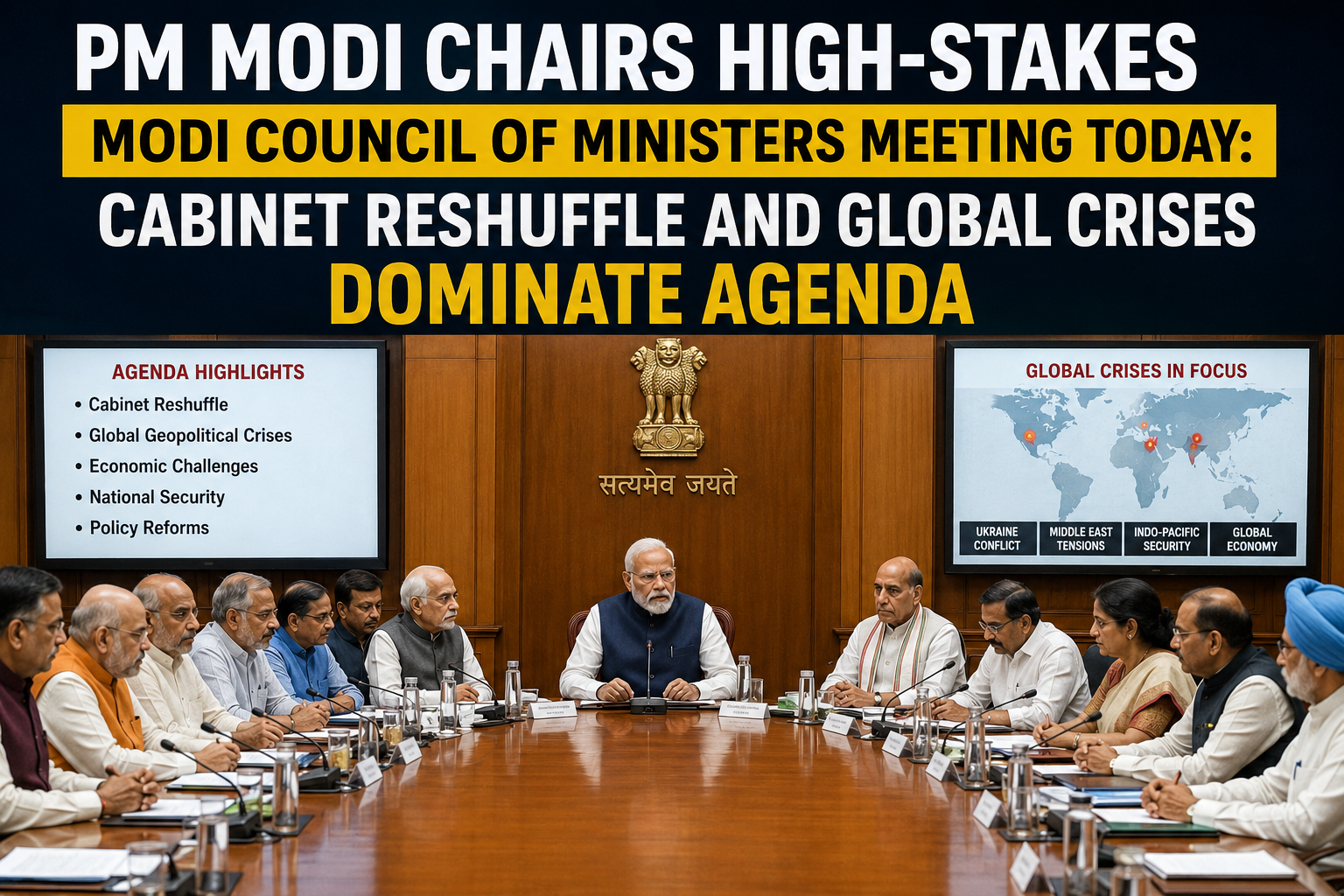
The Modi Council of Ministers meeting scheduled for today has triggered intense political waves across New Delhi. Prime Minister Narendra Modi has called an urgent, full-scale assembly of his entire ministerial team, directing every single Union Minister to cancel external plans and remain firmly stationed in the national capital. This massive gathering, happening at a critical geopolitical and domestic juncture, serves as a comprehensive midterm review of the Modi 3.0 administration as it approaches a major milestone. With the global economy on edge due to escalating conflicts abroad and intense speculation building over a massive structural shake-up within the government itself, this high-powered huddle at Bharat Mandapam is set to outline India’s administrative and political roadmap for the coming years.
Modi Council of Ministers meeting Assembly a Massive Strategic Power Move?
When the entire Council of Ministers is summoned under one roof, it signals that the government is preparing for major policy shifts or navigating a complex national situation. Unlike routine Cabinet meetings that involve only top-tier senior ministers, a full Council meeting includes:
Union Cabinet Ministers: The core decision-makers heading crucial portfolios like Home, Finance, Defense, and External Affairs.
Ministers of State (Independent Charge): Ministers who manage specific portfolios independently without reporting to a Cabinet minister.
Ministers of State: Junior ministers who assist Cabinet heads in executing complex ministerial tasks.
This complete attendance ensures that the Prime Minister’s directives trickle down to every layer of governance simultaneously. It eliminates bureaucratic silos, aligns political communication, and ensures that every department is working toward a unified goal. Coming right after PM Modi’s return from an intensive foreign tour, the timing indicates a swift transition from global diplomacy back to strict domestic execution.
Navigating Global Turbulence: The West Asia Crisis and India’s Economy
A dominant theme on the agenda for today’s meeting is the volatile conflict in West Asia, specifically the escalating tensions involving the US-Iran geopolitical dynamic. For an economy growing as rapidly as India’s, any instability in the Middle East poses immediate, tangible challenges. The government is keeping a close eye on several critical risk factors:
+----------------------------------------------------------------------------+
|                        WEST ASIA CRISIS RISK FACTORS                       |
+----------------------------------------------------------------------------+
|  [Crude Oil Price Spikes]  -->  Threatens domestic inflation control       |
|  [Supply Chain Disruptions] -->  Delays critical import/export logistics   |
|  [Energy Security Risks]   -->  Requires strategic reserve management      |
+----------------------------------------------------------------------------+
The Informal Group of Ministers (GoM) Safeguard
To buffer the Indian economy against these external shocks, the Prime Minister previously established a high-powered, informal Group of Ministers led by Defense Minister Rajnath Singh. This elite committee includes:
Amit Shah (Union Home Minister)
Nirmala Sitharaman (Union Finance Minister)
Hardeep Singh Puri (Union Petroleum and Natural Gas Minister)
This specific combination of leadership ensures that internal security, national fiscal health, and energy logistics are coordinated seamlessly. Defense Minister Rajnath Singh recently reassured the public, noting that India maintains round-the-clock monitoring of the situation. He confirmed that India’s strategic reserves of crude oil, LPG, and general energy components remain entirely stable, leaving no room for immediate panic regarding domestic fuel shortages.
Deciphering the Cabinet Reshuffle and Expansion Buzz
Beyond global economics, the political grapevine in Delhi is buzzing with anticipation over a potential restructuring of the Modi 3.0 government. As the administration nears its first anniversary on June 10, insider reports strongly hint that a major Cabinet expansion and reshuffle could take place during the second week of June.
Key Insight: A Cabinet reshuffle is rarely just about changing names; it is a calculated political alignment. It allows the leadership to reward high-performing individuals, transition underperforming ministers to organizational roles within the party, and balance regional and state representation ahead of upcoming state assembly elections.
For the past several weeks, the top leadership has been quietly reviewing internal performance metrics. This evaluation assesses how effectively ministries have executed flagship schemes, managed budgetary allocations, and communicated government policies to the public. Today’s meeting acts as a final face-to-face assessment before the leadership decides who stays, who moves, and who enters the Union Cabinet.
Driving the “Reform Express”: Midterm Governance and Welfare Review
At its core, this meeting is designed to evaluate how efficiently the government is delivering on its promises to ordinary citizens. Prime Minister Modi has frequently spoken about the “Reform Express”—a systematic approach to governance aimed at eliminating red tape, digitizing public services, and making welfare delivery transparent.
Infrastructure and Welfare Under the Scanner
The Prime Minister is expected to conduct a thorough review of several flagship initiatives and infrastructure projects. The evaluation will likely focus on three core operational areas:
Coordination: Enhancing cross-ministerial cooperation to ensure large projects (such as transport corridors and smart city initiatives) do not get stalled by bureaucratic disagreements.
Execution: Tracking the physical progress of infrastructure construction against set deadlines.
Delivery: Ensuring welfare benefits—ranging from direct bank transfers to housing and healthcare subsidies—reach target beneficiaries without leakages.
By setting clear administrative targets for the coming months, the Prime Minister aims to lock down the government’s operational roadmap, ensuring that the momentum built over the past year carries forward smoothly into the rest of the administration’s term.
Summary of the Key Priorities
Geopolitical Defense: Continuous tracking of the West Asia conflict via Rajnath Singh’s high-powered committee to safeguard India’s energy security and market stability.
Cabinet Restructuring: Final adjustments ahead of the highly anticipated Cabinet reshuffle and expansion scheduled for mid-June.
Rigorous Auditing: An uncompromised review of ministry performance and the execution speeds of flagship welfare programs.
Policy Acceleration: Revving up the “Reform Express” to ensure that systemic economic upgrades show tangible, real-world results for everyday citizens.