
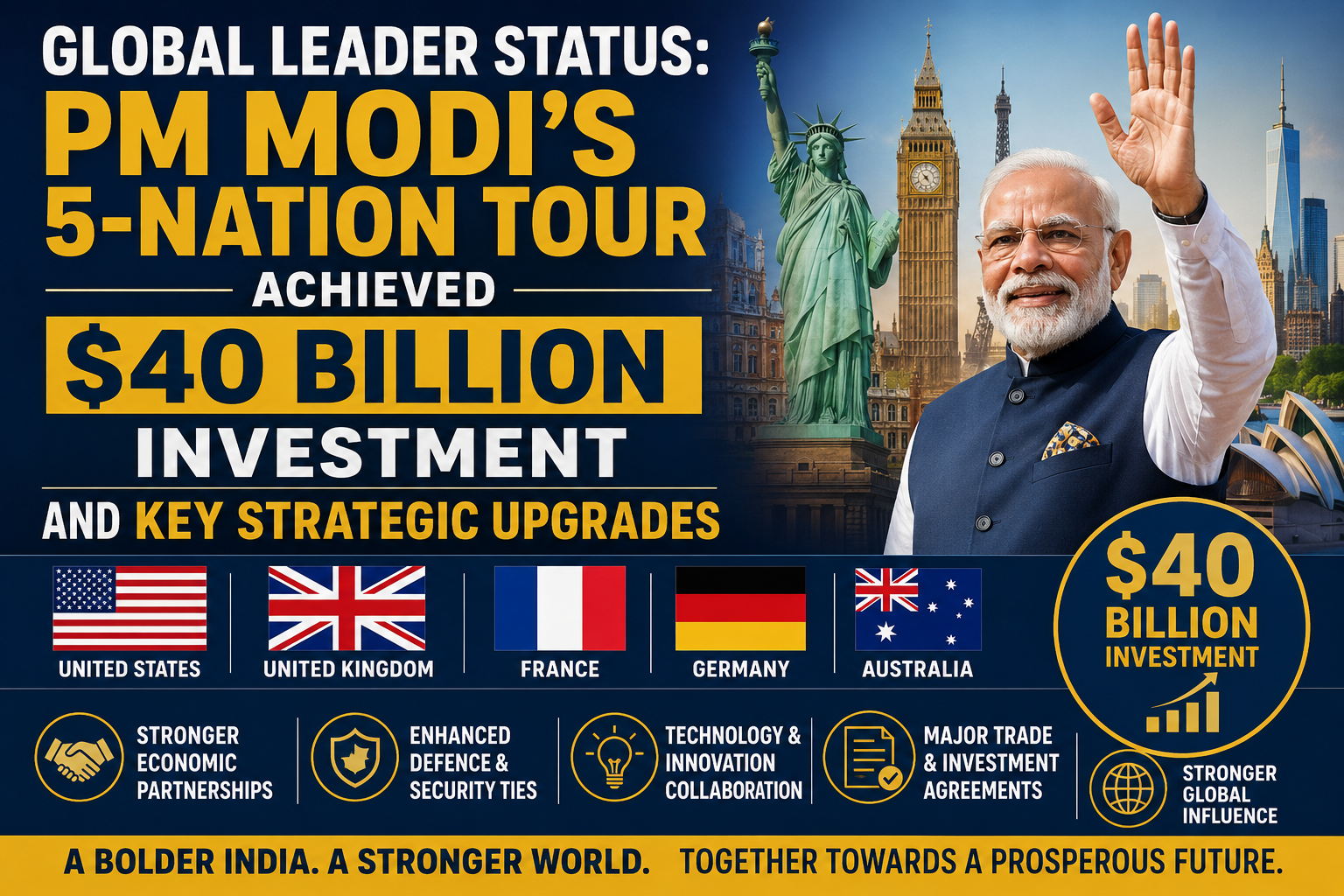
PM Modi’s 5-Nation tour achieved an unprecedented milestone in modern Indian diplomacy, securing a massive Rs 3.5 lakh crore (approximately USD 40 billion) investment pipeline while systematically elevating India’s geopolitical standing. Landing back in New Delhi on Thursday, May 21, 2026, after an intense multi-day journey that commenced on May 15, Prime Minister Narendra Modi concluded a high-stakes diplomatic mission spanning the United Arab Emirates (UAE), the Netherlands, Sweden, Norway, and Italy.
This tour unfolded against a backdrop of deep global volatility. With escalating geopolitical tensions, extreme energy market uncertainty, and rapid macroeconomic realignments, nations worldwide are searching for stability. India used this critical window to position itself not merely as a fast-growing market, but as an indispensable global anchor—a trusted democratic alternative for manufacturing, a burgeoning technology hub, and a stabilizing geopolitical voice bridging the Global South and the West.
Summary Of The Key PM Modi’s 5-Nation Tour Achieved:
- Massive $40 Billion Investment Pipeline: Secured an estimated ₹3.5 lakh crore (around USD 40 billion) in fresh business commitments and expansion plans after high-level meetings with over 50 global corporate leaders, including an immediate $5 billion commitment from the UAE.
- Semiconductor and High-Tech Alliances: Anchored critical semiconductor partnerships in Europe, highlighted by a landmark collaboration between ASML in the Netherlands and the Tata Group to integrate India into the global microchip supply chain and build a domestic fabrication ecosystem.
- Strategic Fuel and Energy Security: Solidified long-term energy cooperation with the UAE through a binding agreement to maintain a physically localized gas reserve within Indian territory, serving as a vital buffer against global supply chain disruptions.
- Major Diplomatic and Defense Upgrades: Elevated international ties by establishing a “Special Strategic Partnership” with Italy to co-develop defense systems and critical tech, while simultaneously upgrading ties to a “Strategic Partnership” with Sweden to drive heavy industrial decarbonization.
- The “China-Plus-One” Positioning: Successfully pitched India across all five nations as a highly stable, democratic, and scalable alternative for global companies looking to diversify their manufacturing networks and supply lines away from China.
1. The Financial Blueprint: Breaking Down the $40 Billion Investment PipelineThe most immediate, quantifiable outcome of the Prime Minister’s multi-nation tour is the sheer scale of economic commitments secured. In an era where global venture capital and foreign direct investment (FDI) have grown cautious, India managed to position itself as the premier destination for long-term capital.
Economic Footprint of the Tour
| Parameter | Value |
| Total Fresh Investment Pipeline | $40 Billion (₹3.5 Lakh Crore) |
| UAE Specific Commitment | $5 Billion (₹45,000 Crore) |
| Total CEOs Met | 50+ Global Executives |
| Combined Valuation of Capital Met | Approx. $3 Trillion |
| Existing India Footprint of Corporate | $180 Billion |
Engaging the $3 Trillion ClubThroughout his five stops, Prime Minister Modi engaged in high-level roundtables and one-on-one sessions with more than 50 elite international CEOs. The combined market capitalization of these enterprises approaches a staggering USD 3 trillion. Crucially, these are not firms unfamiliar with India; they hold a cumulative existing exposure of roughly USD 180 billion within the Indian domestic ecosystem.
The core objective of these interactions was to transition these multinational giants from traditional service-delivery frameworks into deep, localized manufacturing and technology operations. By addressing regulatory ease, infrastructure scaling, and fiscal incentives directly, the tour successfully unlocked major expansion plans in:
Advanced logistics and supply chain systems
Physical and digital infrastructure development
Heavy and high-tech manufacturing
Clean energy grids and storage networks
The UAE’s $5 Billion Immediate Injection
The United Arab Emirates further solidified its role as one of India’s premier economic partners by committing an immediate USD 5 billion (approximately Rs 45,000 crore) in fresh investment funds. This capital is earmarked for rapid deployment across India’s infrastructure corridors, logistics networks, and emerging technological frameworks, providing an immediate booster shot to domestic capital expenditure.
2. The Silicon Frontier: Securing the Semiconductor EcosystemIf infrastructure was the physical foundation of this tour, semiconductor technology was its intellectual crown jewel. As the world recognizes the vulnerability of highly centralized microchip supply chains, India is making an aggressive push to establish a robust domestic semiconductor fabrication and design ecosystem.
The Netherlands-India Semiconductor Blueprint
- Global Tech Shifts $rightarrow$ Driven by international microchip demand and regional tech realignments.
Supply Chain De-risking $rightarrow$ Actively diversifying hardware dependencies away from centralized hubs.
| Collaboration Node | Strategic Action & Objectives |
| Industrial Core | ASML (Lithography Leadership) $\longleftrightarrow$ Tata Group (Domestic Fab/OSAT setup) |
| Supply Chain | Establishment of highly resilient component supply lines and specialized hardware manufacturing nodes inside India. |
| Talent Ecosystem | High-level technical skills transition and deep-tech talent incubation bridging European engineering with Indian tech pools. |
The definitive highlight of the European leg occurred in the Netherlands, where a landmark Memorandum of Understanding (MoU) was finalized between ASML and the Tata Group.
ASML occupies a near-monopolistic position in the global semiconductor manufacturing chain, being the sole producer of the Extreme Ultraviolet (EUV) lithography machines required to print the world’s most advanced microchips. Tata, on the other hand, is leading India’s multi-billion-dollar charge into domestic semiconductor assembly, testing, and fabrication.
This strategic partnership is expected to:
Integrate Indian industrial capacity directly into ASML’s global supply chain for components and specialized subsystems.
Provide critical technical insights to Indian engineering teams as they set up domestic Outsourced Semiconductor Assembly and Test (OSAT) and commercial wafer fabrication facilities.
Create a talent pipeline bridging European advanced engineering with India’s massive pools of tech talent.
By focusing on deep-tech partnerships in Europe, New Delhi is systematically reducing its long-term reliance on single-source East Asian supply chains, turning India into a critical node for global hardware technology.
3. Energy Security and Maritime Defenses in the GulfWith persistent conflict and tension disrupting traditional maritime transit and energy markets in West Asia, securing India’s fuel lifelines was a non-negotiable priority for this diplomatic mission. The stops in the Middle East delivered vital structural guarantees for India’s massive energy requirements.
Strategic Advancements with the UAE
| Strategic Domain | Core Policy Deliverables & Outcomes |
| Energy Assets | Guaranteed long-term crude supplies and streamlined Liquefied Natural Gas (LNG) trade pathways. |
| Strategic Reserves | Binding Memorandum of Understanding (MoU) for a UAE-maintained gas reserve physically located inside India. |
| Defense Corridors | Expanded joint naval exercises and deeper maritime security cooperation across the Indian Ocean Region. |
| Technology Transfer | Institutional frameworks for real-time cyber security defense coordination and tactical technology sharing. |
Institutionalizing Gas and Crude ReservesIndia imports over 80% of its crude oil requirements, leaving its fiscal health deeply exposed to global price shocks. In a major win for domestic energy resilience, India and the UAE signed a comprehensive MoU that includes a commitment by the UAE to maintain a dedicated gas reserve physically located within Indian territory.
This mechanism acts as a buffer against sudden maritime blockades or geopolitical choke-points. Alongside this reserve agreement, long-term pathways were finalized for:
Continuous, uninterrupted crude oil shipments.
Expanded Liquefied Natural Gas (LNG) partnership frameworks.
Joint investments into the expansion of India’s Strategic Petroleum Reserves (SPR).
Deepening Naval and Maritime Security
Beyond resource extraction, the relationship with the UAE underwent a sharp defense upgrade. Recognizing the rising threats of piracy, drone strikes on commercial shipping, and state-backed maritime disruption, both nations committed to expanding their defense footprint.
Key outcomes include structured plans to elevate naval cooperation across the vital lanes of the Indian Ocean Region (IOR). Furthermore, the two countries are establishing collaborative frameworks for defense manufacturing, combining Indian production scale with Gulf capital to develop tactical emerging technologies and secure cyber defense platforms.
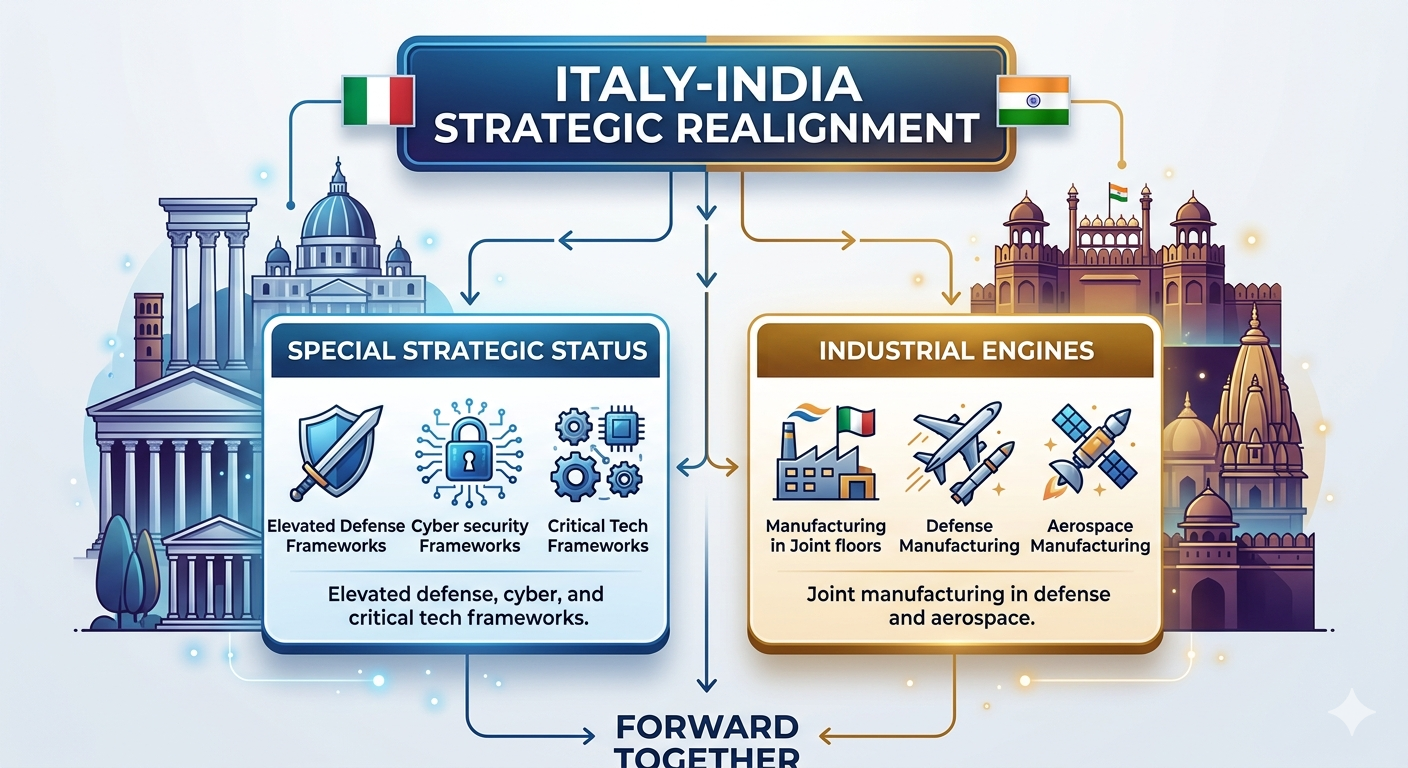
4. Elevating Continental Ties: The Italian "Special Strategic Partnership"On the European mainland, Italy has rapidly emerged as a foundational anchor for India’s Western foreign policy. The interaction between Prime Minister Modi and Italian Prime Minister Giorgia Meloni yielded structural diplomatic shifts alongside heavy economic commitments.
Upgrading the Diplomatic Framework
During the bilateral discussions in Rome, India and Italy officially elevated their bilateral relationship to a “Special Strategic Partnership.” This designation is reserved for a select tier of nations and unlocks deep-tier intelligence sharing, defense co-development, and streamlined industrial technology transfers.
The bilateral agenda focused heavily on:
Defense Production: Moving past a buyer-seller dynamic toward joint industrial manufacturing of defense systems on Indian soil.
Critical Technologies: Establishing institutional working groups for artificial intelligence, quantum computing, and secure communication networks.
Mobility and Migration: Structuring lawful, highly skilled migration pathways for Indian tech professionals and students to integrate into Italy’s industrial north.
The Power of Soft Power: The “Melodi” Factor
Beyond the dense text of the official communiqués, the undeniable personal chemistry between Prime Minister Modi and Prime Minister Meloni dominated global social media spaces. Dubbed “Melodi” by online commentators, their high-visibility informal interactions, videos, and joint statements generated enormous digital reach.
Strategic Takeaway: In modern diplomacy, digital optics are far from superficial. This immense social media traction served as an effective exercise in soft power, keeping India at the absolute center of global conversation, humanizing complex geopolitical alignments, and projecting an image of warm, stable, and highly functional Western-Eastern partnerships.
5. The Nordic Model: Driving Clean Energy, Sustainability, and the Arctic FrontThe India-Nordic Summit—bringing together leaders from Sweden, Norway, and their regional peers—shifted the focus toward future-proofing economies through deep sustainability initiatives and cutting-edge industrial technology.
Nordic Convergence at a Glance
| Country / Partner | Core Strategic Focus & Deliverables |
| Sweden | Relationship officially elevated to a Strategic Partnership, focusing heavily on manufacturing and industrial decarbonization. |
| Norway | Conferred its top national honor on PM Modi; signed agreements targeting green hydrogen, advanced maritime technology, and Arctic research. |
| Shared Priorities | Joint, deep-tier developmental focus on Artificial Intelligence (AI), smart mobility, sustainable agriculture, and scaling digital public infrastructure. |
Green Hydrogen and Heavy Industrial Decarbonization
The Nordic countries lead the world in green technology, while India offers the world’s largest market for green transitions. Bridging this gap was the primary focus of the summit. Sweden elevated its relationship with India to a Strategic Partnership, paving the way for joint ventures in low-carbon steel production, smart mobility, and next-generation automotive manufacturing.
Norway focused heavily on clean energy investments. Detailed roadmaps were discussed for:
Green Hydrogen: Utilizing Nordic electrolysis technologies to scale Indian green hydrogen hubs.
Sustainable Maritime Systems: Transforming commercial shipping fleets with low-emission propulsion technologies.
Arctic Cooperation: Expanding India’s scientific presence and research footprint in the Arctic circle to study long-term climate impacts on the Indian monsoon system.
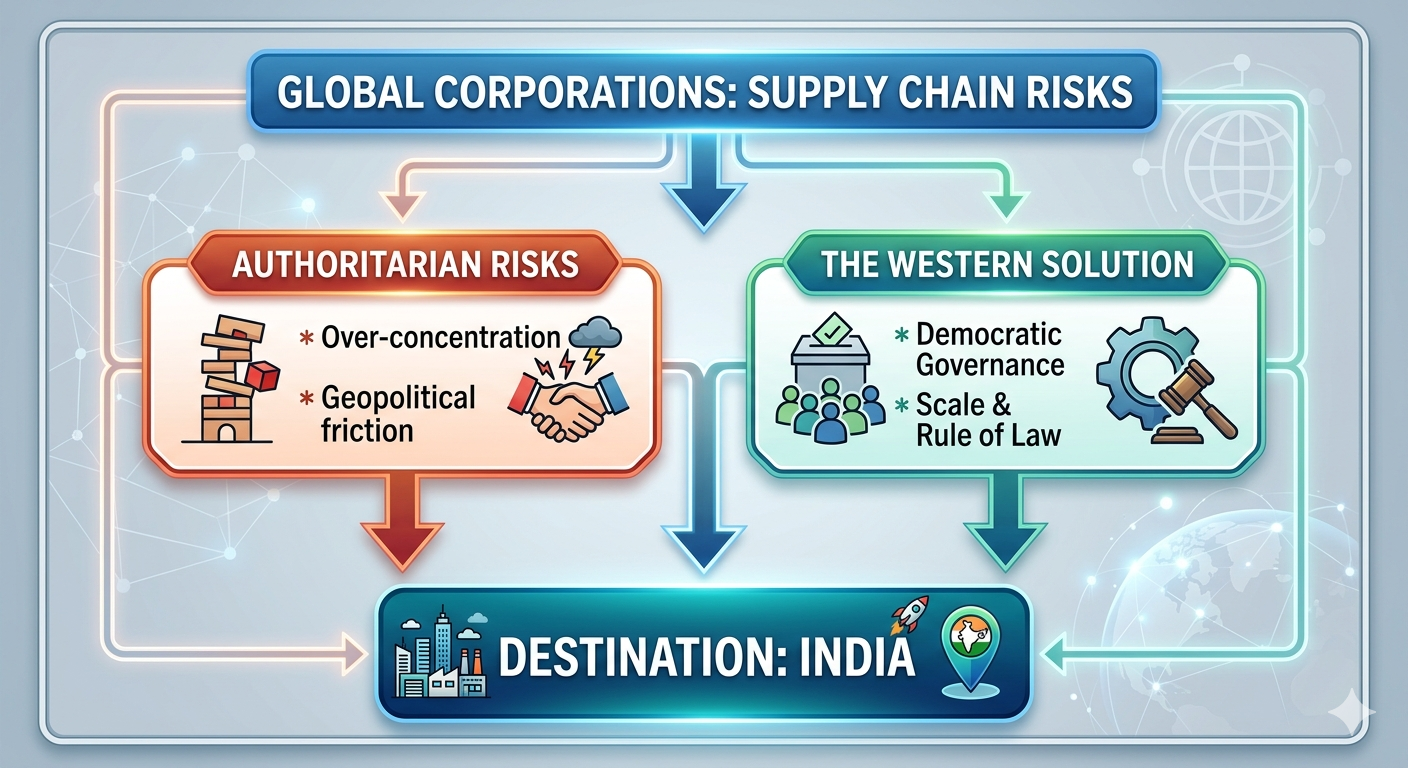
6. Capitalizing on the "China Plus One" Industrial RealignmentA unifying theme woven through every single meeting, roundtable, and state dinner of this five-nation tour was India’s targeted pitch as the definitive global manufacturing alternative.
The Democratic Alternative
As corporate boardrooms in the West and the Middle East actively de-risk their supply networks to move away from over-concentration in China, Prime Minister Modi presented India as a highly scalable, stable, and democratic partner. The core pillars of the Indian pitch included:
Unrivaled Scale: A massive, young, and technically literate workforce capable of meeting global industrial demands.
Policy Stability: Long-term fiscal incentives, such as the Production Linked Incentive (PLI) schemes across critical sectors like electronics, pharmaceuticals, and advanced chemistry cells.
Rule of Law: A reliable democratic legal framework that ensures intellectual property protection and corporate security—an asset that alternative autocracies simply cannot offer.
This pitch resonated deeply with European corporate heads, resulting in explicit commitments from logistics and tech manufacturing conglomerates to significantly expand their physical footprints across various Indian industrial states.
7. Global Accolades and Affirmation of Food Security LeadershipThe tour also brought international validation for India’s internal development strategies, particularly regarding agricultural supply chains and social safety nets.
The FAO Agricola Medal
During the Italian leg of the tour, Prime Minister Modi was honored with the prestigious Agricola Medal by the Food and Agriculture Organization (FAO) of the United Nations. This high honor recognizes outstanding contributions to global food security, sustainable agriculture, and the empowerment of smallholder farming ecosystems.
Significance of the FAO Agricola Medal
| Strategic Focus | Core Impact & Evaluation |
| Domestic Scaling | International validation of India’s large-scale agricultural safety nets, including PM-KISAN and digital targeted Public Distribution Systems (PDS). |
| Global Positioning | Establishes India’s role as a resilient, highly reliable food provider and strategic agricultural voice for the Global South. |
| Tech Integration | Formal recognition of India’s rapid deployment of agritech frameworks, smart data-driven farming, and digital crop monitoring systems. |
The presentation of this medal serves two critical functions:
International Validation: It acknowledges India’s massive food security programs, which successfully sustain over 800 million citizens through advanced digital public distribution infrastructure.
Voice of the Global South: It highlights India’s capacity to export frugal, highly effective agritech innovations to developing nations across Africa and Asia, cementing its status as a developmental leader.
Additionally, Norway conferred its own top national honor upon the Prime Minister, underscores a growing international respect for India’s developmental blueprint.
8. Strategic Autonomy: Navigating a Fragmented World OrderPerhaps the most significant takeaway from this five-nation diplomatic mission is how clearly it illustrates India’s sophisticated doctrine of Strategic Autonomy.

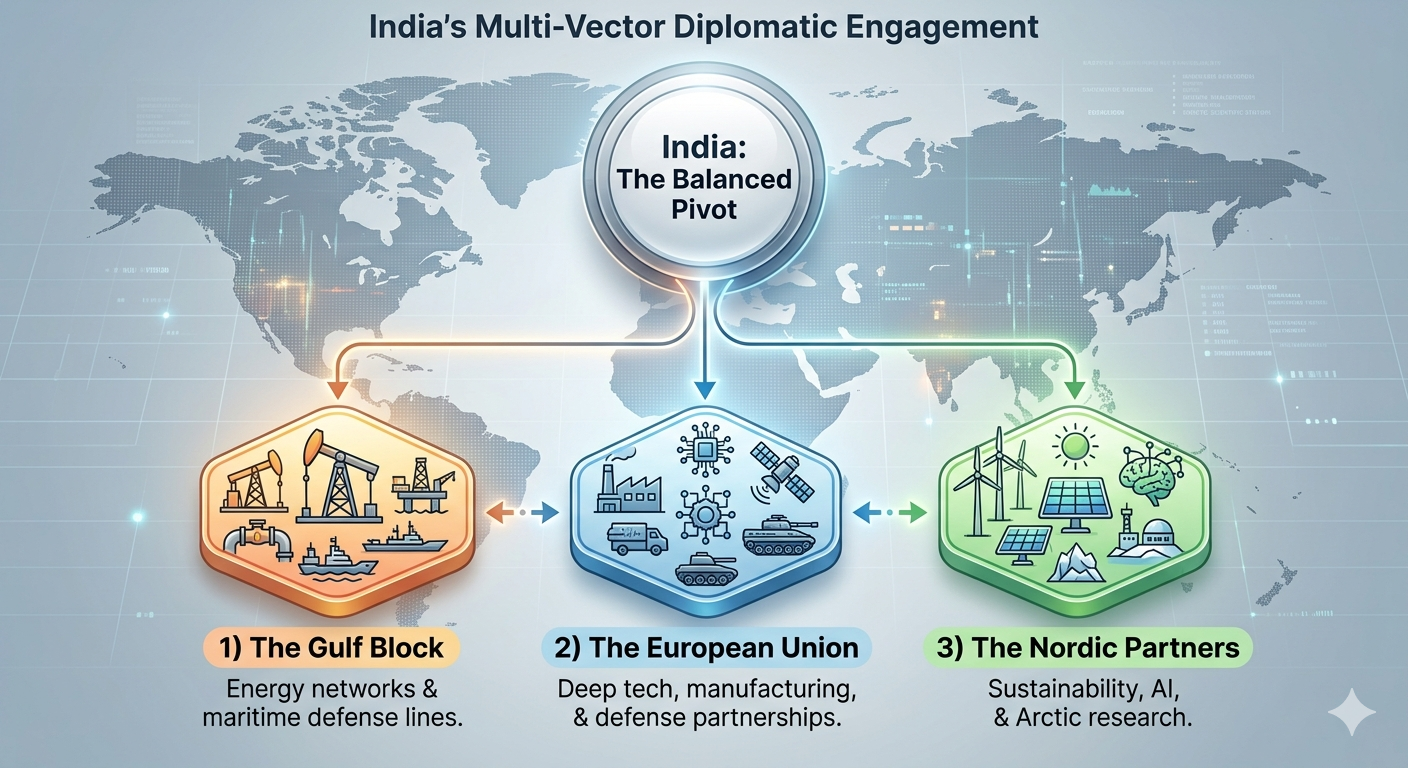
In a highly polarized international landscape where countries are frequently pressured to align with rigid geopolitical blocs, India demonstrated its ability to engage deeply with distinct power centers simultaneously. Within the span of a single week, Prime Minister Modi seamlessly balanced ties between:
The hydrocarbon-rich energy capitals of the Gulf.
The industrial, defense-forward powerhouses of Southern Europe.
The highly progressive, climate-focused democracies of the Nordic region.
By refusing to become tied to any single exclusive alliance, New Delhi preserves its freedom of action. The true success of the tour lies in showing that India is no longer an observer of global geopolitical realignments—it is actively shaping them. For the Indian government, this tour delivers a definitive statement: India enters the second half of this decade not just as an economic powerhouse, but as an indispensable architect of the emerging global order.