
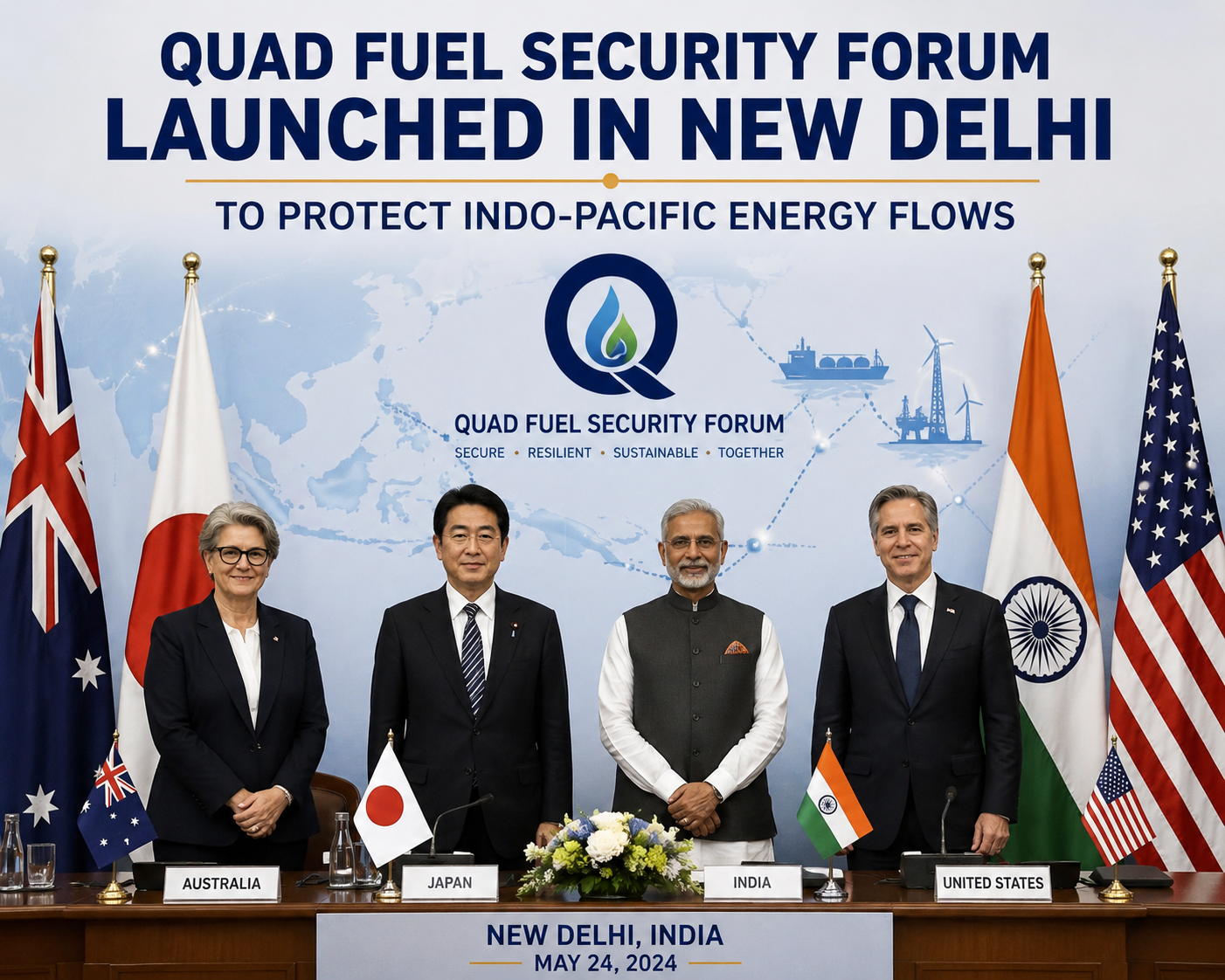
The Quad Fuel Security Forum launched in New Delhi this Tuesday following a high-level ministerial summit, marking an ambitious expansion of the Quadrilateral Security Dialogue’s mandate from a maritime monitoring coalition into a robust economic and energy security alliance. Faced with soaring oil prices across Asia and escalating geopolitical friction surrounding the Strait of Hormuz, the foreign ministers of India, Australia, Japan, and the United States converged in the Indian capital to present a unified strategy aimed at shielding the Indo-Pacific from global energy shocks.
The meeting, hosted by India’s External Affairs Minister S. Jaishankar and attended by U.S. Secretary of State Marco Rubio, Australian Foreign Minister Penny Wong, and Japanese Foreign Minister Toshimitsu Motegi, delivered an explicit message to regional stakeholders: the alliance will act collectively to stabilize critical commercial shipping routes and secure the supply chains underpinning modern industrial economies. However, the grouping’s expanded focus on critical minerals, energy infrastructure, and maritime surveillance immediately drew sharp criticism from Beijing, which accused the member states of fostering exclusive regional cliques and forcing a bloc confrontation.
Quad Fuel Security Forum Highlights :
New Energy Alliance Formed: The four Quad nations (India, Australia, Japan, and the US) launched the Quad Fuel Security Forum in New Delhi to protect energy flows and handle market emergencies together.
Focus on Shipping Chokepoints: The alliance explicitly spoke out against disruptions in the Strait of Hormuz, promising to keep critical maritime trade routes open and free from unilateral restrictions.
Shared Financial and Regional Support: Each member country committed unique resources—like Australia’s funding pools and Japan’s resilience initiatives—to help protect vulnerable developing nations from sudden energy price spikes.
India’s Growing Leadership: India has stepped up as a major anchor for this regional energy network, shifting from its traditional stance of staying independent to actively protecting shared economic and maritime corridors.
Strong Pushback from China: Beijing strongly criticized the meeting, calling the Quad an exclusive “small clique” aimed at bloc confrontation, especially after the alliance raised concerns over military tensions in the South and East China Seas.
1. The Strategic Blueprint of the Quad Fuel Security Forum
The core institutional outcome of Tuesday’s diplomatic gathering is the formal establishment of the Quad Fuel Security Forum. Conceived as a high-level coordination mechanism, the body is specifically tasked with driving policy alignment, conducting collaborative market analysis, and orchestrating rapid crisis-response protocols during periods of acute global energy volatility.
                     ┌────────────────────────────────────────┐
                     │   Quad Fuel Security Forum Launched    │
                     └───────────────────┬────────────────────┘
                                         │
        ┌────────────────────────────────┼────────────────────────────────┐
        ▼                                ▼                                ▼
┌─────────────────────────┐    ┌─────────────────────────┐    ┌─────────────────────────┐
│     Crisis Response     │    │    Policy Alignment     │    │     Market Analysis     │
│ Instantly coordinate    │    │ Harmonize petroleum     │    │ Jointly evaluate supply │
│ strategic reserves      │    │ stockpiling and rules   │    │ vulnerabilities across  │
│ during supply shocks.   │    │ among member nations.   │    │ Indo-Pacific corridors. │
└─────────────────────────┘    └─────────────────────────┘    └─────────────────────────┘
The forum operates under the broader umbrella of the newly minted Quad Initiative on Indo-Pacific Energy Security. This wide-ranging framework expands beyond administrative dialogue to introduce practical technical cooperations, joint emergency response exercises, and structural enhancements for national strategic petroleum reserves. By building this integrated infrastructure, the four partner nations aim to shift from reactive diplomatic statements to an active, operational framework capable of absorbing sudden macroeconomic shocks.
2. Navigating the Strait of Hormuz and Global Energy Shocks
The immediate catalyst driving this unprecedented level of energy coordination is the ongoing volatility tracking through the Middle East. In an unusually direct diplomatic maneuver, the Quad’s joint ministerial statement explicitly cited the Strait of Hormuz, expressing profound concern over the widening conflict that has continuously jeopardized regional shipping lanes.
The closure and disruption of these vital chokepoints by Tehran, alongside the imposition of controversial tolls on commercial shipping traversing the region, have sent shockwaves through global oil markets. For nations heavily reliant on Gulf crude imports, the economic fallout has been immediate and severe:
Surging Commodity Costs: Brent crude values have risen significantly over recent months, directly increasing the base cost of transportation, global manufacturing, and electricity generation.
Downstream Supply Chain Disruption: The surge in oil and gas prices has triggered inflationary ripples through chemical supply chains, driving up the production costs of essential agricultural fertilizers and plastics.
Consumer Economic Hardship: Higher landed costs have translated into inflated household energy bills and consumer pricing stress from Mumbai to Tokyo to Sydney.
The joint statement issued in New Delhi strongly reiterated the alliance’s commitment to “unimpeded freedom of navigation” and declared absolute opposition to any unilateral or coercive measures capable of hampering the free flow of commercial shipping vessels.
3. Financial Commitments and Regional Integration Strategies
To ensure the new initiatives deliver practical, tangible benefits rather than merely symbolic value, the member states brought diverse financial assets and localized development strategies to the negotiating table.
| Member State | Primary Program / Contribution | Strategic Target Area | Core Objective |
| Australia | $2 Billion Financing Facility & AUD 30 Million Budget Support | Southeast Asia & Pacific Island States | Providing capital for localized energy resilience and infrastructure diversification. |
| Japan | POWERR Asia (Partnership on Wide Energy & Resources Resilience) | Broad Indo-Pacific Region | Securing supply chains and expanding regional energy asset diversification. |
| India | Regional Response Hub & Stabilization Anchor | South Asian Subcontinent | Deploying logistical and diplomatic weight to shield surrounding developing economies. |
| United States | Technical & Surveillance Infrastructure Support | Comprehensive Maritime Corridors | Enhancing real-time data collection, port defense, and maritime domain awareness. |
A central theme running through these combined resources is the recognition of structural inequities in global energy distribution. The ministers acknowledged that when maritime chokepoints are disrupted, the economic burden falls disproportionately onto vulnerable developing nations and small Pacific island states. For these economies, even minor supply contractions or marginal price hikes can lead to severe macroeconomic instability.
4. India’s Pivot to a Centerpiece of Transnational Energy Security
A notable aspect of the New Delhi declaration is the evolving strategic positioning of India. Traditionally, New Delhi has guarded its strategic autonomy with extreme care, often resisting binding commitments within multilateral energy frameworks to balance its complex global alignments.
                          ┌───────────────────────────┐
                          │   India's Dual Identity   │
                          └─────────────┬─────────────┘
                                        │
             ┌──────────────────────────┴──────────────────────────┐
             ▼                                                     ▼
┌───────────────────────────┐                         ┌───────────────────────────┐
│ Massive Crude Importer    │                         │ Emerging Clean Tech Hub   │
│ Vulnerable to Middle East │                         │ Positioning to export     │
│ supply chokepoints and    │                         │ renewable infrastructure  │
│ price spikes.             │                         │ and solar technology.     │
└───────────────────────────┘                         └───────────────────────────┘
However, the current global climate has prompted a clear shift. India has stepped forward as a foundational pillar of the Quad’s joint response architecture, actively anchoring energy security initiatives across South Asia. This transformation reflects a pragmatic realization: as one of the world’s largest consumers of imported crude, India’s domestic economic growth is directly linked to the stability of transnational shipping corridors. By aligning its domestic economic defense with the Quad’s maritime and logistical capabilities, India is projecting its influence as a stabilizing regional power.
5. China’s Pushback: The Critique of “Small Cliques”
The rapid expansion of the Quad’s focus into critical minerals, energy logistics, and enhanced port infrastructure did not go unnoticed in Beijing. On the exact day the joint statement was released in New Delhi, the Chinese Foreign Ministry issued a formal reprimand of the proceedings.
Chinese Foreign Ministry spokesperson Mao Ning stated unequivocally that Beijing remains fundamentally opposed to the creation of exclusive “small cliques” designed to instill bloc confrontation in Asia. The Chinese leadership argues that multilateral cooperation between sovereign states should focus entirely on regional peace, stability, and mutual prosperity, rather than targeting or seeking to contain any third-party nation.
From Beijing’s perspective, the Quad’s newly unveiled maritime surveillance upgrades and critical mineral agreements are viewed as elements of a geopolitical containment policy. This perspective is amplified by the fact that the Quad’s joint statement openly expressed deep concern regarding unilateral, destabilizing actions within the East China Sea and South China Sea—maritime zones where China’s military posture has encountered friction with regional neighbors like Japan and the Philippines.
6. Expanding Maritime Surveillance and Port Infrastructure
To guarantee that commercial vessels retain unhindered access to international shipping lanes, the Quad foreign ministers unveiled an array of new tracking and infrastructure capabilities. These technical measures are designed to provide comprehensive, transparent data regarding regional maritime corridors, thereby reducing the threat of covert actions or asymmetric disruptions.
┌─────────────────────────────────┐       ┌─────────────────────────────────┐
│   Advanced Maritime Domain      │       │     Hardened Port Resilience    │
│           Awareness             │       │          Infrastructure         │
├─────────────────────────────────┤       ├─────────────────────────────────┤
│ Real-time commercial vessel     │──────>│ Targeted financial investments  │
│ tracking across the Indian Ocean│       │ to modernize and secure regional│
│ and South China Sea corridors.  │       │ deep-water harbor facilities.   │
└─────────────────────────────────┘       └─────────────────────────────────┘
By linking real-time maritime tracking with localized port investments, the Quad seeks to create an integrated security net. This data-sharing architecture allows partner nations to rapidly spot anomalies in maritime traffic, flag unauthorized maritime presence, and deploy coordinated coast guard or naval assets to secure commercial transit lanes whenever a crisis looms.
7. Critical Minerals and the Foundation of Techno-Economic Defense
Beyond the immediate tracking of fossil fuel shipments, the ministerial discussions in New Delhi placed significant emphasis on the security of critical minerals. Elements such as lithium, cobalt, nickel, and rare earth materials form the structural foundation of modern electronic manufacturing, defense systems, and renewable energy technologies.
The vulnerability of these minerals was exposed when diplomatic disputes led to severe export caps from dominant global suppliers, leaving manufacturing hubs like Japan struggling to maintain aerospace and semiconductor production schedules. The Quad’s updated roadmap explicitly connects the stability of traditional energy routes with the security of raw mineral processing, aiming to build a diversified supply ecosystem that prevents any single state from leveraging market dominance as geopolitical leverage.
8. Conclusion: The Realignment of Indo-Pacific Strategy
The launch of the Quad Fuel Security Forum in New Delhi represents a clear shift in how the alliance defines regional stability. By recognizing that the free flow of energy and materials through global chokepoints is an indispensable element of national security, the four partner democracies have significantly broadened their collaborative agenda.
The road ahead will require balancing the implementation of these extensive technical and financial programs with the diplomatic management of competing regional interests. While China warns against the institutionalization of exclusive strategic groupings, the Quad appears determined to solidify its framework, sending an unambiguous message that it possesses both the political will and the economic mechanisms necessary to preserve the open status quo of the Indo-Pacific.