
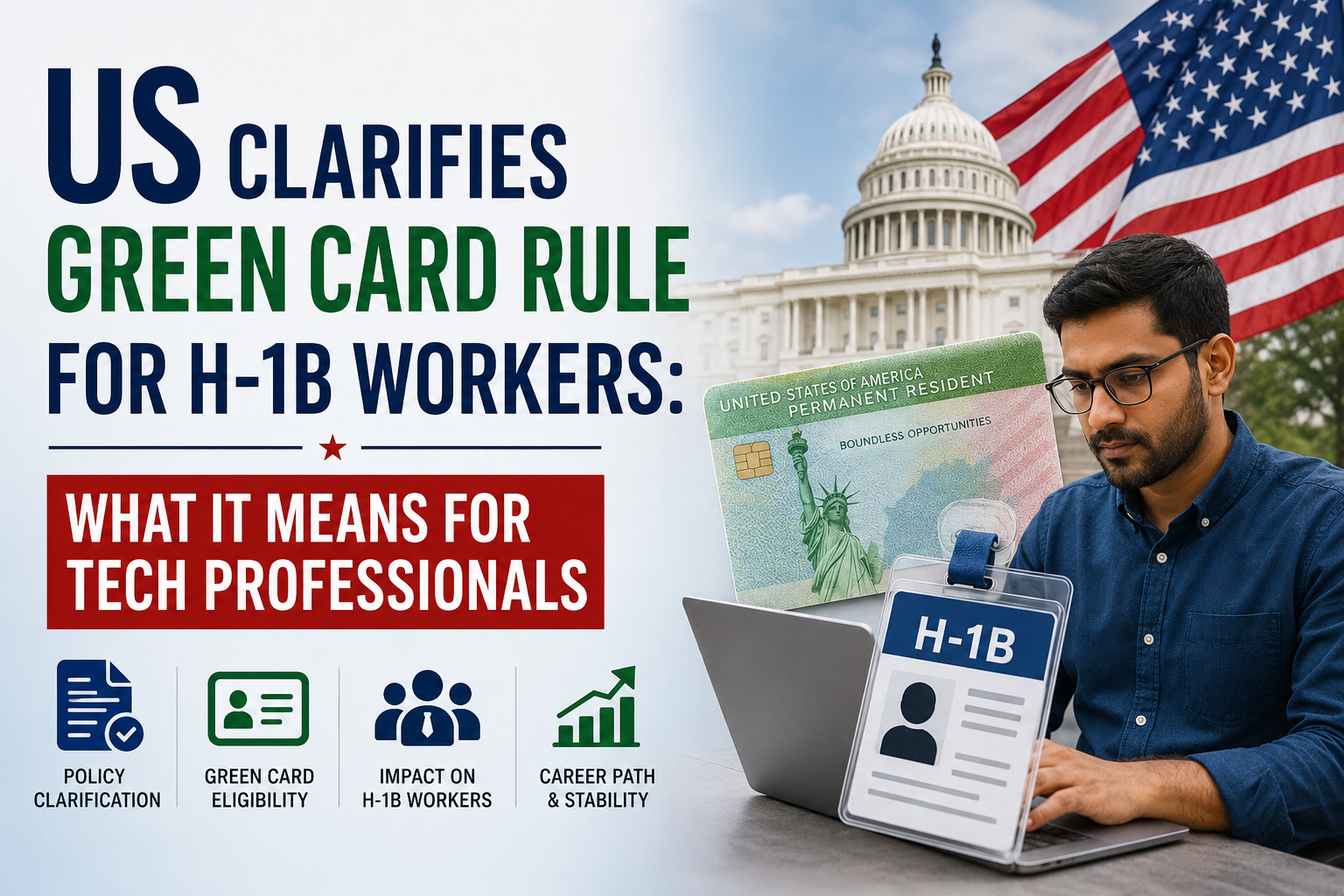
The US clarifies green card rule for H-1B workers to ease growing panic across the global technology sector. United States Citizenship and Immigration Services (USCIS) issued a critical update regarding permanent residency applications. The announcement clarifies that not all temporary visa holders must exit the country to secure permanent residency. This strategic pivot follows widespread anxiety sparked by a previous policy memorandum. The initial document implied that highly skilled foreign nationals would be forced to return to their native countries to transition to a green card status.
For tens of thousands of skilled professionals living in the United States, this clarification offers an essential lifeline. The sudden shift in policy communications highlights the volatile nature of modern immigration frameworks and the profound impact these updates have on global business operations, corporate stability, and individual lives.
The Initial Policy Memo and the Sudden Shift in Stance
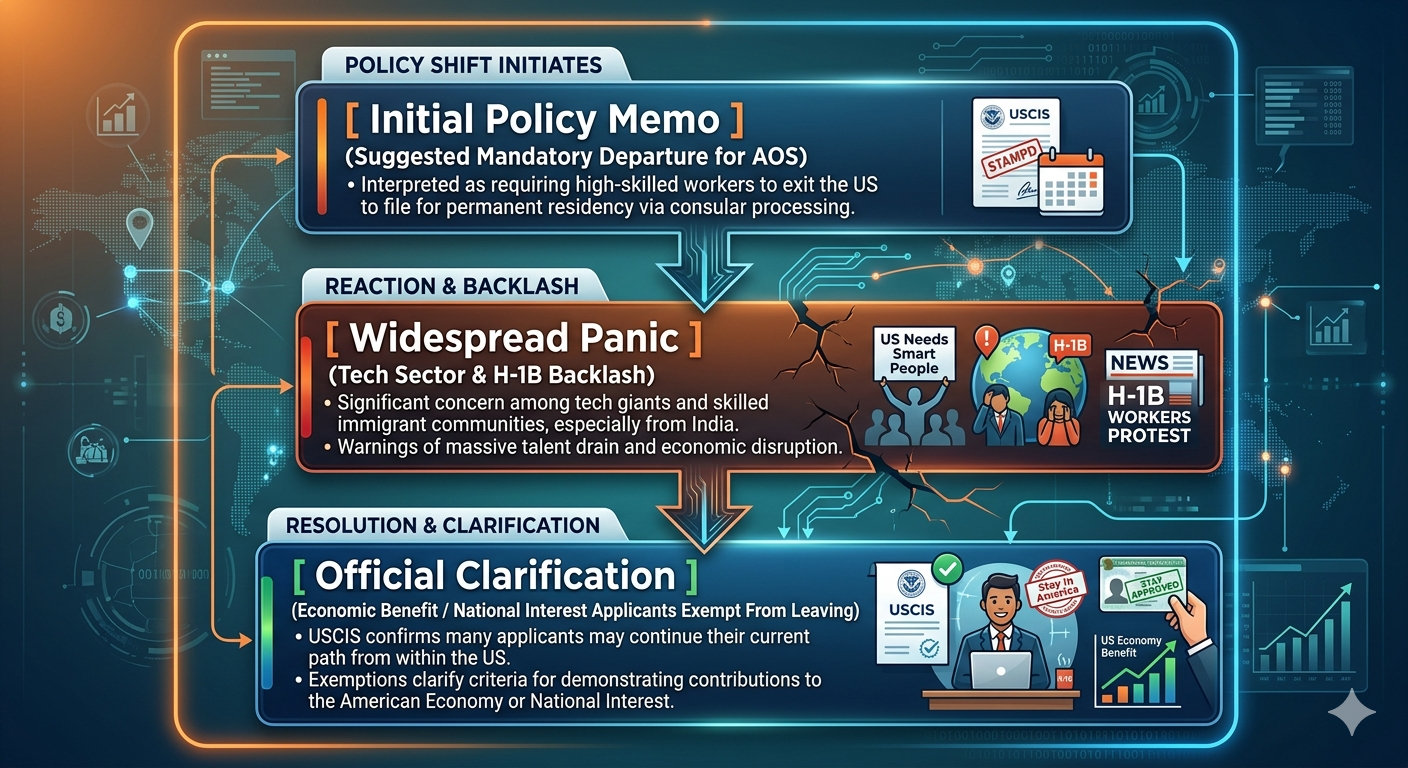
The confusion began with a strict policy statement that seemed to overturn decades of established immigration protocols. A USCIS official initially indicated a major policy shift, stating that foreign nationals residing temporarily in the United States who wished to obtain a green card would be required to return to their home countries to complete the application process, barring any extraordinary circumstances.
This statement challenged the long-standing legal framework of the Adjustment of Status (AOS) process. Historically, the AOS framework has allowed legally employed temporary visa holders, particularly those on H-1B and L-1 visas, to transition smoothly to permanent resident status without leaving American soil. The sudden prospect of mandatory departure caused immediate alarm across corporate boardrooms and immigrant communities alike.
Recognizing the escalating anxiety and potential economic disruption, USCIS spokesperson Zach Kahler issued a vital clarification to the public. He confirmed that a significant portion of applicants will be permitted to remain in the country and continue their current adjustment tracks. Specifically, individuals who present applications that demonstrate a clear economic benefit to the nation, or those whose work aligns directly with the American national interest, will likely face no requirement to depart.
However, Kahler also noted that individualized circumstances will dictate final outcomes, meaning some applicants may still be instructed to process their paperwork via consular offices abroad.
Who Qualifies to Remain in the United States?
The updated guidelines place a strong emphasis on the nature of an applicant’s professional contributions. To avoid consular processing abroad, an H-1B worker must demonstrate that their employment provides a tangible advantage to the domestic market or fulfills broader national strategic goals.
1. Direct Economic Benefit
Applicants must demonstrate that their professional roles actively drive revenue, support job creation for domestic workers, or fill critical talent shortages within specialized industries. This category typically covers:
Senior software engineers managing core enterprise architectures.
Specialized healthcare professionals operating in underserved medical regions.
Lead structural and aerospace engineers managing major corporate projects.
Financial analysts directing large-scale capital investments.
2. National Interest Alignment
This criterion mirrors elements of the existing National Interest Waiver (NIW) framework. Individuals working on cutting-edge technologies, public health initiatives, or national security projects are highly likely to be cleared to stay. This includes researchers developing advanced artificial intelligence algorithms, biomedical scientists engineering next-generation therapeutics, and cybersecurity experts securing vital digital infrastructure.
3. Case-by-Case Individual Assessments
For professionals who do not fall neatly into high-profile innovation categories, the path forward remains highly individualized. USCIS will evaluate the specific circumstances of each application, looking at factors such as total length of legal residency, employer sponsorship commitment, and specific regional labor market dynamics before determining if an applicant must travel abroad for consular processing.
Major Impact on Indian IT Professionals and Corporate Stability
The demographic group most affected by these shifting regulatory directives is the Indian professional community. Indian citizens consistently secure the vast majority of H-1B visas issued annually by the United States government. Over the past several decades, thousands of Indian tech experts, engineers, researchers, and financial analysts have built long-term careers and raised families in the US while waiting through historically prolonged green card backlogs.
| Metric | Details & Impact Analysis |
| Primary Visa Category | H-1B Specialty Occupation Visa |
| Dominant Sector | Information Technology, Software Engineering, AI Development |
| Core Vulnerability | Multidecade backlogs due to country-specific statutory caps |
| Primary Operational Risk | Potential career disruptions due to sudden consular processing rules |
| Mitigation Strategy | Documenting specialized economic impact and national interest contributions |
Because the green card allocation system imposes strict country-of-chargeability limits, applicants from highly populated nations face extensive waiting periods. For these individuals, the ability to utilize the internal adjustment of status process is not merely a convenience—it is a foundational requirement for maintaining personal and professional stability.
A sudden mandate requiring these workers to return to their home countries to wait out bureaucratic backlogs would separate families, disrupt local communities, and create immense financial strain for workers who have deeply integrated into the American economy.
Silicon Valley Backlash: Tech Leaders Speak OutThe tech sector responded swiftly to the initial stricter policy announcements. Tech executives, founders, and industry advocates warned that forcing skilled international workers out of the country would undermine the competitive edge of American businesses.
Reid Hoffman, the co-founder of LinkedIn, publicly questioned the strategic logic behind the restrictive immigration measures. He raised concerns about whether vital artificial intelligence researchers, corporate employees, and advanced academic students would be forced to exit the country and navigate backlogged consular queues just to continue their essential work. Hoffman explicitly characterized the restrictive policy direction as a harmful move for tech, business, and the nation as a whole.
In tandem, tech pioneers like the founders of Coursera expressed deep concern over the broader economic fallout. Industry leaders argue that during a period of intense global competition for artificial intelligence and quantum computing dominance, restrictive immigration policies act as a self-inflicted headwind.
By creating structural barriers for high-skilled talent, the US risks losing top-tier innovators to competing international tech hubs in Canada, the United Kingdom, and Western Europe, all of which have actively optimized their immigration systems to attract displaced tech talent.
The Operational Realities and Risks of Consular Processing
While the latest clarification provides welcome relief to many, the underlying risk of disruption remains a significant concern for corporate legal departments and visa holders. For those applicants who do not explicitly meet the high threshold of “national interest” or clear “economic benefit,” the requirement to apply from abroad through consular processing presents major operational challenges.
[Mandatory Consular Processing]
       │
       ├─► Severe Visa Appointment Backlogs at Embassies Abroad
       │
       ├─► Extended Extended Separation of Working Professionals from US Teams
       │
       └─► Prolonged Risk of Corporate Project Delays and Resource Gaps
The primary risk stems from the chronic administrative backlogs plaguing US embassies and consulates worldwide. An H-1B worker who travels back to their home country to process a green card application may encounter months of delays in securing a standard visa appointment. During this extended waiting period, the worker is effectively barred from returning to the United States, leaving their corporate teams understaffed and creating significant gaps in project execution.
Furthermore, this operational uncertainty becomes particularly dangerous for workers navigating corporate restructuring or unexpected layoffs. Under current regulatory frameworks, an H-1B worker who loses their job has a strict 60-day grace period to secure alternative employment with a sponsoring entity or transition to a different nonimmigrant status.
If forced to navigate these precarious employment transitions while trapped abroad due to consular delays, the likelihood of career disruption increases exponentially. This reality forces many businesses to expend significant financial resources on expedited legal counseling and alternative global mobility setups to protect their core staff.
The Return to India Debate: Perspective vs. Reality
The escalating volatility of the US immigration landscape has reignited a major debate among global Indian professionals regarding long-term career planning. As policy updates swing between strict enforcement and subsequent clarifications, prominent business leaders have started questioning whether the personal and professional toll of remaining in the American visa ecosystem is still justified.
Sridhar Vembu, the high-profile founder and CEO of Zoho Corporation, emerged as a leading voice in this discussion. Commenting on the policy anxieties, Vembu publicly urged Indian professionals residing in the United States to seriously consider returning to their home country. He stated that individuals should evaluate their long-term options, suggesting that self-respect and the rapidly expanding opportunities within India’s domestic tech ecosystem should guide their ultimate choice.
Vembu’s commentary drew a wide range of responses from the global tech community:
The Advocacy for Returning Home: Supporters of this viewpoint point to India’s booming technology sector, surging venture capital investments, and the rapid maturation of local digital infrastructure. For many, returning home offers a chance to lead major domestic enterprises or launch independent startups without the constant psychological burden of visa renewals, travel restrictions, and indefinite green card wait times.
The Case for Staying in the US: Conversely, many professionals emphasize the immense practical difficulties of dismantling established lives abroad. Over the course of decade-long wait times, many H-1B workers have purchased homes, built deep professional networks, and enrolled their children in American schools. For these families, a sudden relocation involves complex personal relocations and the potential disruption of settled careers, making the choice to stay a deeply entrenched financial and personal priority.
Strategic Recommendations for H-1B Workers and Employers
Given the stricter long-term trajectory of immigration enforcement, both corporate employers and H-1B visa holders must adopt a highly proactive approach to managing permanent residency tracks. Relying on standard, generalized application procedures may no longer guarantee a seamless internal adjustment of status.
Detailed Documentation Strategies for Employers
To insulate international workers from mandatory consular processing, corporate human resource departments and legal counsels should build comprehensive, evidentiary files for every adjustment of status application. Legal petitions must explicitly highlight how the employee’s ongoing presence in the country delivers direct economic advantages to the business and the wider industry.
Petitions should include clear documentation of specialized proprietary knowledge, detailed metrics illustrating the worker’s role in driving corporate revenue, and formal expert opinion letters certifying the lack of available domestic talent for the specific niche role.
Proactive Alternative Options for Visa Holders
H-1B professionals should actively evaluate alternative visa pathways that offer greater stability. Workers with exceptional research records, numerous peer-reviewed publications, or significant industry awards should look into the EB-1A (Extraordinary Ability) or EB-1B (Outstanding Professors and Researchers) classifications, which generally move much faster than standard tracks.
Additionally, applicants should talk to their legal teams about utilizing the National Interest Waiver (EB-2 NIW) pathway by compiling clear evidence that their ongoing work directly advances critical fields like artificial intelligence, renewable energy, or advanced biotechnology.
The Broad Trajectory of American Immigration Policy
While the latest update from USCIS provides vital near-term relief to tech workers, it is essential to view this development within the broader context of American immigration trends. The overall direction of immigration policy continues to lean toward heightened scrutiny, rigorous evidentiary demands, and strict regulatory oversight. Authorities have made it clear that consular processing will remain a mandatory requirement for a notable segment of applicants whose cases do not show an undeniable national benefit.
As a result, the global technology sector and the international worker community must remain highly vigilant. As USCIS begins rolling out the practical execution of these guidelines, the precise operational definitions of “economic benefit” and “national interest” will become clearer.
Until then, H-1B visa holders will undoubtedly continue to watch every policy update closely, adjusting their career paths and long-term life plans to navigate the shifting landscape of American permanent residency.
Frequently Asked Questions
1. What did the US clarify about the green card process?
The US government clarified that H-1B visa holders do not all have to leave the country to apply for a green card. Workers can stay in the US if they can prove their job helps the US economy or serves the national interest.
2. Why did the first policy memo cause panic in the tech sector?
The first memo suggested that temporary workers would be forced to return to their home countries to finish their green card applications. This raised fears of big career delays, job disruptions, and long separations from their families.
3. How are Indian IT professionals affected?
Indian professionals make up the largest group of H-1B visa holders in the US and already face very long wait times for green cards. Any rule forcing them to apply from abroad directly threatens their jobs, stability, and family lives.
4. What did tech leaders say against the stricter rules?
Tech leaders warned that forcing highly skilled innovators—like AI researchers and top engineers—to leave the US hurts America’s ability to compete globally. They said it delays important company projects and drives top talent to other countries.