
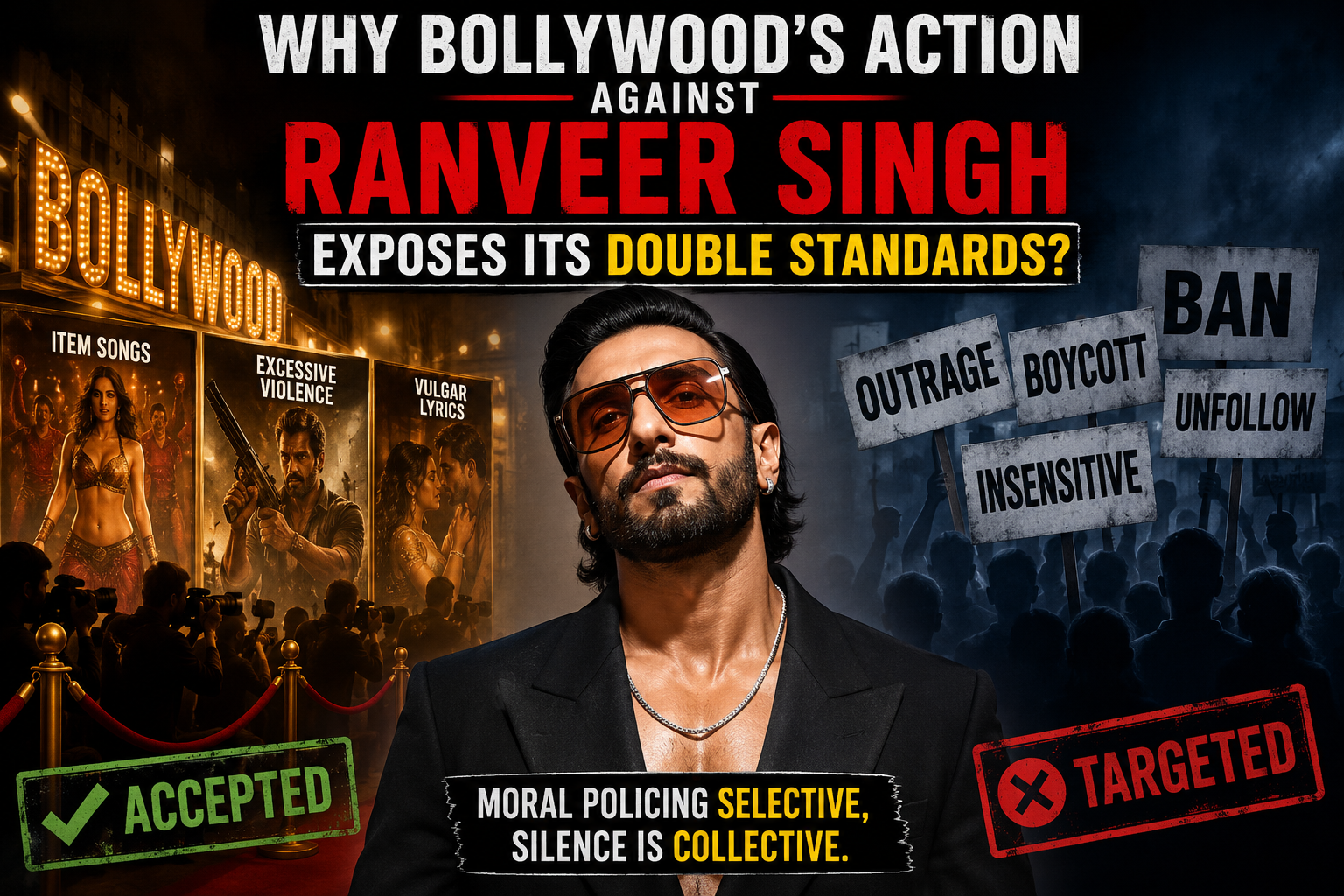
Bollywood’s Action Against Ranveer Singh film industry operates on a fascinatingly hypocritical premise: casting changes are routine business until an actor decides to be the one walking away. Every Friday, the industry silently replaces faces, scraps projects, and alters agreements under the polite, all-encompassing umbrella of “creative differences.” Yet, when a top-tier superstar exercises that exact same autonomy to safeguard his career trajectory, the narrative shifts overnight. Suddenly, it is no longer a business decision; it is framed as a breach of discipline, a lack of commitment, and a matter that requires institutional intervention.
The recent non-cooperation directive issued against Ranveer Singh by the Federation of Western India Cine Employees (FWICE) after his high-profile exit from Don 3 has brought this long-standing imbalance into sharp focus. For an industry that has historicised the practice of dropping actors without notice, turning a star’s exit into a punitive spectacle feels less like an attempt to establish professional accountability and much more like a display of institutional control.
The Anatomy of the Don 3 Conflict: Delay, Vision, and Disagreements
To understand why this situation escalated into a public stand-off, one must look at the timeline and structural shifts behind Don 3. Ranveer Singh was officially announced as the new face of the iconic franchise in 2023, taking over a mantle previously carried by Amitabh Bachchan and Shah Rukh Khan. The initial promotional teaser generated substantial internet traffic, setting high expectations for a modernized take on the classic crime drama.
However, behind the scenes, the project faced prolonged periods of stagnation. Production delays, scheduling adjustments, and the absence of a locked, definitive script reportedly began to stall momentum. For a leading star navigating his peak professional years, indefinite delays represent a massive opportunity cost.
The Creative Divide
Beyond the scheduling conflicts, deep-rooted creative differences emerged regarding the tonality of the film:
The Actor’s Vision: Following the massive, unprecedented global box-office success of Dhurandhar, Ranveer Singh’s market perception and artistic focus shifted. Reports indicate he envisioned a darker, gritty, and far more aggressive incarnation of the titular character—one featuring intense violence and raw, sharp dialogue to match contemporary global action cinema standards.
The Director’s Vision: Filmmaker Farhan Akhtar reportedly preferred to stay closer to the established, stylized, and relatively mainstream aesthetic that defined his previous two installments in the franchise.
When an unyielding creative deadlock meets continuous production delays, an exit is a natural creative outcome. Ranveer Singh chose to step down before principal photography commenced. While an official public statement from his side has not been issued—outside of standard wishes for the franchise’s future—reports suggest he even offered financial compensation to Excel Entertainment to mitigate pre-production losses.
Despite this, the situation escalated when FWICE stepped in, claiming the actor failed to respond to three consecutive invitations to discuss the matter before eventually stating via email that the dispute fell outside the federation’s specific jurisdiction.
The History of the Overnight Replacement: A One-Sided Paradigm
The outrage targeted at Ranveer Singh overlooks a foundational truth about how Bollywood has functioned for decades: producers and studios routinely replace talent at their own discretion without facing industry-wide bans or non-cooperation directives. When a production house changes its mind, it is labeled a strategic pivot. When an actor changes their mind, it is treated as an offense.
| Actor Involved | Project Name | Context of Exit / Replacement | Industry Consequence |
| Kartik Aaryan | Dostana 2 | Removed from the project after extensive pre-production and partial filming due to internal creative disagreements. | Minimal systemic pushback; project was quietly shelved/recast. |
| Aishwarya Rai | Chalte Chalte | Replaced after filming had already commenced due to external personal controversies disrupting the sets. | No institutional compensation; replacement normalized as a logistical necessity. |
| Kareena Kapoor Khan | Kaho Naa… Pyaar Hai | Exited the project during its initial phases following managerial and financial disagreements between family and the director. | Handled as a standard casting change without regulatory interference. |
In the vast majority of these historical cases, the exits are packaged neatly for the public as amicable departures. Actors rarely take these disputes to tribunals or legal courts because of the inherent power dynamics within the industry. The fear of being branded “difficult,” the risk of being quietly blacklisted by a powerful circle of filmmakers, and the threat of losing future projects force talent to accept abrupt dismissals silently. The system is designed to protect the capital investments of the makers, leaving the actors to manage the resulting narrative hits to their credibility on their own.
The Financial Reality vs. Institutional Overreach
It is undeniably true that film development involves massive financial stakes. Reports monitoring the Don 3 situation suggest that nearly Rs 45 crore had already been spent on pre-production, locations, and early conceptual work before the casting fell through. A loss of this magnitude is a serious blow to any production house, and it warrants a professional resolution.
However, the entertainment industry possesses legitimate, legally binding frameworks to handle financial breaches. Contracts contain specific exit clauses, penalty terms, and arbitration guidelines. If a breach of trust or contract occurs, the appropriate venue for resolution is a court of law or a formally recognized corporate arbitration panel.
Key Insight: Turning a contract dispute into an industry-wide “non-cooperation” directive sets a dangerous precedent. It implies that if one specific production house suffers a financial setback, every other independent producer currently working with that actor must halt their projects as well. This collective punishment doesn’t protect the daily wage workers or the crew; instead, it jeopardizes ongoing productions that have absolutely nothing to do with Don 3.
The Dhurandhar Effect: Why Box Office Power Rewrites the Rules
The intensity of the current backlash cannot be examined in isolation from Ranveer Singh’s recent box-office run. The monumental, historic success of Dhurandhar 2 has fundamentally altered his positioning within the commercial ecosystem. When an actor delivers a performance that redefines box-office metrics globally, their professional leverage changes. It forces them to re-evaluate their upcoming lineup with extreme caution.
An extraordinary success like Dhurandhar shifts an actor’s priorities. It makes little strategic sense to transition from a record-breaking, universally acclaimed cinematic property into a delayed franchise project that is plagued by script uncertainties and conflicting creative visions. In any other global entertainment market, an actor choosing to capitalize on their peak momentum by selecting projects aligned with their current box-office status is seen as smart career management. In Bollywood, however, this sudden assertion of independence is frequently misconstrued as arrogance.
Discrediting the Star: The Narrative Game and Contemporary Jealousy
As the institutional pressure mounts, a parallel narrative has emerged within the industry aimed at downplaying Ranveer Singh’s contribution to his own success. A clear example of this trend occurred during a recent promotional event for Hai Jawani Toh Ishq Hona Hai, where actor Varun Dhawan, speaking alongside veteran filmmaker David Dhawan, touched upon the evolving dynamics of modern filmmaking.
When David Dhawan asserted that the film industry, both past and present, is fundamentally driven and run by its actors, Varun Dhawan openly disagreed. He specifically cited Dhurandhar, framing its massive box-office performance entirely as a “director’s win” for filmmaker Aditya Dhar, while completely omitting any mention of Ranveer Singh’s performance.
David Dhawan: “I think anyone who has a pen and a phone feels they are a journalist… But again, it’s run by the actors. Pehle bhi tha, abhi bhi hai.”
Varun Dhawan: “Why do you feel that? Today, when you see Dhurandhar, you see someone like Aditya Dhar and the way he made the film. Toh woh toh director ki jeet thi na?”
This exchange quickly gained traction across digital platforms and entertainment communities like Reddit, where audiences sharply criticized the commentary. Observers pointed out the obvious timing of the remarks, noting an apparent trend among contemporaries to decouple a star’s performance from a film’s historic success precisely when that star is facing institutional pressure.
While a film is undeniably a collaborative team effort guided by its director, attempting to minimize the impact of a lead actor’s performance—especially one that anchored a multi-million-dollar franchise—highlights the underlying professional friction and competitive biases that surface when a peer reaches a new level of industry leverage.
The Question of Jurisdiction and the Search for a Mature Resolution
The core of Ranveer Singh’s legal stance, as revealed by FWICE officials, rests on a fundamental distinction regarding industry governance: film casting choices and pre-production contract terminations do not fall under the standard jurisdiction of daily-wage labor federations. They belong to corporate legal frameworks and individual producer-actor associations.
By bypassing standard corporate legal routes and moving directly toward a public non-cooperation directive, the industry bodies risk revealing their true motivations. The current response looks less like an objective search for a financial solution and much more like a warning shot aimed at the broader talent pool. The underlying message is unmistakable: no matter how high your box-office stock rises, the traditional power structures retain the ability to disrupt your career if you challenge their terms.
Moving Forward Amicably
For an industry constantly trying to modernize and compete on a global scale, this culture of selective enforcement is counterproductive. Films regularly survive high-profile exits:
Scripts are rewritten.
Characters are recast.
Announcements are revised.
Productions adapt and move forward.
Don 3 can, and likely will, be made with a different creative team and a different lead actor who aligns seamlessly with Farhan Akhtar’s original structural vision.
Punishing an actor for walking away before cameras rolled serves no practical financial or creative purpose. It merely exposes the systemic insecurity of an industry struggling to balance old-school control with a modern, talent-driven market. Real accountability requires a fair, two-way street—one where an actor’s right to say “no” is respected just as much as a producer’s right to change their mind. Until that balance is achieved, industry directives will continue to look less like justice and more like an attempt to enforce submission.