
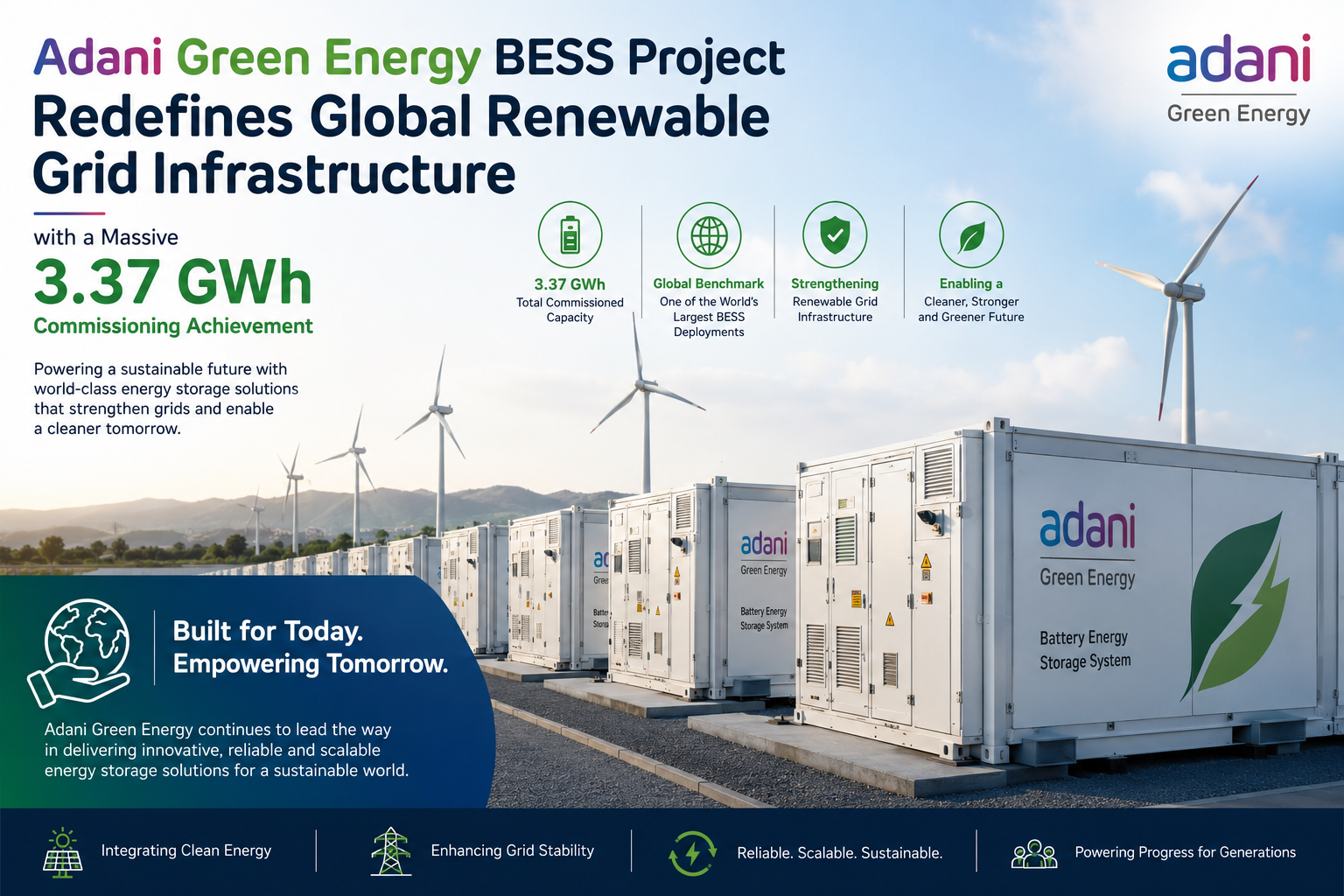
The recent commissioning of the Adani Green Energy BESS project marks a monumental leap forward for India’s clean energy ambitions and the global renewable infrastructure landscape. Adani Green Energy Limited (AGEL), India’s premier renewable energy powerhouse, has officially brought a cumulative 3.37 gigawatt-hour (GWh) Battery Energy Storage System (BESS) online at its massive facility in Khavda, Gujarat. This massive deployment secures its position as the single largest location-specific battery storage installation anywhere in the world outside of China.
Even more astonishing than its sheer scale is the breakneck speed at which it was built. The entire utility-scale infrastructure transitioned from breaking ground to full operational deployment within a tight 10-month window, establishing a new global benchmark for rapid clean energy project execution. As variable renewable power resources like wind and solar expand at an exponential rate, this milestone project offers a blueprint for how modern nations can solve the problem of grid intermittency and successfully transition to completely reliable, round-the-clock green electricity.
Understanding the True Scale of the 3.37 GWh Khavda Facility
To understand the sheer magnitude of the Adani Green Energy BESS deployment, one must look at the physical and statistical realities of what 3.37 GWh of stored electrical energy represents.
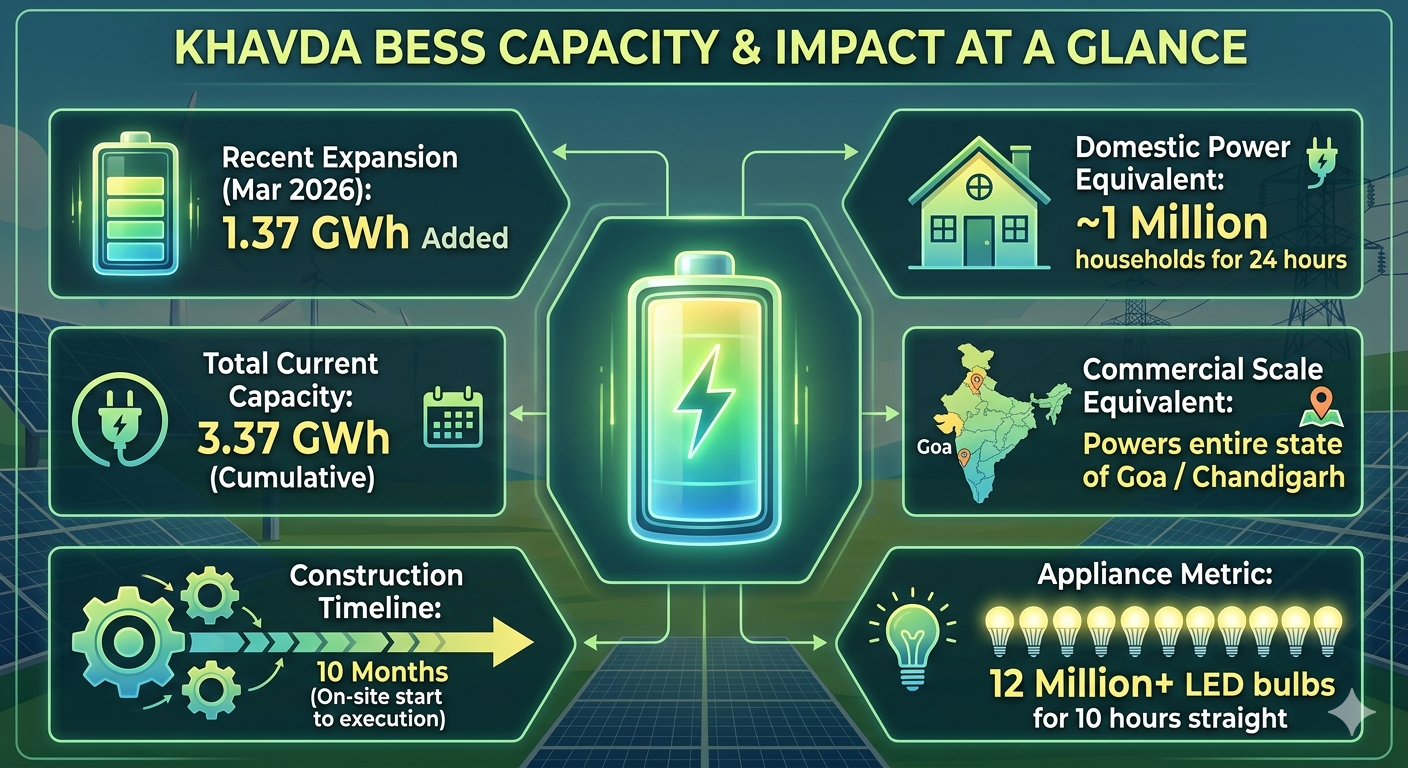
When we talk about gigawatt-hours on this scale, we are no longer discussing localized backup systems or industrial peak-shaving operations. This is macroeconomic infrastructure. A capacity of 3.37 GWh means the system can store enough pure, emission-free electricity to sustain nearly one million standard residential homes for an entire day.
Alternatively, this single storage setup is robust enough to fully manage the peak-hour electricity demands of entire major urban metropolises like Indore or Chandigarh. It can even shoulder the grid load of an entire Indian state, such as Goa. For further context on its efficiency, the stored reserves could keep over 12 million LED light bulbs burning continuously for ten hours straight.
This installation does not just supplement the existing grid; it acts as a massive shock absorber and primary distribution anchor for the regional electrical architecture. By incorporating a massive 1.37 GWh capacity addition that was commissioned in March 2026, AGEL has fast-tracked its master facility timeline, proving that high-volume, capital-intensive green infrastructure can be completed without the multi-year delays that traditionally plague major utility projects.
Solving the Intermittency Problem of Clean Energy
The core challenge of the global green energy transition has never been about generating clean electrons; it has always been about timing. Solar panels produce peak energy during the middle of the day when the sun is highest, whereas wind turbines fluctuate based on unpredictable atmospheric weather patterns. Unfortunately, human society consumes energy on a completely different schedule. Peak electricity demand typically spikes in the mornings as businesses open and surges again in the evenings when families return home, cook, and turn on cooling or heating systems.
This mismatch creates what energy economists call the “intermittency trap.” When a power grid relies heavily on wind and solar without adequate storage, it faces two distinct risks:
Curtailment: Generating too much power during peak sun/wind hours that the grid cannot absorb, forcing operators to literally waste clean energy.
Peaker Plant Reliance: Relying on carbon-heavy coal or gas-fired “peaker plants” to rapidly fire up and fill the supply deficit when renewable generation drops.
The Adani Green Energy BESS initiative directly eliminates this bottleneck. By acting as a massive buffer, the Khavda facility absorbs excess green energy generated during peak production cycles and cleanly releases it into the national grid exactly when demand spikes.
This transitions renewable power from an intermittent, unpredictable resource into a highly dependable, “dispatchable” asset. Base-load power, which historically required burning fossil fuels round-the-clock, can now be sustained using stored, completely green electrons.
Inside the Technology: Advanced Lithium-Ion and Intelligent Management
A battery facility of this magnitude requires far more than just wiring individual cells together. The Khavda infrastructure relies on a highly sophisticated integration of advanced lithium-ion battery technologies coupled with state-of-the-art software systems.
Next-Generation Lithium-Ion Chemistry
The facility utilizes high-density, utility-grade lithium-ion cells optimized for deep cycling. These batteries are specifically engineered to withstand continuous charge and discharge processes without rapid degradation, ensuring that the facility maintains its high operating capacity over decades of service.
Advanced Energy Management Systems (EMS)
The real magic happens within the digital control layer. The Adani Green Energy BESS uses an intelligent, automated Energy Management System that monitors grid frequency, voltage fluctuations, and load demands in real-time.
If the national grid experiences a sudden drop in frequency—perhaps due to an unexpected shutdown of an external generator or a sudden cloud cover over a nearby solar farm—the EMS can trigger the BESS to discharge power within milliseconds. This microsecond responsiveness provides vital synthetic inertia to the grid, preventing blackouts and brownouts before traditional backup systems could even register a fault.
Integrated Thermal Management
Storing gigawatt-hours of electricity generates massive amounts of thermal energy. To maximize safety, efficiency, and life expectancy, the Khavda setup incorporates advanced liquid cooling and climate control mechanisms. These systems ensure that every battery rack operates within a strict, optimized temperature window, preventing thermal runaway and maximizing round-trip efficiency (the ratio of energy put into storage compared to the energy retrieved).
The Strategic Importance of Khavda, Gujarat
The geographic placement of this massive battery bank is far from accidental. AGEL has strategically situated the BESS project within Khavda, Gujarat, which is currently the epicenter of the world’s largest consolidated renewable energy park.
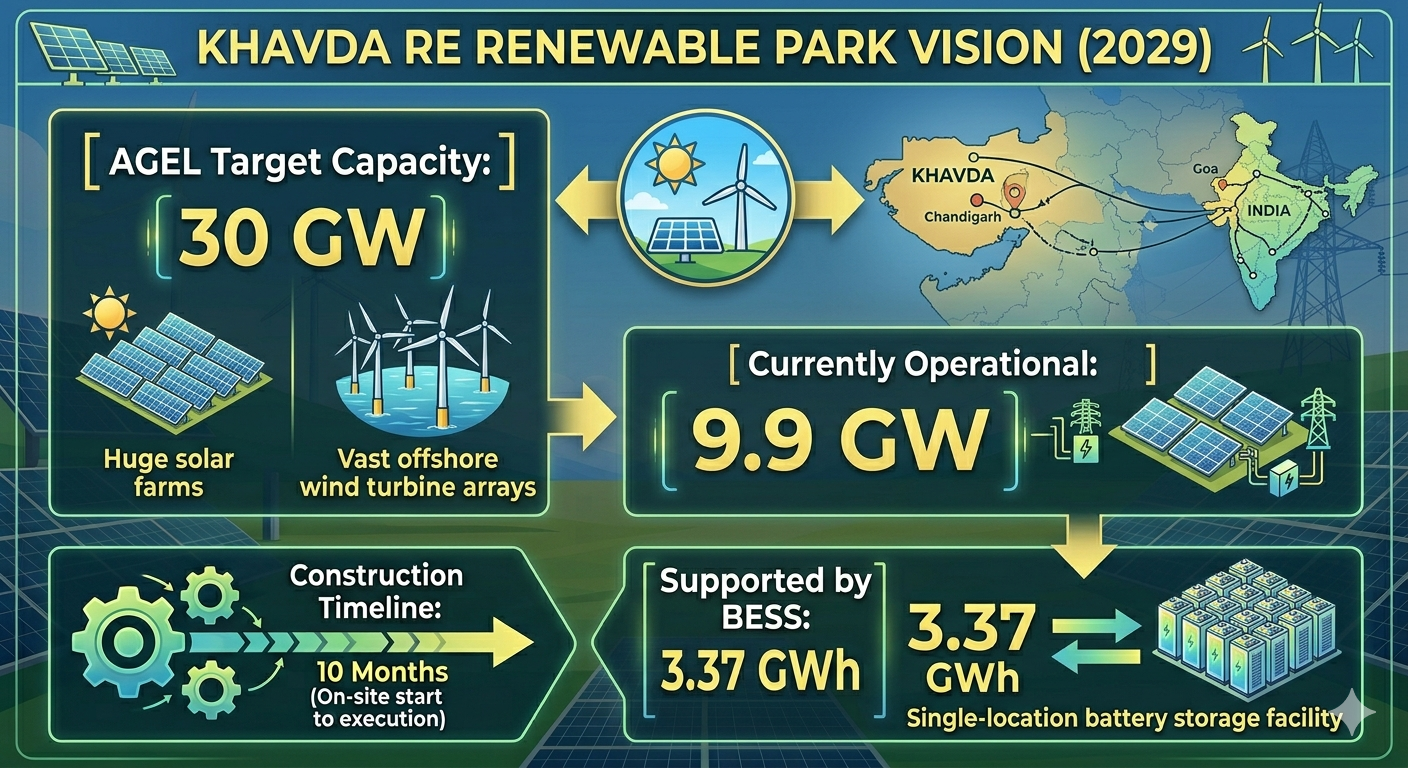
At this single location in the salt deserts of Khavda, Adani Green Energy is actively developing a staggering 30 gigawatts (GW) of total renewable energy generation capacity, scheduled for ultimate completion by 2029. As of mid-2026, an impressive 9.9 GW of this solar and wind capacity is already fully operational and pumping power into the Indian grid.
Building a mega-scale battery project directly adjacent to a mega-scale generation plant offers massive logistical and engineering advantages:
Minimized Transmission Losses: Storing power immediately at the point of generation eliminates the transmission line resistance losses that occur when transporting high-voltage electricity over long distances to remote storage sites.
Direct Grid Balancing: It allows AGEL to manage its own power output profile directly at the source. The combination of 9.9 GW of generation and 3.37 GWh of storage essentially turns the Khavda complex into a self-healing, highly controlled hybrid power plant.
Land and Infrastructure Synergies: Utilizing the expansive, dedicated geography of Khavda allows for seamless physical expansions without the legal, environmental, and spatial constraints found near major urban centers.
Executive Perspectives: Driving India’s Clean Energy FutureThe executive leadership at AGEL views this development not merely as a corporate achievement, but as an essential national foundation. Speaking on the historic commissioning, Sagar Adani, Executive Director of AGEL, emphasized the shifting dynamics of the clean energy industry:
“Large-scale energy storage will play a defining role in the next phase of India’s clean energy transition. As renewable energy capacity scales rapidly, storage infrastructure becomes critical for delivering reliable, round-the-clock clean power. With the commissioning of the 3.37 GWh BESS at Khavda, AGEL is strengthening the foundation for resilient, dispatchable and flexible energy systems. Our investments in battery storage reflect a long-term commitment to building future-ready clean energy infrastructure at global scale.”
This perspective highlights a critical truth: the metrics of success in the green energy sector have permanently evolved. In the early 2010s, success was defined simply by how many solar panels or wind turbines a company could install. In the late 2020s, success is defined by how effectively an energy provider can manage, stabilize, and guarantee the delivery of that power regardless of whether the sun is shining or the wind is blowing.
A Historic Timeline: 10 Months to Global Dominance
In the infrastructure world, large-scale projects often take years to navigate from blueprints to active grid synchronization. Bureaucratic hurdles, supply chain constraints for specialized lithium components, environmental clearances, and complex civil engineering requirements frequently delay utility-scale storage projects.
AGEL’s completion of the 3.37 GWh Khavda project within just 10 months of commencing on-site construction is nothing short of an industrial marvel.
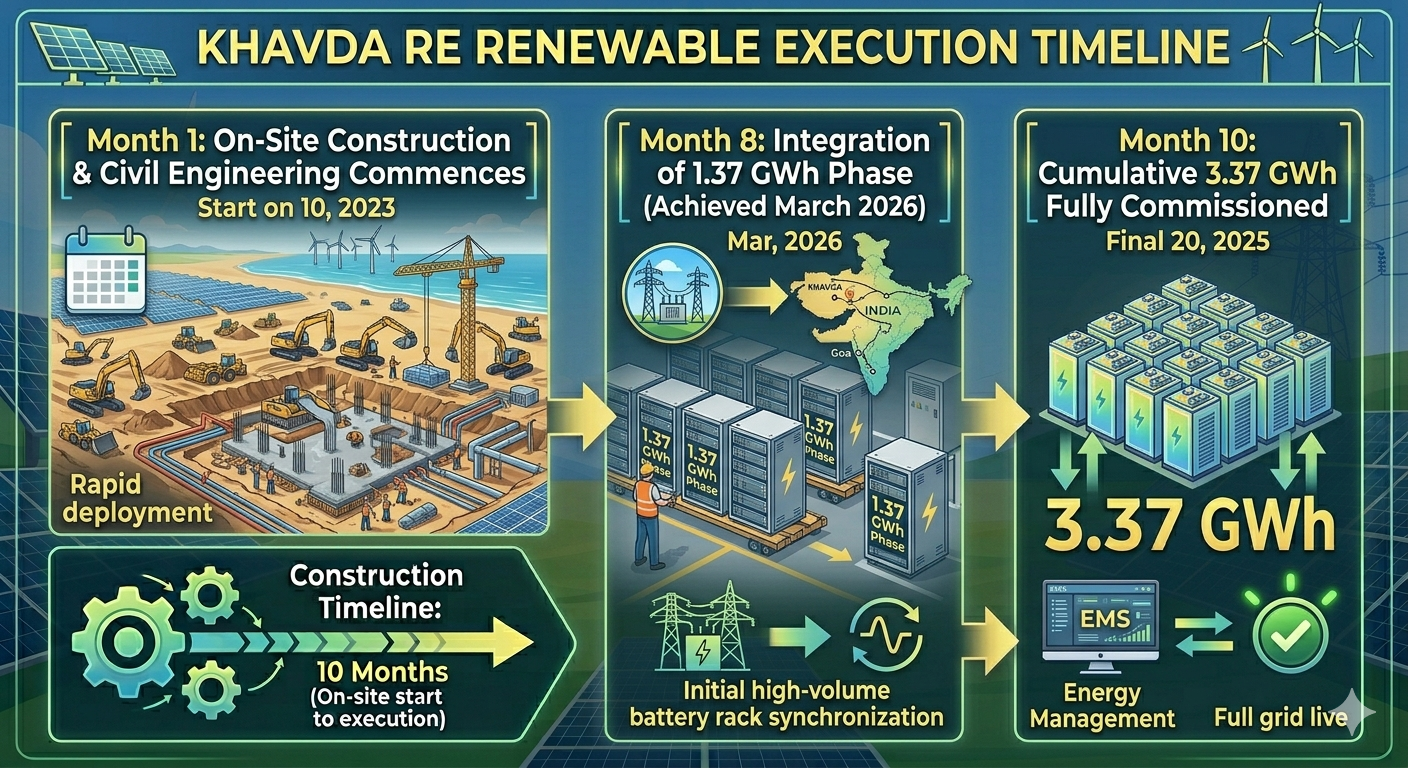
This rapid turnaround demonstrates the company’s vertically integrated supply chain strategy, its deep engineering expertise, and its strong project management frameworks. By proving that gigawatt-hour scale storage can be deployed in under a year, Adani has shown the global energy market that scaling up grid flexibility can keep pace with rapid solar and wind build-outs.
Looking Forward: The Bold 50 GWh Roadmap
The commissioning of the 3.37 GWh system is not the finish line for Adani Green Energy; rather, it is a launchpad. The company has laid out an aggressive, multi-tiered expansion roadmap for its battery storage segment that promises to fundamentally tilt the balance of global energy infrastructure power toward India.
The FY27 Expansion Target
AGEL plans to add over 10 GWh of fresh battery storage capacity in the upcoming financial year (FY27) alone. This near-term target will require duplicating their current record-breaking capacity multiple times over across strategic nodes, further hardening the Indian national grid against supply shocks.
The Five-Year Vision (Through 2031)
Over the next five years, AGEL intends to scale its cumulative operational battery storage capacity to an unprecedented 50 GWh.
AGEL BESS Scaling Horizon:
2026:  ||| 3.37 GWh (Current Status)
2027:  |||||||||||| 10+ GWh (Target)
2031:  ||||||||||||||||||||||||||||||||||||||||||||| 50 GWh (Long-Term Vision)
An energy storage portfolio of 50 GWh will position AGEL as an absolute titan of global green utility operations. A footprint of that scale will easily support the full decarbonization of major industrial corridors across India, enabling heavy industries—such as steel, cement, and manufacturing—to transition away from coal-fired captive power plants toward completely reliable, zero-emission grid power.
Macro Economic and Environmental Implications
The roll-out of the Adani Green Energy BESS has profound positive implications that ripple far beyond the balance sheets of the Adani Group or the borders of Gujarat.
Reducing India’s Carbon Footprint
By smoothing out the supply curve of renewable energy, this massive storage system prevents the need to fire up coal-based thermal backups during peak evening hours. This directly lowers the carbon intensity of the national grid, speeding up India’s trajectory toward its net-zero emission commitments.
Lowering Levelized Cost of Storage (LCOS)
Historically, battery storage was deemed too expensive for developing economies. However, massive single-location deployments like Khavda benefit from tremendous economies of scale. By purchasing components, setting up thermal management systems, and organizing grid links on a multi-gigawatt level, AGEL is driving down the Levelized Cost of Storage per kilowatt-hour. This cost reduction helps make battery-backed green power cost-competitive with, or even cheaper than, traditional fossil fuels.
Enhancing Sovereign Energy Security
India historically imports a significant portion of its hydrocarbon requirements, leaving its domestic economy vulnerable to international oil and gas price shocks. By building out a world-class domestic generation and storage ecosystem in locations like Khavda, the nation secures its own energy independence. Every gigawatt-hour of solar or wind energy captured and stored in Gujarat means less imported fuel is needed to power India’s growth.
Final Thoughts: A Blueprint for the Rest of the World
The successful activation of the 3.37 GWh Adani Green Energy BESS project changes the conversation around what is achievable in renewable energy infrastructure. It proves that with deep capital investment, meticulous engineering, and clear strategic focus, the historical limitations of green energy can be entirely overcome.
As the team at AGEL looks toward their next milestones in FY27 and their ultimate 50 GWh horizon, the Khavda facility stands as a beacon of modern industrial capability. It stands as definitive proof that the clean energy transition is no longer a distant dream for tomorrow—it is actively being built, turned on, and scaled to historic heights today.