
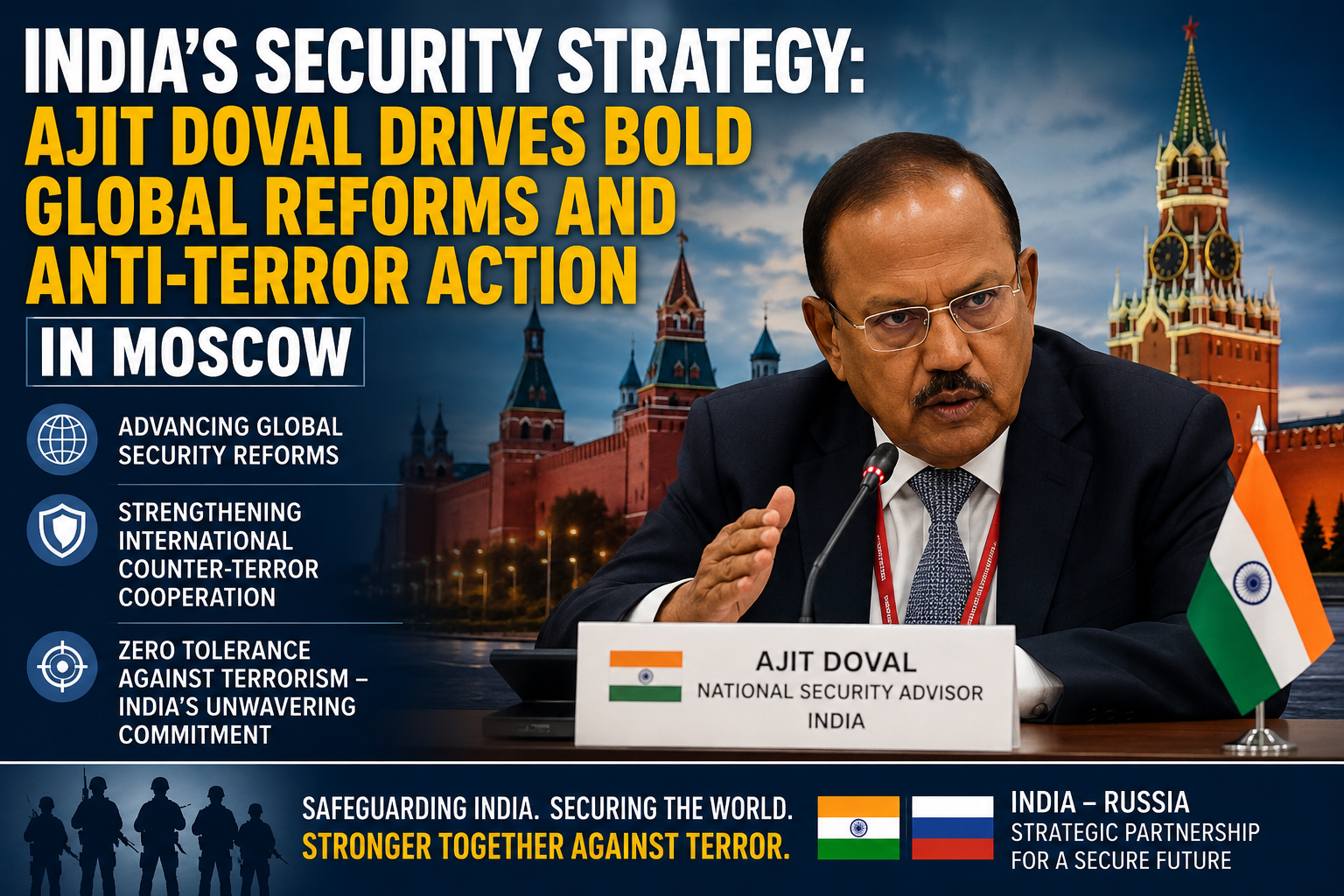
In an era defined by shifting geopolitical alliances and emerging security challenges, India has once again asserted its position as a decisive leader for the Global South. Speaking at a high-level international gathering in Russia, National Security Advisor (NSA) Ajit Doval delivered a powerful, multi-layered address targeting the foundational vulnerabilities of the current global order.
From the halls of the first International Security Forum and the 14th Meeting of High Representatives for Security Matters in Moscow, India’s security strategy took center stage. NSA Doval’s message was unmistakable: the era of geopolitical complacency, institutional bias, and counter-terrorism duplicity must come to an immediate end.
India’s Security Strategy : Moscow’s Multipolar Alignment
The high-level security forum, hosted by the Secretary of the Security Council of the Russian Federation, Sergei Shoigu, arrived at a critical juncture in modern international relations. The core theme of the conference—“Challenges and Threats to International Security in the Context of the Emergence of the Multipolar World”—provided the perfect canvas for India to articulate its vision of a balanced, fair, and secure global architecture.
For decades, global governance has been dictated by frameworks established in the immediate aftermath of the Second World War. However, as power diffuses from traditional Western capitals toward a more fragmented, multipolar reality, these legacy systems are fracturing under the weight of modern crises. By participating actively in this forum, India sought not just to participate in the conversation, but to actively reshape the narrative around global stability.
Dismantling ‘Double Standards’ in the Fight Against TerrorismAt the very heart of India’s security strategy is an unyielding, zero-tolerance approach to cross-border terrorism. Addressing the diverse assembly of international security czars, NSA Ajit Doval delivered a scathing critique of nations that apply selective morality to global terror networks.
“There cannot be double standards in the fight against terrorism. Responsible nations have to evaluate their choices and decide whether they support sponsors of terrorism or counter them with decisive action.”
— Ajit Doval, National Security Advisor
The Myth of ‘Good’ vs. ‘Bad’ Terrorists
For years, India has been at the receiving end of state-sponsored proxy warfare. Doval’s remarks strike at the core of a persistent global malady: the tendency of certain global powers to turn a blind eye to terrorist networks when it suits their immediate strategic interests, only to cry foul when those same networks turn against them.
India’s position is that terrorism is an absolute evil. There are no “freedom fighters” when civilians are targeted, and there are no geopolitical nuances that justify the funding, arming, or harboring of radical extremists.
A Call to Action for the International Community
Doval’s speech was a direct challenge to the conscience of the international community. By demanding that responsible nations make “clear choices,” India is forcing a rhetorical showdown. The message is clear: you cannot claim to be a champion of global peace while simultaneously maintaining diplomatic, financial, or strategic lifelines to states that leverage terror as an instrument of foreign policy.
Overhauling the Post-1945 Global Architecture
A standout element of Doval’s address in Moscow was his direct critique of the United Nations and other legacy multilateral institutions. He underlined the urgent need for comprehensive structural reforms in global bodies established in 1945.
The Anachronism of Post-WWII Structures
The year 1945 reflected a completely different world. The geopolitical landscape was dominated by a handful of victorious Allied powers, colonialism was still rampant, and the vast majority of today’s sovereign nations did not even exist as independent entities.
Eighty years later, the world has fundamentally transformed, yet the structural core of global decision-making—most notably the United Nations Security Council (UNSC)—remains frozen in time.
| Legacy Framework (1945) | Modern Geopolitical Reality (2020s) | India’s Reform Demand |
| Eurocentric & Western-dominated | Multipolar with shifting economic centers | Democratization of global governance |
| Marginalization of colonized territories | Rise of the Global South as an economic engine | Permanent representation for neglected regions |
| Paralysis through unilateral vetoes | Interconnected threats requiring swift, collective action | Transparent, accountable decision-making |
Championing the Voice of the Global South
India’s security strategy is inextricably linked with the welfare of the Global South. Doval argued forcefully that contemporary international security challenges cannot be solved by a closed club of nations.
True structural reform must ensure that the views, anxieties, and aspirations of developing nations are permanently integrated into global decision-making processes. Without this representation, legacy institutions will continue to lose their legitimacy, rendering them ineffective in resolving modern conflicts.
Securing the Arteries of Global Trade: West Asia and Maritime Safety
Beyond the conceptual realms of institutional reform and anti-terror doctrines, NSA Doval anchored India’s strategic interventions in tangible, real-world economic security. He expressed deep concern over the escalating volatility in West Asia, pointing out its direct fallout on global supply chains.
          [ Global Supply Chain Vulnerability ]
                          │
         ┌────────────────┴────────────────┐
         ▼                                 ▼
┌─────────────────┐               ┌─────────────────┐
│ Strait of Hormuz│               │   The Red Sea   │
├─────────────────┤               ├─────────────────┤
│ Energy Arteries │               │ Cargo & Transit │
└────────┬────────┘               └────────┬────────┘
         └────────────────┬────────────────┘
                          ▼
            [ Risk: Geopolitical Chokepoints ]
The Vulnerability of Critical Waterways
India’s economic growth is heavily dependent on open, predictable, and safe maritime trade routes. The Strait of Hormuz and the Red Sea serve as vital maritime highways connecting Asia to Europe and the Americas.
The Strait of Hormuz: The world’s most critical energy chokepoint, through which a massive percentage of the world’s petroleum passes daily. Any disruption here instantly triggers global energy spikes that hurt developing economies the hardest.
The Red Sea: A vital transit corridor for container ships navigating toward the Suez Canal. Recent drone and missile attacks on commercial shipping in this sector have already demonstrated how quickly regional instability can inflate freight rates and delay consumer goods worldwide.
The Far-Reaching Impact of Regional Instability
Doval warned that instability in West Asia is not a localized problem. Because the modern global economy is hyper-interconnected, a security vacuum in the Middle East ripples across the globe within hours. By calling for a concerted international effort to ensure the safe and uninterrupted movement of trade through these maritime corridors, India highlighted its role as a net security provider and a responsible stakeholder in global commerce.
Strengthening the Indo-Russian Strategic Partnership
On the sidelines of the main forum, the bilateral engagement between Ajit Doval and his Russian counterpart, Sergei Shoigu, signaled the enduring resilience of the Indo-Russian strategic matrix.
Reviewing the Pillars of Cooperation
The meeting between Doval and Shoigu provided an opportunity to review the foundational pillars of the bilateral relationship:
Defence Ties: Moving beyond simple buyer-seller dynamics toward co-production, joint ventures, and technology transfers.
Security Architecture: Sharing intelligence on transnational radicalization, cyber threats, and regional flashpoints.
Energy Security: Optimizing hydrocarbon imports, civil nuclear energy cooperation, and developing sustainable, long-term energy corridors amid shifting global sanctions regimes.
Economic Corridors: Accelerating the operationalization of routes like the International North-South Transport Corridor (INSTC) to bypass traditional geopolitical bottlenecks.
Setting the Stage for the New Delhi BRICS NSA Meeting
The discussions also looked ahead to the upcoming BRICS NSA meeting scheduled to take place in New Delhi. As BRICS expands its footprint to include new economic players from the Global South, the consultations in Moscow served as an essential alignment of perspectives. Both sides exchanged vital views on how to leverage the expanding BRICS framework to advocate for a more equitable financial and security ecosystem.
Why India’s Practical Diplomacy Matters
What makes India’s security strategy uniquely compelling on the global stage is its rejection of dogmatic, bloc-based alignment. India’s presence in Moscow, coupled with its simultaneous engagements with Western security architectures, underscores a mature approach to foreign policy often described as “multi-alignment.”
India does not look at the world through the reductive lens of a new Cold War. Instead, New Delhi engages with multiple poles of power based on shared interests, mutual respect, and international law. By speaking candidly about terrorism in Moscow, demanding Western-dominated institutional reforms, and advocating for freedom of navigation in global waters, India demonstrates that its foreign policy is dictated entirely by its enlightened national self-interest and a genuine commitment to global stability.
The Path Forward for Global Security
The takeaways from NSA Ajit Doval’s Moscow visit offer a clear roadmap for how the international community must pivot if it hopes to navigate the turbulent waters of a multipolar century.
A Shared Antiterrorism Lexicon: The world must discard political opportunism and unite under a single, uncompromised definition of terror.
Democratic Multilateralism: If institutions like the UN do not bend toward reform to include the Global South, they risk breaking entirely into irrelevance.
Proactive Maritime Security: Protecting global chokepoints like the Strait of Hormuz must be viewed as a collective economic necessity, rather than a regional geopolitical game.
As India prepares to host the BRICS security leadership in New Delhi, the strategic markers laid down by Ajit Doval in Moscow will undoubtedly form the cornerstone of India’s ongoing effort to build a safer, more representative, and truly balanced global order.