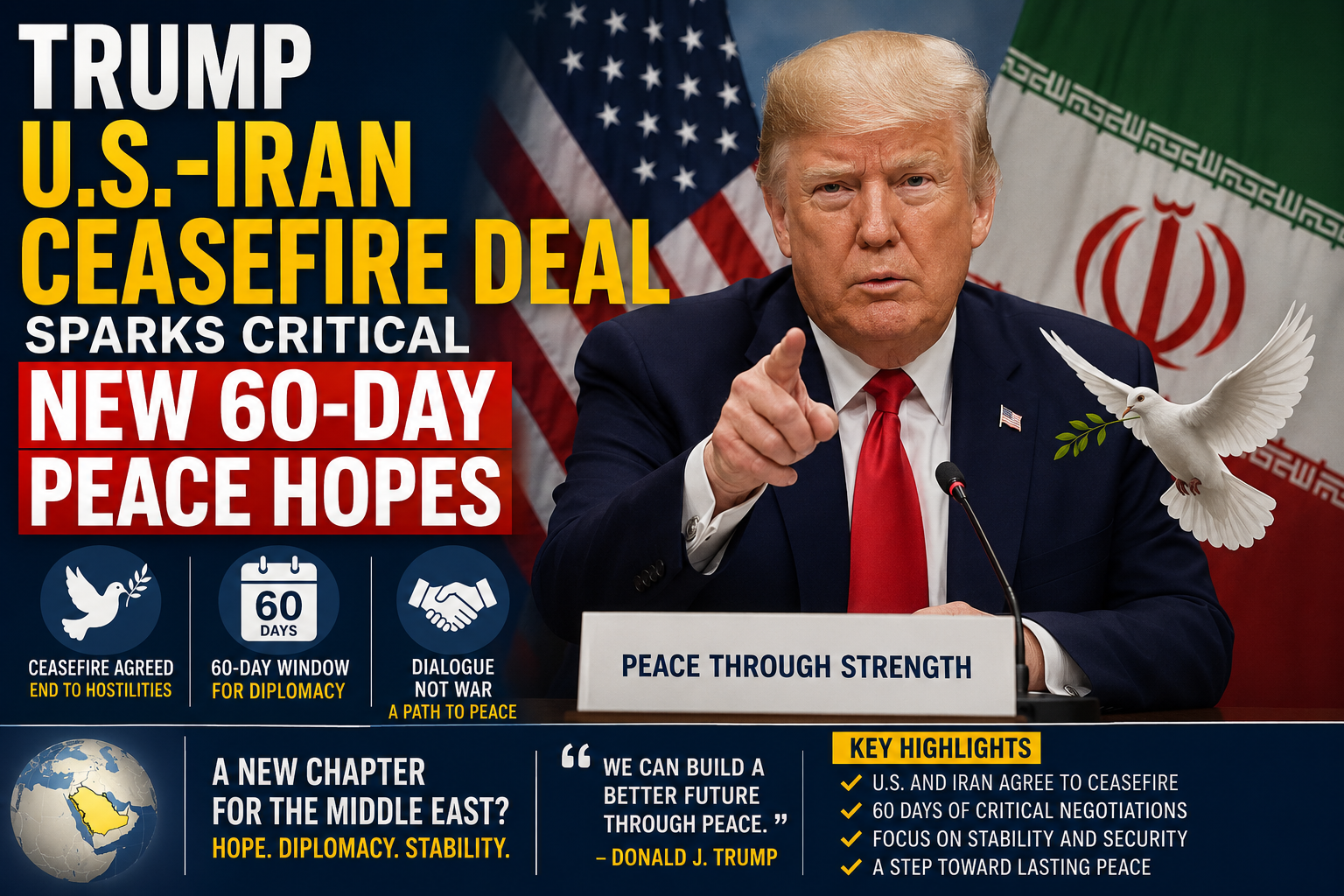
Trump U.S.-Iran Ceasefire Deal in the Middle East stands at a historic turning point . The United States and Iran have agreed on a temporary 60-day peace deal (truce) to pause a war that started in late February. This pause gives both countries a chance to hold formal peace talks.
However, the deal is not final yet. It is waiting for U.S. President Donald Trump to sign it, leaving the world waiting on edge.
At the same time, the situation remains dangerous. Just hours ago, warning shots were fired near the Strait of Hormuz, showing how easily this peace could break.
Here is everything you need to know about the 60-day ceasefire, the nuclear talks, and how it affects the global economy.
Trump U.S.-Iran Ceasefire Deal : An Analysis of the 60-Day Framework
At its core, the proposed memorandum of understanding is designed to create a structured, 60-day window of calm. This period is not a permanent peace treaty, but rather a diplomatic runway. If signed by President Trump, it will allow both nations to transition from active military engagement to substantive, long-term negotiations.
The primary objectives of this 60-day framework include:
A Complete Cessation of Hostilities: Halting active military strikes between U.S.-led forces and Iranian military units.
Regional De-escalation: Addressing the ongoing conflict between Israel and Hezbollah, ensuring that regional proxies do not inadvertently reignite the broader war.
Establishing a Direct Diplomatic Channel: Moving past initial backchannel communications to tackle deeply rooted issues like nuclear enrichment and international sanctions.
Inside the Diplomatic Trenches: U.S. Vice President JD Vance, who has played an instrumental role in guiding these delicate talks, confirmed to reporters that a framework is largely in place. “We’re going back and forth on a couple of language points,” Vance noted, strike a cautious yet optimistic tone. “We’ve made a lot of progress here.”
The Nuclear Stumbling Block: Disposing of Highly Enriched Uranium
The most sensitive and complex element of the draft agreement revolves around Iran’s nuclear program. Under the proposed terms, Iran must pledge a definitive commitment to refrain from pursuing nuclear weapons.
Furthermore, the initial 60-day negotiation window will focus intensely on the immediate disposal of Iran’s highly enriched uranium (HEU) stockpile.
Iran's Current Nuclear Profile (IAEA Data):
┌──────────────────────────────┬──────────────────────────────┐
│ Metric                       │ Current Status               │
├──────────────────────────────┼──────────────────────────────┤
│ 60% Enriched Uranium Stock   │ ~440.9 kg (970 pounds)       │
│ Lower-Level Nuclear Material │ ~10 Metric Tonnes            │
│ Proximity to Weapons-Grade   │ Short technical step to 90%  │
└──────────────────────────────┴──────────────────────────────┘
According to regional officials close to the negotiations, two primary methods for disposing of Iran’s 60% enriched uranium are currently being considered:
Dilution: Chemically down-blending the highly enriched material back to lower, non-weapons-grade enrichment levels.
Foreign Offloading: Exporting the stockpile to a neutral third-party country, with Russia being floated as a highly probable destination.
While American officials assert that Tehran has shown a verbal willingness to address its nuclear stockpile, Iranian state media and sources close to Tehran’s negotiating team have downplayed these claims, insisting that a final agreement on the technicalities has not yet been set in stone.
Economic Relief: Reopening the Strait of Hormuz and Lifting Sanctions
The economic ramifications of this war have reverberated across the globe, primarily due to the closure of the Strait of Hormuz—a maritime choke point responsible for the daily transit of roughly 20% of the world’s oil supply.
When the war began in late February, Iran effectively closed the strait as a retaliatory measure, prompting a retaliatory U.S. naval blockade of all major Iranian ports. This double-blockade sent global energy markets into a tailspin, pushing domestic gas prices in the West toward historic highs.
The Maritime Strategy
Under the tentative agreement, a phased normalization of commercial shipping would take place:
Unrestricted Transit: Iran must guarantee that commercial shipping can pass through the Strait of Hormuz without harassment, artificial delays, or illegal transit tolls.
Mine Clearance: Military intelligence suggests that naval mines deployed during the early weeks of the conflict must be fully cleared by Iranian forces within a strict 30-day window.
Lifting the U.S. Blockade: In direct proportion to the restoration of safe, verifiable commercial shipping, the United States will systematically lift its naval blockade on Iranian ports.
Sanctions Waivers and Frozen Assets
To incentivize compliance, the United States is prepared to discuss structured sanctions relief. Washington would issue targeted oil sanctions waivers, allowing Iran to legally sell its crude oil on the global market once again. This anticipated influx of oil has already begun to soothe volatile energy trading desks worldwide.
Additionally, the 60-day window will establish a mechanism to address Iran’s massive financial reserves currently frozen in foreign banks. Tehran holds an estimated $24 billion in restricted assets abroad and is aggressively pushing for the immediate release of up to $20 billion to stabilize its struggling domestic economy. The draft agreement also outlines a dedicated humanitarian channel to ensure Iran can seamlessly import essential medicines, food, and agricultural goods.
Will Trump Sign? The View from the White House and Tehran
Despite the massive breakthrough achieved by international mediators, the entire framework remains frozen in place until the political leadership of both nations gives a definitive green light.
The American Perspective
President Donald Trump has maintained a characteristically tough, unpredictable stance regarding the deal. Speaking to reporters during a recent cabinet meeting at the White House, Trump made it clear that he is in no hurry to compromise unless the terms heavily favor American security interests.
“Iran is very much intent, they want very much to make a deal,” President Trump stated. “So far they haven’t gotten there… we’re not satisfied with it, but we will be. We will be either that or we’ll have to just finish the job.”
Demonstrating this “maximum pressure” strategy, the U.S. administration simultaneously announced fresh, aggressive sanctions targeting Iran’s military oil trade network, proving that Washington is willing to penalize Tehran even while peace talks are actively underway.
The Iranian Perspective
In Tehran, the official rhetoric is far more guarded. Iran’s Tasnim news agency, citing a senior source close to the country’s diplomatic team, explicitly rejected Western media narratives claiming the deal is fully finalized.
Iranian officials emphasize that the text of the MoU remains incomplete. They maintain that the official Pakistani mediators—who have been working tirelessly to bridge the gap between the two warring nations—have not yet been handed a finalized text. Tehran has firmly stated that any valid deal will only exist when it is formally announced by Iranian authorities, rather than being unilaterally proclaimed by Washington.
A Fragile Ceasefire Put to the Test in the Open SeaThe sheer volatility of this conflict was put on full display on Thursday, May 28, 2026, when a serious naval skirmish threatened to completely detail months of mediation.
The Islamic Revolutionary Guard Corps (IRGC) navy opened fire, launching warning shots at four commercial vessels attempting to traverse the Strait of Hormuz. Iranian authorities claimed the ships were attempting to pass through the strategic waterway “without prior coordination or authorization.”
The United States military responded rapidly, launching targeted defensive strikes against an Iranian ground control drone station located in the southern port city of Bandar Abbas. The localized conflict quickly escalated, drawing in U.S. ally Kuwait, which was forced to activate its domestic air defense systems against retaliatory drone threats.
While this brief, intense exchange of fire did not completely collapse the overarching ceasefire, it serves as a stark reminder of how unstable the current environment is. With both militaries operating on a hair-trigger, the necessity of turning the tentative MoU into a signed, operational agreement is more urgent than ever.
What Happens Next?
The upcoming days will be entirely decisive for the future of the Middle East. President Trump is currently reviewing the final details of the memorandum alongside his closest national security advisors.
If Trump signs off on the framework, the world will likely see an immediate, stabilizing drop in global oil prices, the gradual reopening of vital shipping lanes, and the launch of the most complex nuclear negotiations witnessed in a generation. If he rejects it, the temporary ceasefire will collapse, likely plunging the region back into an all-out war with devastating global economic consequences.