
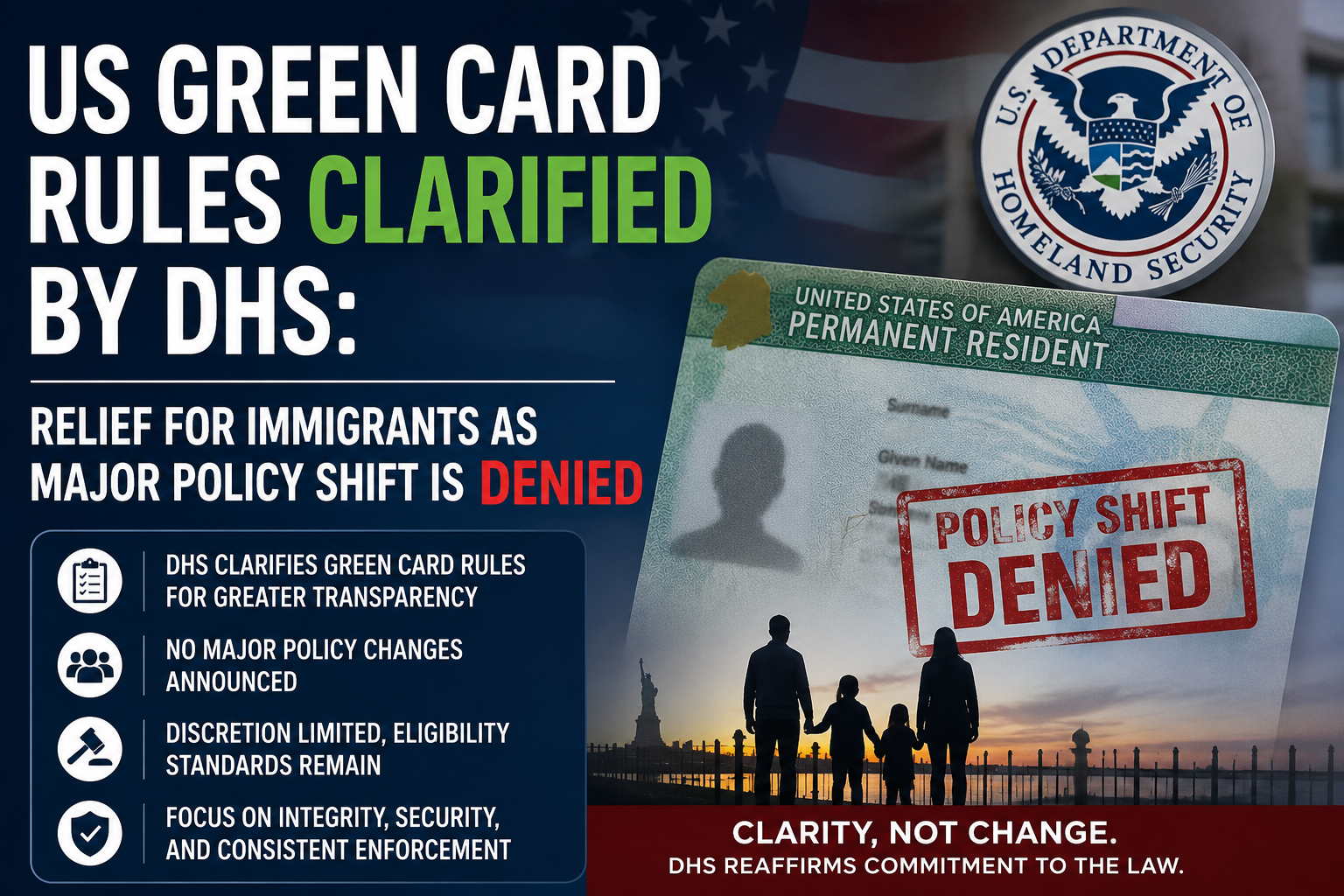
Recently US Green Card rules , a massive wave of panic hit millions of immigrants in the U.S. after a routine update from the United States Citizenship and Immigration Services (USCIS) was misunderstood. Many people mistakenly believed a new law was forcing green card applicants to leave the country.
Fortunately, the Department of Homeland Security (DHS) quickly stepped in to clarify the rules, bringing massive relief to families nationwide.
What Actually Happened?
The Confusion: A standard administrative update was misinterpreted as a mandatory directive ordering immigrants to leave the U.S. while their paperwork was being processed.
The Reality: Senior officials confirmed that the rules have not changed. The vast majority of immigrants applying for permanent residency can safely stay in the U.S. while waiting for their green cards.
The Lesson: This event shows how fragile immigration communication can be. Even a tiny change in legal language can cause widespread fear, project delays, and financial stress for businesses and families alike.
The Bottom Line: The status quo remains intact. Immigrants seeking permanent residency do not need to pack their bags or leave the United States.
The Genesis of the Panic: What Sparked the Confusion?
To understand why the DHS clarification was so critically necessary, it is essential to trace the origin of the panic back to its source. The anxiety started with a technical policy announcement issued by USCIS. The agency’s initial publication appeared to suggest a much stricter interpretation of where an applicant must physically reside while their permanent residency application undergoes official review.
The Misinterpreted “Extraordinary” Exception Clause
In the initial guidance, terminology surfaced that caught immigration attorneys and advocacy groups off guard. The text seemed to imply that adjustment of status applicants—individuals currently residing within the United States who are attempting to transition to a green card—would generally be required to return to their native countries. According to this interpretation, remaining within the U.S. during the processing period would be restricted exclusively to those who could prove “extraordinary” or deeply exceptional circumstances.
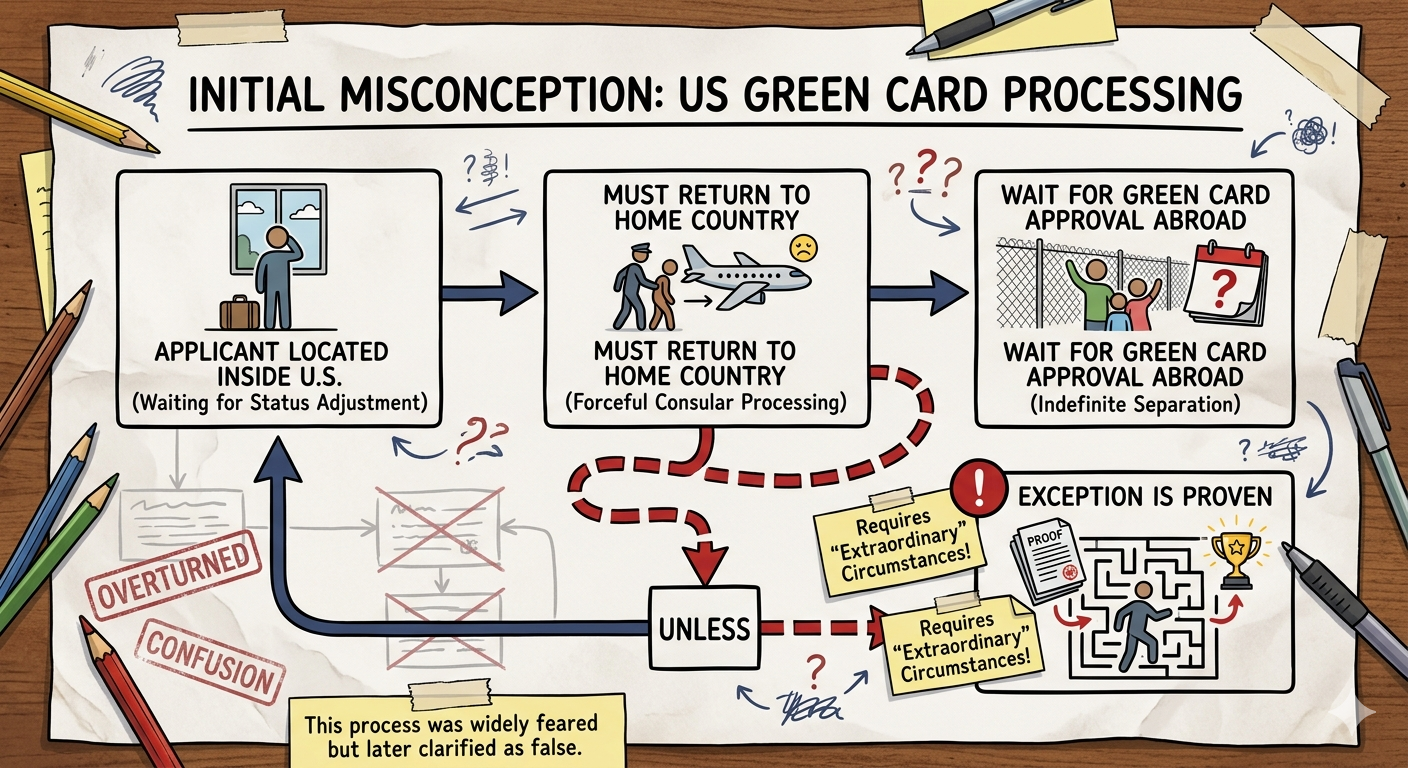
The immediate fallout from this phrasing was profound:
Widespread Anxiety: Immigrant families feared sudden, long-term separations.
Legal Inundation: Law firms were flooded with calls from terrified clients asking if their ongoing adjustment of status cases were suddenly in jeopardy.
Community Alarm: Grassroots organizations scrambled to decode what looked like a monumental, restrictive overhaul of long-standing immigration protocols.
Institutional Uncertainty Within the Government Due to US Green Card Rules
Compounding the public panic was the fact that the initial rollout lacked internal alignment. Reports surfaced indicating that even certain officials within DHS and USCIS were temporarily left in the dark regarding the precise scope, intent, and operational execution of the guidance. When internal agency personnel are unclear about whether a rule marks a fundamental structural shift or a minor procedural reminder, it inevitably amplifies public distrust and fear.
For nearly a week, a narrative circulated that the United States was shutting its doors to in-country green card processing, signaling a harsh turn toward mandatory consular processing for almost everyone.
The DHS Clarification: Demystifying the Status Quo
Recognizing the escalating anxiety and the potential for severe disruption to both the legal system and the economy, the Department of Homeland Security intervened to set the record straight. Speaking to major national media outlets, including The New York Times, a senior DHS spokesperson categorically denied that a sweeping policy change had occurred.
No Broad Change in Immigration Policy
The core takeaway from the DHS clarification is straightforward: the foundational rules governing where an applicant waits for a green card have not been rewritten. The department explicitly stated that the controversial guidance was never intended to act as a brand-new blanket requirement targeting all applicants. Instead, officials described the publication as a routine administrative reminder of legal mechanisms that have been embedded in the Immigration and Nationality Act (INA) for decades.
Reaffirming the Principle of Case-by-Case Discretion
Rather than establishing a rigid, mandatory rule forcing applicants to depart the United States, the DHS emphasized that immigration officers retain their traditional, long-standing discretionary authority.
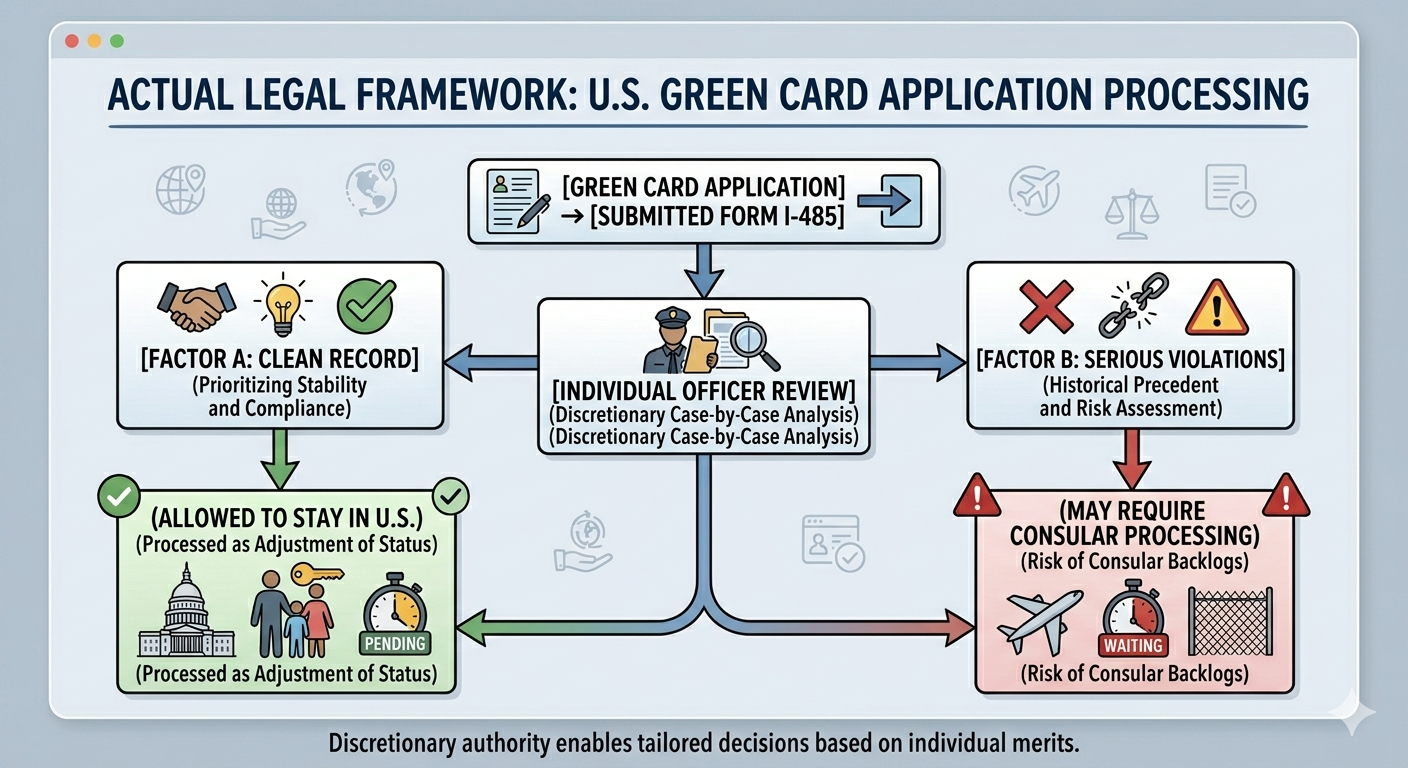
Immigration law is rarely entirely black and white. Officers have long possessed the mandate to evaluate each application based on its unique merits and historical context. The recent guidance was intended to remind adjudicators of their power to evaluate specific negative factors when determining whether an individual is eligible to adjust their status entirely within the United States or if they must undergo consular processing abroad.
Understanding “Adjustment of Status” vs. “Consular Processing”
To fully grasp why this clarification is so meaningful for immigrants, it helps to understand the two primary pathways used to obtain a green card: Adjustment of Status (AOS) and Consular Processing. The tension between these two pathways sits at the very heart of the recent policy confusion.
| Feature / Pathway | Adjustment of Status (AOS) | Consular Processing |
| Physical Location | Inside the United States | Outside the United States (At a U.S. Embassy/Consulate) |
| Governing Form | Form I-485 | Form DS-260 |
| Travel and Work | Eligible for Advance Parole & Employment Authorization Document (EAD) | Must wait in home country; no U.S. work authorization while waiting |
| Interview Location | Local USCIS field office in the U.S. | U.S. Embassy or Consulate abroad |
| Risk Factor | If denied, applicant is already in the U.S. and can pursue legal appeals or defenses. | If denied, applicant is stuck outside the U.S. with limited options for review. |
The Value of Adjustment of Status
For an immigrant already living, working, and building a life in the United States, Adjustment of Status is the preferred route. It provides stability. While Form I-485 is pending, applicants can obtain interim benefits like a work permit (EAD) and a travel document (Advance Parole). This allows them to maintain their livelihoods, support their households, and keep their families intact under one roof while the wheels of the federal bureaucracy turn.
The Risks of Consular Processing
Forcing an in-country applicant to switch to consular processing is not just a logistical hassle; it can be life-altering. If an immigrant is forced to return to their country of origin to complete the process, they face the risk of prolonged family separation due to massive consular backlogs.
Furthermore, if an individual has accrued unlawful presence in the United States, stepping foot outside the country can automatically trigger statutory 3-year or 10-year bars to re-entry, trapping them outside America indefinitely. This explains why the mere hint of a mandatory departure rule caused such profound panic.
Who is Potentially Affected? Factors Influencing Officer Discretion
Even though the government’s update brings relief to most green card seekers, it is not a free pass for everyone. Immigration officers still have the power to look closely at complicated cases and make a negative decision.
If an applicant has certain “negative factors” in their history, an officer can deny their request to process their green card from inside the U.S.
Here are the 4 main reasons an applicant might face extra scrutiny:
1. Staying Past a Visa Expiration Date (Visa Overstays)
The Rule: If you are a close relative of a U.S. citizen (like a spouse or child), staying past your visa deadline is usually forgiven.
The Catch: If you are applying through a job or a more distant family member, significant overstays are not automatically forgiven. You might be forced to leave the U.S. to finish your application.
2. Entering the Country Secretly (Unlawful Entry)
If someone entered the U.S. without going through an official border check or being inspected by an officer, they usually cannot apply for a green card from inside the country.
They will likely have to apply for special waivers and leave the U.S. for an interview abroad.
3. Lying or Using Fake Documents (Misrepresentation or Fraud)
If an officer finds out that an applicant lied, used fake information, or hid the truth to get a visa or enter the country, the case gets red-flagged.
Officers will routinely use their power to deny in-country processing for these individuals.
4. Criminal Records (Public Safety Concerns)
Any history of arrests, criminal charges, or convictions will immediately pull an application out of routine processing.
Drug violations or crimes that threaten public safety give officers a strong reason to say “no,” which can disrupt the applicant’s ability to stay in the United States.
The View from the White House: Routine Administration vs. Policy StrategyTo calm the public, a senior White House official explained that the entire event was just a “routine administrative matter.”
The Administration’s Goal: The government wants to balance secure borders with fair, humane ways for immigrants to get legal status.
No Policy Change: Officials stated this was just a standard paperwork update to align internal manuals with existing laws. It was never meant to target or deport law-abiding green card applicants.
The Criticisms: Immigration advocates argue that even routine updates must be written clearly. In a tense political environment, confusing language causes real-world panic and anxiety.
What Is Still Unclear? (Remaining Ambiguities)
Even though the government cleared up the immediate misunderstanding, immigration lawyers say a big problem remains: the rules are too vague.
The Problem with “Case-by-Case” Choices: The government has not published an exact guide on how officers should make decisions. This means an officer in one state might forgive a minor mistake (like accidentally overstaying a visa for 15 days years ago), while a stricter officer in another state might use that same mistake to deny a green card.
The Call for Clear Rules: Advocates are demanding that the government publish a clear, transparent guide that defines:
Exactly what mistakes are bad enough to make someone leave the country.
What positive factors (like having family in the U.S. or paying taxes) can outweigh past mistakes.
How an applicant can appeal a unfair decision.
The Human Element: Impact on Communities
Behind the legal language are real people. Navigating the U.S. immigration system takes years of waiting, thousands of dollars, and constant stress.
When the confusing news first broke, it wasn’t just about booking a flight. For millions of families, it meant facing the terrifying fear of losing their jobs, pulling their kids out of school, breaking house leases, and leaving their loved ones behind with no promise of return.
The Bottom Line: While the White House claims it was a simple paperwork mix-up, the event highlights how deeply legal uncertainty impacts the mental health and stability of immigrant families.
The Economic Strain on U.S. EmployersThe anxiety surrounding this rule extended well beyond immigrant households and into the boardrooms of American businesses. Thousands of U.S. companies rely heavily on high-skilled foreign workers holding H-1B, L-1, or O-1 visas who are in the middle of transitioning to employment-based green cards (such as the EB-2 or EB-3 categories).
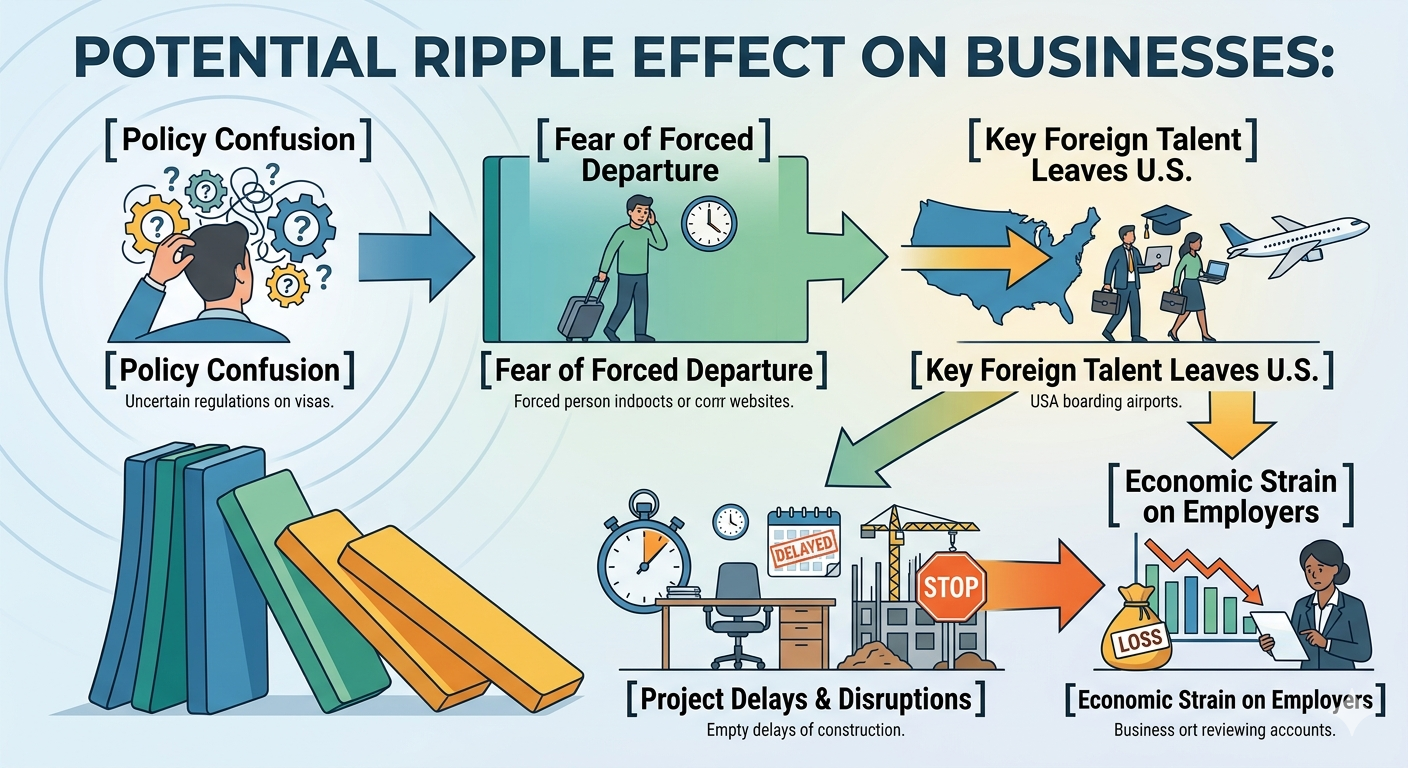
If these vital employees had been forced to leave the country abruptly to wait for consular appointments abroad, American businesses would have faced severe project disruptions, lost productivity, and logistical nightmares trying to manage remote work across multiple time zones and international legal jurisdictions. By clarifying that these workers can remain firmly planted in their U.S. roles while their applications are processed, DHS effectively averted a localized economic disruption.
Step-by-Step: What Green Card Applicants Should Do Now
In light of the DHS clarification, what should individuals currently navigating the green card journey do to safeguard their status and ensure their application proceeds smoothly? Legal experts recommend a proactive, methodical approach.
1. Review Your Comprehensive Immigration History
Before filing any paperwork, sit down and compile a complete timeline of your presence in the United States. Document every entry, every exit, every visa renewal, and every period of employment. Identify any potential red flags, such as:
Gaps between the expiration of one visa status and the approval of another.
Any unauthorized employment, even if it was short-lived or freelance.
Any traffic stops, arrests, or legal disputes, regardless of how minor they may seem.
2. Consult with a Qualified Immigration Attorney
Given that the government has reaffirmed the power of officer discretion, having an experienced legal advocate is more critical than ever. Do not rely on advice from unauthorized individuals or unverified internet forums. A licensed immigration attorney can analyze your specific history, evaluate whether any negative discretionary factors apply to your case, and help prepare a robust application strategy.
3. Build a Strong Portfolio of Equities
If your case involves a minor infraction—such as a past visa overstay—your application should ideally include a compelling presentation of your positive contributions to the United States. This is often referred to as building a portfolio of equities. You can gather:
Letters of recommendation from employers, community leaders, or church officials.
Proof of consistent tax filings and financial responsibility.
Evidence of deep-rooted family ties to U.S. citizens or lawful permanent residents, such as birth certificates of children or marriage certificates.
4. Stay Informed Through Official Channels
In an era where misinformation can go viral within minutes, it is vital to source your updates directly from primary channels. Regularly check the official USCIS newsroom and DHS press releases for verified policy updates rather than relying solely on summarized social media posts.
Conclusion: A Welcome Respite, But Vigilance Remains Essential
The clarification from the Department of Homeland Security (DHS) is a major victory for common sense and stability. By confirming that there is no major policy change and that most immigrants can stay in the U.S. while waiting for their green cards, the government successfully ended a massive wave of unnecessary panic.
Key Takeaways:
The Good News: The doors remain wide open for average applicants to finish their green card process safely inside the United States. Your American dream is still on track.
The Reminder: This situation proves how delicate immigration laws can be. Because officers look at applications on a “case-by-case” basis, being honest, precise, and legally prepared is more important than ever.
The Big Picture: For now, millions of immigrants across the country can finally breathe a collective sigh of relief and look forward to the future with their families.