
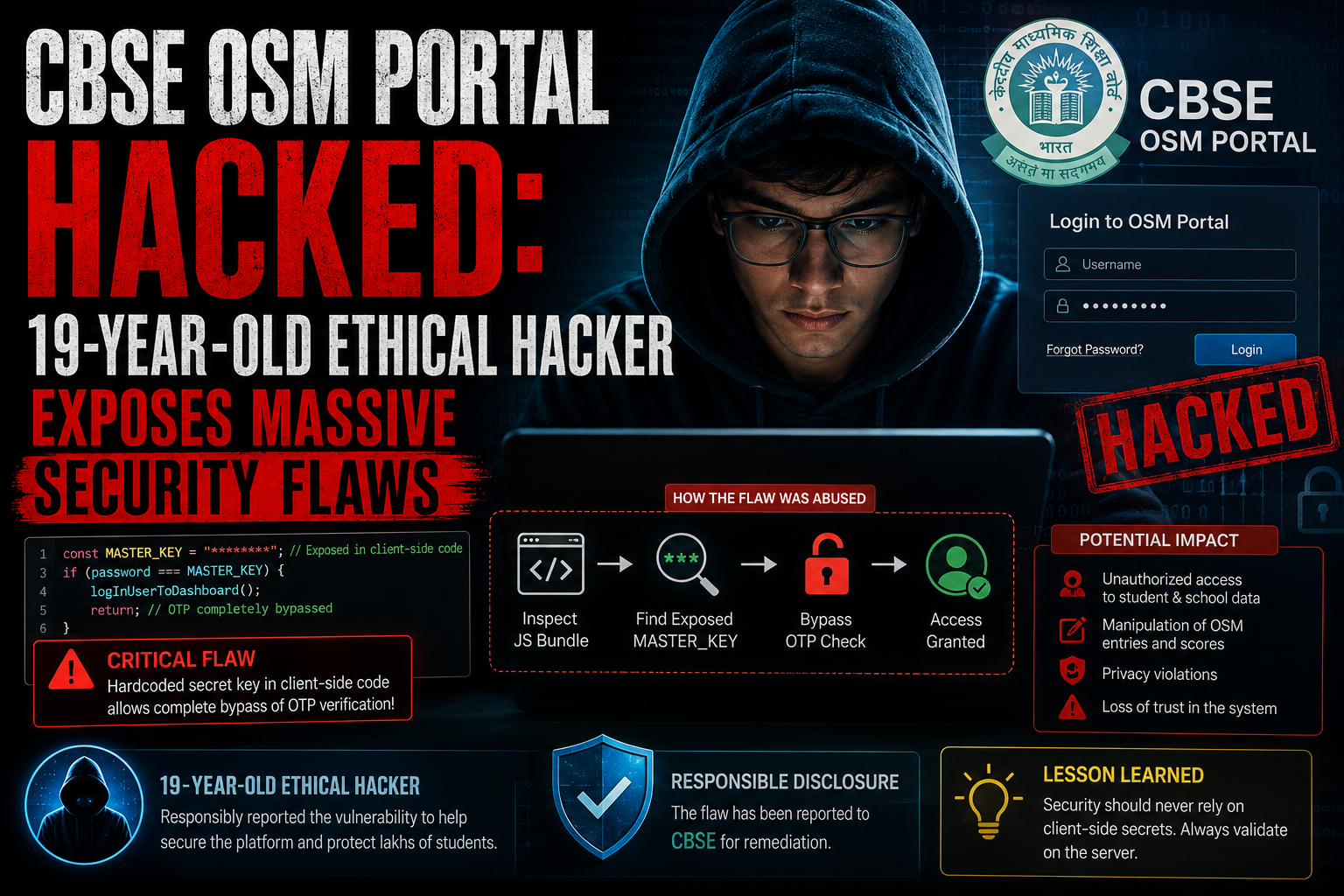
The CBSE OSM Portal Hack is facing immense pressure after a 19-year-old ethical hacker, Nisarga Adhikary, exposed critical security vulnerabilities in its On-Screen Marking (OSM) portal. The system, which is actively used by evaluators to grade board examination papers digitally, reportedly contained jaw-dropping security lapses, including an easily accessible “master password” embedded directly within the website’s public code.
Following days of intense public scrutiny, viral social media posts, and widespread panic among student communities, the education board finally broke its silence on Sunday. CBSE confirmed that it is actively collaborating with government cybersecurity cells and top experts from the Indian Institutes of Technology (IITs) to patch the vulnerabilities.
Responding to the official acknowledgement, Adhikary stated simply, “My work is done,” signifying a major victory for independent ethical researchers pushing for better digital infrastructure in India’s public sector.
The Genesis of the Breach: How an Indie Researcher Stumbled Upon a National Vulnerability.
The controversy began when Nisarga Adhikary, a self-described “hobbyist cybersecurity researcher,” published an incredibly detailed technical breakdown on his personal blog and social media platforms. According to his public disclosure, the investigation into the CBSE OSM portal hack didn’t require multi-million dollar military-grade software or state-sponsored cyberweapons. Instead, the vulnerability was sitting in plain sight due to flawed web development practices.
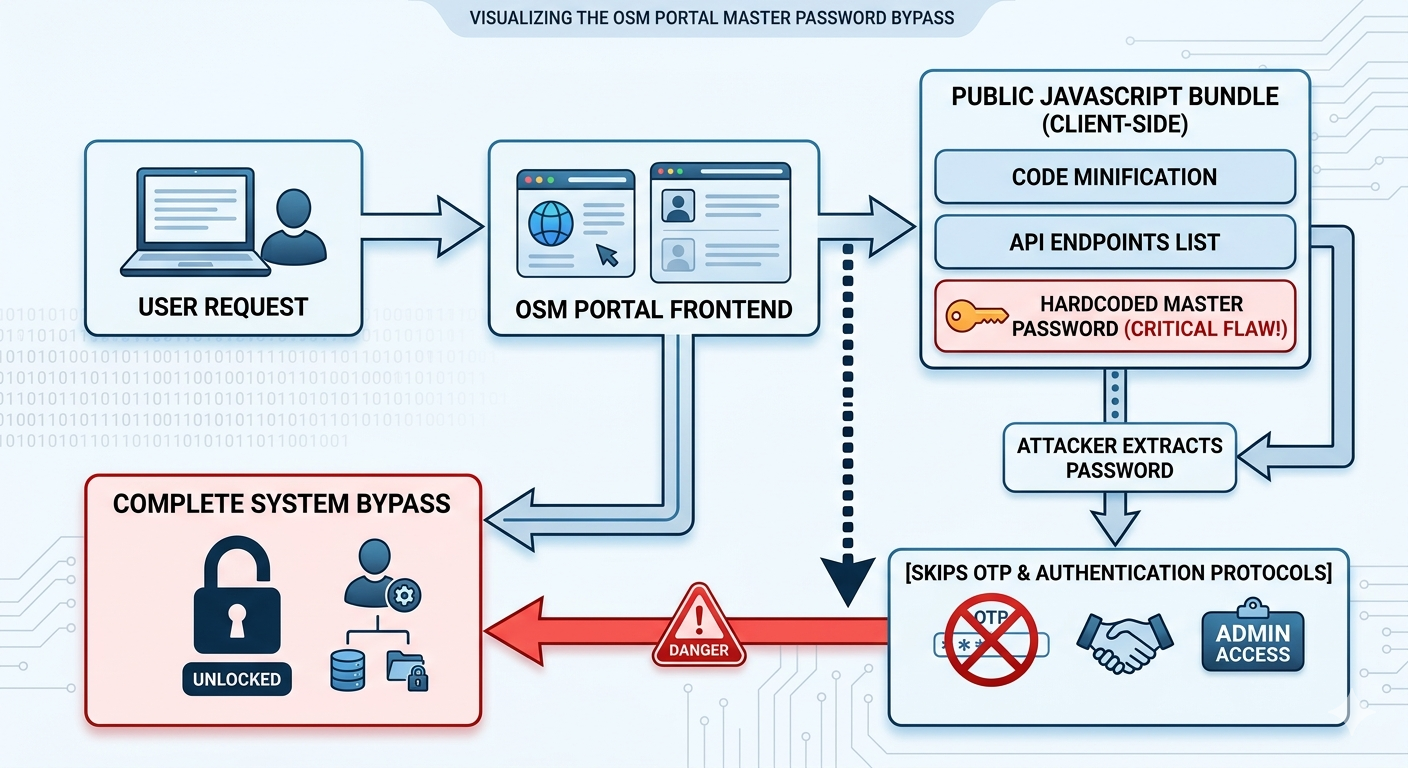
Adhikary discovered that the digital developers managing the On-Screen Marking infrastructure for CBSE’s third-party service provider had left the system’s “master password” exposed inside the website’s JavaScript bundle. Because JavaScript runs natively on the user’s browser, anyone with basic web development knowledge could hit F12 on their keyboard, inspect the source code, and pull out the master credentials.
Bypassing the Entire Authentication Matrix
In normal operations, the OSM portal requires a multi-tiered authentication process:
Unique Evaluator Usernames assigned to specific teachers.
Secure Passwords updated periodically.
One-Time Passwords (OTPs) delivered via registered mobile numbers or emails to prevent unauthorized remote sessions.
However, Adhikary discovered that the hardcoded master password possessed unique administrative overrides. When entered, the logic processing the login sequence explicitly skipped the OTP generation step entirely. This meant that an attacker didn’t need physical access to an evaluator’s mobile device; they could slide past the entire perimeter defense and access the primary dashboard within seconds.
What Could Have Happened? Anime, Memes, and the Risk of Altered Board Marks.
The implications of the CBSE OSM portal hack are deeply unsettling for millions of students across India whose academic futures rely heavily on the integrity of their board exam scores. When interviewed regarding the level of control the master password provided, Adhikary revealed that the access was absolute.
“I started examining the special logic for username, password, and OTPs and how it’s processed. When examining that, I found a master password. After a bit of reading the code, I saw that the master password can bypass all the security protocols and open the dashboard directly,” Adhikary explained.
To demonstrate the severity of the flaw without causing malicious damage, the young researcher performed a series of non-destructive, ethical demonstrations:
Website Defacement: He successfully injected custom scripts to modify the visual appearance of the portal, building entirely new pages filled with anime images and popular internet memes.
Database Access: The exploit provided unhindered access to thousands of scanned, digitized student answer sheets waiting to be evaluated or archived.
Grading Manipulation Risks: Most critically, Adhikary confirmed that the administrative privileges unlocked by the master password were broad enough to allow a malicious actor to rewrite, alter, or falsify the marks assigned to specific answer scripts.
Recognizing the catastrophic fallout of this discovery, Adhikary did not sell the exploit on the dark web or use it to manipulate actual student data. Instead, he compiled a thorough vulnerability report back in February and submitted it directly to the Indian Computer Emergency Response Team (CERT-In), the national nodal agency responsible for handling cybersecurity incidents.
CBSE Breaks Silence: IIT Experts Deployed to Fortify Defenses
For days following the viral social media threads detailing the exploit, an anxious silence loomed over the board’s offices. However, as the technical documentation gained mainstream media traction, the central board took to X (formerly Twitter) on Sunday to assure the public that defensive countermeasures were underway.
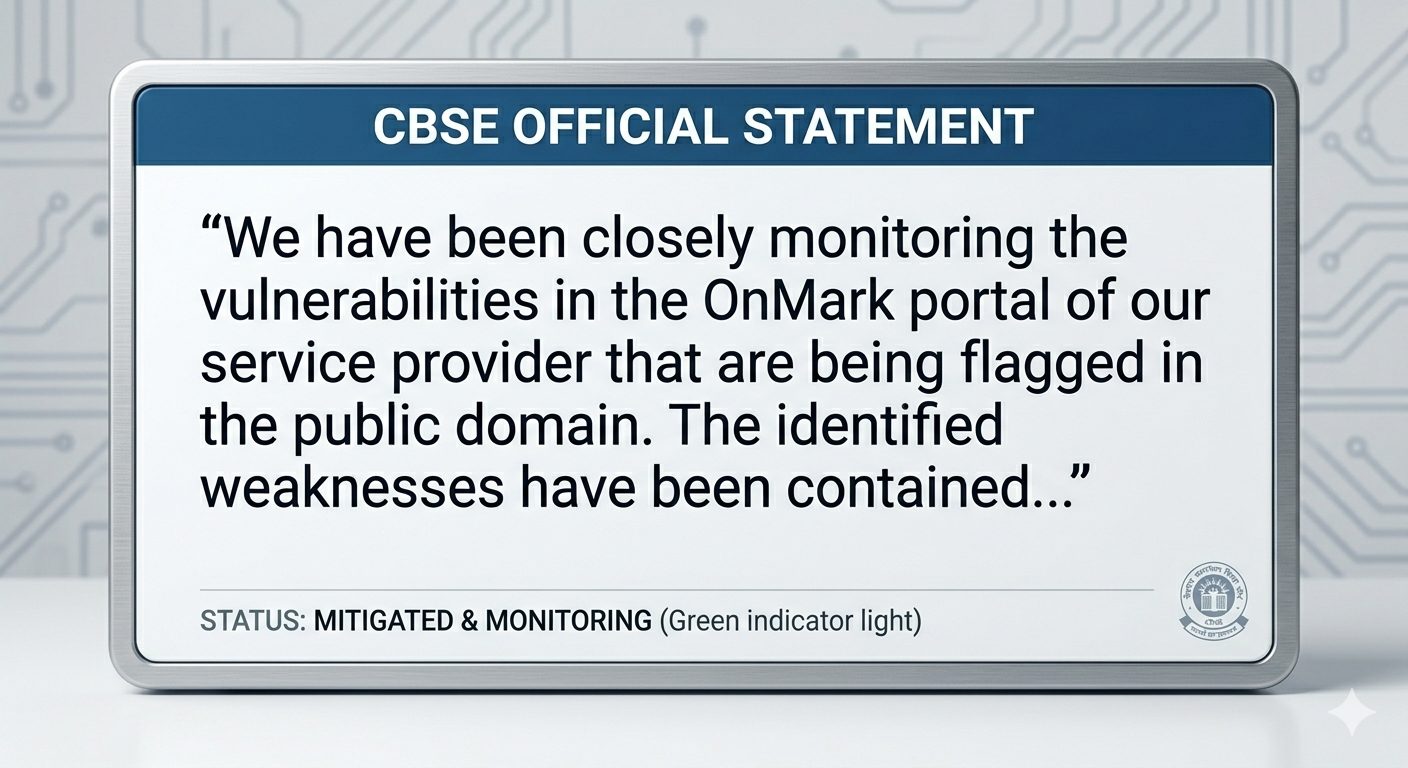
The board clarified that the flaw resided specifically within the OnMark portal, a platform managed by an external third-party digital service provider hired to facilitate digital paper evaluations. To regain control of their digital ecosystem, CBSE has mobilized a high-tier cyber defense unit consisting of:
Government Cybersecurity Analysts: Specialized teams tasked with auditing network traffic and checking for unauthorized access footprints.
IIT Tech Experts: Software architects and cryptography researchers from top Indian Institutes of Technology brought in to re-engineer the authentication pipeline.
The official statement also extended a rare note of public gratitude to independent security communities:
“The identified vulnerabilities have been contained, and other exploitable weaknesses are being ruled out. We are grateful to all alert citizens and ethical hackers pointing out such weaknesses, and have gotten in touch with some of them directly.”
'My Work Is Done': The Ethical Hacker's Relieved ReactionFor Nisarga Adhikary, the public statement from the country’s largest educational board serves as the ultimate validation of his efforts. White-hat hackers frequently face legal retaliation or defensive denials from large institutions when pointing out security lapses.
Following the board’s public tweet, Adhikary posted a rapid reaction on X noting that the governing body had formally admitted to the structural flaws he highlighted. While that initial reaction post was briefly deleted and re-uploaded, his final stance remains clear and professional.
Speaking on the matter, the 19-year-old stated that his primary objective had been fully realized. “My work is done,” he remarked, expressing relief that the authorities had stepped up to secure the academic data of millions of peers. He confirmed that since the publication of CBSE’s update, he has ceased all testing and analysis on the OSM portal, respecting the boundaries of ethical disclosure guidelines.
The Critical Danger of Hardcoded Credentials in Enterprise Applications
The technical breakdown of the CBSE OSM portal hack highlights a persistent, dangerous anti-pattern in modern web development: hardcoded credentials.
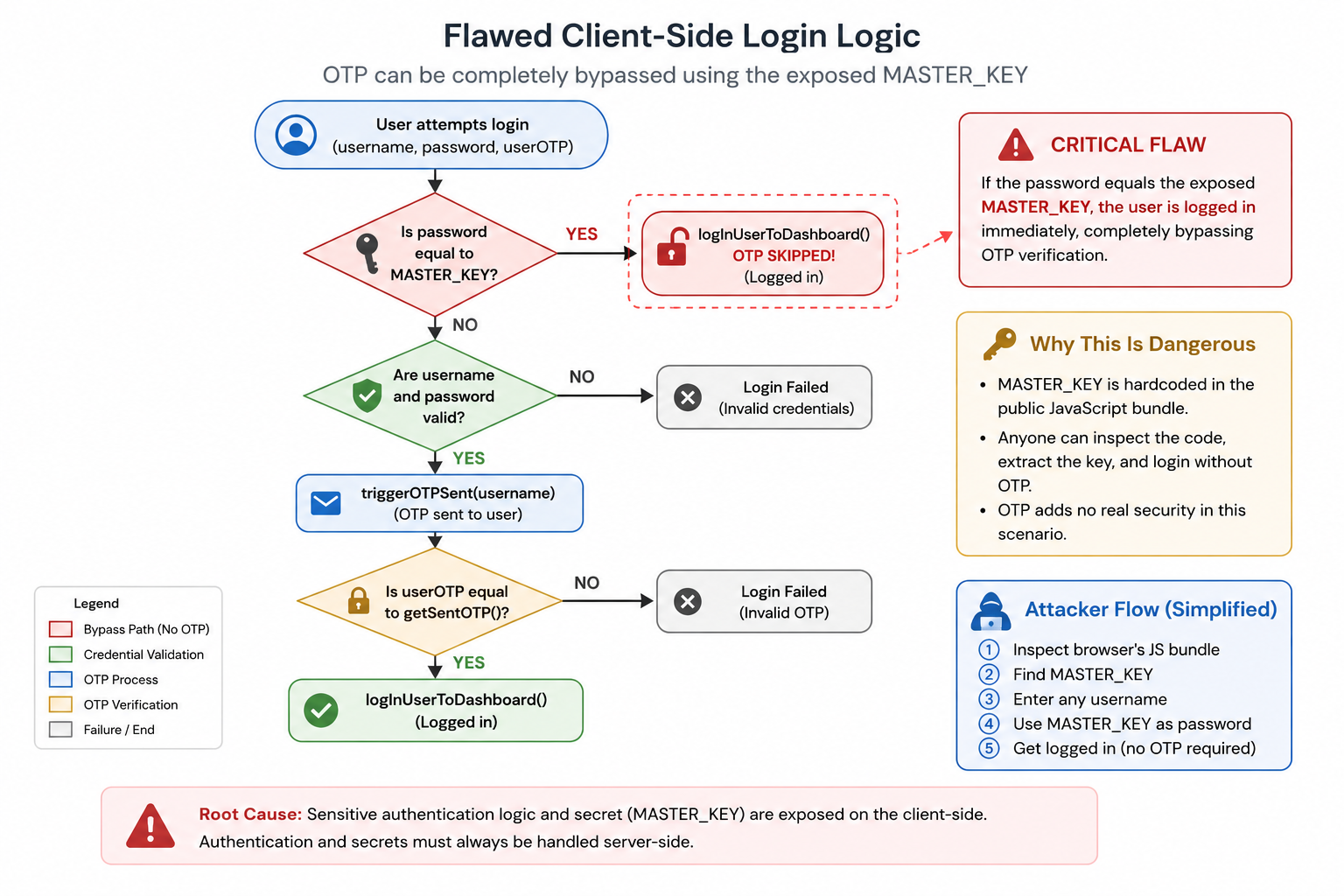
When backend programmers build large-scale applications, they often create “backdoors” or universal master keys during the early development phase. These master keys allow internal QA testers to jump into the system quickly without waiting for real SMS or email gateways to process verification codes thousands of times a day.
The critical failure occurs when developers forget to strip these testing bypasses out of the codebase before moving the site from a local development computer to live, public internet servers. Because the code processing this logic was sent directly to the client browser, it became public property the moment the site loaded.
The Broader Impact: External Service Providers as Weak LinksThis incident brings a critical question to the forefront of India’s rapid digital push: How secure are our third-party government tech vendors?
While the core internal infrastructure of organizations like CBSE might feature robust enterprise security protocols, those defenses are rendered useless if their external service vendors do not maintain identical standards. In this case, the vulnerability did not originate within CBSE’s direct internal network, but rather on the OnMark platform managed by an outsourced partner.
Comparative Cybersecurity Standards: In-House vs. Outsourced
| Operational Parameter | Direct Government Infrastructure | Third-Party Vendors & Providers |
| Security Auditing Frequency | Monitored regularly by national agencies like CERT-In. | Often self-audited or checked only during contract renewals. |
| Code Review Protocols | Multi-stage review cycles with strict deployment gates. | Fast-paced code updates that risk leaving debug features live. |
| Data Access Limits | Heavily restricted, requiring state-level permissions. | Broad access keys given to support staff and QA engineers. |
Moving forward, cyber specialists argue that public institutions must enforce strict, legally binding development guidelines on all software vendors. Every piece of external code interacting with sensitive citizen or student records must undergo rigorous black-box and white-box penetration testing before going live to prevent catastrophic exposures like the CBSE OSM portal hack.
The Vital Importance of Protecting White-Hat Ecosystems
The constructive resolution of this incident sets an encouraging precedent for the Indian tech community. All too often, independent security researchers who find flaws in public infrastructure are met with legal threats, harassment, or accusations of criminal hacking under sweeping IT laws.
By publicly thanking Adhikary and the wider “alert citizen” ecosystem, CBSE has demonstrated a mature approach to modern threat mitigation. Bug bounty programs and open lines of communication for vulnerability disclosure are standard practices among global tech giants like Google, Microsoft, and Apple. Bringing this collaborative philosophy to public sector platforms is an essential step in safeguarding national digital landscapes.
For now, CBSE insists that the immediate threat has been neutralized, and that student grading metrics remain completely accurate and uncompromised. As cybersecurity professionals continue to scan the OnMark database for any lingering architecture flaws, the tech community will undoubtedly keep a watchful eye on how the country’s premier educational body reinvents its digital safety standards.