
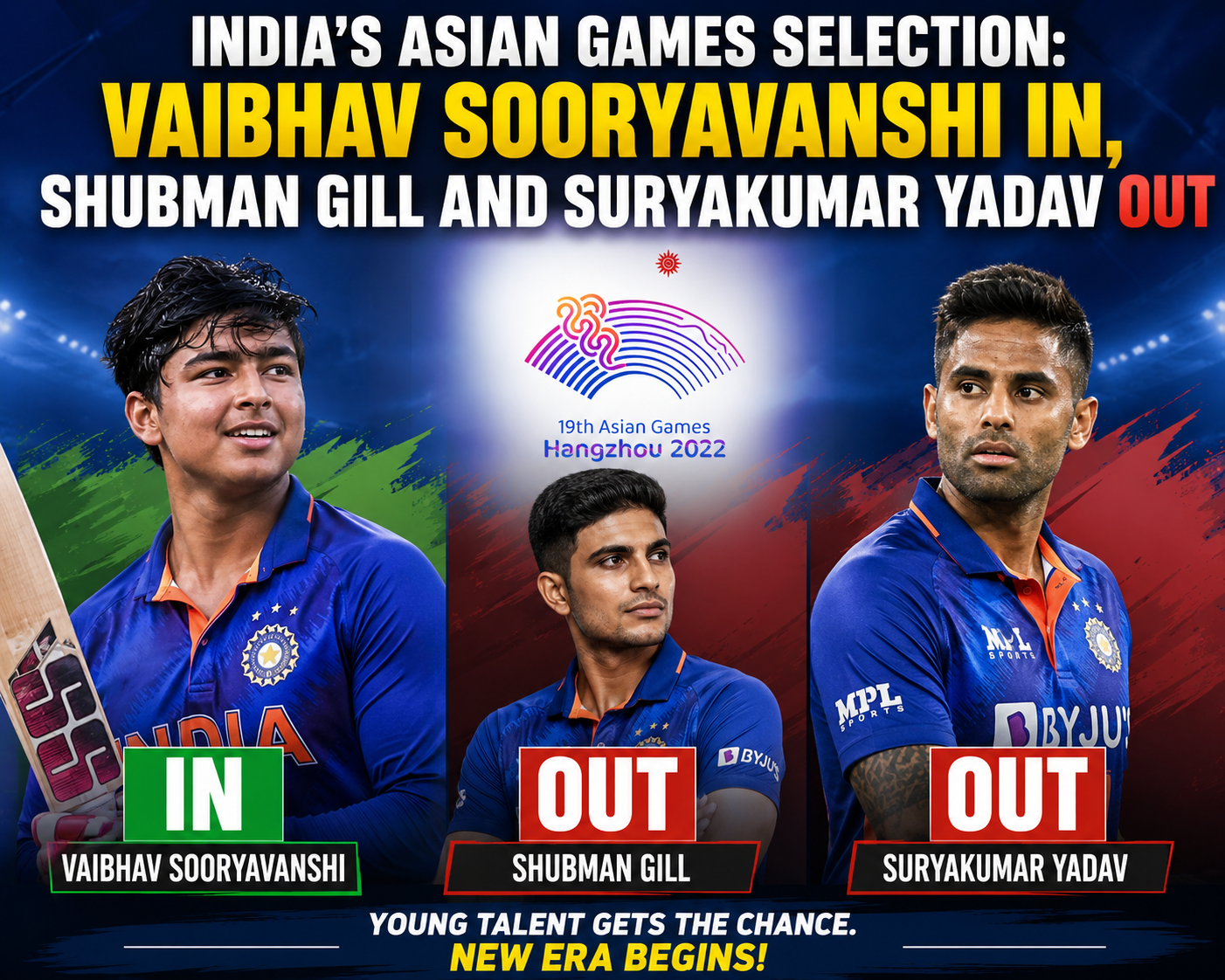
India’s Asian Games selection has sent shockwaves through the cricketing community, signaling a definitive shift in how the Board of Control for Cricket in India (BCCI) plans for the future. The board recently submitted a 30-strong longlist of men’s probables to the Indian Olympic Association (IOA) for the upcoming multi-sport event in Aichi-Nagoya. The roster reveals a fascinating blend of audacious youth promotion and cold, calculating veteran management.
At the heart of the announcement is the inclusion of teen batting sensation Vaibhav Sooryavanshi, whose meteoric rise now puts him on the absolute precipice of a senior international debut. Conversely, the high-profile absences of current T20I skipper Suryakumar Yadav and Test/ODI captain Shubman Gill underline a complex scheduling dilemma that has forced India to effectively split its elite talent pool into two distinct national squads.
The Strategic Conflict: A Tale of Two Squads
The root cause of this radical selection strategy is an unavoidable scheduling clash on the international cricket calendar. The men’s cricket event at the Asian Games is scheduled to run from September 24 to October 3. Meanwhile, India is locked into hosting a comprehensive home white-ball series against the West Indies, featuring three One Day Internationals (ODIs) and five T20 Internationals (T20Is) spanning from September 27 to October 17.
With the two tournaments overlapping significantly, the BCCI was left with no choice but to draft a massive pool of players to ensure both fronts are strongly defended.
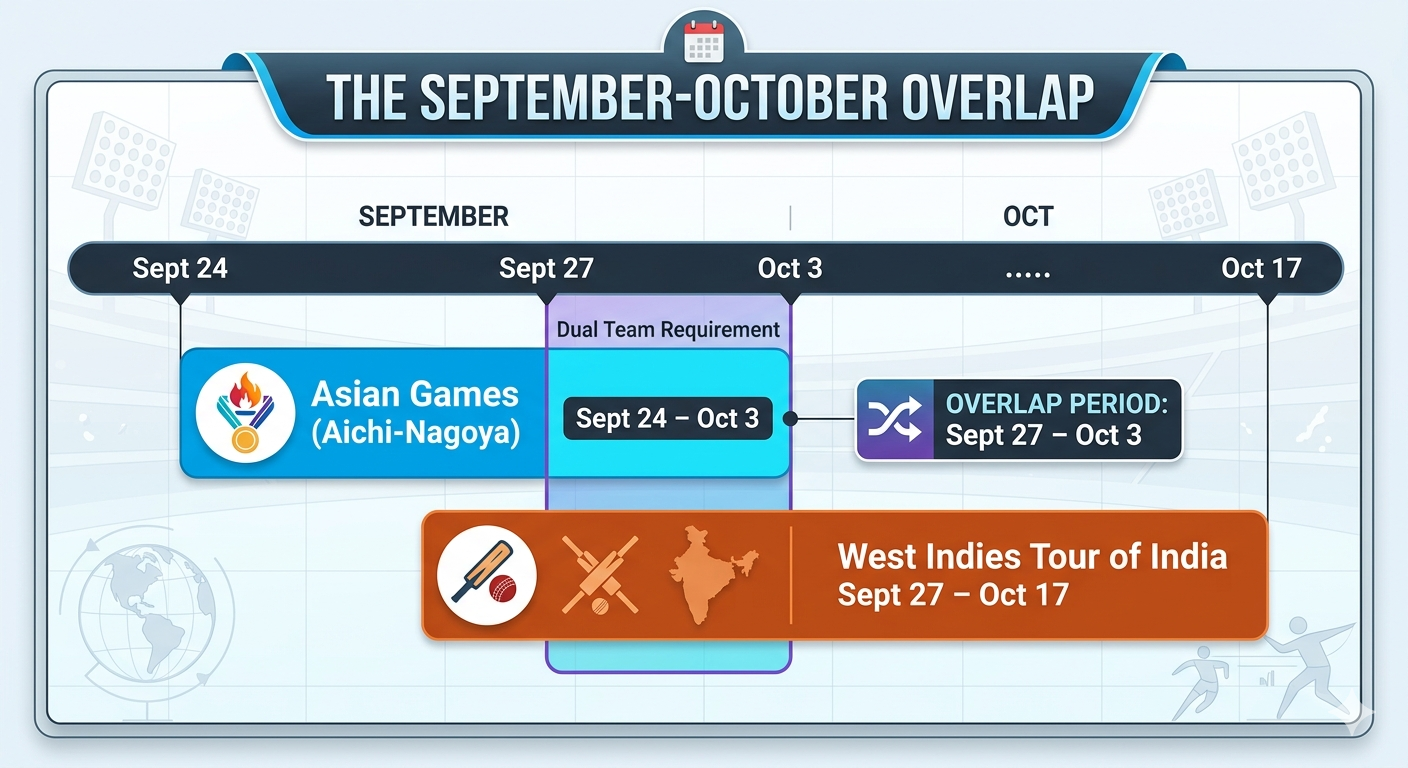
Because the home series against the West Indies holds critical ranking points and broadcast obligations, the selectors have had to balance preserving a world-class core for the bilateral matches while sending a deeply competitive, gold-medal-worthy contingent to Japan. This logistical jigsaw puzzle explains why the 30-man longlist features an intriguing mix of absolute superstars, returning veterans, and raw, unpolished youth.
The Rise of Vaibhav Sooryavanshi
For most casual cricket fans, the headline of India’s Asian Games selection is undoubtedly the inclusion of Vaibhav Sooryavanshi. The teenage prodigy has been tearing up age-group cricket and domestic tournaments with a maturity that belies his tender age. By placing him in the 30-man probables list, the selectors have handed him a golden ticket and a massive vote of confidence.
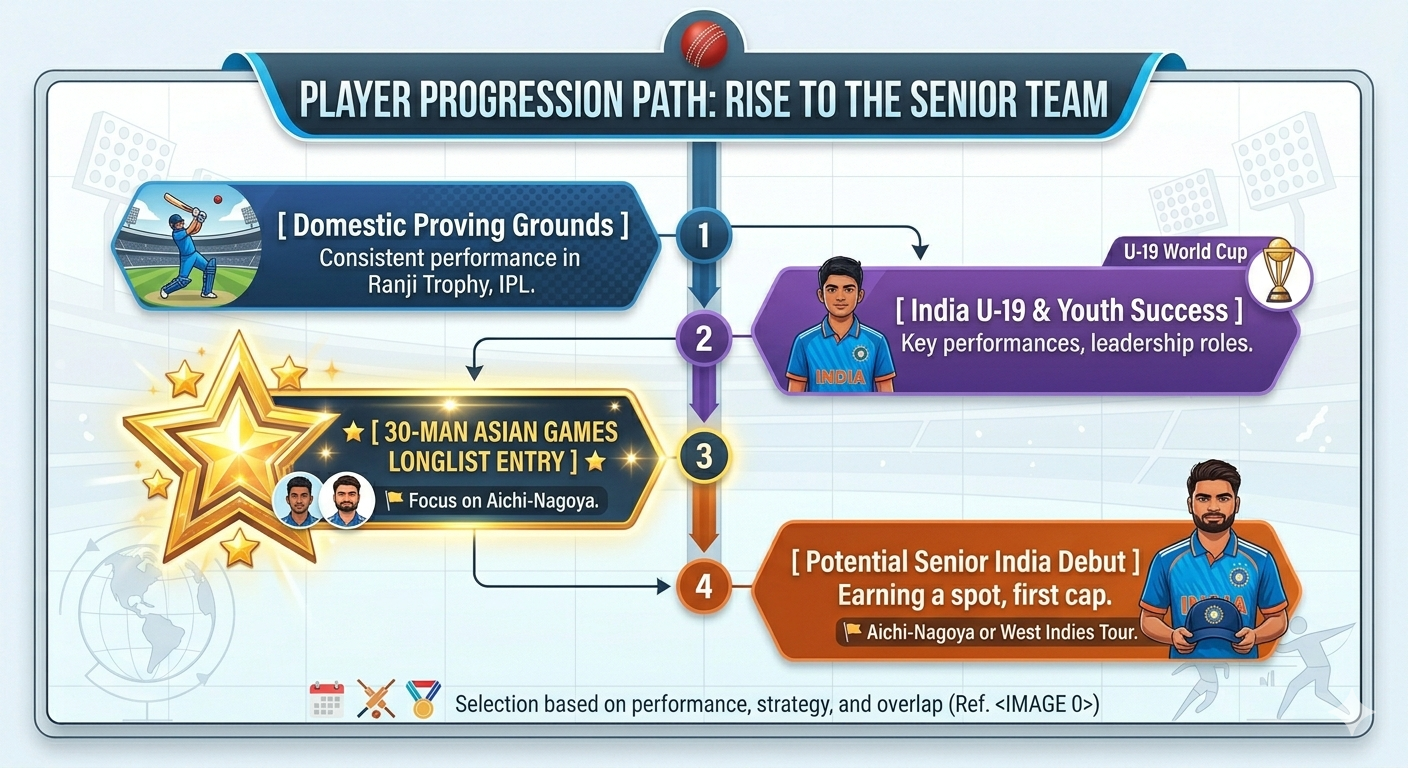
Sooryavanshi’s inclusion isn’t merely a token nod to the future; it is a calculated tactical move. The Asian Games pitches in Japan are expected to be somewhat unpredictable, requiring dynamic, fearless batsmen who can maximize the powerplay overs without carrying the psychological baggage of past international failures. Sooryavanshi represents the quintessential modern T20 batsman—unafraid, innovative, and possessing an incredibly high ceiling. If he makes the final cut, his debut will be one of the most highly anticipated events in recent Indian cricket history.
The Omission of Suryakumar Yadav and Shubman GillWhile youth is celebrated, the absence of two pillar figures of modern Indian cricket has raised eyebrows across the subcontinent. The omission of Shubman Gill and Suryakumar Yadav from the list reveals the long-term roadmap the BCCI is drawing up for the national side.
Why Shubman Gill is Missing
Shubman Gill’s absence is primarily a matter of workload management and format prioritization. As the designated leader of the ODI setup and a fundamental anchor of the Test team, Gill is expected to captain the side during the three-match ODI leg against the West Indies.
Because the ODIs against the Windies overlap directly with the business end of the Asian Games, it was physically impossible for Gill to be in two places at once. The selectors clearly view Gill’s leadership and batting stability as indispensable for the home bilateral series, where vital preparation for upcoming ICC events is on the line.
The Suryakumar Yadav Conundrum
The non-selection of Suryakumar Yadav, however, tells a far more dramatic story. Unlike Gill, who is being rested or preserved for the concurrent home series, reports suggest that Suryakumar Yadav is no longer in the larger scheme of things for India’s long-term T20 targets—specifically the 2028 Olympic Games in Los Angeles and the next edition of the T20 World Cup.
“It is understood that Suryakumar is no longer in the larger scheme of things as far as 2028 Olympic Games and the next T20 World Cup is concerned, and his name not featuring in the Asian Games longlist is a no-brainer.”
At his peak, Suryakumar has been the most destructive T20 batsman in the world. However, with an eye toward rebuilding a younger, more agile squad for the late 2020s, the management seems ready to transition away from the veteran dynamic batsman. His omission from the Asian Games longlist confirms that the selectors are ready to pass the torch to the next generation of middle-order enforcers.
India’s Asian Games Selection: The Captaincy Puzzle – Who Will Lead the Team in Japan?
With Gill and Suryakumar out of the equation for the Asian Games, the leadership mantle is completely up for grabs. Analyzing the 30-man longlist reveals three primary candidates who have the domestic pedigree, international experience, and tactical acumen to captain India on the Olympic stage.
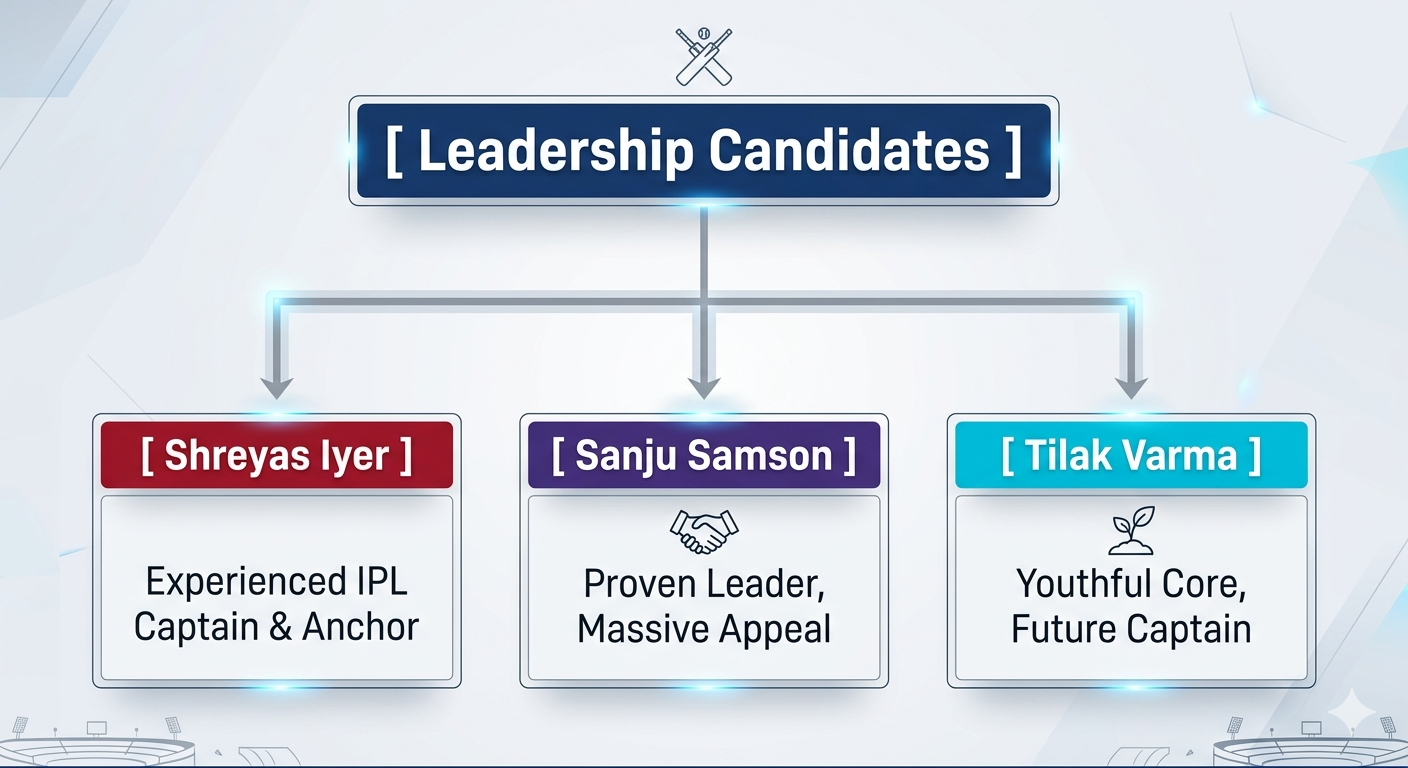
1. Shreyas Iyer
Iyer is perhaps the most seasoned captaincy option available in this pool. Having successfully led franchises in the Indian Premier League (IPL) to playoffs and finals, his tactical understanding of the T20 format is unquestioned. Furthermore, his ability to anchor an innings in the middle overs makes him a lock for the starting XI, providing a stable foundation from which he can command the field.
2. Sanju Samson
A fan favorite and an incredibly astute leader, Sanju Samson has earned immense respect for his captaincy style in domestic cricket and the IPL. Samson brings a calm, intuitive approach to captaincy, often empowering his bowlers and making bold, proactive field placements. His inclusion as a wicketkeeper-batsman adds immense balance to the squad, making him a frontrunner for the captaincy.
3. Tilak Varma
If the selectors decide to go down a completely youthful route, Tilak Varma represents the vanguard of the future. Though younger and less experienced in captaincy than Iyer or Samson, Varma has shown an incredibly mature head on his shoulders. Leading a young Indian side at the Asian Games could serve as a perfect grooming exercise for a player many pundits believe will be a future all-format captain for India.
Analyzing the 30-Man LonglistThe list submitted to the IOA is a fascinating study in squad depth. It features a mix of multi-format superstars, white-ball specialists, and fringe players looking to cement their spots in the national ecosystem.
The Complete 30-Man Probables Roster
Top-Order Batsmen: Yashasvi Jaiswal, Abhishek Sharma, Vaibhav Sooryavanshi, Ruturaj Gaikwad
Middle-Order / All-Rounders: Shreyas Iyer, Tilak Varma, Rinku Singh, Hardik Pandya, Nitish Kumar Reddy, Ayush Badoni, Shivam Dube, Anukul Roy, Shahbaz Ahmed
Wicketkeepers: Ishan Kishan, Sanju Samson, Rishabh Pant, Dhruv Jurel
Fast Bowlers: Jasprit Bumrah, Arshdeep Singh, Prasidh Krishna, Harshit Rana, Khaleel Ahmed, Yash Thakur
Spinners: Axar Patel, Kuldeep Yadav, Washington Sundar, Harsh Dubey, Varun Chakravarthy, Ravi Bishnoi, Vipraj Nigam
The Bowling Blueprint: Star Power and Injury ReturnsOne of the most stunning inclusions in India’s Asian Games selection longlist is the presence of premier fast bowler Jasprit Bumrah. On paper, Bumrah is the world’s most feared bowler across formats, and his inclusion in an Asian Games list shows how seriously India takes the prospect of continental glory.
However, cricket analysts expect that Bumrah’s true priority during this window will remain the ODI series against the West Indies, keeping the 2027 ICC Cricket World Cup in mind. His inclusion in the IOA list is likely a safety net, ensuring that if scheduling or tactical priorities shift, the spearhead remains available for selection.
Beyond Bumrah, the pace battery looks incredibly robust. Harshit Rana, who has been recovering from an injury layoff, is tracking to be fully fit by September. The selectors have kept him in the longlist alongside Prasidh Krishna and Arshdeep Singh. This blend of raw pace, left-arm angles, and bounce ensures that whichever squad travels to Japan will have enough firepower to dismantle any batting lineup in Asia.
The Spin Sensation: A Four-Way BattleSpin bowling will undoubtedly play a massive role in the Asian Games, given the turning tracks often encountered in late-summer Asian tournaments. The selectors have named four premier slow bowlers in the longlist:
Kuldeep Yadav (Left-arm wrist spin)
Axar Patel (Left-arm orthodox)
Washington Sundar (Off-spin / All-rounder)
Harsh Dubey (Domestic standout)
The strategy here is transparent: the four spinners will be split evenly between the two concurrent assignments.
Two of these premium spinners will be tasked with leading the bowling attack at the Asian Games, while the other two will remain at home to tackle the West Indies batsmen on Indian turning tracks. This ensures that neither squad is left short of elite spin options, maintaining India’s traditional strength in the slow-bowling department across both venues.
The Surprise Inclusion: Ruturaj Gaikwad’s Life-LinePerhaps the most polarizing name on the 30-man list is Ruturaj Gaikwad. Gaikwad was the celebrated captain who led the Indian men’s team to a historic gold medal at the Hangzhou Asian Games. However, his recent international form has been under immense scrutiny, with critics labeling him a prominent non-performer in recent national assignments.
Despite his recent struggles to cement a permanent spot in the premier T20I playing eleven, the selectors have opted to honor his past continental success by including him in the longlist.
Gaikwad’s experience in navigating the unique pressures of an Olympic-style village and tournament structure likely played a massive role in his inclusion. For Gaikwad, this selection serves as a vital lifeline—a golden opportunity to silence his critics, rediscover his fluent run-scoring form, and prove that his leadership at Hangzhou was no fluke.
Tactical Implications: The Future of Indian T20 Cricket
When we look at the macro picture of India’s Asian Games selection, it becomes obvious that the BCCI is using this unique logistical challenge to accelerate a comprehensive reset of its T20 philosophy. By systematically moving away from established veterans like Suryakumar Yadav and actively blooding generational talents like Vaibhav Sooryavanshi, the national selectors are building a blueprint for an incredibly aggressive, highly athletic T20 side.
The presence of explosive, modern all-rounders like Abhishek Sharma, Nitish Kumar Reddy, and Rinku Singh alongside pure young stroke-makers demonstrates a conscious effort to build a batting lineup that can score at an astronomical strike rate from ball one. The Asian Games will serve as a high-stakes laboratory where these young players can test their mettle under intense pressure, effectively auditioning for permanent spots in the premier white-ball squads of the future.
The Logistics of Running Dual International SquadsOperating two separate international cricket teams simultaneously is a monumental administrative and coaching feat that few cricket boards in the world can pull off. The BCCI, with its immense financial resources and vast talent pool developed through years of robust domestic cricket and the IPL, is uniquely positioned to achieve this.
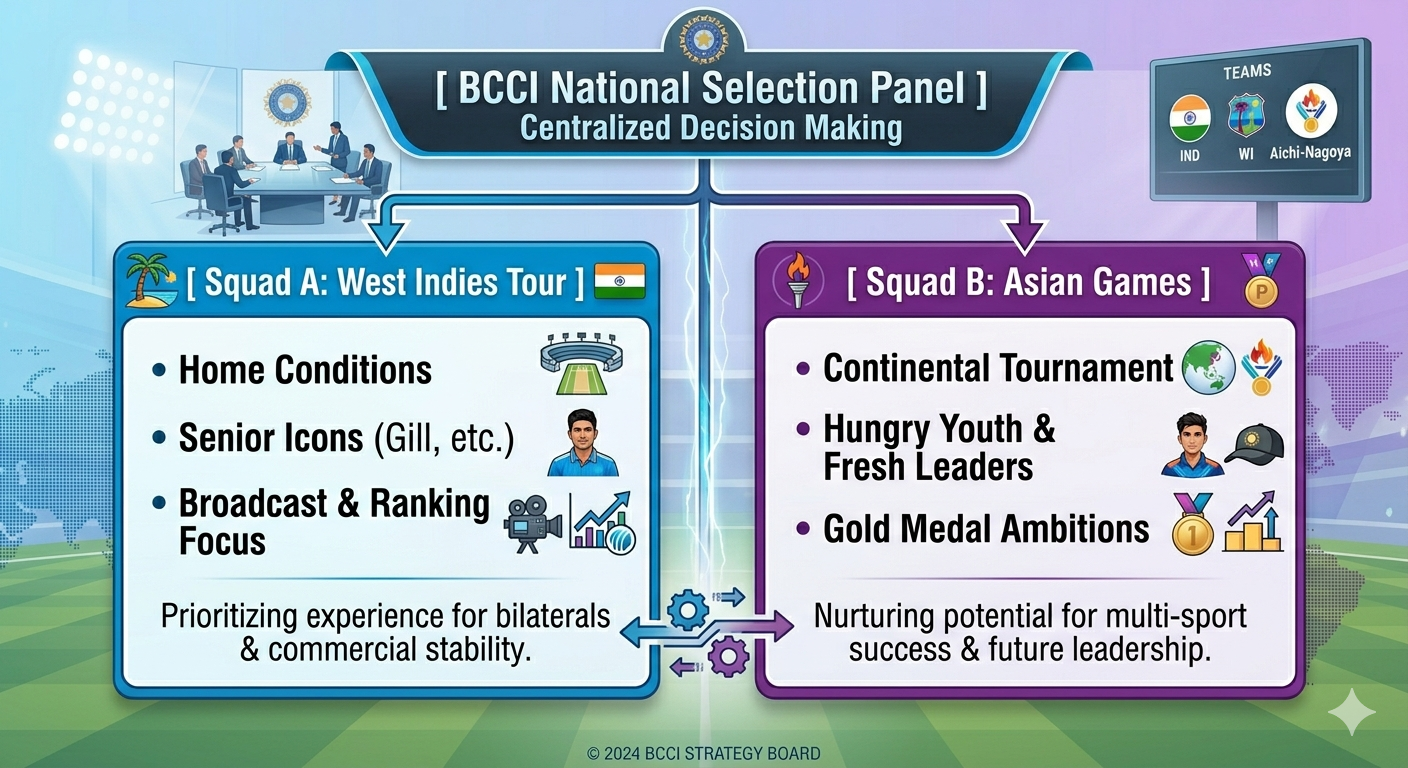
This dual-squad system requires distinct coaching staffs, independent medical teams, and separate logistical planners. While the main coaching staff manages the high-profile home series against the West Indies, a secondary, highly competent coaching group—often drawn from the National Cricket Academy (NCA)—will accompany the young squad to Aichi-Nagoya. This structure ensures that the young players receive elite-level guidance and tactical support as they chase an Olympic-style podium finish.
Conclusion: A High-Stakes Gametime for Indian Cricket
The unveiling of the 30-man probables list for the Asian Games represents a defining moment for Indian cricket. It manages to balance the realities of a grueling international schedule with a bold, visionary look toward the future.
While fans will undoubtedly miss watching the explosive exploits of Suryakumar Yadav and the elegant strokeplay of Shubman Gill on the continental stage, the prospect of seeing young dynamo Vaibhav Sooryavanshi don the national colors provides an electric narrative that will captivate millions.
Ultimately, this selection cycle isn’t just about winning a gold medal in Japan or defeating the West Indies at home; it is a showcase of India’s terrifying cricketing depth. By fielding two independent squads capable of beating any international team in the world, India is sending a clear message to the cricketing globe: the conveyor belt of elite talent is moving faster than ever, and the future of Indian cricket is already here.