
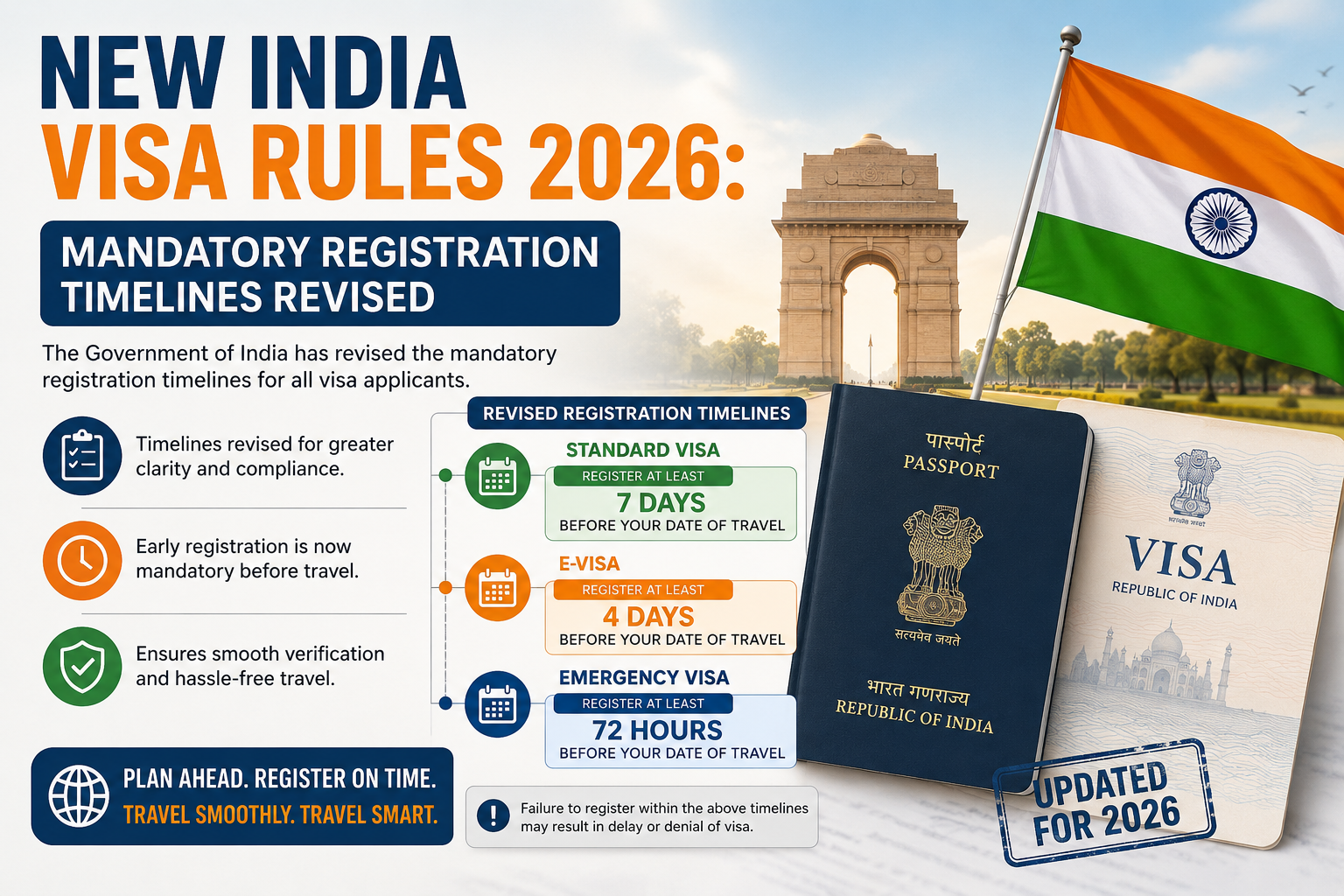
New India Visa Rules 2026 government has officially overhauled its immigration policies, marking a significant shift in how foreign nationals must manage their stay within the country. Under the newly notified Immigration and Foreigners Rules, 2025, the Union Home Ministry has tightened the deadlines for visa extensions while simultaneously offering targeted administrative relief for multicultural families.
For global travelers, expatriates, and medical institutions operating within India, these updates change long-standing bureaucratic timelines. The core objective of the amendment is clear: strengthening oversight of foreign nationals residing in India, streamlining immigration monitoring procedures, and eliminating the grace periods that previously existed.
The Shift in Foreigner Registration Deadlines
For years, foreign nationals navigating the Indian immigration system operated under a relatively predictable buffer system. If a traveler arrived on a short-term visa and decided they needed to extend their stay past the standard 180 days, the law provided a two-week safety net.
The historical framework allowed individuals to initiate and complete their formal registration within 14 days after their initial 180-day stay had already lapsed.
OLD RULE: [ 180 Days Stay ] ---> |Visa Expires| ---> [ 14-Day Grace Period to Register ]
NEW RULE: [ Register ANY TIME Before Day 180 ] ---> |Visa Expires| ---> No Grace Period
The Union Home Ministry’s latest notification completely abolishes this grace period. According to the gazette notification published on June 1, 2026, Rule 12 of the Immigration and Foreigners Rules, 2025, has been explicitly amended. The phrase requiring registration “within fourteen days after the expiry of one hundred and eighty days of his arrival in India” has been permanently deleted. It is replaced with the strict mandate that registration must occur “any time before the expiry of the said period of one hundred and eighty days.”
This advancement of the deadline shifts the responsibility entirely onto the visa holder. Waiting until your visa timeline runs out is no longer a legally viable option; applications must be active and processed before the 180th day of arrival.
Strict Realities for Long-Term Visa Holders
The amendment introduces an even more rigorous standard for individuals holding long-term visas that feature specific stay stipulations. Many business, tourist, or entry visas are granted for multiple years but carry an explicit rider: “each stay shall not exceed 180 days.”
Previously, navigating this clause involved a mix of short exits (often referred to as “visa runs” to neighboring countries) or applying for local extensions under standard administrative tracks. The 2025 rules firmly close these loopholes for those who wish to extend their stay continuously or cumulatively without leaving:
The Cumulative Cap: If a foreigner intends to remain in India beyond the 180-day limit on any single occasion—or in the aggregate across a single calendar year—they must register before that 180-day limit expires.
The “Emergent Circumstances” Barrier: In what is perhaps the most critical policy tightening within this notification, the government has clarified that registration and extension under these specific conditions will now be granted “only in emergent circumstances.”
What constitutes an emergent circumstance? While the text does not exhaustively define every scenario, historical immigration precedents in India suggest this track will be reserved strictly for documented medical crises, sudden natural disasters, or diplomatic emergencies. Routine business delays or personal travel preferences will no longer suffice.
New India Visa Rules 2026: Streamlining Mixed-Citizenship Birth Reporting
While the registration timelines have become significantly more stringent, the revised rules offer a compassionate and logical administrative reprieve for international families living in India.
The Previous Bureaucratic Hurdle
Under the older legal framework, if a child was born in India and either one or both of the parents were foreign nationals, a strict 30-day countdown began. The parents were legally required to electronically intimate the registration officer via the government’s designated online portal or mobile application within 30 days of birth. Failing to do so blocked access to critical visa-related services, such as obtaining a new visa for the newborn or securing essential exit permissions to travel abroad.
This rule applied indiscriminately, even if one of the parents was a born-and-raised Indian citizen who intended for their child to hold Indian citizenship.
The New Exemption
The 2025 amendment permanently fixes this bureaucratic overlap. The updated sub-rule explicitly states that this mandatory 30-day notification does not apply if one of the parents is an Indian citizen and that parent wishes to retain the Indian citizenship of the child.
| Scenario | Parentage | Intended Child Citizenship | 30-Day Reporting Required? |
| Scenario A | Both parents are Foreign Nationals | Foreign Citizenship | Yes (Via online portal/app) |
| Scenario B | One Parent Indian, One Foreign | Indian Citizenship | No (Exempt under new rules) |
| Scenario C | One Parent Indian, One Foreign | Foreign Citizenship (Later Stage) | Yes (Within 30 days of acquisition) |
This change cuts down on unnecessary paperwork for mixed-citizenship couples raising children within India, ensuring that families aren’t penalized under immigration laws for simply exercising the child’s natural right to Indian citizenship.
The Delayed Foreign Citizenship Clause
However, the government has maintained a crucial safeguard regarding dual citizenship, which India generally does not permit. If a child born to a mixed-citizenship couple initially retains their Indian status but later acquires the citizenship of a foreign country while still residing in India, a new clock begins.
In this event, either of the parents must formally intimate the registration officer within 30 days of the child acquiring that foreign citizenship. This ensures the Bureau of Immigration maintains an unbroken record of the legal status of all foreign passport holders residing within domestic borders.
Updated Compliance Protocols for Medical InstitutionsThe final major component of the Union Home Ministry’s notification targets the administrative ecosystem surrounding medical tourism and international healthcare hospitality. India has grown into a major global hub for complex medical procedures, drawing hundreds of thousands of international patients annually.
The updated Immigration and Foreigners Rules, 2025, introduce revised reporting requirements and administrative procedures for:
Hospitals
Nursing Homes
Specialized Medical Centers
Any institution providing medical treatment alongside lodging or sleeping facilities on their premises.
While the core medical responsibilities of these institutions remain unchanged, their compliance obligations have been modernized. Medical facilities hosting foreign nationals for long-term treatments must now strictly align their internal reporting with the advanced registration timelines.
If an international patient’s treatment plan unexpectedly extends beyond the 180-day mark, the hospital administration and the patient can no longer rely on the historical 14-day grace period to sort out paperwork. They must proactively flag and file for registration well before the 180 days conclude, backed by documented medical necessity to prove the “emergent circumstances” now required by law.
Practical Action Plan for Foreign Nationals in India
To ensure complete compliance with the updated legal framework and prevent unexpected legal friction or deportation risks, foreign travelers, expats, and institutional stakeholders should adopt the following operational strategies:
1. Audit Your Arrival Calendar Immediately
Do not rely on the expiration date printed on a visa sticker if your visa contains a duration of stay restriction (e.g., “each stay not to exceed 180 days”). Count your days manually from the exact date stamped on your passport at immigration entry. Set institutional alerts or personal reminders at the 120-day mark to evaluate whether an extension will be necessary.
2. Compile Evidence for “Emergent” Claims Early
Because extensions for specific visa types are now restricted to emergency scenarios, assembling a comprehensive documentation trail is critical. If your extension relies on medical treatments, ensure that hospital certificates, expert prognoses, and institutional compliance forms are signed, stamped, and ready for submission weeks before your 180 days lapse.
3. Leverage Digital Platforms Proactively
The Union Home Ministry continues to process these updates through centralized digital portals. Ensure that all digital applications are submitted well in advance. Under the new rules, a pending application submitted after the 180 days have lapsed will likely be treated as an overstay, exposing the individual to financial penalties, visa blacklisting, or legal prosecution.
Final Thoughts
The overhaul of the Immigration and Foreigners Rules represents India’s transition toward a more tightly monitored, digitally integrated immigration system. By advancing registration deadlines and limiting long-term stay extensions to genuine emergencies, the government is prioritizing national security and rigorous tracking. Conversely, the thoughtful exemptions provided to mixed-citizenship families demonstrate an effort to balance strict border enforcement with practical, humane administrative relief.
Whether you are an expatriate living in India, a business traveler on a long-term multi-entry visa, or a healthcare administrator managing international patients, staying ahead of these revised timelines is no longer just a recommendation—it is a strict legal necessity.