
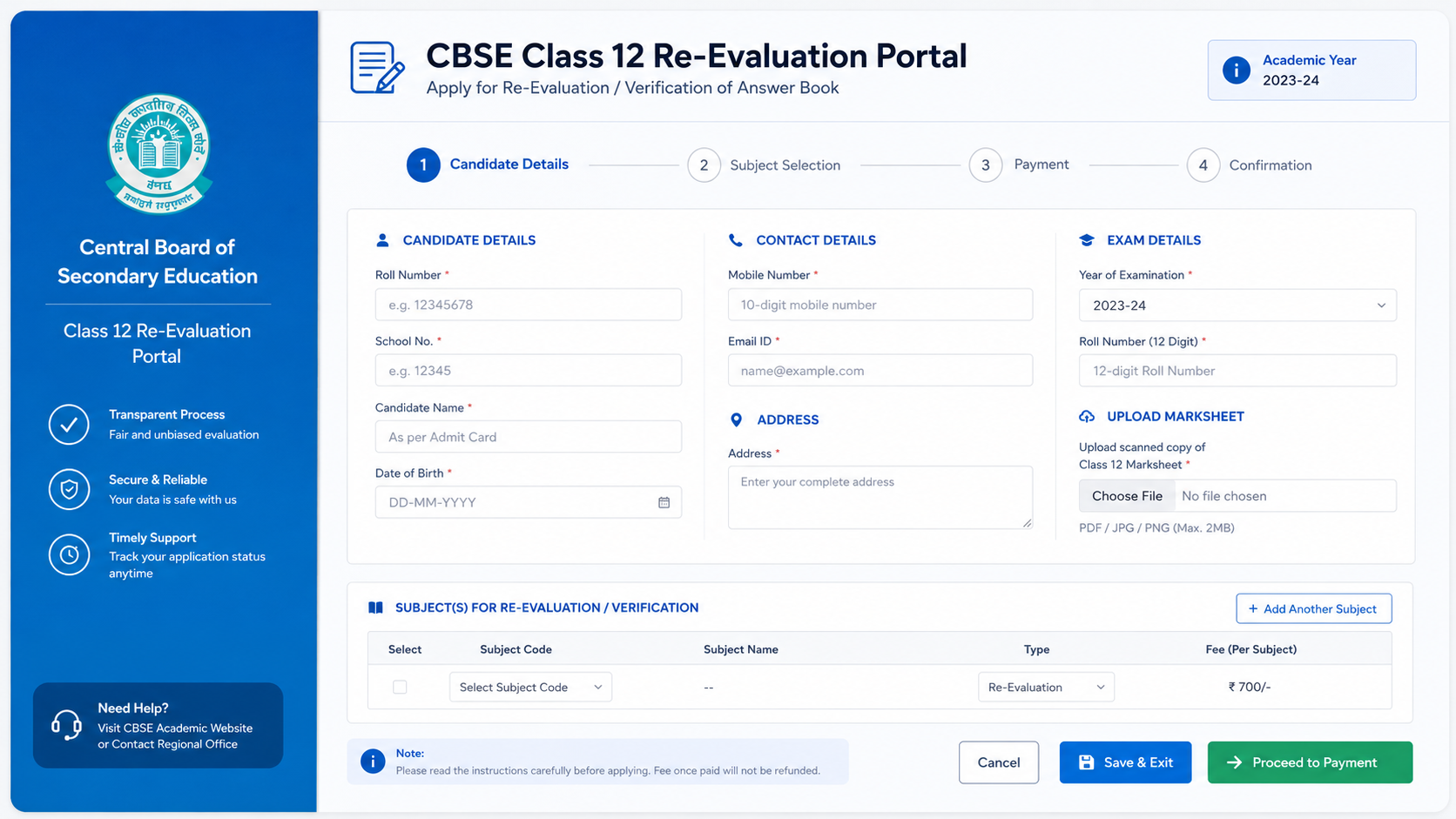
The CBSE Class 12 Re-Evaluation system is officially live, marking a critical post-examination phase for hundreds of thousands of senior secondary students across India and abroad. Following weeks of intense anticipation and a brief technical delay, the Central Board of Secondary Education (CBSE) activated its online application portal in the early morning hours of Tuesday, June 2, 2026. This digital avenue allows students who are dissatisfied with their initial board exam results to formally request a thorough review of their answer scripts.
The announcement, which dropped via the board’s official X (formerly Twitter) handle, brings massive relief to students looking to secure every single mark they have rightfully earned. For high school graduates eyeing competitive university admissions where fractions of a percent can alter cut-offs, this re-evaluation process is nothing short of a high-stakes lifeline.
The Midnight Launch: Overcoming the Initial 24-Hour Delay
According to the board’s original administrative timeline, the digital application window for marks verification was slated to go live on Monday, June 1, 2026. However, as the day progressed, thousands of anxious students, parents, and school administrators refreshing the official portal were met with server errors and inactive hyperlinks.
Social media platforms, particularly X, were flooded with complaints throughout Monday afternoon and evening. Many users reported that they were completely unable to log into the portal, while others encountered timeout errors during the initial registration phase
[Student Complaint on X – June 1]
“Trying to log into the CBSE verification portal since 2:00 PM. The page keeps crashing, and it says ‘Server under maintenance’. Please extend the deadline as we are losing crucial time!”
Responding to the growing anxiety among the student community, technical teams worked overnight to stabilize the database infrastructure. In a public update shared during the early hours of Tuesday, June 2, CBSE confirmed that the technical snags had been fully resolved and that the portal was operational. The board acknowledged the delay implicitly by providing immediate, real-time access to the application dashboards, alongside an explanatory video tutorial designed to streamline the user experience.
The Three-Tiered Structure of the CBSE Class 12 Re-Evaluation Process
A common misconception among students is that “re-evaluation” is a single, direct step. In reality, the Central Board of Secondary Education operates a strict, sequential three-stage protocol. Students cannot skip stages; each tier acts as a mandatory prerequisite for the next.
Understanding this hierarchy is vital to ensuring that your application is not rejected on technical grounds.
             STAGE 1: Verification of Marks
   (Mathematical checking of totals and unchecked text)
                            v

       STAGE 2: Obtaining Scanned Answer Sheets
     (Reviewing actual images of evaluated pages)

                            |
                            v

              STAGE 3: Final Re-Evaluation
     (Challenging specific answers on a per-mark basis)
Stage 1: Verification of Marks (The Base Level)
In this introductory stage, the board does not re-assess the quality of your answers. Instead, an independent examiner reviews your physical or digital answer booklet to ensure:
All questions answered by the student have been assigned a mark.
There are no computational errors in aggregating the marks from individual questions to the front cover sheet.
The marks uploaded into the central CBSE database match the marks written on the physical answer sheet.
Stage 2: Requesting Scanned Copies of Answer Sheets
If a student undergoes Stage 1 and still believes their performance deserves a higher score, they must apply to receive a scanned, photographic PDF copy of their evaluated answer booklet. This stage gives students transparency, allowing them to see exactly how individual questions were graded, where marks were deducted, and whether the examiner adhered to the official CBSE marking scheme.
Stage 3: Actual Re-Evaluation (The Final Challenge)
Once the scanned answer sheet is in hand, if a student finds that a specific answer was evaluated incorrectly according to the official marking keys, they can lodge an online appeal for Stage 3. Here, specific questions are re-checked by a senior subject expert. This is the only stage where the qualitative distribution of marks can be modified.
Step-by-Step Guide: How to Apply via the Official Portal
To minimize human error and prevent invalid submissions, CBSE released an exhaustive video walkthrough on its social channels. Below is an itemized breakdown of how candidates can seamlessly submit their applications online:
Visit the Official Website: Navigate to the main portal via
cbse.gov.inand select the “Pariksha Sangam” or “Main Website” tab. Look for the active link titled “Online Application for Verification of Marks/Obtaining Photocopy/Re-Evaluation – 2026”.Authentication and Login: Enter your unique credentials, which include your Roll Number, 5-digit School Number, and Center Number (as printed on your Class 12 Admit Card).
Select the Subjects: The system will display a list of all subjects you appeared for. Carefully tick the checkboxes next to the specific subjects you want verified. Note: You can only apply once; you cannot add more subjects later.
Fill Out Contact Details: Provide an active email address and working mobile number. The board will use these channels to send status updates, OTPs, and confirmation slips.
Fee Payment Gateways: Proceed to the integrated online payment portal. Payments can be processed via Net Banking, Debit/Credit Cards, or verified UPI applications.
Save the Confirmation Page: Once the payment is marked successful, the system will generate an application receipt containing an Application Number. Save this safely; it is required to check your final status.
Fee Structure and Hidden Costs to Keep in Mind
The re-evaluation process requires meticulous financial planning, as fees are collected on a per-subject and per-question basis. For students planning to challenge multiple papers, the total expenditure can quickly accumulate.
Based on institutional guidelines from previous academic cycles and current operational briefs, here is the projected cost breakdown for the Class 12 review process:
| Process Stage | Applicable Fee (INR) | Scope of Payment |
| Stage 1: Verification of Marks | ₹500 | Per Subject |
| Stage 2: Photocopy of Answer Script | ₹700 | Per Book / Per Subject |
| Stage 3: Detailed Re-Evaluation | ₹100 | Per Individual Question |
The Financial Risk Factor
It is important to remember that all processing fees are completely non-refundable, regardless of whether your marks increase, decrease, or remain exactly the same. For example, if a student challenges 5 questions in Chemistry during Stage 3, the cost will be:
Critical Timelines and Strict DeadlinesCBSE enforces an unyielding schedule regarding its re-evaluation windows. Because the board must process these requests quickly to help students meet university admission deadlines, the portals remain open for only a very limited number of days.
Marks Verification Window: Usually open for 4 to 5 days from the activation date (Closing tentatively by the end of the week).
Photocopy Application Window: Typically opens 10 to 12 days after the verification results are declared, remaining active for just 48 hours.
Re-Evaluation Window: Opens within 3 to 4 days after the distribution of scanned copies, lasting for a strict 2-day period.
Crucial Warning: No offline applications, speed posts, or manual letters addressed to the CBSE regional offices will be accepted under any circumstances. Missing the online deadline means forfeiting the chance to challenge your results.
Psychological and Academic Risks: The “Marks Decrease” Reality
While most students enter the re-evaluation process expecting their marks to go up, there is an inherent risk that every candidate must understand: Your marks can drop.
When you sign the digital undertaking during the application process, you agree to accept the final outcome, whatever it may be. If an independent examiner reviews your paper and finds that the initial teacher was overly generous, your score will be lowered.
Scenario Analysis: The Double-Edged Sword Initial Score: 88/100 After Verification/Re-evaluation: 84/100 Result: The student’s official marksheet will be updated to 84, and the older 88 mark sheet will become legally invalid.
When is it worth the gamble?
University Cut-Off Margins: If you are missing a seat at a premier institution (like Delhi University or a top-tier engineering college) by just 1 or 2 marks, the risk is often worth taking.
Objective Marking Discrepancies: If you are entirely certain that your answers for objective sections (like multiple-choice questions or math derivations) matched the textbook precisely but were marked wrong, re-evaluation is highly recommended.
The Borderline Fail Case: If a student has failed a subject by a margin of 1 to 3 marks, applying for verification is a smart move, as minor counting errors might be uncovered that cross them over into passing territory.
How Universities and Higher Education Institutions Handle Updated Marksheets
A common question among high school graduates is how colleges handle admissions when a student’s marks change after the initial cutoff lists are published.
By law and UGC guidelines, Indian universities must accommodate students whose marks increase through the official CBSE re-evaluation process. Once your revised score is uploaded to the central database, CBSE issues a fresh, digitally verified marksheet via DigiLocker, followed by a physical copy sent through your respective school.
If your marks improve significantly, you can present your updated DigiLocker certificate to your target university’s admissions office. If your new score meets a previously closed cut-off, the college is required to offer you a seat, provided vacancies exist or supernumerary provisions apply.
Final Checklist for Candidates Ahead of Submission
Before clicking that final “Submit and Pay” button on the portal, double-check that you have taken care of the following details:
[ ] Cross-verify Code Numbers: Ensure the subject code (e.g., Physics-042, Mathematics-041) exactly matches the paper you want reviewed.
[ ] Review Financial Balances: Make sure your bank account or UPI wallet has sufficient limits to handle transaction failures, as a failed payment with a deducted balance can take up to 7 business days to reverse, causing you to miss the deadline.
[ ] Consult Subject Teachers: Show your question paper and your estimated answers to your school teachers before applying for scanned copies. Their professional guidance can save you money and protect you from unnecessary mark deductions.
[ ] Download the Official Video Guide: Watch the step-by-step video tutorial posted on the CBSE X account to avoid clicking the wrong link or entering incorrect parameters.
For immediate support, students can reach out to the official CBSE helpline numbers listed under the “Contact Us” tab on the main website or contact their respective school administration offices to clear up any lingering doubts. Keep a close eye on cbse.gov.in for the latest updates on when the results for the Stage 1 verification will start trickling in.