
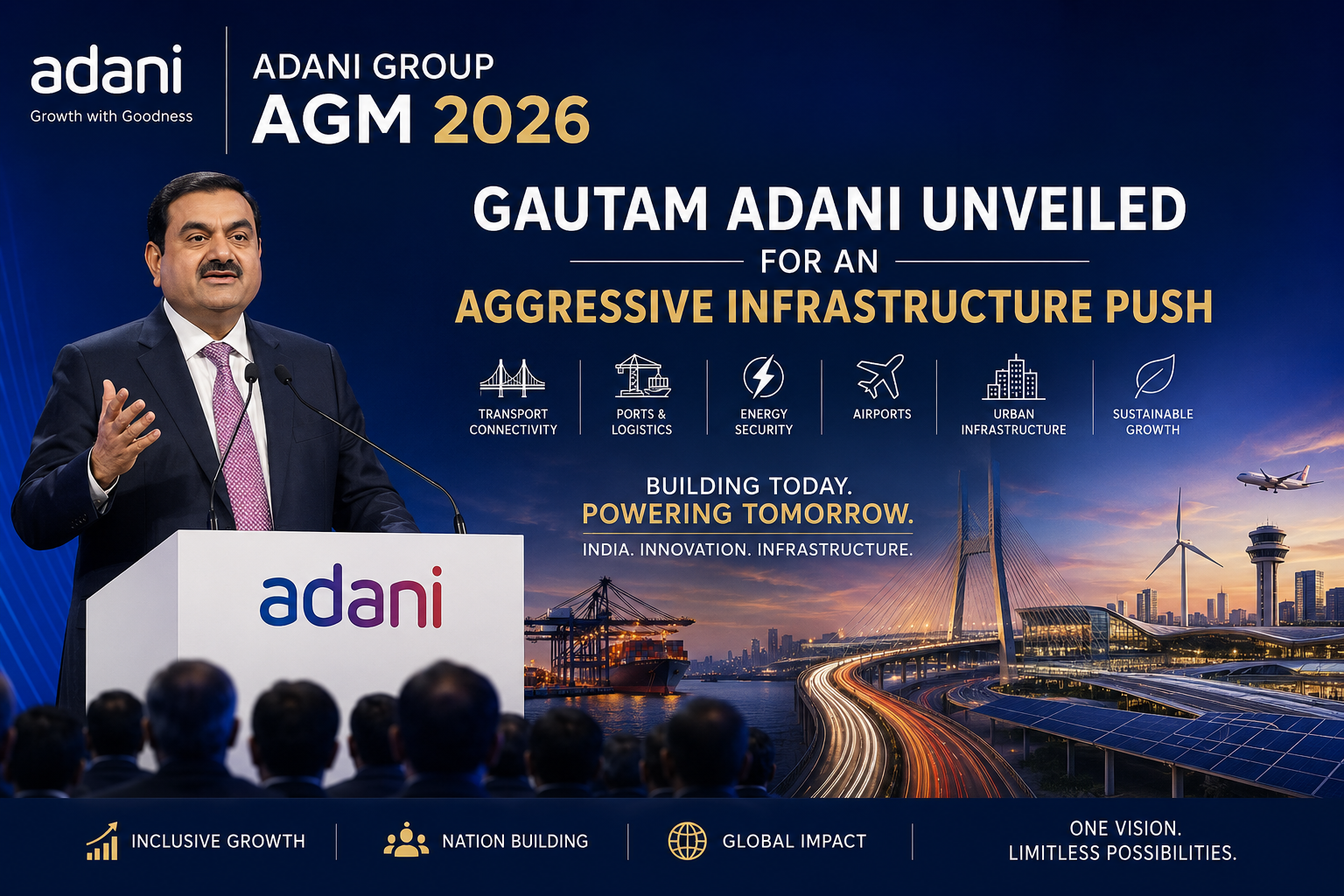
At the highly anticipated Adani Group AGM 2026, Chairman Gautam Adani corporate titan delivered a definitive blueprint for the conglomerate’s next decade of growth. Addressing the shareholders of Adani Enterprises Limited (AEL) during its 34th Annual General Meeting on Wednesday, June 24, 2026, Adani mapped out a massive roadmap centered on what he called the “twin engines” of modern economic muscle: physical hard infrastructure and cutting-edge digital intelligence.
The meeting, which is the first of seven distinct group AGMs scheduled to take place through June 26, highlighted an aggressive capital expenditure strategy that firmly positions the conglomerate as a primary driver of India’s national development goals and long-term energy security. From massive investments in nuclear energy and data centers to a sweeping operational restructuring that shifts non-core activities to Global Capacity Centres (GCCs), the announcements signal a bold operational and structural evolution.
The Visionary Shift: Three Foundational Pillars for the Next Decade
To ensure the conglomerate can smoothly execute its aggressive long-term strategy without becoming bogged down by operational inefficiencies, Gautam Adani revealed three fundamental structural steps. The core objective is clear: streamline the organizational framework, optimize capital allocation, and focus strictly on high-impact, mega-scale projects.
1. Outsourcing and Migration to GCCs
In a significant organizational shift, the Adani Group plans to systematically outsource its non-core corporate activities or transition them entirely into dedicated Global Capacity Centres (GCCs). By moving routine administrative, transactional, and IT support services to specialized GCCs or trusted third-party vendors, the group’s core leadership teams can dedicate their absolute attention to executing massive, capital-intensive infrastructure projects. This structure is designed to build a highly agile corporate hierarchy capable of rapid decision-making.
2. Building a 3 GW Data Centre Platform
On the digital intelligence front, the group is rapidly accelerating its footprint by developing a massive 3 Gigawatt (GW) data center platform. This vertical bridges the gap between heavy industrial capacity and modern artificial intelligence workloads. As India’s digital economy explodes, these data centers will provide the essential computing backbone, powered increasingly by the group’s own green energy corridors.
3. Entering the Nuclear Energy Frontier with a 10 GW Blueprint
Perhaps the most surprising and strategically vital announcement was the group’s official entry into the nuclear power sector. Adani announced a foundational plan to build a 10 GW nuclear energy capacity. This initiative marks a crucial diversification of their green energy portfolio, complementing their existing solar and wind dominance. Nuclear energy provides a reliable, round-the-clock baseload clean power supply, which is critical for running high-consumption industries and the massive 3 GW data center networks currently under construction.
Financial Muscle: Breaking Down the FY26 Performance Numbers
The scale of the group’s project pipeline is fully backed by an exceptionally strong balance sheet. During the session, Gautam Adani shared audited financial performance highlights for the financial year 2025–26 (FY26), demonstrating highly stable growth and disciplined debt management.
| Financial Metric | FY26 Performance Figures | Year-on-Year (YoY) Growth / Status |
| Consolidated Revenue | ₹2,92,000 Crore | Up 7.4% |
| EBITDA | ₹94,834 Crore | Highly Stable Operating Cash Flow |
| Net Profit | ₹46,376 Crore | Up 14% |
| Cash Flow Surplus | ₹67,995 Crore | High Liquidity for Reinvestment |
| Net Debt-to-EBITDA Ratio | 3.3x | Healthy Leverage & Risk Management |
These metrics demonstrate that despite volatile global macroeconomic conditions and shifting regulatory frameworks, the conglomerate has managed to sustain double-digit profit growth while simultaneously maintaining a highly secure liquidity buffer. The Net Debt-to-EBITDA ratio sitting comfortably at 3.3x proves that their aggressive expansion blueprint is funded by sustainable internal accruals and structured, long-term institutional debt rather than over-leveraged capital frameworks.
Driving India’s Capex: The Meaning Behind the ₹1.5 Lakh Crore DeploymentOne of the most jaw-dropping revelations from the Adani Group AGM 2026 was the sheer volume of capital deployed into physical asset creation. During FY26 alone, the group pumped more than ₹1.5 lakh crore directly into “hard infrastructure” projects across the country.
To put this massive figure into a broader national perspective, this single conglomerate’s investments represented over 30 percent of India’s total new private-sector capital expenditure for the entire fiscal year.
“For us, this is more than a financial number,” Gautam Adani emphasized during his address to shareholders. “It is a statement of belief, and there can be no stronger testimony to our commitment to nation-building than the scale at which we continue to invest in the infrastructure that will power India’s next chapter.”
This massive capital deployment serves as a strong vote of confidence in India’s macroeconomic trajectory. By absorbing nearly a third of the country’s private-sector infrastructure capex, the group is directly underwriting major transport, energy, and logistics networks that will yield supply-chain efficiencies for decades to come.
Physical Infrastructure and Digital Intelligence: The Twin Engines of Growth
The core philosophy guiding the group’s future operations is the deep integration of heavy industrial assets with modern digital frameworks. Rather than treating ports, power grids, and tech platforms as separate businesses, the group views them as interconnected parts of a unified economic ecosystem.
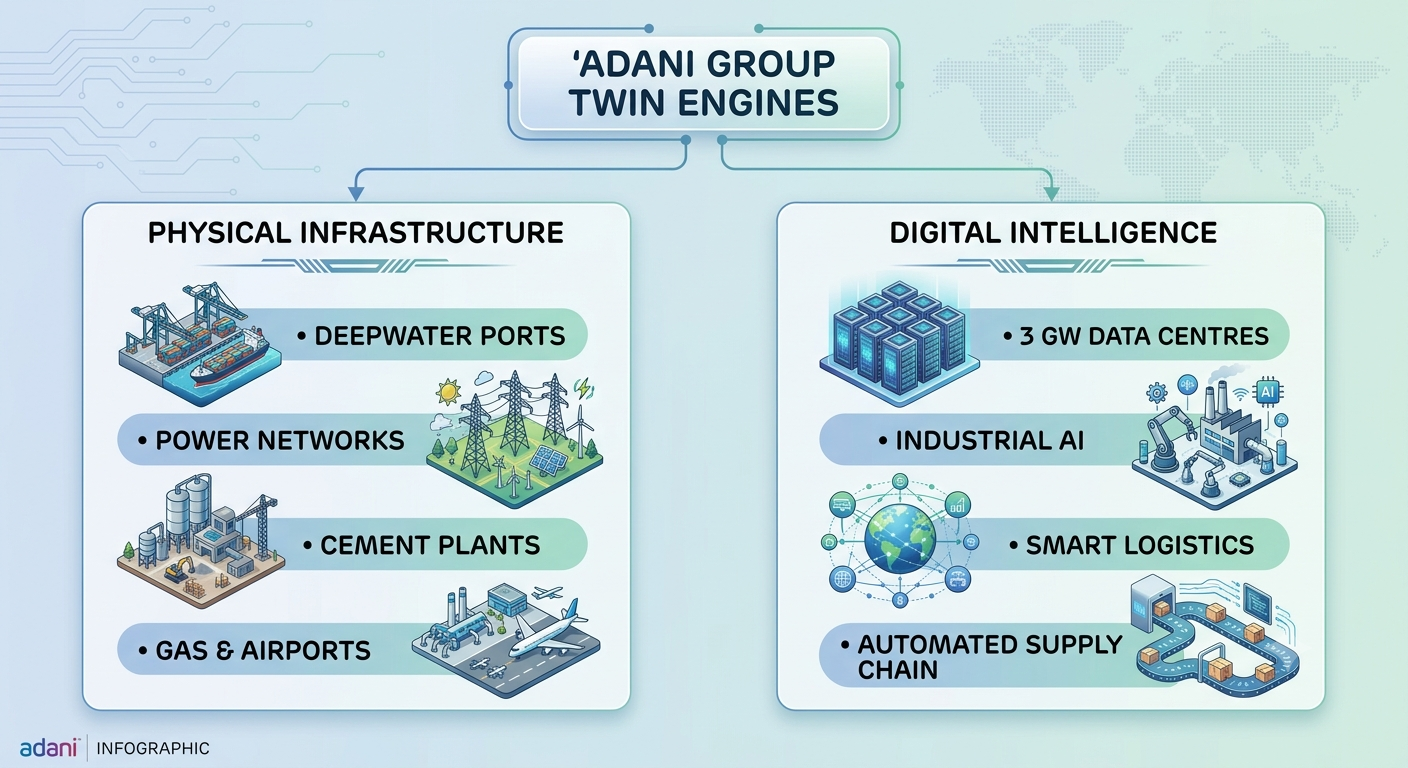
Doubling Down on Hard Physical Assets
The aggressive infrastructure push will see continuous, heavy capital injections into several core sectors:
Deepwater Ports & Logistics: Expanding handling capacity and integrating automated container terminals to lower India’s overall logistics costs.
Power Networks & Utilities: Upgrading cross-country transmission lines to minimize distribution losses and seamlessly integrate renewable power into the national grid.
Cement Production: Ramping up manufacturing capacity to feed the raw materials required for India’s urban transformation and massive transport corridors.
Airports & Gas Utilities: Modernizing newly acquired airport hubs into comprehensive commercial ecosystems while expanding city gas distribution (CGD) networks for cleaner residential and industrial fuel access.
Infusing Digital Intelligence
The physical networks are being paired with advanced digital infrastructure. The 3 GW data center platform is not merely a real estate play; it is designed to run proprietary artificial intelligence models that optimize port logistics, predict power grid maintenance needs, automate supply chain tracking, and maximize the efficiency of energy distribution. This technological layer will dramatically improve asset utilization and boost profit margins across all business verticals.
Navigating the Decadal Vision: What Lies Ahead for Investors?
The announcements made on June 24 lay down a highly ambitious roadmap that essentially future-proofs the conglomerate. By diversifying away from traditional fossil-fuel-dependent asset classes and pivoting firmly toward green energy, baseload nuclear power, and digital infrastructure, the group is positioning itself to ride the wave of global secular trends.
For institutional and retail shareholders alike, the restructuring model provides a clearer look at operational efficiencies. Shifting non-core work to GCCs will likely shrink overhead expenses and remove bureaucratic layers within individual listed entities. This means corporate units like Adani Green Energy, Adani Ports, and Adani Enterprises can operate with clean balance sheets and highly specialized teams dedicated entirely to execution.
Furthermore, entering the nuclear power sector is a massive long-term play. While nuclear projects have extended gestation timelines and strict regulatory pathways, they offer highly predictable, multi-decade cash flows once operational. Balancing short-cycle consumer infrastructure projects (like airports and consumer gas) with long-cycle mega-projects (like nuclear power and deepwater ports) creates a resilient, counter-cyclical business model.
Summary of Key Takeaways from Gautam Adani’s 2026 Address
As the remaining six group AGMs unfold over the coming days, the corporate world will look for granular details on specific project locations, joint venture partners for the nuclear rollout, and exact timelines for the GCC transition. However, the overarching theme is already undeniably set.
The Adani Group is no longer just expanding its footprint; it is actively rewriting its operational playbook. With a massive war chest, a record-breaking share of national private capex, and a clear focus on physical and digital integration, the conglomerate is matching its corporate ambitions directly with India’s long-term economic strategy. Investors and market analysts can expect a highly dynamic fiscal year ahead as these ambitious, capital-intensive plans begin transitioning from board-room strategies into reality on the ground.