
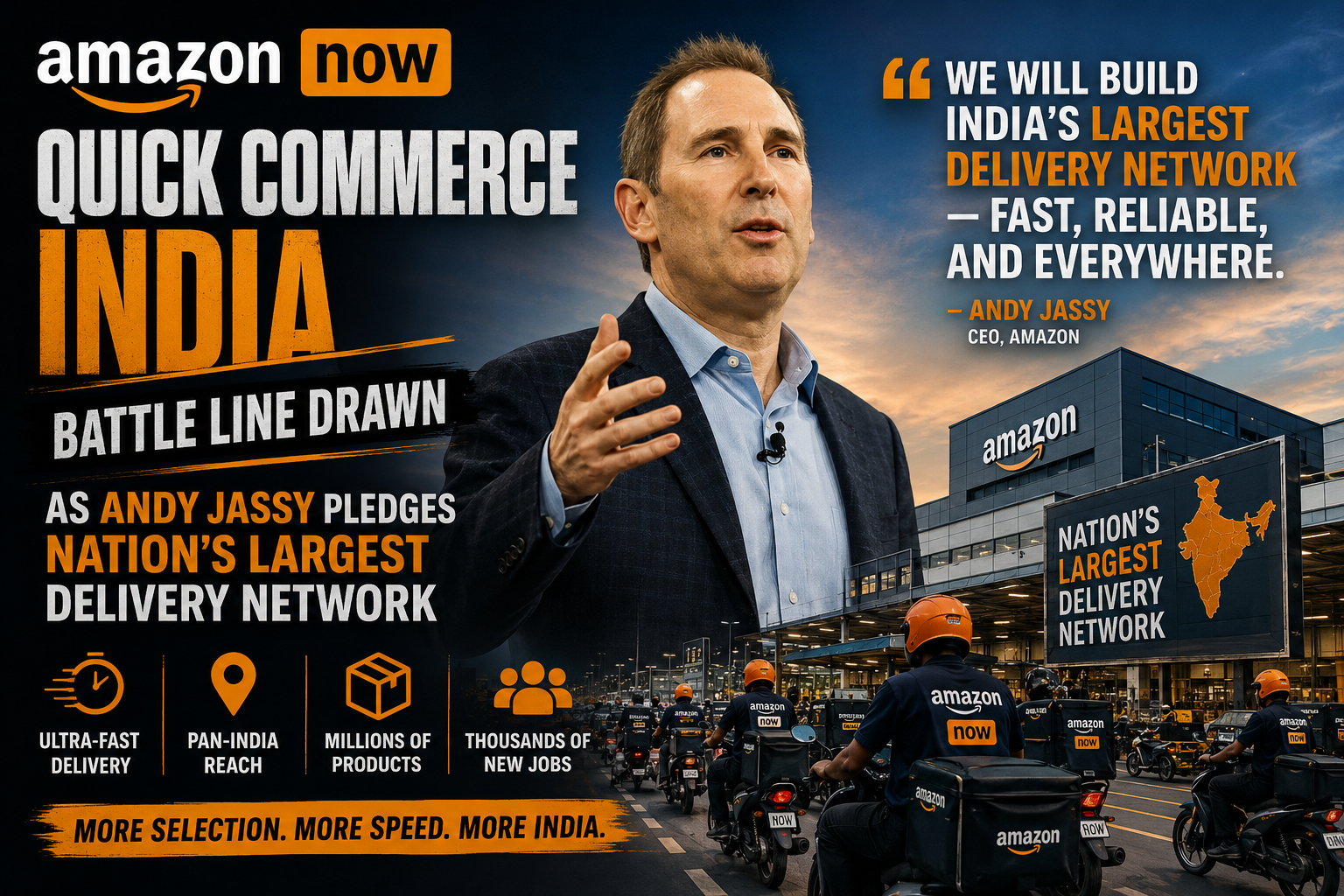
Amazon Now quick commerce services are expanding rapidly across India. Amazon CEO Andy Jassy arrived in the country on Wednesday, June 24, 2026. This is his first major visit since taking over from founder Jeff Bezos in 2021.
During his trip, Jassy announced a massive plan to bring Amazon’s ultra-fast delivery service, Amazon Now, to more than 300 cities. He promised to build India’s largest “delivery-in-minutes” network, directly challenging local rivals like Blinkit, Zepto, Swiggy Instamart, and Flipkart Minutes.
This move comes as the competition for India’s online grocery market heats up. Experts predict the market will grow from $658 billion to $992 billion by 2030. What started as a small test in India is now a major success, and Amazon is using this fast-delivery model in other countries around the world.
Inside Amazon’s Micro-Fulfillment Counter-Offensive
The Amazon CEO initiated his tour early Wednesday by visiting a bustling Amazon Now micro-fulfillment center deep within the commercial heart of Mumbai. Stepping onto the active warehouse floor, Jassy spent time interacting with delivery associates and logistics partners who facilitate hundreds of thousands of daily orders.
“It’s our fastest-growing e-commerce business unit in India, and we’re expanding to 300+ cities as part of our plan to build the country’s largest delivery-in-minutes network,” Jassy shared via social media platform X. “The things you need quickly—groceries, shampoo, baby products, and more—get picked and delivered just minutes after ordered. Customers are loving it”.
According to internal operational data shared by Samir Kumar, Country Manager at Amazon India, Amazon Now has achieved unprecedented momentum, with order volumes doubling every single quarter since its launch. The network currently caters to more than 50 million customers across 15 critical metro and non-metro hubs, including Bengaluru, Delhi-NCR, Mumbai, Pune, Hyderabad, Amritsar, and Kochi.
The upcoming expansion to 300 cities will see an aggressive scaling of specialized urban fulfillment infrastructure. These localized dark stores will house an expanded catalog ranging from fresh produce, frozen foods, and household staples to beauty products, apparel, and small kitchen appliances. The logistical masterplan aims to deliver tens of thousands of items in under ten minutes, while simultaneously supporting a broader tier of one million products for same-day delivery and four million items by the subsequent day.
The Broader $35 Billion Investment Playbook
The hyper-escalation of the Amazon Now quick commerce framework does not exist in an infrastructural vacuum. It represents a vital cog in Amazon’s broader, long-term capital commitment to the Indian digital ecosystem. The company has previously earmarked a massive $35 billion investment commitment by 2030—which builds directly on top of the $40 billion already deployed in the country.
This capital influx is explicitly channeled toward:
AI-driven digitization and cloud computing infrastructure.
The creation of highly advanced AI data centers.
Expanding nationwide e-commerce logistics.
Boosting exports, with Amazon establishing a concrete target to enable $80 billion in cumulative exports by Indian sellers by 2030.
Following his logistical inspections and a high-level roundtable focused on moving Artificial Intelligence from mere corporate experimentation to real-world industrial impact, Jassy met with Maharashtra Chief Minister Devendra Fadnavis. Their discussions centered on how Amazon’s cloud infrastructure and digital networks are actively digitizing local enterprises to compete on a global scale. Jassy is scheduled to head north to New Delhi, where he is highly expected to meet with senior Union government officials, industry leaders, and potentially Prime Minister Narendra Modi on Thursday.
The Multilateral Quick Commerce War of 2026
Amazon’s ambitious expansion lands at a time when India’s quick commerce sector is experiencing its most contested, capital-heavy era. Homegrown startups and massive retail conglomerates are locked in a brutal race for neighborhood dominance, constantly adding real estate to lock down local network effects.
The Quick Commerce Leaderboard (FY26)
| Platform | Market Share (Est.) | Active Dark Stores | Geographic Reach |
| Blinkit | 46% | 2,243 | 200+ Cities |
| Swiggy Instamart | 24% | 1,143 | 129 Cities |
| Zepto | 22% | 1,139 | 66 Cities |
| Flipkart Minutes | 3% – 4% | 1,000 | 130 Cities |
| Amazon Now | 3% – 5% | ~500 (Current) | 15 Cities (Scaling to 300+) |
The pure-play quick commerce pioneers currently hold significant physical advantages. Jefferies market estimates reveal that Zomato-owned Blinkit processed a massive 917 million orders in FY26 through its sprawling network of 2,243 dark stores. Mumbai-based Zepto followed closely with 640 million orders, while Swiggy Instamart registered 412 million orders.
Simultaneously, Walmart-owned Flipkart has mounted an incredibly aggressive offensive via Flipkart Minutes. In less than two years, Flipkart has scaled its quick commerce network to 1,000 micro-fulfillment centers spanning 130 cities and 8,000 pincodes, with order volumes surging fivefold over the past year. Flipkart plans to expand its network to 1,500 dark stores in the coming months, leaning heavily on its massive existing pool of 230 million annual active users and targeting high-ticket consumer electronics alongside Tier-2 and Tier-3 markets.
Faced with this formidable wall of domestic competition, Amazon is leveraging its ultimate weapon: Prime loyalty. Samir Kumar noted that Prime members typically triple their overall shopping frequency on the broader Amazon ecosystem once they begin utilizing the Amazon Now quick commerce application. By marrying ultra-fast delivery with the unparalleled trust of the Prime ecosystem, Amazon aims to rapidly erode the market share of pure-play operators.
Balancing Speed with Workforce Welfare: The 'Sammaan' InitiativeAs delivery timelines shrink across the industry, the immense operational pressure on ground-level gig workers has become a focal point of intense public and regulatory scrutiny. Recognizing that sustainable speed cannot be built on an compromised workforce, Amazon co-announced the launch of ‘Sammaan’—a dedicated, institutional program focused entirely on the holistic welfare of tens of thousands of delivery associates powering its e-commerce and quick commerce pipelines.
A strategic portion of Amazon India’s recently announced $300 million investment dedicated to operational optimization and associate well-being will fund the scaling of Sammaan. The program formally introduces:
Comprehensive Safety Nets: Upgraded health and life insurance plans alongside robust on-road safety protocols.
Socioeconomic Upward Mobility: Financial inclusion programs and dedicated educational scholarships for the children of delivery partners.
Physical Infrastructure Relief: The expansion of air-conditioned ‘Ashray’ rest centers to 250 locations across India this year. Crucially, in a move to foster industry-wide standards, these rest facilities will remain open to any delivery driver across the logistics sector, completely irrespective of their company affiliation.
“None of this is possible without our delivery associates who are at the heart of our e-commerce and quick commerce business,” stated Samir Kumar. “It is our promise that as we grow faster, the people powering that speed grow with us, with better health and wellness, education support for their families, and a safer working environment every day”.
The AI Frontier: Building from India for the World
Beyond the immediate mechanics of dark store rollouts and fast transit timelines, Andy Jassy used his Mumbai visit to convene a closed-door roundtable with prominent leaders of the Indian corporate ecosystem. The executive cohort featured heavyweights including Sunil D’Souza (MD & CEO, Tata Consumer Products), V. Vaidyanathan (MD & CEO, IDFC FIRST Bank), Anchit Nayar (CEO, Nykaa Beauty), Dr. Praveer Sinha (CEO & MD, Tata Power), Zia Mody (Founder, AZB & Partners), Vibha Padalkar (MD & CEO, HDFC Life), and Anil Rai Gupta (Chairman & MD, Havells India).
The core of their dialogue centered on transitioning generative AI models out of localized corporate sandboxes into measurable, consumer-facing applications. Jassy stated unequivocally that AI represents the single most transformational technology he has witnessed in his lifetime. He emphasized that India, backed by its vast engineering talent pool and unmatched pace of grassroots digital adoption, is uniquely positioned not merely as a mass consumer of artificial intelligence, but as a premier global builder and innovator.
The technology refined within India’s hyper-complex logistical landscape is already yielding dividends elsewhere. The proprietary data sequencing, automated inventory predictive mapping, and micro-fulfillment models engineered to make Amazon Now successful amidst Mumbai’s dense traffic are now actively being integrated to optimize Amazon’s rapid delivery networks within the United States and European markets.
The Long-Term Retail Outlook
As Andy Jassy prepares for his critical geopolitical meetings in New Delhi, the strategic trajectory for Amazon India stands explicitly redefined. The global e-commerce giant is no longer content with being an online destination for deferred gratification and next-day deliveries. By pouring massive capital into Amazon Now, the company is fundamentally anchoring its long-term future within the neighborhood commerce ecosystem of the Indian consumer.
The coming twelve months will serve as a severe stress test for the unit economics of this localized model. With dark store capital expenditure averaging ₹45 lakh to ₹60 lakh per hub, and maturity break-even demanding an average order value of ₹500 to ₹600 at 1,400 daily orders, the platform that can optimize its supply chain while retaining consumer loyalty will ultimately command the market. Backed by a $35 billion financial war chest and a renewed focus on worker dignity, Amazon Now is making its definitive move to capture the ultimate crown of Indian retail.