
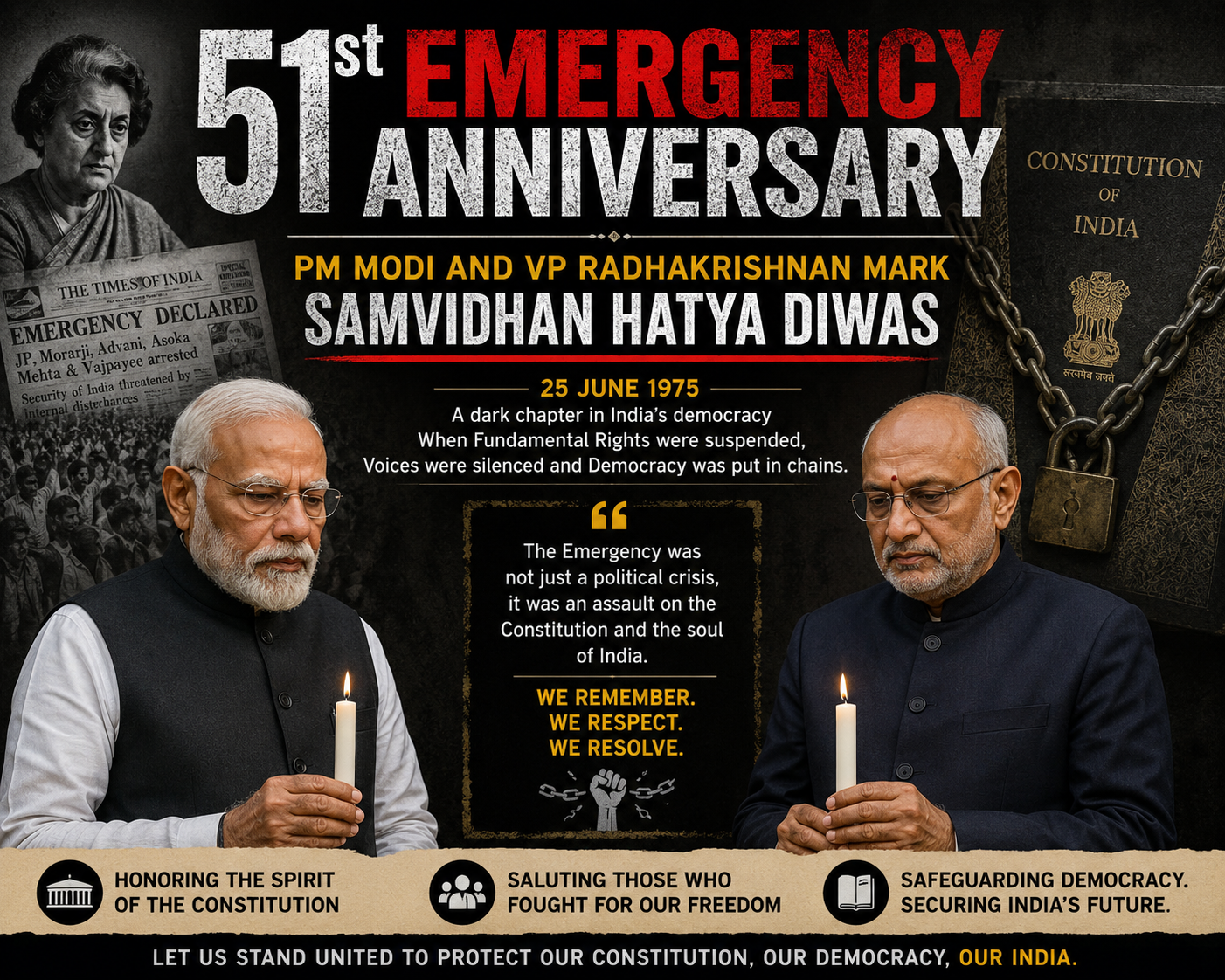
The 51st Emergency anniversary serves as a stark, historic reminder of the fragile nature of democratic institutions when balanced against absolute executive authority. On June 25, 2026, India solemnly observed this milestone under the official designation of ‘Samvidhan Hatya Diwas’ (Constitution Murder Day). Prime Minister Narendra Modi, alongside Vice President C.P. Radhakrishnan and senior leaders of the Bharatiya Janata Party (BJP), led the nation in honoring those who fought to restore the country’s democratic fabric.
The declaration of Emergency on June 25, 1975, by the then Prime Minister Indira Gandhi, initiated a harrowing 21-month period that permanently altered India’s political, legal, and social landscape. Decades later, the collective memory of this era remains a powerful catalyst for debates surrounding civil liberties, constitutional safeguards, and the protection of institutional autonomy.
Through nationwide commemorative programs, seminars, and public declarations, the current administration has sought to ensure that the events of 1975 are not forgotten, framing them as a cautionary tale for future generations.
PM Modi’s Direct Critique: A Systemic Assault on the Constitution
In a series of strongly worded statements shared on social media platforms, Prime Minister Narendra Modi characterized the 1975 Emergency as a direct, unmediated assault on the Indian Constitution. According to the Prime Minister, the period between June 25, 1975, and March 21, 1977, represented a systematic dismantling of the foundational pillars of the world’s largest democracy.
“The Emergency was a direct assault on our Constitution. It witnessed the suspension of civil liberties, curbs on freedom of expression, arrests of political leaders, journalists, social workers and an assault on institutions that are the bedrock of our democracy.”
— Prime Minister Narendra Modi
The Suspension of Fundamental Freedoms
PM Modi highlighted how the everyday rights of ordinary citizens were summarily stripped away overnight. The suspension of Article 19 and Article 21 meant that citizens could no longer look to the judiciary for protection against arbitrary state action. The Prime Minister emphasized that the era was marked by:
The widespread arrest of opposition political figures without formal charges.
The silencing of independent media houses through rigorous pre-censorship.
The imprisonment of social activists and trade union leaders who dared to question government policies.
Reaffirming Constitutional Ideals
While recalling the dark era, the Prime Minister also used the occasion to look forward, calling upon the 140 crore citizens of India to renew their collective commitment to safeguarding constitutional values. He reiterated that the Constitution is not merely a legal text but the living embodiment of the aspirations, rights, and duties of every Indian. Guided by this foundational text, he emphasized the national resolve to build a society strictly rooted in justice, liberty, equality, and fraternity.
The Significance of ‘Samvidhan Hatya Diwas’
Introduced by the Central Government as an annual day of solemn remembrance, Samvidhan Hatya Diwas aims to institutionalize the memory of the anti-Emergency struggle. By officially naming June 25 as “Constitution Murder Day,” the government seeks to anchor the historical narrative around the absolute defense of democratic norms.
| Aspect of Remembrance | Historical Impact | Modern Significance |
| Civil Liberties | Complete suspension of fundamental rights. | A reminder to protect individual freedoms against overreach. |
| Press Freedom | Total censorship and state control of information. | Reinforces the necessity of an independent fourth estate. |
| Judicial Autonomy | Weakened judicial review through rapid amendments. | Highlights the importance of the separation of powers. |
According to government gazette notifications, the day is designed to remind the public of the “gross abuse of power by the government of the day” and the immense atrocities suffered by ordinary citizens. It stands as a tribute to the luminaries, underground activists, and common individuals who refused to be silenced by state intimidation.
Vice President C.P. Radhakrishnan on the Testing of Constitutional Values
Joining the nation in paying homage, Vice President C.P. Radhakrishnan stated that constitutional values were severely tested during the 1975 crisis. Speaking on the 51st Emergency anniversary, the Vice President offered humble tributes to the “brave souls” who stood firm against authoritarianism.
The Resilience of Indian Citizens
Radhakrishnan noted that while institutions central to the democratic framework were heavily undermined, the spirit of the Indian citizen remained unbroken. The 21-month period, though dark, eventually showcased the inherent resilience of the electorate. When given the opportunity to vote in 1977, the public decisively rejected the authoritarian regime, signaling that the ultimate power in India rests with its people, not its rulers.
The Vice President urged modern institutions—the judiciary, the legislature, and the executive—to view the historical context of the Emergency as a guiding light, ensuring that the checks and balances designed by the makers of the Constitution are never compromised again.
Historical Context: Anatomy of the 1975 EmergencyTo fully comprehend the gravity of the 51st Emergency anniversary, one must examine the socio-political factors that led to the fateful declaration by President Fakhruddin Ali Ahmed on the advice of Prime Minister Indira Gandhi on the night of June 25, 1975.
The Catalyst: State of Uttar Pradesh v. Raj Narain
The immediate political trigger was the landmark judgment delivered by the Allahabad High Court on June 12, 1975. Justice Jagmohanlal Sinha found Prime Minister Indira Gandhi guilty of electoral malpractices during her 1971 parliamentary campaign in Rae Bareli. The court unseated her from Parliament and barred her from holding elected office for six years.
Faced with mounting protests led by veteran leader Jayaprakash Narayan (JP), who called for a total revolution and asked the military and police to disregard illegal orders, the ruling dispensation chose to invoke Article 352 of the Indian Constitution, citing “internal disturbance.”
The Institutional Shift
Once the Emergency was proclaimed, the political dynamic of the country shifted instantly:
Overriding Executive Powers: The federal structure of India was effectively paused. The Central Government assumed direct control over state administrations.
Muzzling the Press: Electricity supplies to major newspapers in New Delhi were disconnected on the night of June 25 to prevent the news from spreading. When printing resumed, all content had to clear a government censor officer.
Constitutional Subversion: Parliament, depleted of its opposition leaders who were jailed under the Maintenance of Internal Security Act (MISA), passed sweeping amendments. The 39th Amendment placed the election of the Prime Minister beyond judicial scrutiny, while the sweeping 42nd Amendment sought to reduce the power of the High Courts and the Supreme Court to review central laws.
Excesses and Atrocities: The Human CostThe historical narrative of the Emergency is not merely one of legal documents and parliamentary debates; it is profoundly defined by widespread human suffering. The centralization of power gave rise to administrative excesses executed without accountability.
The Forced Sterilization Campaign
One of the most controversial and deeply resented initiatives of the Emergency era was the mass compulsory sterilization drive, spearheaded by Sanjay Gandhi. In an aggressive bid to curb population growth, quotas were assigned to administrative officials, police personnel, and teachers. To meet these targets, vulnerable sections of society, particularly young men, the poor, and marginalized communities, were forcibly subjected to vasectomies under unhygienic conditions, resulting in numerous fatalities and widespread public terror.
Urban Clearance and Slum Demolitions
Simultaneously, aggressive beautification campaigns were launched in major urban centers. The most notorious of these occurred at the Turkman Gate in Delhi in April 1976. Slum dwellings were bulldozed overnight, displacing thousands of residents. When local communities protested the sudden destruction of their homes, the police responded with brutal force, leading to clashes and police firing that resulted in several civilian casualties.
BJP’s Nationwide Awareness and Commemorative Programs
Marking the 51st Emergency anniversary, the Bharatiya Janata Party orchestrated extensive public outreach campaigns across multiple states, including Haryana, Bihar, Maharashtra, and Uttar Pradesh. These programs were aimed at educating the youth—who have no living memory of the 1970s—about the stark realities of the authoritarian era.
Political Objectives and Public Education
Through symposia, photographic exhibitions, and documentary screenings, the party sought to emphasize the importance of political vigilance. Senior leaders addressed gatherings, drawing parallels between historical events and contemporary political discourses. The party asserted that celebrating ‘Samvidhan Hatya Diwas’ is crucial to ensuring that no political entity in the future attempts to dilute the sanctity of the democratic mandate or weaken institutional autonomy for personal political survival.
Conclusion: Eternal Vigilance as the Price of Liberty
The political shift triggered by the general elections of March 1977 brought an end to the Emergency, proving that the roots of democracy ran deep within the Indian consciousness. The defeat of Indira Gandhi’s government in that historic election was a clear validation of the public’s insistence on constitutional governance and personal liberty.
As India marks the 51st Emergency anniversary, the reflections offered by PM Modi and VP Radhakrishnan underscore a timeless political truth: democracy is not self-sustaining. It requires constant care, robust institutional checks, an independent judiciary, a free press, and an informed, vigilant citizenry.
By remembering the dark chapters of the past under the banner of Samvidhan Hatya Diwas, the nation seeks to fortify its democratic foundations, ensuring that the constitutional ideals of justice, liberty, equality, and fraternity remain absolute and unassailable for generations to come.
Disclaimer: This information is based on various inputs from news agency.