
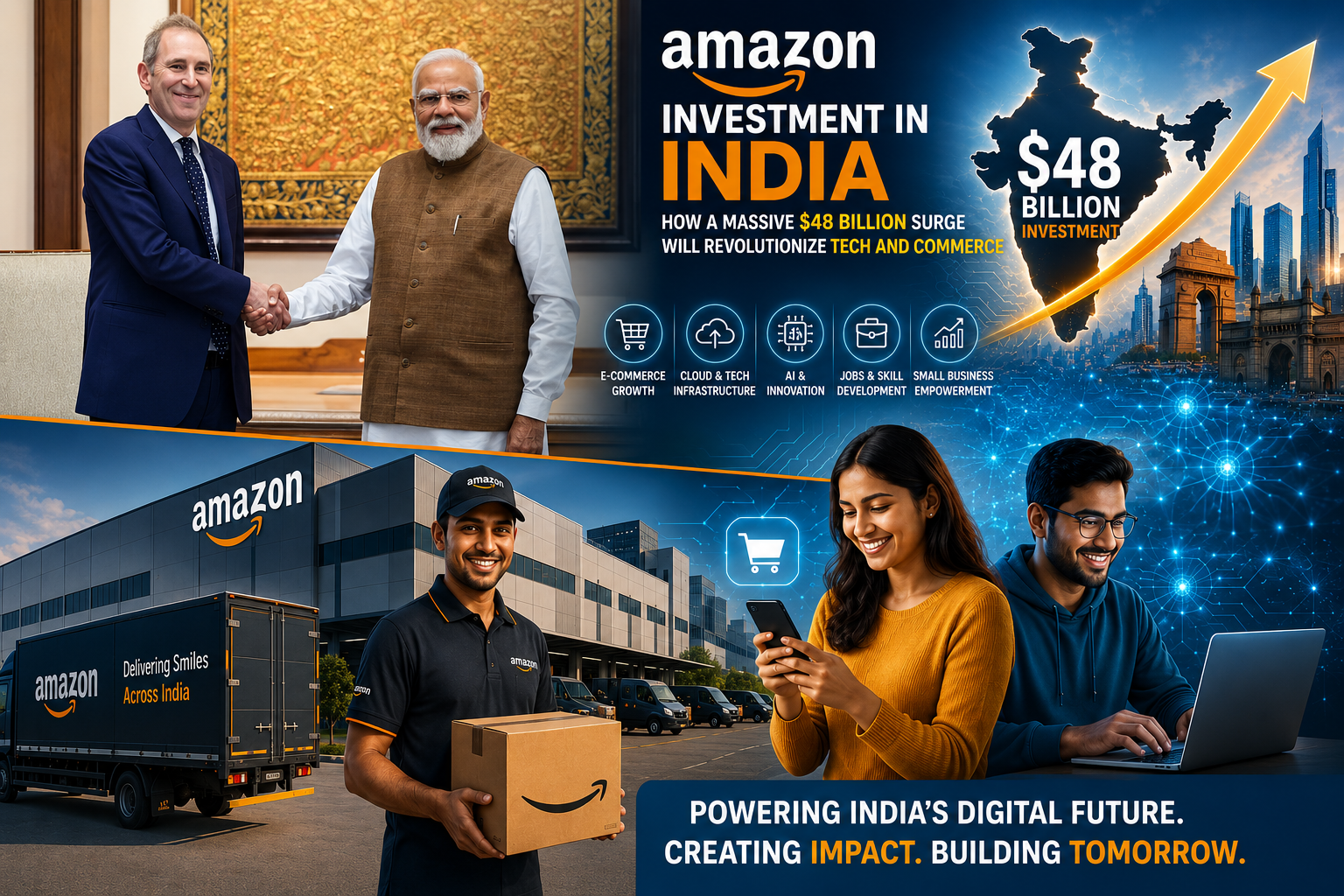
The recent announcement regarding a massive Amazon investment in India marks a historic turning point for the South Asian digital economy. In a high-profile meeting in New Delhi, Amazon CEO Andy Jassy met with Prime Minister Narendra Modi to solidify a monumental commitment: a staggering $48 billion investment blueprint spanning from 2026 through 2030. This strategic financial influx is set to turbocharge India’s rapidly growing ecommerce ecosystem, bolster its digital supply chain, and establish a foundational backbone for next-generation Artificial Intelligence (AI) and cloud computing infrastructure.
By injecting these resources into the market, the global retail and technology titan is alignment-checking its corporate strategy with the Indian government’s overarching national vision of a Viksit Bharat (Developed India) and Atmanirbhar Bharat (Self-Reliant India). This initiative doesn’t just represent corporate expansion—it represents a multi-layered economic catalyst designed to uplift small businesses, generate millions of livelihoods, and position India as a premier hub for global technology exports.
Decoding the Blueprint: Where Will the $48 Billion Go?
The sheer scale of this investment requires a closer look at how the capital will be distributed across Amazon’s diverse operations in India. Rather than focusing solely on retail logistics, the $48 billion strategy is split into two major pillars: retail supply chain expansion (including quick commerce) and cutting-edge cloud infrastructure.
The $21 Billion Cloud and AI Framework
A massive portion of the newly announced capital—specifically an additional $13 billion building on top of previous commitments—brings Amazon’s total AI and cloud infrastructure allocation to over $21 billion between 2026 and 2030. Managed through Amazon Web Services (AWS), this capital will directly expand data center capacities in critical technological hubs, specifically Mumbai and Hyderabad.
Key Takeaway: This multi-billion-dollar infrastructure boost will democratize access to advanced technology, giving Indian startups, enterprise businesses, and government institutions direct access to custom-built AI chips, fully managed AI services, and highly secure developer tools.
Strengthening Logistics, Fulfillment, and Quick Commerce
While cloud computing forms the invisible backbone, the physical infrastructure of Amazon’s ecommerce machine is receiving an immediate upgrade. To meet the soaring demands of Indian consumers—particularly in Tier 3 and Tier 4 cities—Amazon is rapidly expanding its physical footprint.
Plans are already underway to launch:
Over 20 new fulfillment centers across various states.
More than 100 new last-mile delivery stations within the calendar year.
This aggressive expansion ensures that Amazon can maintain its competitive edge against local players while making ultra-fast shipping a reality for rural and semi-urban populations who are entering the digital economy for the first time.
Aligning Corporate Strategy with National Priorities
The partnership between tech conglomerates and sovereign governments works best when corporate goals align with national development metrics. During his dialogue with PM Narendra Modi, Andy Jassy emphasized that Amazon’s business priorities are tailor-made to match India’s economic growth drivers.
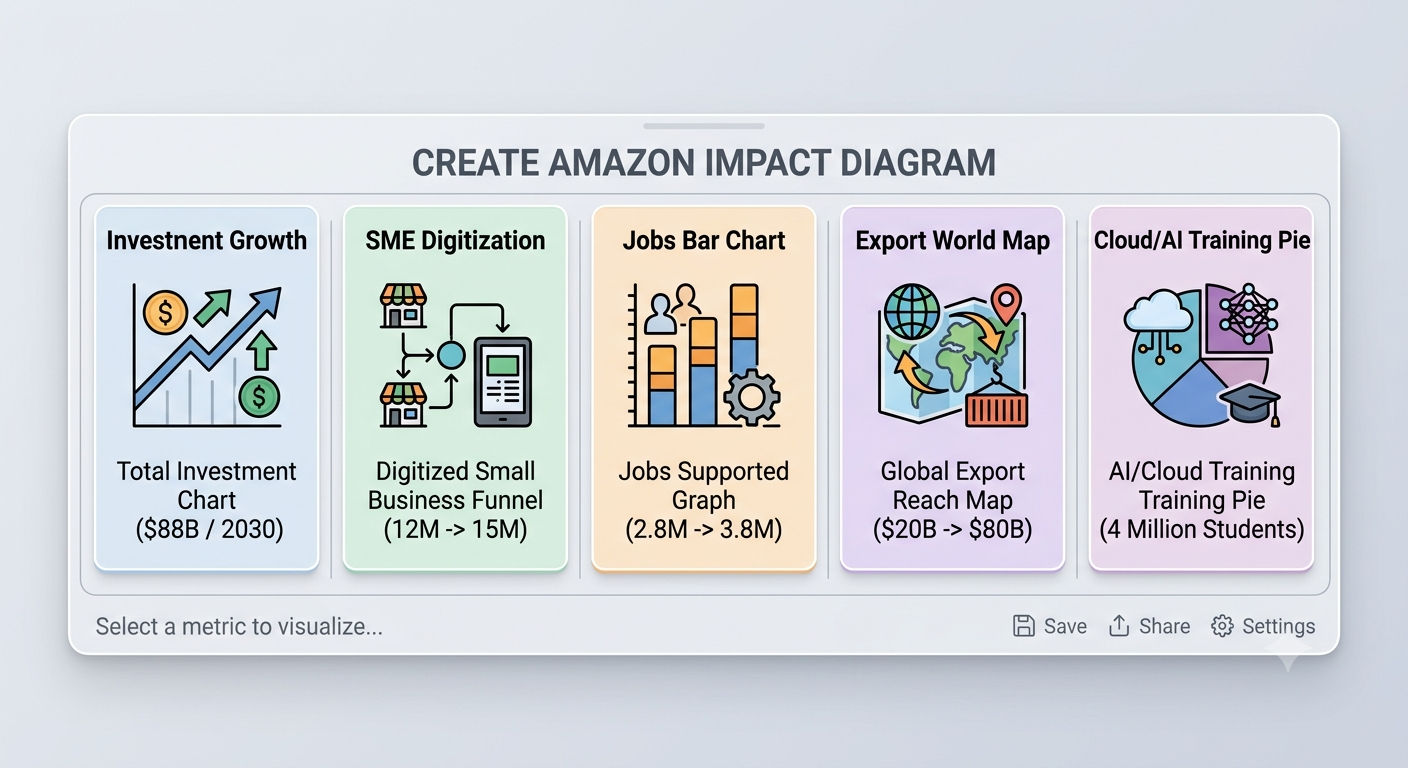
As the data shows, Amazon’s historical footprint of over $88 billion in cumulative investments from 2010 to 2030 establishes it as one of the single largest foreign direct investors in India’s history.
Empowering the Grassroots: MSMEs and the Export Boom
One of the most profound aspects of this economic roadmap is its focus on Micro, Small, and Medium Enterprises (MSMEs). Historically, Indian retail has been dominated by localized, brick-and-mortar storefronts (Kirana stores). Amazon’s ongoing digitization efforts have already brought 12 million of these small businesses into the modern digital fold. The new capital aims to push this number to 15 million, lowering the barrier to entry for small-scale merchants looking to access a nationwide customer base.
Driving the Made-in-India Global Export Strategy
Beyond domestic sales, the international export channel is where the true transformation lies. To date, Indian sellers utilizing Amazon’s global marketplace framework have achieved over $20 billion in cumulative cross-border ecommerce exports.
With the added investment, Amazon has pledged to scale this metric to an astronomical $80 billion by 2030. This means traditional Indian textiles, organic goods, local handicrafts, and manufactured consumer goods will find direct routes to consumers in North America, Europe, the Middle East, and beyond, significantly balancing the nation’s trade dynamics.
Human Capital: Job Creation and the “Sammaan” Initiative
An investment of this scale carries immense social responsibility. Amazon has already been credited with supporting 2.8 million jobs across its corporate offices, tech hubs, fulfillment networks, and ecosystem partners. By 2030, that number is projected to climb to 3.8 million total jobs.
Prioritizing Gig Worker Well-being
To support the massive network of on-the-ground logistics personnel, Amazon recently introduced “Sammaan”—a dedicated program tailored to support the lives of thousands of delivery associates across the subcontinent. Funded partly by a fresh $300 million investment dedicated purely to operations and associate well-being, the initiative includes:
Educational Scholarships: Providing financial backing for the children of delivery associates to pursue higher education.
Financial Inclusion: Assisting gig workers in gaining seamless access to government benefits, formal banking, and savings programs.
Comprehensive Safety Networks: Offering robust on-road safety measures and extensive medical insurance coverage to secure the livelihoods of delivery teams.
Preparing India’s Youth for an AI-Driven Future
As India transitions into a knowledge-based digital economy, the need for a tech-savvy workforce is paramount. Having already trained over 10 million citizens in cloud skills, Amazon is now pivoting hard toward foundational AI education.
Under the newly outlined goals, the company will extend basic AI education and digital literacy training to 4 million government school students. By introducing machine learning concepts, basic coding, and cloud fundamentals to underprivileged youth early on, the corporate giant is essentially cultivating the next generation of software engineers, data scientists, and tech entrepreneurs right at the grassroots level.
Final Thoughts: A Definitive Partnership for the Digital Age
The massive scope of this latest venture demonstrates that the global tech ecosystem views India not just as a consumer market, but as an innovation engine. The partnership forged between PM Narendra Modi and CEO Andy Jassy highlights a shared understanding: the future of global tech and commerce is inextricably linked to India’s domestic growth.
Through localized data centers, robust physical fulfillment grids, and an unwavering commitment to grassroots empowerment, this multi-billion dollar framework will echo far beyond corporate balance sheets. It sets a new benchmark for how foreign direct investment can act as a true partner in a country’s socio-economic evolution.