
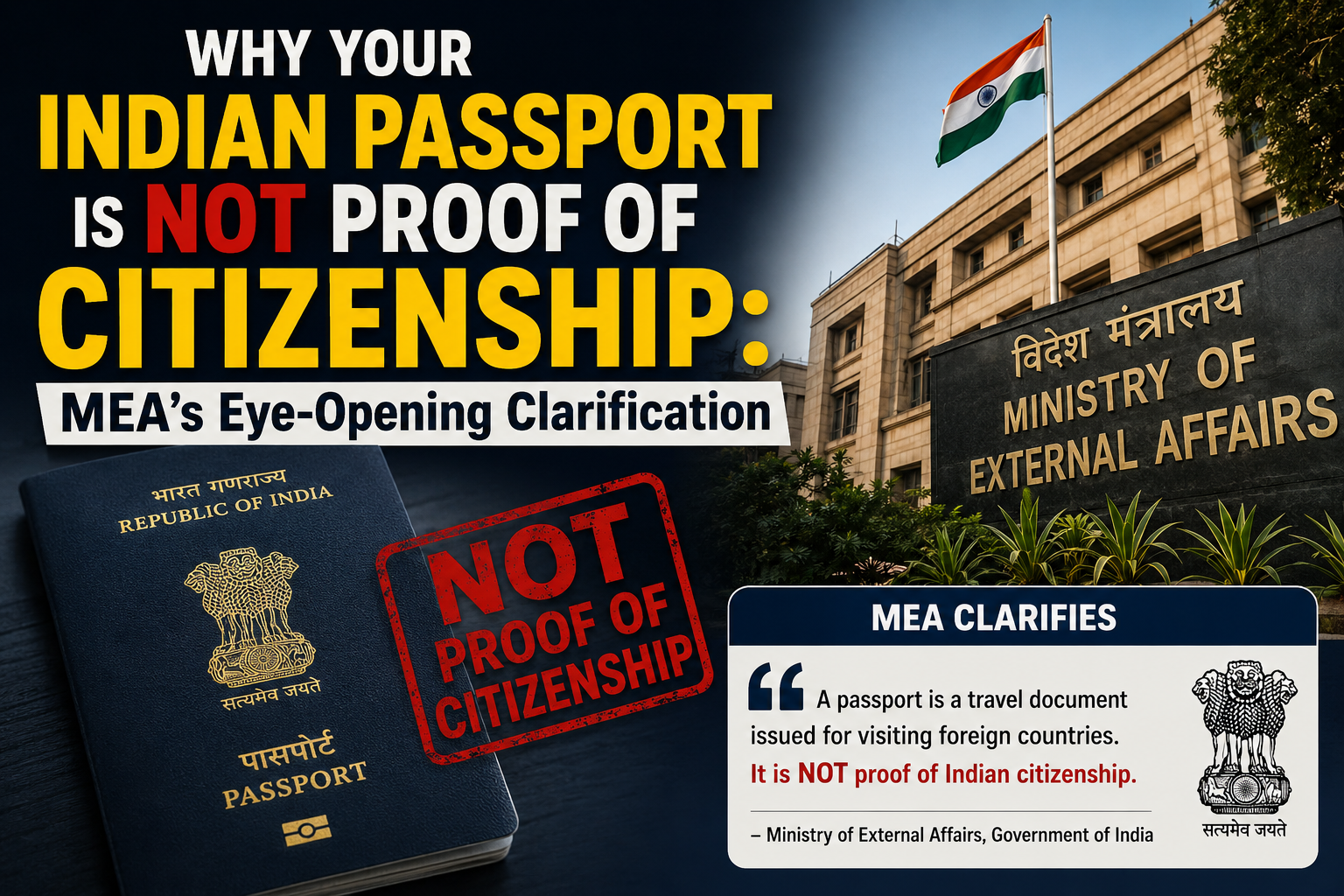
Indian passport in an era where international travel is booming and digital identification governs our daily lives, a sudden announcement from New Delhi has sent shockwaves across social media and living room discussions alike. The Ministry of External Affairs (MEA) recently dropped a bombshell clarification: your Indian passport is strictly a travel document and should not be treated as conclusive proof of citizenship.
For decades, the dark blue booklet emblazoned with the Ashoka Emblem has been fiercely guarded by citizens as the ultimate badge of national identity. If a document issued by the sovereign government to clear you for global travel doesn’t prove you are a citizen, what does?
This unexpected revelation emerged during a detailed briefing at the 14th Passport Seva Divas, triggering widespread public debate, intense digital skepticism, and a collective scramble to understand the shifting legal boundaries of identity in India.
The MEA’s Big Reveal: Travel Document vs. Citizenship Proof
During a comprehensive review of India’s rapidly expanding passport and mobility ecosystem, senior MEA officials systematically decoupled the concept of an international travel permit from domestic citizenship validation.
“While passports are issued exclusively to Indian citizens, the document’s primary, legal purpose is to enable international travel and establish identity abroad. It attests to the nationality of Indians when they are outside the country, but it does not serve as an absolute, foundational document of citizenship within domestic borders.”
The distinction might sound like bureaucratic hair-splitting, but from a constitutional standpoint, it carries immense weight. The announcement immediately sparked viral trends on platforms like X (formerly Twitter), where bewildered citizens posted photos of their passport data pages, pointing directly to the printed field reading “National / Nationalité: INDIAN”.
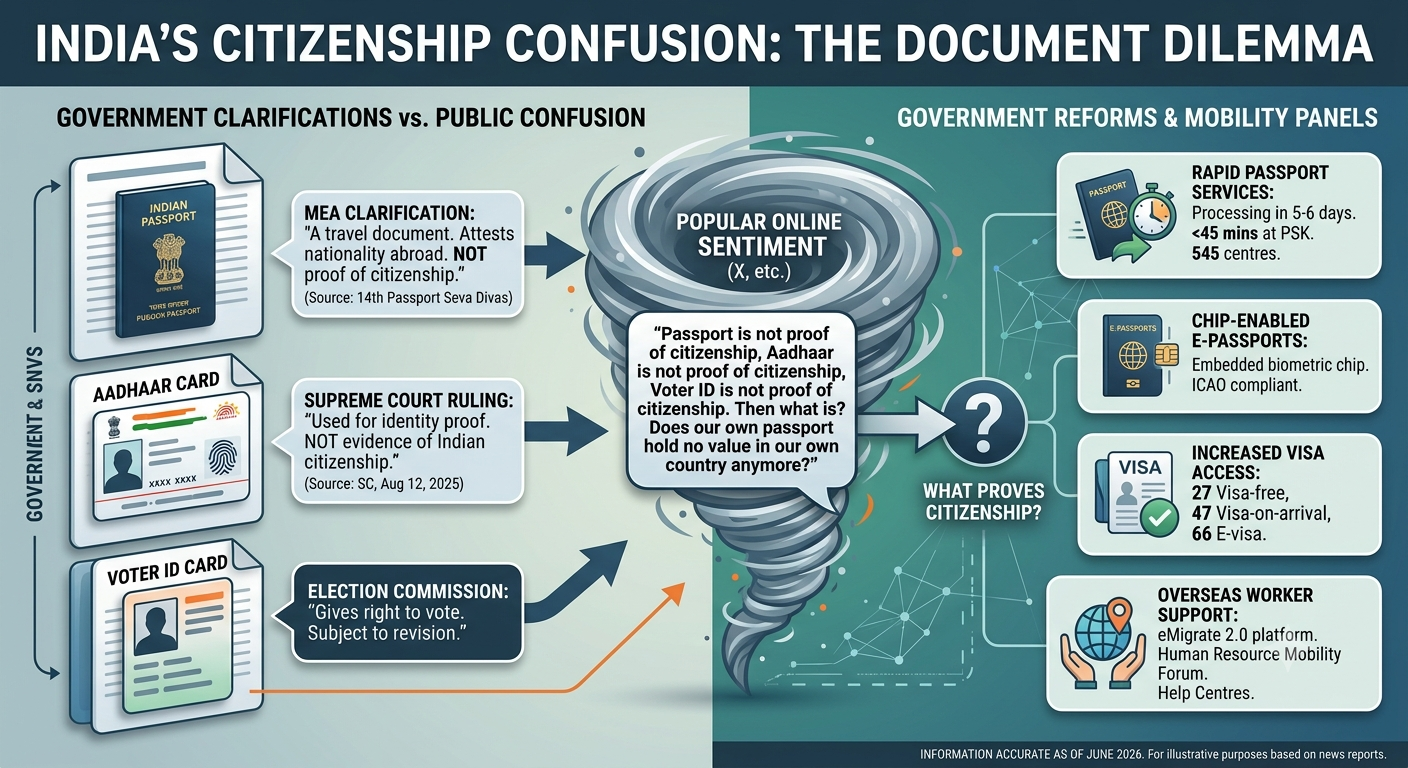
The underlying anxiety is understandable. If the state’s most heavily verified physical document is legally insufficient to prove you belong to the nation, it opens a massive gray area for the average citizen.
The Legal Reality: Decoding the Supreme Court’s Stance
To understand why the MEA took this stance, we have to look at the judiciary’s historical handling of state-issued identity cards. The ministry’s recent clarification isn’t an arbitrary rule change; it aligns directly with established legal precedents and past court judgments.
The conversation around official documentation has grown increasingly complex, particularly during intensive revisions of electoral rolls managed by the Election Commission of India. The highest court in the land has repeatedly stepped in to draw boundaries around what specific identity trackers can and cannot do.
The Landmark 2025 Supreme Court Ruling
On August 12, 2025, a Supreme Court bench consisting of Justices Surya Kant and Joymalya Bagchi addressed this precise issue while hearing the Bihar special intensive revision case. Their ruling provided absolute clarity on digital biometric markers:
$$ \text{Identity Proof} \neq \text{Citizenship Evidence} $$
The bench explicitly stated that the use of standard biometric identification databases while filing official claims and objections would strictly be as proof of identity and not as evidence of Indian citizenship.
The Conceptual Divide
To make sense of this legal maze, it helps to break down how the Indian legal system categorizes these documents:
| Document Type | Primary Purpose | Legal Limitations |
| Indian Passport | International travel & overseas identification | Attests nationality abroad; not conclusive domestic citizenship proof |
| Biometric ID (Aadhaar) | Targeted delivery of subsidies and identity verification | Explicitly ruled by courts as identity proof only; zero citizenship status |
| Voter ID Card | Grants the right to participate in specific electoral processes | Subject to ongoing revision; can be challenged during electoral roll audits |
If Passports and ID Cards Fail, How Do You Prove Citizenship?The MEA’s clarification has naturally revived a lingering, high-stakes question: What actually constitutes definitive proof of Indian citizenship?
The root of the confusion stretches back to structural policy discussions. On December 20, 2019, the government’s Press Information Bureau (PIB) attempted to pacify public panic regarding a potential National Register of Citizens (NRC) by issuing a QA framework. At the time, the bureau stated that citizenship could fundamentally be proven by submitting documents tracking an individual’s date of birth and place of birth.
However, they added a critical caveat: “A decision is yet to be taken on the exact, acceptable list of such documents.”
Fast forward to June 2026, and the Ministry of Home Affairs (MHA) has still not finalized a definitive, nationwide checklist of acceptable documents required to prove citizenship under a holistic national framework. While specific rules like the Citizenship Amendment Act (CAA) Rules—notified in March 2024 and amended later that year—have established relaxed frameworks for specific applicant groups using regional, historical, or quasi-judicial records, the everyday citizen remains in a state of documentation limbo. For now, basic birth certificates linked to clear parental lineage remain the safest legal anchor, even as comprehensive statutory definitions remain pending.
Beyond the Debate: The Massive Upgrading of India’s Passport Ecosystem
While the legal definitions of citizenship continue to stir healthy debate, the physical infrastructure backing the Indian passport has undergone an extraordinary, tech-driven revolution. The MEA’s briefing wasn’t just a lesson in constitutional law; it was a showcase of structural modernization designed to cater to millions of globally minded Indians.
1. The Dawn of Chip-Enabled E-Passports
The most significant milestone in recent border security history is the nationwide integration of secure technology into the passport booklet itself. Following a rollout initiated last year, all newly issued Indian passports feature an embedded electronic chip.
[ Cover Booklet ] ---> [ Embedded Microchip ] ---> [ Secure Biometric Data ]
                                                         |
                                                         v
                                         Compliant with ICAO Standards
This structural upgrade contains localized biometric information and advanced cryptographic security features fully compliant with the International Civil Aviation Organisation (ICAO). What does this mean for travelers?
Drastic Fraud Reduction: Cloning or altering physical data pages becomes virtually impossible.
Seamless Border Crossings: Indian travelers can look forward to faster clearance times through automated e-gates at global airports.
Higher Document Integrity: The global trust rating of the Indian passport increases significantly.
2. Radical Reductions in Wait Times
Historically, securing an Indian passport was an exercise in bureaucratic patience, often taking weeks or months of nervous waiting. Today, that narrative has been completely rewritten.
Thanks to highly streamlined internal workflows and automated randomized processing systems across 17 regional passport hubs, processing windows have plummeted to an average of just five to six working days for standard applications. Furthermore, structural optimizations mean that once an applicant walks into a Passport Seva Kendra (PSK), they spend an average of less than 45 minutes inside the venue to complete their biometric imaging and data verification.
Expanding the Infrastructure: A Six-Fold Growth StoryThe speed of modern passport processing is a direct byproduct of a massive, decentralized physical network. A decade ago, India’s passport infrastructure operated out of a mere 77 localized hubs, making access a logistical nightmare for rural populations.
Today, that footprint has scaled to an astonishing 545 passport service centers operating across the country—a literal six-fold expansion.
India's Passport Network Expansion:
Then (A Decade Ago): 77 Centers
Now (2026):          545 Centers
Moving Target:       +20 New Hubs This Year
Ultimate Blueprint:  1 Dedicated Facility per Lok Sabha Constituency by 2027
To bridge the remaining gaps, the government is executing an aggressive push to open 20 additional Passport Seva Kendras before the end of the year. The explicit objective is to ensure that no parliamentary constituency is left without a localized passport office by 2027.
For the roughly 30 remote or difficult-to-access districts still lacking a permanent base, the MEA has deployed specialized mobile passport teams. These agile, tech-equipped units, alongside specialized outreach camps, managed to process and deliver passports to nearly 300,000 citizens living in historically underserved regions over the last year alone.
The Penetration Problem: Turning a Privilege into a RightDespite the mind-boggling scale of this infrastructure rollout, India faces a fascinating paradox: passport penetration remains surprisingly low.
Currently, only about 10 percent of India’s vast population holds a valid passport. For generations, the document was viewed culturally as an elite luxury item—a status symbol reserved strictly for wealthier families or specialized professionals.
The MEA is working actively to dismantle this perception. As international cross-border mobility turns into a foundational pillar for modern higher education, vocational training, trade, and corporate growth, expanding democratic access to travel documents has become a top-tier national economic priority. The goal is to evolve the passport from an exclusive privilege into an accessible tool for hundreds of millions of aspiring citizens.
Global Mobility and the Rising Power of the Indian Traveler
As the domestic ecosystem modernizes, India’s diplomatic machinery is simultaneously working overtime to expand the practical utility of the passport beyond domestic shores. The country’s international leverage has translated directly into greater freedom of movement for its workforce and tourists.
Rising Travel Freedom
The global currency of the Indian passport is rising steadily. The travel landscape for Indian citizens has expanded dramatically:
Visa-Free Entry: Currently extended by 27 countries, a significant leap from just 16 destinations in 2019.
Visa-on-Arrival Access: Now offered by 47 nations, up from 38 down the line.
Electronic Visas (e-Visas): Smooth digital application pathways are now open across 66 countries, eliminating the need for physical embassy visits.
Strategic Migration Pacts
Beyond casual tourism, India has systematically secured 27 mobility and migration agreements with 25 key nations, including the European Union, the United Kingdom, Australia, and a string of Gulf countries. These highly specialized treaties create legally protected, friction-free pathways for Indian students, research fellows, corporate professionals, and apprentices to move seamlessly without getting trapped in migratory legal limbo.
Safeguarding the Global Indian Workforce
A major pillar of India’s renewed mobility blueprint focuses directly on blue-collar and skilled labor migration. The days of workers falling prey to unregulated, predatory middle-men are being aggressively phased out through systemic transparency.
The eMigrate 2.0 Revolution
Launched with a vision to clean up international recruitment, the upgraded eMigrate 2.0 platform has emerged as a cornerstone tech asset for worker safety. Since its debut in October 2022, nearly 700,000 Indian workers have successfully obtained institutional emigration clearances through the portal. The integration of automated, randomized application processing across passport offices has effectively cut out human bias, reduced systemic delays, and shut down illegal recruitment networks.
Welfare and Pre-Departure Safeguards
To ensure that migration remains safe, dignified, and mutually beneficial, the government has instituted mandatory pre-departure orientation programs. These sessions provide migrating workers with crucial, country-specific cultural overviews, legal rights awareness, and basic survival skills before they board their flights.
Furthermore, dedicated support mechanisms have been firmly established on international soil to catch vulnerable demographics when things go wrong:
Global Safety Nets: The Ministry has successfully operationalized specialized, one-stop support centers across Singapore and the Gulf cooperation zone. Backed structurally by the Indian Community Welfare Fund, these centers provide immediate legal representation, emergency housing, and psychological counseling for distressed Indian women facing exploitation or hardship abroad.
Looking forward, India is hosting an international Human Resource Mobility Forum featuring key global economic powerhouses—including Germany, Italy, Japan, Russia, and Denmark. The event is custom-designed to match skilled Indian professionals directly with vetted, ethical employers abroad, setting a new benchmark for state-backed labor mobility.
Final Thoughts: Navigating Identity in a Modernizing Nation
The MEA’s sudden reminder that an Indian passport is purely a travel document may have initially caused confusion, but it highlights an essential truth about modern governance: identity is multi-layered.
The administrative separation of identity verification, travel privileges, and foundational citizenship proof reflects a mature, legally precise system designed to protect both the citizen and the state. While the Ministry of Home Affairs continues to refine the domestic legal parameters of what proves citizenship within our borders, the Ministry of External Affairs has successfully transformed the passport itself.
No longer a bureaucratic luxury reserved for the few, the modern e-passport stands as a highly secure, rapidly issued, and globally respected document—powering millions of Indians as they step confidently onto the world stage.