
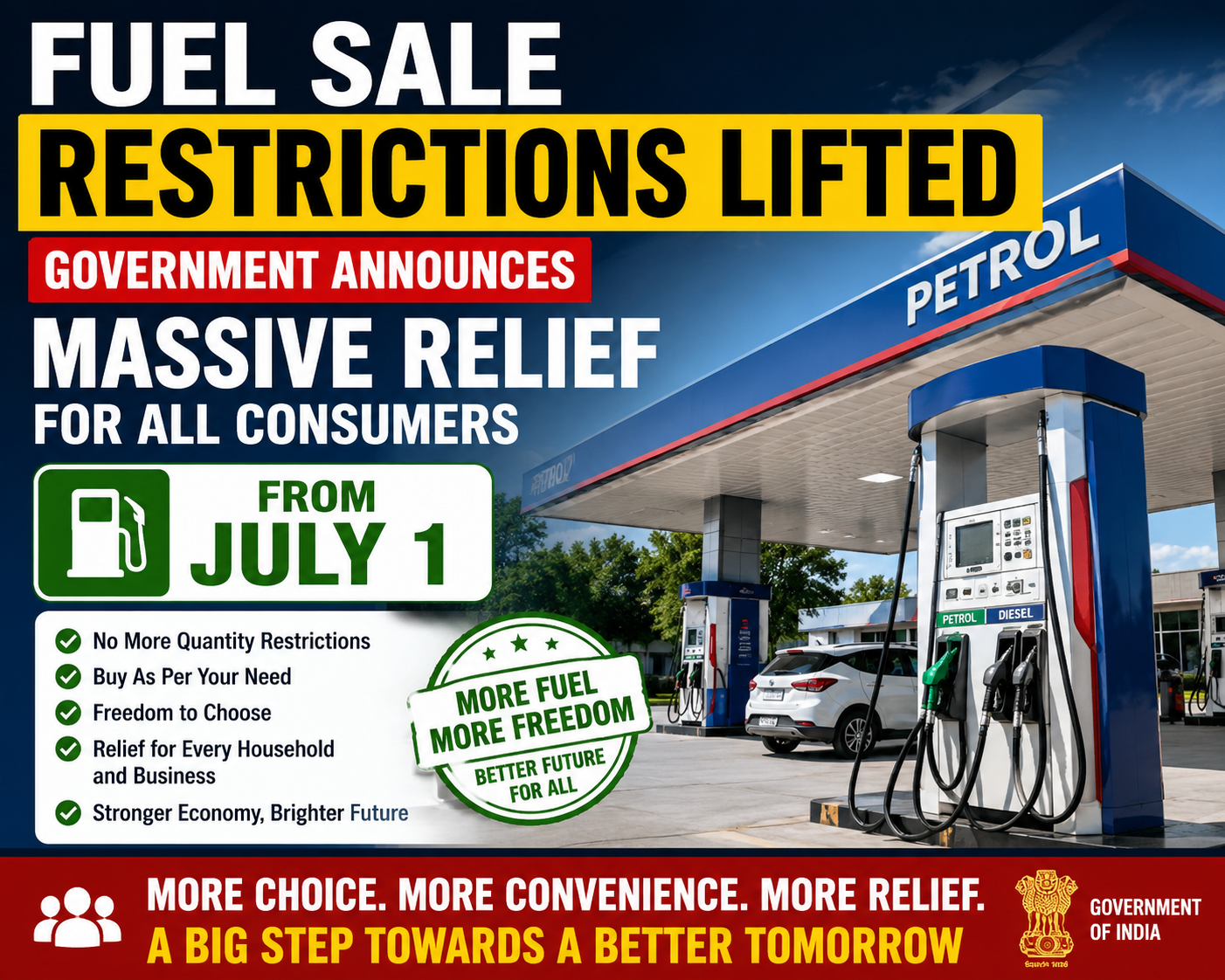
Fuel sale restrictions in India are officially coming to an end. In a major announcement that brings immense relief to both individual motorists and industrial consumers, the Union Government on Monday evening decided to completely withdraw all caps and limitations on the purchase of petrol and diesel across the country. The new directive will come into effect from July 1, 2026, marking a swift return to normalcy after a turbulent month of supply chain disruptions triggered by intense geopolitical conflict in West Asia.
The decision, formalised through an official government order on June 29, effectively repeals the emergency measures implemented earlier this month on June 12. With this move, the daily cap of 200 litres of diesel per consumer at retail outlets stands completely abolished. Furthermore, large-scale industrial and commercial buyers, who were previously barred from buying directly from retail fuel stations, are now permitted to resume their regular procurement practices without any statutory bottlenecks.
The Turning Point: Diplomatic Breakthrough Eases Global Supply Chains
The sudden removal of these stringent guidelines is closely tied to a dramatic easing of global energy supply constraints. India’s domestic fuel ecosystem faced severe pressure following the outbreak of a major military crisis in West Asia, which began on February 28, 2026. The subsequent closure of the strategic Strait of Hormuz severely bottlenecked maritime trade routes, directly choking India’s energy import pipelines.
Because India relies heavily on foreign imports—sourcing 85% of its crude oil, 50% of its liquefied natural gas (LNG), and 60% of its liquefied petroleum gas (LPG) from overseas—the maritime blockade forced the Ministry of Petroleum and Natural Gas to take defensive regulatory action to prevent national hoarding.
However, the geopolitical landscape shifted favorably last week. The United States and Iran signed a historic Memorandum of Understanding (MoU) aimed at halting the West Asian conflict. Following this diplomatic milestone, Washington announced a vital 60-day sanctions reprieve for Tehran, allowing Iran to legally export crude oil and refined petroleum products once again. This massive breakthrough immediately restored confidence in global energy markets, paving the way for New Delhi to roll back its emergency domestic rationing.
Analysis of the June 12 restrictions: Why were these limits imposed?
To understand the magnitude of Monday’s decision, it is essential to review why the Ministry felt compelled to act on June 12. As international crude shipments delayed, a significant pricing disparity emerged between state-run Public Sector Undertaking Oil Marketing Companies (PSU OMCs) like IOCL, HPCL, and BPCL, and private fuel retailers.
Private petroleum retailers raised their pump prices significantly to match soaring international spot market rates. This caused an unprecedented market distortion:
Private Sales Crash: Driven away by steep prices, retail consumers abandoned private bunks en masse, leading to a staggering 58% decline in private diesel sales during May 2026.
Massive Run on PSU Bunks: Millions of vehicles shifted their refueling patterns entirely to state-run retail outlets, causing panic buying.
Bulk Diversion Traffic: Industrial and commercial bulk buyers, who usually purchase directly from oil companies at wholesale rates, realized retail pumps were suddenly cheaper. This led bulk users to illegally divert approximately 3.50 lakh tonnes of transport fuel from retail stations in May alone, threatening fuel availability for ordinary citizens.
To protect retail consumers and curb rampant black-marketing, the Centre stepped in, capping daily vehicle diesel purchases at 200 litres and explicitly banning commercial industries from buying at retail pumps.
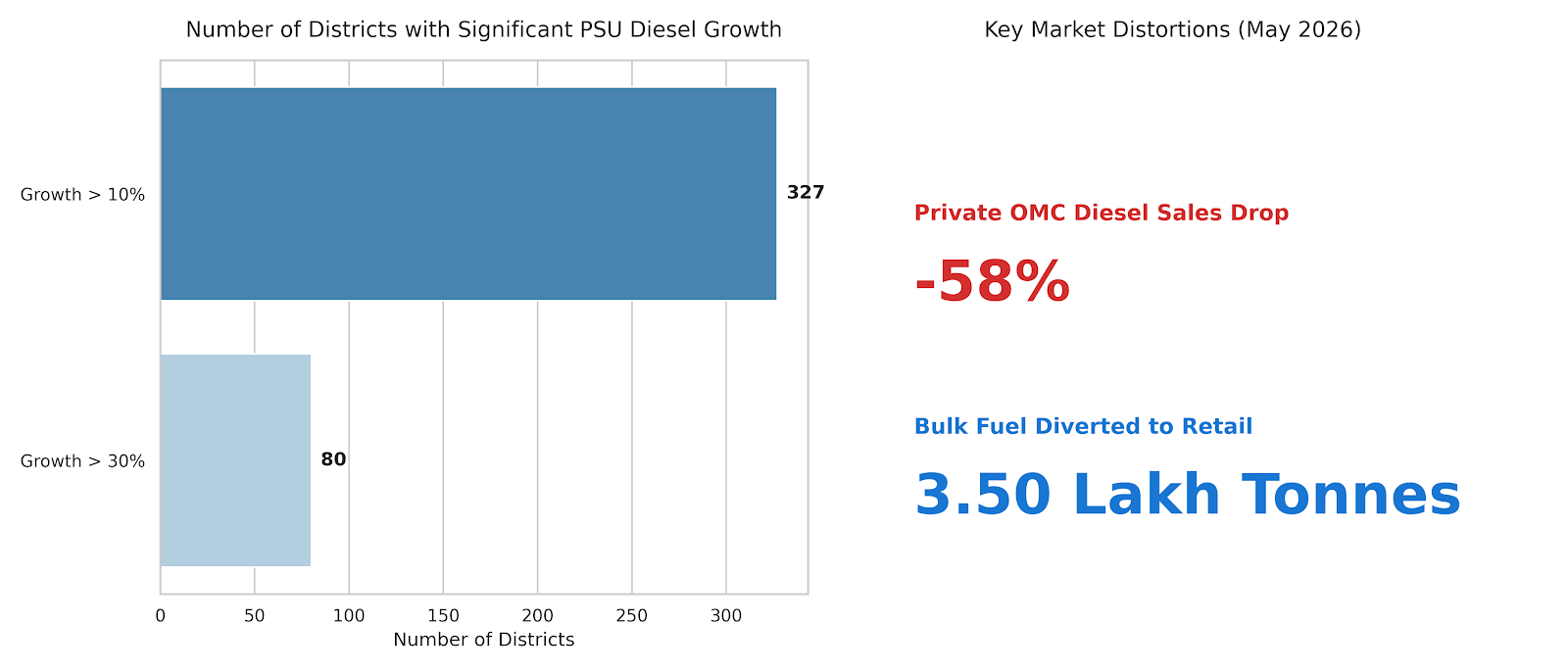
May 2026 Fuel Market Breakdown
Key Points Highlighted in the Visuals:
The Private-to-Public Shift: Private fuel pump sales plummeted by 58%, directly funneling massive retail lines into state-run (PSU) pumps.
Widespread Strain: The ripple effect hit 327 districts with over 10% sudden growth in diesel demand, while 80 districts faced an extreme surge exceeding 30%.
The Institutional Leak: Commercial operations diverted 3.50 Lakh Tonnes of cheaper retail fuel to avoid paying standard wholesale market pricing, creating localized supply panics.
Official Ministry Statement on Inventory Normalization
In its official notification released on Monday evening, the Ministry of Petroleum confirmed that domestic product inventories have stabilized back to safe operational levels.
“The Central Government on review of the prevailing supply situation of petroleum products in the country is satisfied that it is no longer necessary in the public interest to continue with the directions contained in the said Order. The Central Government hereby withdraws its order with effect from July 1, 2026.”
This policy reversal follows a similar relaxation introduced last week regarding commercial Liquefied Petroleum Gas (LPG) distributions. With both commercial LPG and retail liquid transport fuel allocations returning to an open-market model, Indian industries can now resume full-scale manufacturing operations without worrying about fuel rationing or logistics bottlenecks.
Expected Impact on Indian Industries and Retail Logistics
The complete withdrawal of these limitations will inject much-needed operational speed back into the Indian economy. The transport, manufacturing, and agricultural sectors are expected to experience immediate structural benefits:
1. Relief for Heavy Transport and Long-Haul Logistics
The 200-litre daily cap on diesel heavily impacted long-distance multi-axle trucks, which frequently require larger fuel quantities to cover long interstate routes. Fleet operators were forced to make multiple unscheduled stops at different stations, delaying supply chains for essential commodities. From July 1, long-haul commercial trucks can fill up their fuel tanks completely in a single stop, lowering transit turnaround times across major freight corridors.
2. Smooth Operations for Infrastructure and MSMEs
Small and medium enterprises (MSMEs), alongside real estate and infrastructure developers who rely on standalone diesel generator sets, were hit hard by the retail ban. Lacking the massive capital required to book bulk institutional shipments weeks in advance, these businesses depend on small-scale refueling from local pumps. The policy rollback allows these commercial operators to freely acquire fuel for their daily production lines, eliminating operational downtime.
3. Normalization of Fuel Station Traffic
With private fuel retail marketing networks expected to recalibrate their retail pricing closer to public sector benchmarks following the inflow of cheaper Iranian oil, the immense rush visible at PSU fuel stations will subsidize. This balanced distribution of consumer traffic will eliminate localized artificial shortages and long lines at urban fuel stations.
Conclusion: A Resilient Recovery for India’s Energy Sector
The lifting of the fuel rationing guidelines highlights the agility of India’s energy management strategy. Facing a severe supply chain disruption due to geopolitical conflict, the government utilized temporary rationing tools effectively to prevent widespread domestic hoarding.
Now, with global diplomacy opening up alternative crude channels and stabilizing global logistics via the US-Iran MoU, the swift elimination of these regulatory barriers ensures that India’s industrial growth engine remains uninhibited as it enters the second half of the year.