
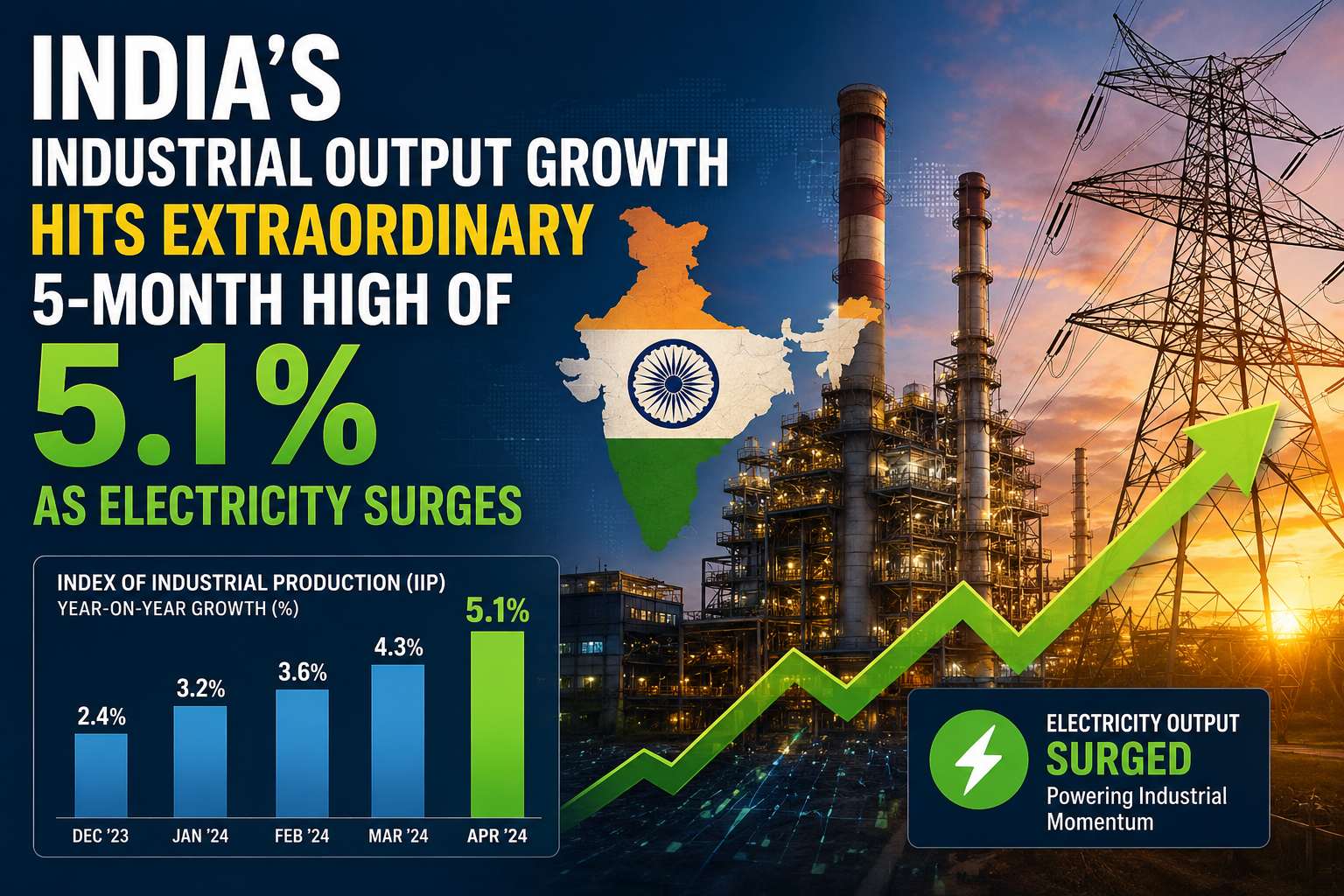
New Delhi: India’s industrial output growth accelerated to a remarkable five-month high of 5.1 percent in May 2026, showcasing the inherent resilience of the domestic economy. Data released by the Ministry of Statistics and Programme Implementation (MoSPI) on Monday highlights a steady upward trajectory from the 4.9 percent expansion recorded in April. This latest milestone represents the second monthly Index of Industrial Production (IIP) dataset published under the government’s newly revised series.
The latest quick estimates show that the primary catalyst behind this economic acceleration was an intense spike in electricity generation, closely supported by broad-based expansions across key manufacturing segments. Despite persistent global uncertainties, severe geopolitical headwinds, and supply chain disruptions, India’s domestic consumption and investment-linked production channels have continued to anchor overall industrial performance.
Driving Forces Behind the May IIP Acceleration
The headline growth figure of 5.1 percent points toward strong domestic demand. However, a deeper dive into the sector-specific indices reveals a more nuanced, multi-tiered economic picture.
The Electricity and Gas Boom
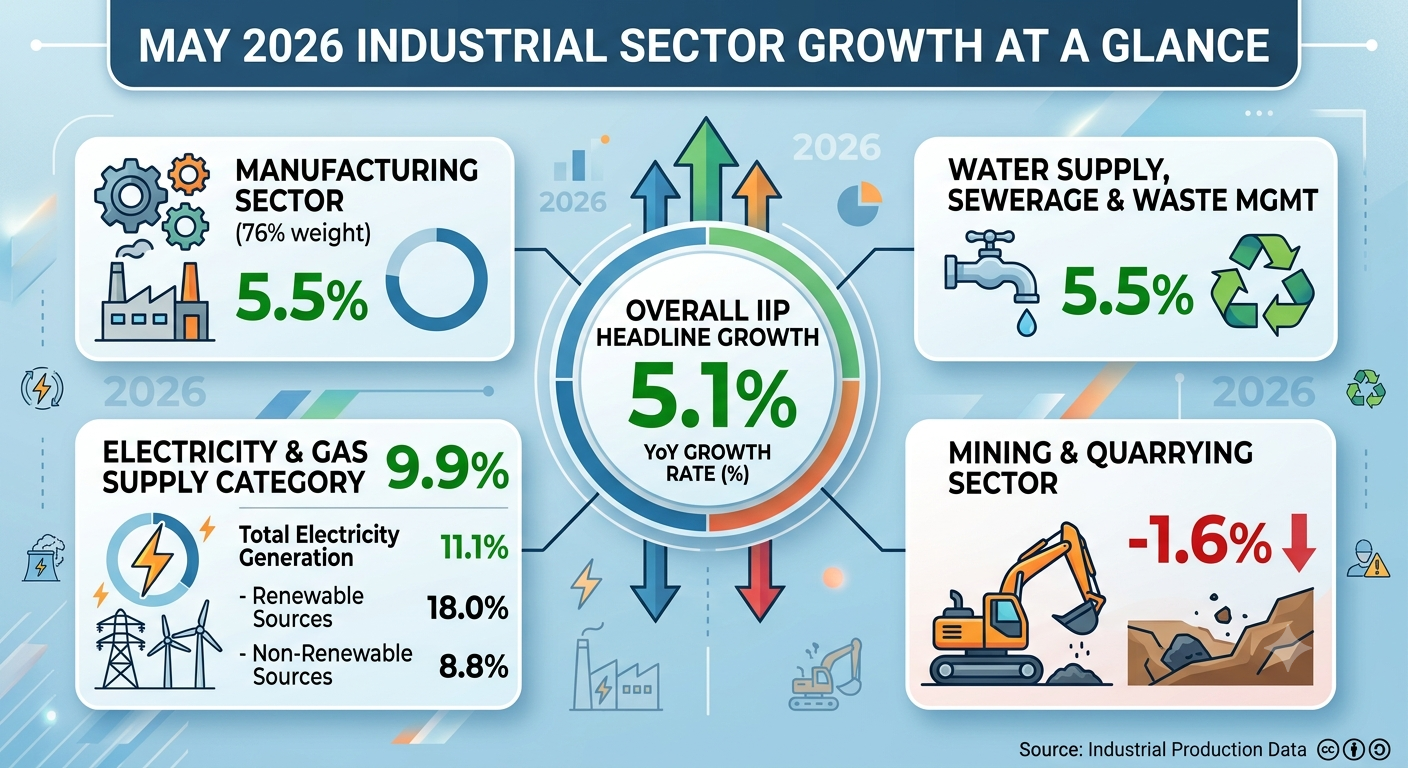
With a searing summer driving up temperatures across the Indian subcontinent, power grids faced unprecedented loads. This seasonal surge in energy requirements resulted in the “electricity and gas supply” category emerging as the single biggest driver of headline industrial growth, skyrocketing by 9.9 percent year-on-year.
Breaking down the power sector further:
Overall Electricity Production: Expanded by 11.1 percent.
Renewable Energy Sources: Witnessed a massive 18.0 percent jump, underlining India’s aggressive clean energy transition.
Non-Renewables: Grew by a solid 8.8 percent to stabilize baseline grid requirements.
Conversely, the gas supply segment suffered a 7.1 percent contraction during the month. According to Megha Arora, Director at India Ratings & Research, this decline is a direct fallout of global external shocks. The ongoing West Asia crisis has severely restricted gas logistics, extending a pattern seen in April when gas supply fell by 7.7 percent.
Manufacturing Sector Maintains Steady Core Momentum
The manufacturing sector, which commands the largest share of the IIP basket with a dominant weight of 76 percent, posted a year-on-year growth rate of 5.5 percent in May 2026. While this marks a minor deceleration from the 6.1 percent expansion recorded in April, the sector continues to exhibit steady production momentum.
Out of the 23 sub-segments that comprise the manufacturing index, 16 registered positive year-on-year growth. However, economists from the National Statistics Office (NSO) pointed out that despite a highly favorable base effect from last year, a broad-based slowdown was visible across 15 of these sub-segments when compared on a sequential monthly basis.
High-Performing Manufacturing Segments
Growth in the factory sector was heavily front-loaded by heavy machinery, transport infrastructure, and high-tech consumer components:
Electrical Equipment: This segment recorded the most explosive expansion among all manufacturing verticals, surging by 20.8 percent year-on-year. Industry analysts note that production lines were heavily driven by a sustained domestic demand for small power transformers, industrial circuit breakers, and grid-distribution components.
Fabricated Metal Products: Grew by an impressive 15.5 percent, riding on the back of domestic real estate developments and corporate capital expenditures.
Motor Vehicles, Trailers, and Semi-Trailers: Expanded by 14.5 percent, proving that the domestic automotive space remains highly lucrative.
Other Transport Equipment: Logged a strong 14.3 percent rise, heavily supported by public infrastructure expansions in railways and aerospace.
Computer and Electronic Products: Registered a healthy 11.4 percent increase, fueled by localized assembly lines and domestic technology adoption.
Structural Weaknesses: Mining and Consumer Discretionary Softness
Despite the encouraging headline numbers, the IIP data highlights several vulnerable areas within the domestic supply chain that require continuous monitoring.
Five Months of Mining Contractions
The mining and quarrying sector continues to be a persistent drag on India’s macroeconomic performance. The sector contracted by 1.6 percent year-on-year in May 2026. While this represents a marginal recovery compared to the sharper 3.7 percent shrinkage witnessed in April, it marks the fifth consecutive month that mining output has slipped into negative territory.
This downturn is largely structural, heavily weighed down by lower domestic crude oil extraction, sluggish natural gas output, and a notable drop-off in non-metallic mineral production.
Consumer Discretionary and Export Segments Lagging
Traditional, labor-intensive, and export-driven consumer sectors continue to feel the pressure of inflationary input costs and cooled overseas demand:
Wearing Apparel: Production plummeted by 8.8 percent.
Printing and Reproduction of Recorded Media: Declined by 10.3 percent.
Refined Petroleum Products: Contracted by 4.7 percent, reflecting refining maintenance shutdowns and volatile global crude supply.
Chemicals and Chemical Products: Fell by 1.3 percent, caught in a margin squeeze from expensive imported raw materials.
Use-Based Classification: Investment Goods Outpace Mass Consumption
An analysis of the use-based classification data confirms that India’s economic narrative is currently being written by public and private investments rather than a broad-based revival in rural mass consumption.
Capital Goods Lead the Charge
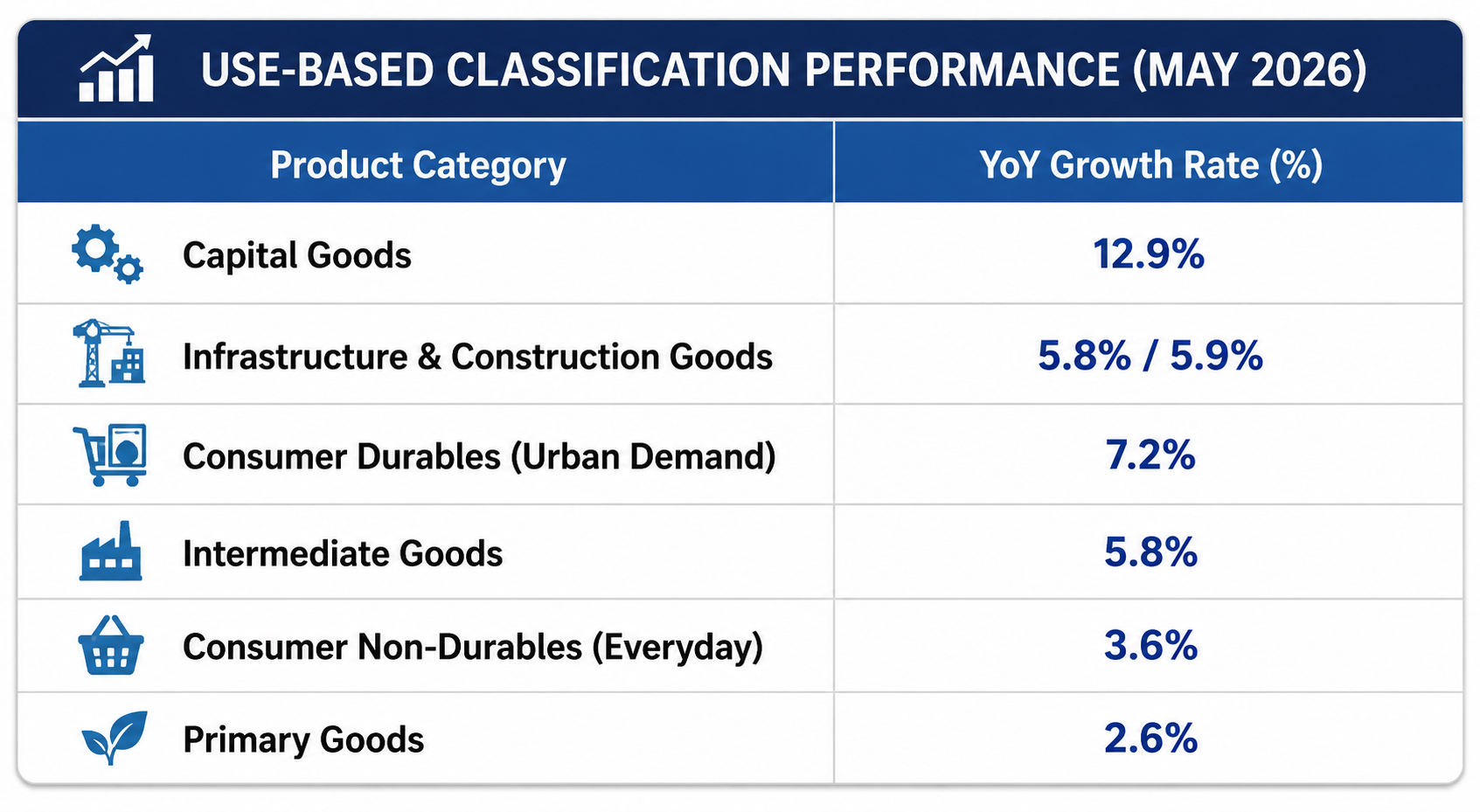
Capital goods output—a critical proxy for measuring corporate capital expenditure and long-term industrial capacity expansion—rose by an extraordinary 12.9 percent in May. This is a substantial step up from the 12 percent growth recorded in April and drastically higher than the 9.5 percent expansion seen during the same period a year ago. It underscores a powerful, sustained appetite for heavy machinery, plant equipment, and automation tools across Indian factories.
Divergent Trends in Consumer Spending
The consumer-facing indices paint a picture of a split economy:
Consumer Durables: Expanded by 7.2 percent year-on-year. This reflects strong, resilient urban discretionary demand, where high- and middle-income households continue to purchase white goods, electronics, and passenger vehicles.
Consumer Non-Durables: Grew by just 3.6 percent. This relatively subdued figure points to a lingering softness in everyday consumption items, indicating that rural markets and lower-income brackets are still cautious with their spending due to localized food inflation and a slow monsoon takeoff.
Looking Ahead: Downside Risks and the Road Ahead
While the 5.1 percent industrial expansion offers major macro relief, economists urge caution regarding the sustainability of this momentum through the second and third quarters of the fiscal year.
Geopolitical Shocks and Input Costs
The geopolitical instability in West Asia remains the single largest external risk factor for Indian manufacturers. Even if critical shipping lanes like the Strait of Hormuz remain functional, the physical damage inflicted upon regional oil and gas infrastructure will take a significant amount of time to repair.
Dipti Deshpande, Principal Economist at Crisil, warned that elevated war risk premiums, high freight insurance costs, and volatile global energy prices will likely keep input costs high for manufacturing and construction firms. If companies are forced to pass these imported input costs down to the end consumer, it could further suppress consumer non-durable demand.
Expert Commentary on Economic Durability
Rajani Sinha, Chief Economist at Care Edge Ratings, highlighted that while the sequential uptick in consumer durables and non-durables is an inherently positive signal, the structural durability of this recovery warrants a close watch. Factors such as persistent global macroeconomic volatility, lingering inflationary pressures, and the progress of the southwest monsoon will dictate industrial capacity utilization in the months to come.
Final Verdict
India’s industrial landscape in May 2026 presents a compelling mix of domestic strength and external vulnerability. Driven forward by a massive surge in electricity demand and an investment boom in capital goods, factory floors are keeping their momentum. However, to translate this five-month high into sustained, balanced growth, the domestic economy will need an enduring recovery in rural consumption, a stabilizing commodities market, and a swift resolution to external supply chain challenges.