
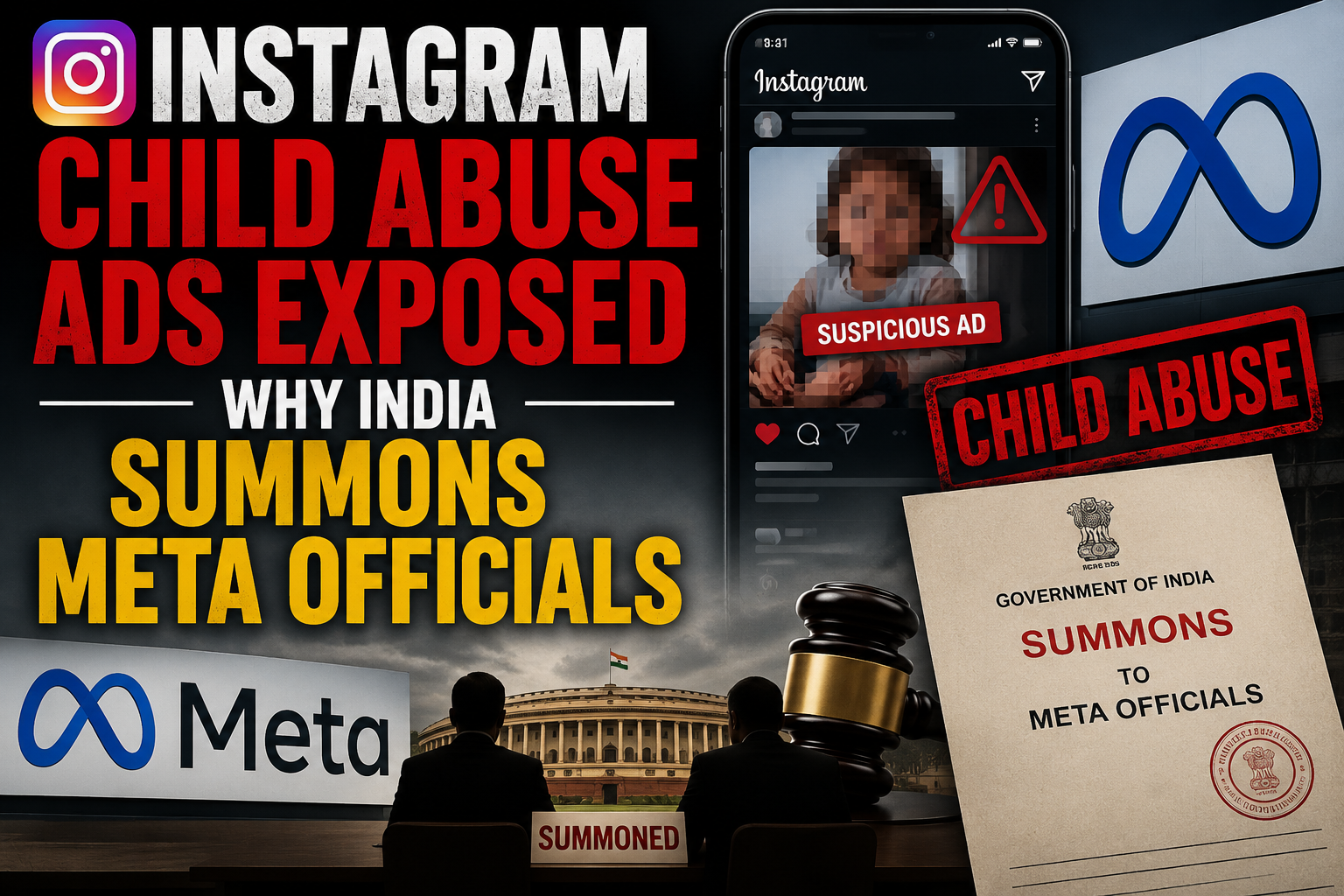
Instagram child abuse ads have sparked an unprecedented regulatory firestorm in India, forcing the central government to take a decisive stand against Silicon Valley’s content moderation failures. In a dramatic escalation, Union Minister for Electronics and Information Technology, Ashwini Vaishnaw, directed the Ministry of Electronics and Information Technology (MeitY) to formally summon top executives from Meta. This critical move follows a horrifying investigative report that exposed how the social media giant’s automated advertising systems approved and monetized paid promotions marketing child sexual abuse material (CSAM) within the country.
The shocking revelation has sent shockwaves through both global tech boardrooms and national security agencies. The Ministry will demand an immediate, granular explanation from Meta—the corporate parent of WhatsApp, Instagram, and Facebook—concerning how its commercial infrastructure was allowed to act as a gateway for illegal, predatory operations.
1. The Catalyst: What the BBC Eye Investigation Uncovered
The current crisis traces back to a comprehensive undercover investigation conducted by the British Broadcasting Corporation (BBC) World Service. Journalists established an alias account based out of India after noticing that Instagram’s standard recommendation algorithms frequently pushed highly sexualized content toward users, even without active searches for such material.
Initially, the test account followed a handful of public profiles featuring suggestive content or sexual innuendos. However, within a single week, Instagram’s commercial algorithmic engine began populating the account’s feed with paid advertisements. What started as promotions for explicit adult video calls quickly spiraled into something far worse: paid advertisements featuring minors and adults in explicitly criminal, sexually suggestive situations.
In total, the investigation identified approximately 30 unique advertisements directly promoting child sexual exploitation, many of which were replicated across multiple dummy accounts. Under Indian jurisprudence, the distribution, possession, and facilitation of both adult pornography and child sexual abuse material constitute severe criminal offenses. Despite Meta’s explicit global policies prohibiting adult nudity and child exploitation, these ads bypassed all internal systemic safeguards, proving that illicit networks can easily weaponize the platform’s advertising tools.
2. The Commercial Bridge: Moving from Instagram to Telegram
A particularly alarming dimension of this crisis is the mechanical efficiency with which these advertisements operated. The illicit promotions appeared directly in standard user feeds using highly explicit and alarming search terms, including explicit variations of “rape video” and “child video.”
These paid advertisements were not isolated incidents; they functioned as the top funnel for sophisticated criminal networks. Every advertisement contained an embedded hyperlink directing users away from Instagram and into private channels on the Dubai-based messaging application, Telegram.
Once inside these unmoderated Telegram channels, users were offered access to vast libraries of child sexual abuse material for prices as low as 99 Indian Rupees (approximately 80p or $1.20 USD). This frictionless ecosystem allowed bad actors to leverage Instagram’s vast consumer reach to build highly profitable, illicit pipelines. While organizations and child safety advocates frequently flag and remove these assets, criminal syndicates exploit this cross-platform navigation to evade law enforcement, rapidly shifting consumers across digital borders.
3. The Failed Review Framework and Corporate Inaction
Perhaps the most damaging aspect of the report centers on how Meta handled the initial community flags. When investigative journalists formally reported an active advertisement depicting a very young girl in explicit distress, the company’s frontline moderation systems failed to intervene.
Exactly 24 hours after the complaint was lodged, Instagram issued an automated reply stating that its review team had evaluated the content and determined that the advertisement “does not go against our community standards.”
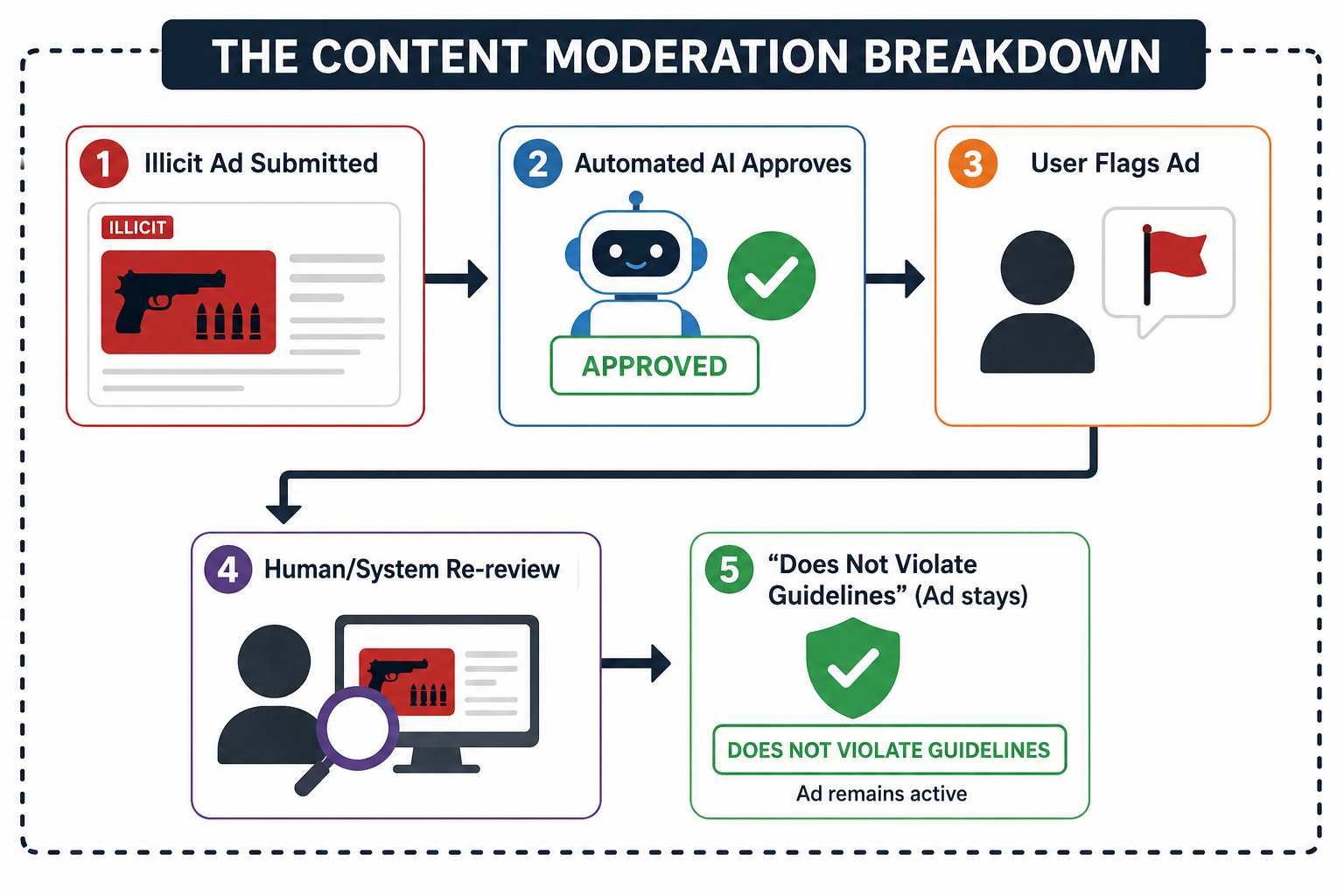 It was only after the BBC directly confronted Meta’s global communications team with empirical evidence that the parent firm intervened. Meta subsequently disabled several of the flagged advertisements, suspended the hosting accounts, and blocked associated URLs. In an official statement, Meta acknowledged the gap, stating:
“Child exploitation is a horrific crime and Meta works aggressively to fight it on our apps… No system is perfect, and our review process may not detect all policy violations. We continue to run proactive detection technology on ads once they’re live.”
4. Automation Over Humanity: The Core Technical Deficit
The systemic failure to block these advertisements stems directly from Meta’s evolving technical infrastructure. Unlike standard user posts, which are generally checked after they are published, Meta mandates that every single advertisement must undergo a review process before it goes live.
This review framework relies almost entirely on automated AI technology trained to parse text, analyze imagery, interpret audio, and evaluate destination hyperlinks. In early March, Meta publicly announced a conscious strategy to scale back its reliance on third-party human review teams, pivoting instead toward advanced artificial intelligence models overseen by a smaller internal cohort of engineers.
Critics argue that this heavy reliance on AI has created massive vulnerabilities. Sophisticated criminal syndicates can bypass automated filters using coded text, obscured metadata, or multi-layered URL redirects. When AI models prioritize commercial throughput and rapid ad approvals, subtle variations of highly illicit content slip through the cracks, allowing criminal networks to purchase ad space using standard corporate payment pathways.
5. Profit vs. Protection: The Financial Conundrum
The monetization of these illegal ads raises uncomfortable ethical and legal questions regarding Big Tech’s revenue models. Advertising remains the lifeblood of Meta’s corporate structure; the company’s financial disclosures indicated that nearly 98% of its $200 billion global revenue for the financial year ending in 2025 was generated directly through ad sales. Market analysts estimate that Instagram alone accounts for over 90% of that total revenue stream.
Former industry insiders have expressed deep concern over this alignment of incentives. Brian Boland, a former Vice President at Facebook who helped construct the platform’s early advertising business before resigning, noted that the corporate compromise between safety and profitability has deteriorated over the past decade. Boland emphasized that the platform’s underlying algorithms are inherently optimized to chase engagement, clicks, and ad views, often pushing users toward increasingly extreme content to keep them active.
This commercial dynamic drew sharp criticism from Madan Lokur, a retired Justice of the Supreme Court of India. Commenting on the investigative findings, Justice Lokur stated that social media giants cannot escape legal accountability when their paid ad infrastructure is actively leveraged to profit from criminal enterprises. He suggested that the severity of the findings warrants suo motu cognizance by the Supreme Court of India to compel immediate structural reform.
6. India’s Surging Global Footprint in CSAM Tracking
The scale of online child exploitation in India presents an immense challenge for both law enforcement and technology platforms. According to data provided by the National Center for Missing and Exploited Children (NCMEC)—the global clearinghouse for reporting digital child exploitation—India has become one of the primary sources for digital alerts worldwide.
In 2025, India received nearly 1.9 million reports of suspected child sexual abuse material through the NCMEC CyberTipline, placing it second globally, just behind the United States which registered two million reports.
| Metric / Country | India (2025) | United States (2025) |
| Total NCMEC CyberTipline Reports | 1.9 Million | 2.0 Million |
| Primary Platform Source | Meta (Instagram/Facebook) | Diversified Tech |
| Dominant Secondary Route | Telegram Hyperlinks | Peer-to-Peer Networks |
Senior law enforcement officials, including Shikha Goel, Director of the Cyber Security Bureau in Telangana, note that while Meta platforms generate the highest volume of automated tipline reports, this is partly due to their active tracking systems. However, grassroots organizations like the Rati Foundation emphasize that the core issue lies in the ease with which bad actors navigate between different platforms, using Instagram for discovery and Telegram for transaction.
7. Escalating Friction: The WhatsApp Username Standoff
This summons is the second major clash between the Indian government and Meta in just one week, showing that the government is tightening its grip on the tech giant. Just days earlier, India ordered Meta to stop launching its new “username” feature on WhatsApp.
The government gave Meta three days to explain how the feature works. Officials worry that moving away from phone numbers will lead to more online scams, phishing, and fake accounts pretending to be banks or government officers.
Between these WhatsApp worries and the horrific Instagram ads, India is taking a much tougher stand on big tech. The government is making it clear that tech companies cannot launch new features without strong security steps to keep people safe. Meta is now under intense pressure to prove it can clean up its apps and stop criminals from using its tools.