
India’s top five Information Technology (IT) powerhouses has plummeted to match the size of a single domestic conglomerate: Mukesh Ambani’s Reliance Industries Limited (RIL).
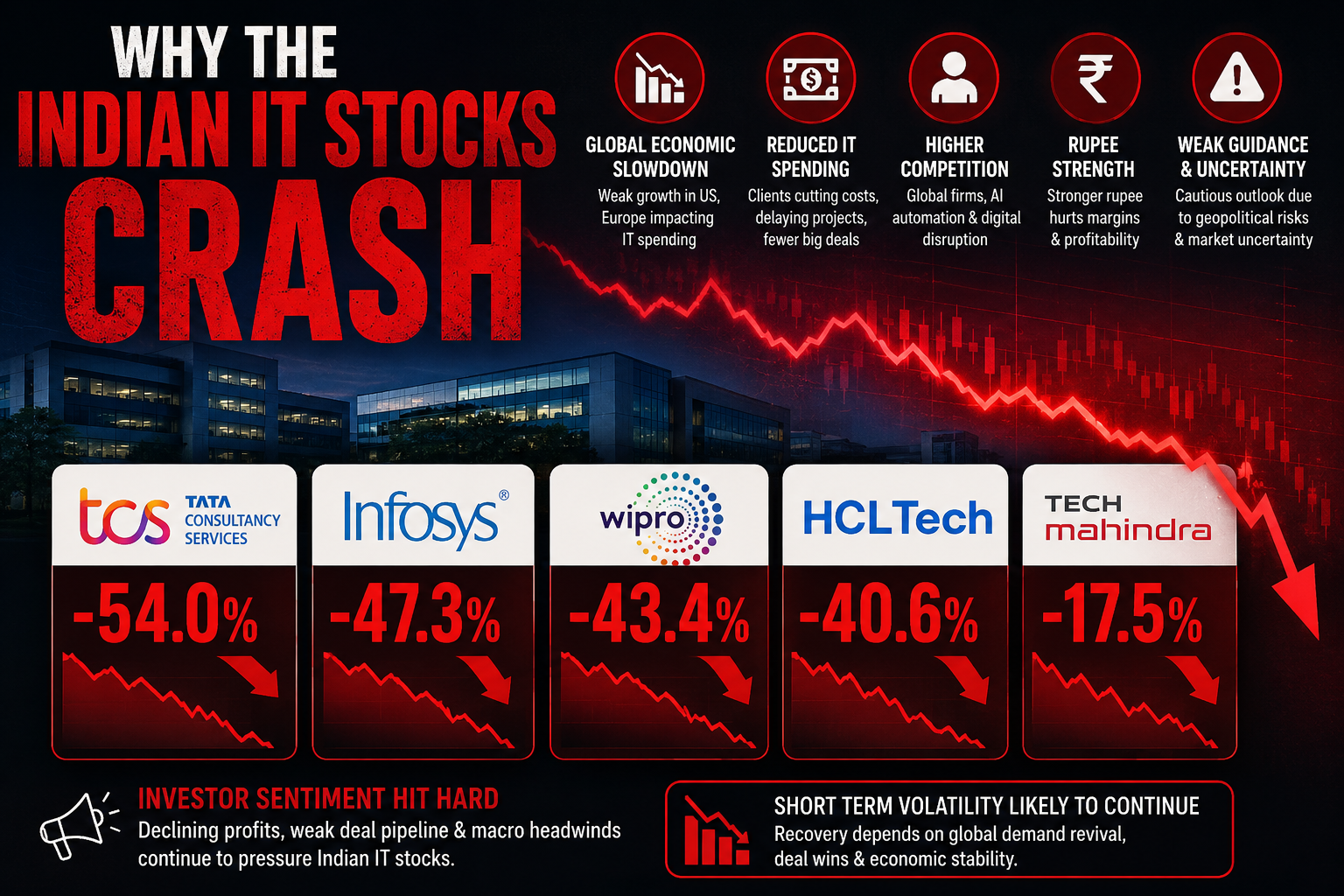
The relentless Indian IT stocks crash has fundamentally shaken investor confidence across the National Stock Exchange (NSE). The collective market capitalization of Tata Consultancy Services (TCS), Infosys, Wipro, HCL Technologies, and Tech Mahindra has nose-dived by over 46%, plunging from a dizzying historic peak of ₹33.71 lakh crore in August 2024 to a staggering ₹18.15 lakh crore. For a brief moment earlier this week, the combined weight of these five digital titans actually slipped below Reliance’s market valuation—marking the first time in over twenty years that India’s collective software army was outweighed by a single energy-to-retail behemoth.
To understand how this massive value destruction occurred, we have to look closely at the converging forces of structural shift and macroeconomic headwinds. Major global brokerages like JP Morgan and JM Financial have cast a long shadow of caution over the sector, sounding structural alarm bells just as the Q1 FY27 earnings season kicks off.
1. The Paradox of Generative AI: From Catalyst to Deflationary Threat
When Generative AI burst into the enterprise mainstream, many investors initially viewed it as a massive premium opportunity for Indian tech firms. The reality has proven far more complicated and punishing. Instead of triggering a wave of high-margin development contracts, rapid GenAI adoption has introduced severe pricing deflation across traditional services.
Automation tools are now completing routine tasks—such as legacy code maintenance, basic software testing, and infrastructure management—in a fraction of the time it used to take human engineers. Because Indian IT’s legacy business model relies heavily on billing by time and material (billing per engineer hour), these massive productivity gains have unintentionally shrunk transaction sizes. Clients are aggressively demanding that these AI-driven cost savings be passed directly down to them, triggering intense competitive pricing pressures across the industry.
As JP Morgan noted in its latest structural review, the sector is currently only in the second year of an extended AI deflationary cycle. The brokerage warns that these headwinds will likely pinch top-line growth for at least another two years, fundamentally altering long-term software margins.
2. The Great IT Budget Tug-of-War
Global enterprise tech spending hasn’t necessarily frozen entirely, but it has shifted into areas where traditional Indian service firms have a smaller footprint. Large corporations in North America and Europe are facing immense internal pressure to fund their own internal AI initiatives.
To pay for expensive cloud computing infrastructure, high-end graphic processing units (GPUs), and specialized AI tokens, corporate boards are cannibalizing their traditional operational IT budgets. Money that would have historically gone toward large-scale enterprise resource planning (ERP) migrations or standard application development is being reallocated. Consequently, Indian IT providers are witnessing a severe drought in high-value discretionary tech spending.
3. Global Macroeconomic Stagnation and Client Indecision
The macroeconomic climate in western markets remains deeply fragile. With persistent geopolitical tensions, volatile energy costs, and prolonged high interest rates in key economies, corporate buyers are playing defense.
This anxiety has translated directly into long delays in closing new deals and slower project ramp-ups. Even when Indian IT firms successfully secure large multi-year deals, clients are taking much longer to clear the actual project implementation phases. Deal conversion cycles have lengthened significantly, meaning signed contracts are failing to translate into immediate quarterly revenue. Recent operational guidance from global bellwether Accenture confirmed this reality, signaling that slower decision-making throughout Europe and the Americas is dragging down near-term revenue pipelines across the globe.
4. Aggressive Valuation Downgrades by Global Brokerages
As structural growth slows, financial institutions are aggressively slashing their target multiples. The era where a large-cap Indian IT company could command a premium price-to-earnings (P/E) multiple of 25x to 30x appears to be drawing to a close.
JP Morgan recently delivered a significant blow to sector sentiment by cutting target P/E multiples by 10% to 25%, indicating that it now models scale-firm multiples at a conservative 12x to 15x. The brokerage expects structural growth for large-cap firms to hover around a modest 3% to 4%, rather than bouncing back to historical mid-single-digit averages. Consequently, both JP Morgan and JM Financial have initiated targeted downgrades on major companies:
HCL Technologies & Wipro: Downgraded to ‘Underweight’ by JP Morgan, citing a projected 5% to 9% downside in consensus earnings estimates for FY27-28.
Tata Technologies: Placed under an ‘Underweight’ or ‘Reduce’ tag across major brokerages due to near-term execution pressures.
5. The Individual Casualties: How the Titans Fell
The pain of this market correction has not been distributed evenly, though no large-cap player has emerged completely unscathed. The individual drops from historical peaks tell a dramatic story of shifting market dynamics:
| IT Stock Name | Decline from Historical Peak Value | Current Market State & Outlook Notes |
| TCS | -54.0% | The sharpest absolute faller; down to a valuation of ₹7.57 lakh crore from its peak of ₹16.47 lakh crore. |
| Infosys | -47.3% | Anticipated to lower its FY27 constant-currency revenue growth guidance down to 1.5% – 2.5%. |
| Wipro | -43.4% | Facing sequential growth pressures, with Q2 FY27 projections hovering between -2% and 0%. |
| HCL Tech | -40.6% | Services growth guidance expected to feel pressure; downgraded due to valuation risks. |
| Tech Mahindra | -17.5% | Deemed relatively resilient compared to its peers, showing the smallest drop from its absolute peak. |
In stark contrast to this collective rout, Reliance Industries has managed to anchor the domestic market. While RIL did experience a moderate 16.7% correction from its June 2024 peak of ₹21.2 lakh crore, its current valuation of ₹17.65 lakh crore allows a single corporate entity to stand on equal financial footing with the country’s entire frontline software export machine.
Finding Pockets of Value: The Brokerage Playbook
Despite the pervasive near-term gloom, institutional analysts stress that this correction is a structural re-baselining rather than an existential threat. Selective IT companies with unique market niches, strong engineering capabilities, or robust balance sheets are still drawing positive corporate ratings.
For investors navigating this volatile landscape, JM Financial’s revised post-correction coverage offers a selective roadmap of preferred plays versus stocks to avoid:
The Buy & Add Conviction List
Infosys (Target Price: ₹1,230): Positioned as a preferred choice for investors looking for long-term recovery, backed by a stable 20-22% margin outlook.
Mphasis (Target Price: ₹2,715): Highly favored in near-term pair trades alongside mid-tier digital service players.
Tech Mahindra (Target Price: ₹1,525): Showing relatively superior resilience in large-cap defensive strategies.
Specialist Mid-Caps: Sagility (Target Price: ₹55) and Firstsource Solutions (Target Price: ₹285) remain high-conviction picks due to insulated healthcare and business process niches.
The Reduce & Avoid Watchlist
Wipro (Target Price: ₹165) & HCL Tech (Target Price: ₹1,020): Facing immediate headwinds from down-side revenue guidance revisions.
LTIMindtree (Target Price: ₹3,285): Underperforming relative to peers in converting pipeline wins to immediate bottom-line growth.
KPIT Technologies (Target Price: ₹620): Dealing with changing enterprise software research cycles in the automotive and mobility ecosystems.
Looking Ahead: The Q1 FY27 Litmus Test
The upcoming weeks will provide crucial validation for these cautious market outlooks. Tata Consultancy Services is scheduled to report its quarterly earnings for the April-June 2026 period on Thursday, July 9. As the traditional bellwether, TCS’s management commentary regarding discretionary spending trends and execution timelines will set the tone for the entire market.
While a depreciating Indian Rupee (INR) may provide a temporary cushion for operational margins, the core challenge remains structural. Until Indian IT service providers can successfully pivot from human-hour billing models to high-value, non-linear AI platform implementation frameworks, structural valuation pressures will likely remain. The current market layout underscores a profound truth for modern equity markets: in the era of rapid automation, even the most deeply entrenched technological empires must rapidly transform or risk losing ground to old-economy giants.
Disclaimer: The information provided above is for educational purposes only. We strongly advise investors to consult with SEBI-certified financial experts before making any investment decisions.