
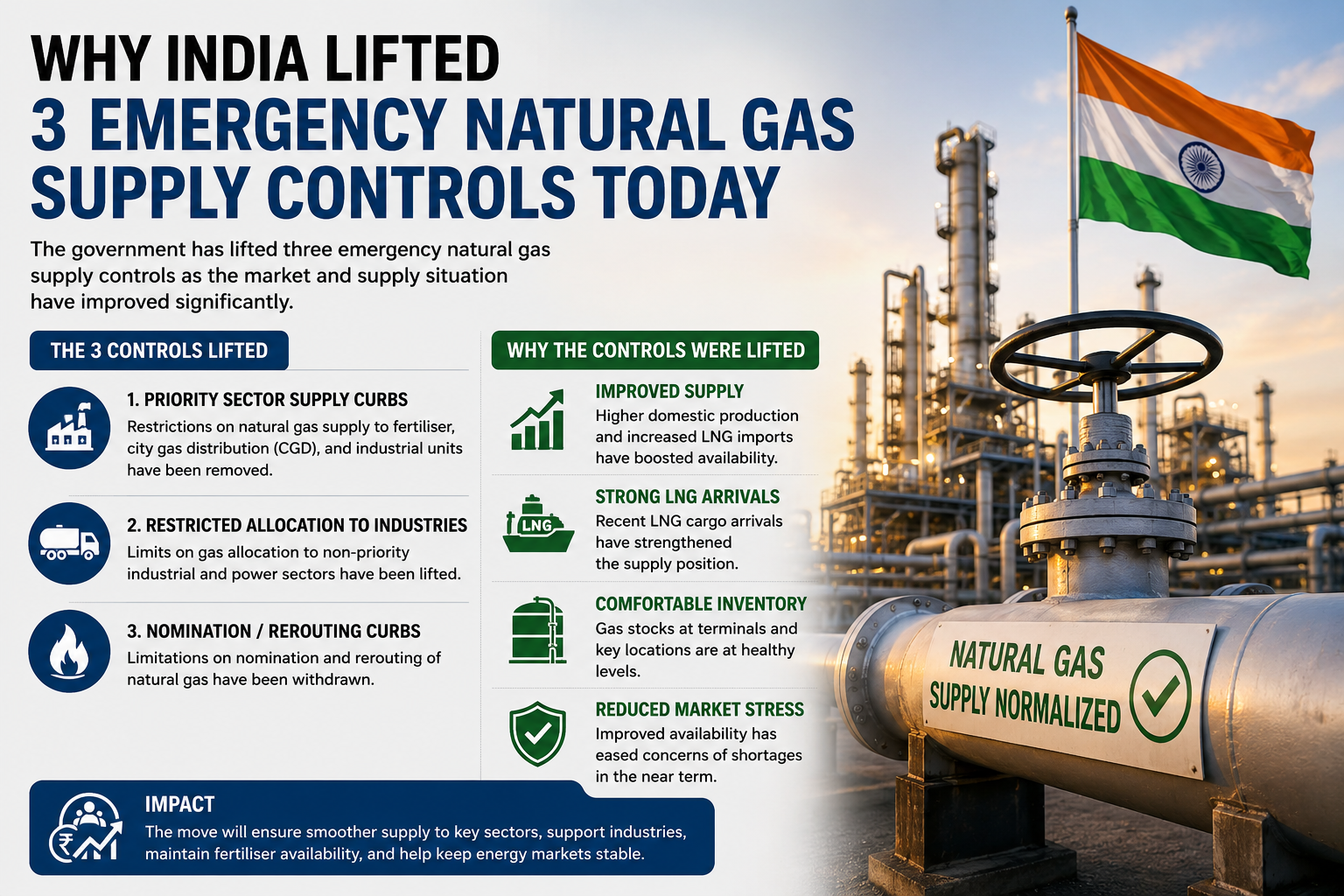
Emergency natural gas supply controls that reshaped India’s energy distribution network earlier this year have officially been withdrawn by the Central Government. In a significant move that signals a return to normalcy for the nation’s energy sector, the Ministry of Petroleum and Natural Gas issued a formal notification on Saturday confirming the complete rollback of the emergency restrictions.
The decision comes as a massive relief to non-priority industrial sectors, which had been facing supply cuts and mandatory diversions since March. According to government officials, the stabilization of global supply chains and the steady resumption of Liquefied Natural Gas (LNG) shipments from West Asia have allowed the government to confidently phase out these strict intervention policies.
The Genesis of the Emergency Measures
To understand the significance of this policy reversal, it is essential to look back at the volatile geopolitical landscape of early 2026. In March, the Middle East conflict reached a critical boiling point, directly impacting maritime trade routes that are vital to India’s energy security.
The primary catalyst for the domestic crisis was a major disruption at the Strait of Hormuz, a narrow chink in global shipping lanes through which a massive percentage of the world’s liquefied natural gas passes. As security threats escalated, international LNG suppliers found themselves unable to guarantee safe passage for their cargo vessels.
The Force Majeure Trigger
Faced with unprecedented security risks in the gulf, several major West Asian LNG suppliers took the drastic step of invoking force majeure clauses in their supply contracts. This legal mechanism effectively absolved suppliers from liability for failing to deliver contracted volumes due to circumstances beyond their control.
For India, a country heavily reliant on imported gas to power its industries, fertilizer plants, and city gas distribution networks, this sudden halt in shipments created an immediate supply deficit.
Securing Essential Sectors
Faced with a sudden shortage, the Centre acted swiftly by invoking emergency powers under domestic energy regulations. The government mandated strict supply controls designed to preserve the nation’s core economic infrastructure.
Under these emergency directives, gas supplies were systematically diverted away from non-priority sectors—such as luxury manufacturing, refined commercial industries, and certain power plants—and redirected toward critical, high-priority users. These essential sectors included:
Fertilizer Manufacturing Plants: Crucial for maintaining India’s agricultural output and food security.
City Gas Distribution (CGD) Networks: Ensuring uninterrupted piped natural gas (PNG) for households and compressed natural gas (CNG) for public transportation.
Essential Power Generation Units: Preventing potential grid failures during periods of peak demand.
Strategic Shift: How the Energy Grid Weathered the Storm
The imposition of these restrictions was a calculated risk by the Ministry of Petroleum and Natural Gas. While it protected everyday citizens and the agricultural backbone of the country, it left many manufacturing units scrambling for alternative fuel sources, driving up operational costs in the secondary industrial sectors.
          STATIONARY SUPPLY STABILIZATION CHAIN


   [West Asia Tensions Ease] -> [Shipping Lanes Reopen]

                              v

   [Force Majeure Cancelled] -> [LNG Cargoes Dispatched]

                              v

   [Indian Terminal Stocks Rise] -> [Emergency Curbs Lifted]
Over the last few months, intensive diplomatic efforts, combined with a gradual easing of active hostilities along the crucial maritime corridors, allowed shipping lines to resume standard operations. De-escalation in the zone meant that major Qatari and Emirati suppliers could safely navigate the Strait of Hormuz once again, fulfilling long-term supply contracts that had been temporarily put on ice.
Market Implications of the Rollback
The withdrawal of the emergency natural gas supply controls is expected to have an immediate, widespread positive impact across multiple sectors of the Indian economy.
1. Relief for Non-Priority Industries
Industries such as ceramics, glass manufacturing, steel processing, and chemical refining, which were forced to cut production or purchase expensive spot-market LNG during the restriction period, can now access regular, contracted pipeline supplies. This will lower manufacturing input costs and help stabilize consumer price inflation for industrial goods.
2. Stabilization of Spot Market Prices
When India was forced to adjust to the sudden domestic deficit, domestic gas aggregators had to hunt for immediate volumes on the international spot market, which pushed up local delivery pricing structures. With long-term, cheaper West Asian supply lines fully restored, Indian domestic spot prices for natural gas are projected to cool down significantly over the financial quarter.
3. Boost to Infrastructure Projects
With consistent gas availability guaranteed, major infrastructure initiatives under the City Gas Distribution network expansion can resume regular timelines. The assurance of steady supply will also boost investor confidence in India’s long-term transition towards a more gas-based economy, aimed at increasing the share of natural gas in the primary energy mix.
Policy Analytics: Lessons from the 2026 Crisis
This brief but intense crisis highlighted both the vulnerability and the resilience of India’s energy architecture. By successfully managing the supply shock without triggering widespread power blackouts or agricultural distress, the Centre demonstrated robust crisis-management protocols.
However, industry experts suggest that this episode will likely accelerate India’s strategic push toward diversifying its energy import footprint. Relying less on a single geographic corridor like West Asia and increasing bilateral trade agreements with emerging LNG exporters in North America, Africa, and Australia could serve as a vital buffer against future geopolitical disruptions.
Furthermore, it underscores the critical need for expanded domestic commercial gas storage facilities. Much like the Strategic Petroleum Reserves (SPR) maintained for crude oil, building equivalent buffer capacities for liquefied natural gas could offer the nation crucial weeks of breathing room, eliminating the need to implement emergency rationing controls the next time global shipping lanes face sudden geopolitical headwinds.
The Road Ahead for Indian Energy Security
The official notification issued on Saturday serves as conclusive proof that the immediate energy emergency has passed. As the Ministry of Petroleum and Natural Gas completely untangles these supply interventions, the market is expected to adjust rapidly, allowing industrial output to regain its full momentum moving into the second half of the year.
For now, the restoration of smooth shipping lines through the West Asian corridors brings much-needed stability to Indian markets, proving that the nation’s energy infrastructure is capable of navigating complex geopolitical storms.