
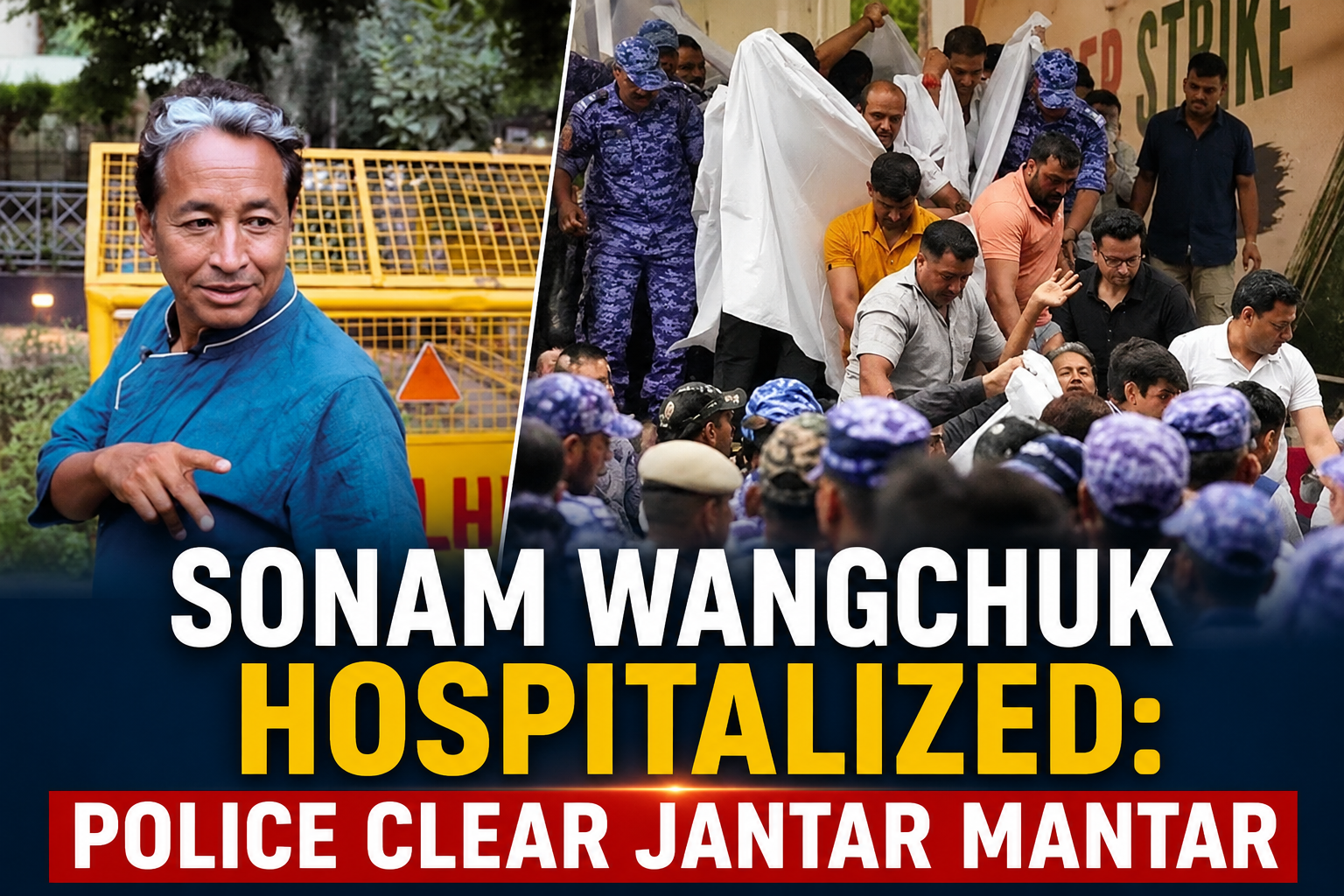
Sonam Wangchuk has been shifted to Safdarjung Hospital after fasting for 20 days straight on just water. Doctors warned that his health was dipping fast, forcing the move. The protest, which started against the NEET paper leak and demanded the Education Minister’s resignation, has now turned into a direct clash between the government and the activists. On the morning of July 18, the Delhi Police is attempting to remove tents and protesters from Jantar Mantar and completely clear the site.
The Morning Operation at Jantar Mantar
According to ground reports from the heart of Delhi, police officers arrived at the pavement site where protesters had been camp-sleeping through the monsoon humidity.
Key Details of the Police Action:
Civilian Clothes: Instead of traditional riot gear, officers arrived in plain clothes—wearing casual blue, white, yellow, and black T-shirts. This initial lack of uniform caused massive confusion among the sleeping supporters.
Screening the Site: Police deployed large white sheets to cover the area, cutting off public visibility during the evacuation.
Clashes with CJP: Activists from the Cockroach Janta Party (CJP), who have been co-organizing the protest, tried to block the vehicles, leading to brief shouting matches and slogans.
The Delhi Police maintained that they exercised maximum restraint. Authorities confirmed they moved Wangchuk purely on medical grounds after doctors warned that losing eight kilograms had put him at imminent risk of organ failure. A police vehicle moved him directly to Safdarjung Hospital, where officials state his vitals are currently stable.
Inside the Emergency Ward: The Medical Demand
While the political debate intensifies outside, a strict medical boundary has been set inside Safdarjung Hospital. Gitanjali J. Angmo, Wangchuk’s wife, issued an immediate, protective directive to the hospital staff:
“Nothing should be administered to him orally or intravenously without my consent, his family, and his doctors who have been monitoring his health for the past 20 days.”
Before his forced removal, Wangchuk had been surviving solely on water to protest the massive NEET paper leak scandal. The movement holds Education Minister Dharmendra Pradhan directly responsible for the leak, demanding his immediate resignation over the compromised future of lakhs of medical aspirants.
Escalation: The Cockroach Janta Party’s Strategy
The logistical momentum of the protest now rests heavily on the Cockroach Janta Party (CJP), led by Abhijeet Dipke. Following the police action, Dipke addressed the remaining crowd at Jantar Mantar, shifting the group’s target from the Education Minister directly to the Prime Minister.
[NEET Leak Grievance] ➔ [Demand Minister's Resignation] ➔ [Call for PM's Resignation]
Dipke announced that the removal of their leader would not stop the movement. The group plans to escalate the agitation by launching a direct march to Parliament on July 20, 2026, coinciding exactly with the start of the Monsoon Session.
The Core Issue: Why the NEET Leak Agitation Persists
The 20-day protest has resonated widely because the NEET exam serves as the primary gateway for students trying to break out of poverty or secure a stable career. A compromised exam shatters the basic trust between the youth and state institutions.
Wangchuk channeled this intense student frustration, famously warning his followers before his arrest: “If you don’t come and July 20 is not successful, I will come back as a ghost.”
Battle Lines Drawn for July 20
The government now faces a delicate balancing act. Authorities want to prevent Wangchuk from becoming a martyr in a state-run facility, yet they need to contain the spreading street agitation. Heavy security barricades have been reinforced around both Safdarjung Hospital and the Jantar Mantar perimeter.
The ultimate test for the movement occurs on Monday, July 20. With Wangchuk hospitalized, the leadership falls entirely on frontline organizers like Dipke. Whether the crowd can maintain discipline and focus on the NEET paper leak demands without their central figure remains the crucial question as the Monsoon Session begins.