
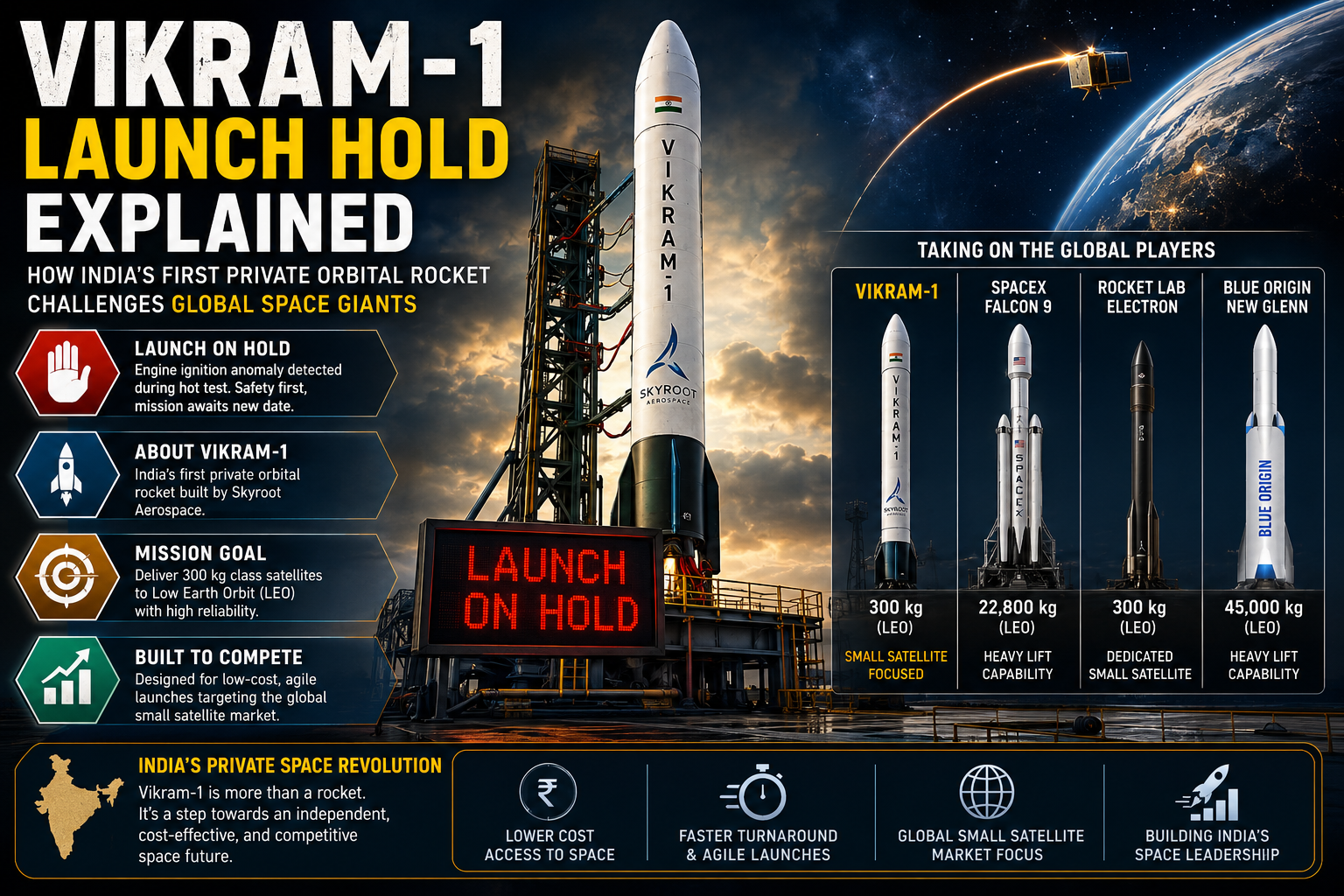
The highly discussed Vikram-1 launch encountered a sudden “planned hold” exactly five minutes before its scheduled liftoff at 11:30 AM on Saturday, July 18, 2026. Standing on the launch pad at the Satish Dhawan Space Centre (SDSC) in Sriharikota, India’s first privately developed orbital-class rocket has kept space tracking teams, industry analysts, and global satellite operators waiting for the final clearance. While the mission control team reviews live telemetry and sensor data before resetting the countdown clock, this brief pause highlights the intense precision required for modern commercial space missions.
Developed entirely by Hyderabad-based space-tech startup Skyroot Aerospace, this maiden orbital test flight—officially named Mission Aagaman (“Arrival”)—represents a massive turning point for the Indian subcontinent’s aerospace ecosystem. It marks a decisive shift from a decades-long model of purely government-run space missions managed by the Indian Space Research Organisation (ISRO) toward a commercial, industry-backed market.
When the countdown resumes, this seven-storey structural marvel will attempt to completely rewrite the operating economics of the global small-satellite launch market. Here is an in-depth, comprehensive analysis of the seven core ways Vikram-1 is altering space travel.
1. The “Uber for Orbit” Commercial Model
For the past twenty years, small satellite operators—including universities, research labs, agricultural monitoring groups, and tactical communication startups—have faced a massive logistical bottleneck. If a company wants to deploy a compact payload weighing less than 350 kg into low-Earth orbit, it traditionally has to buy space as a secondary passenger on a massive commercial launch vehicle.
This creates severe operational problems. The primary customer who paid for 90% of the rocket dictates the entire timeline: the launch date, the weather parameters, the specific launch window, and the final orbital insertion altitude. Small operators often wait months or even years in storage warehouses because the primary satellite faced manufacturing delays. Furthermore, they are dropped off wherever the primary customer needs to go, forcing the small satellites to use up their own limited internal fuel supplies to steer themselves into their correct working orbits.
Skyroot Aerospace is dismantling this entire setup by introducing what leadership describes as an on-demand taxi service for space. By optimizing the Vikram-1 rocket strictly for small payloads up to 350 kg, the company can offer highly customizable, dedicated launch schedules.
Instead of adjusting to a foreign space agency’s itinerary, global commercial clients can now buy the entire rocket to fly directly to their exact target coordinates. This model closely mirrors the commercial success of Rocket Lab’s Electron vehicle in the United States, introducing a highly flexible, low-cost options engine tailored directly to the global small-satellite boom.
2. Advanced Material Science: All-Carbon Fiber Composites
From a structural engineering standpoint, Vikram-1 breaks traditional rocket manufacturing conventions by using an all-carbon composite body instead of classic aerospace metals. Historically, rocket builders relied on high-grade aluminum-lithium or stainless steel alloys to build propellant tanks and outer fairings. While these metals handle internal pressures well, they add massive amounts of dead weight to the vehicle’s dry structure.
Skyroot’s engineering team replaced these heavy metals with advanced carbon fiber sheets woven together at their specialized production lines. The differences between these two methodologies define the operational metrics of the rocket:
| Structural Feature / Metric | Conventional Rocket Engineering | Vikram-1 Composite Design |
| Primary Structural Material | Aerospace-grade steel or aluminum alloys | 100% High-Strength Carbon Fiber |
| Dead Weight Profile | Heavy frame, demands massive liftoff thrust | Ultra-lightweight structural architecture |
| Fatigue Under Severe Stress | Prone to structural micro-cracking and flexing | High strength-to-weight structural resilience |
| Payload Delivery Efficiency | Lower percentage of total mass allocated to cargo | Maximized weight limits for commercial cargo |
By shedding dead structural weight from the rocket’s outer walls, Skyroot can allocate that saved weight directly to commercial or scientific cargo. Every single gram removed from the first, second, or third stage translates into extra revenue-generating capacity inside the payload fairing.
Crucially, the first stage of the Vikram-1 vehicle sets a national record as India’s longest monolithic carbon composite rocket stage manufactured domestically. Building a single, seamless carbon tube of this size requires precise thermal curing and automated fiber placement machines, proving that India’s private sector can now execute cutting-edge aerospace manufacturing completely in-house.
3. Additive Manufacturing: 100% 3D-Printed Liquid Engines
The innovations built into Vikram-1 extend deep into its internal propulsion systems. The critical top stage of the vehicle—the Orbital Adjustment Module (OAM)—runs on a liquid propellant engine built entirely through 3D printing (additive manufacturing). This marks the first time a fully 3D-printed liquid engine is being deployed on an Indian orbital launch vehicle.
Traditional rocket engines are notoriously difficult to build. They feature highly complex internal cooling channels wrapped around the combustion chamber to prevent the metal from melting during firing. Manufacturing these channels traditionally requires casting individual parts, machining them down to millimeter tolerances, and manually welding hundreds of intricate tubes, joints, and injectors together. This process takes months, costs millions, and introduces hundreds of structural welds that could crack under extreme operational pressures.
[Traditional System] -> Manual Castings -> Complex Welding -> Multi-Month Timeline -> High Defect Risk
[Skyroot 3D Printing] -> Automated Laser Print -> Monolithic Engine -> Built in Days -> Low Defect Risk
Skyroot completely bypasses these manufacturing hurdles by utilizing industrial metal 3D printers. A specialized laser fuses super-alloy powders layer by layer, printing the entire engine block, internal cooling channels, and injector head as a single, solid piece of metal.
This monolithic build completely eliminates weak structural joints, slashes engine production timelines from months down to a few days, and allows Skyroot to hit an unprecedented industrial scale. The company can now manufacture up to one complete multi-stage rocket every single month at their state-of-the-art Hyderabad production facility.
4. Space Debris Removal: Cleaning Up the Low Orbit Crisis
As thousands of new commercial satellites enter low-Earth orbit, space debris has become a major threat to global telecommunications, weather tracking, and national security infrastructure. A single stray bolt or dead satellite casing traveling at 28,000 kilometers per hour can completely destroy an operational multi-million-dollar satellite asset upon impact.
Skyroot is addressing this problem directly by converting its first orbital test flight into a live laboratory for environmental space cleanup tech. Nestled alongside the commercial satellites inside the nose cone is the specialized EMBRACE payload, developed by the private firm Cosmoserve Space. This experimental system carries a miniature robotic arm assembly designed specifically to handle objects in zero gravity.
During the final phases of Mission Aagaman, the module will deploy this mechanical arm to test its stabilization loops, joint responses, and tracking cameras in a microgravity environment. By gathering real-world data on how automated systems manipulate physical hardware in orbit, Skyroot is laying the technical foundation for future cleanup vessels. Providing a commercial platform to test these systems proves that India’s private tech sector is actively investing in the long-term environmental sustainability of the orbital highways.
5. Micro-Art and Cultural Tributes in Space
While Vikram-1 is an intensely technical engineering project, Skyroot has intentionally woven cultural storytelling and national scientific history into the payload bay. The rocket carries a specialized capsule containing micro-sculptures of three legendary scientific icons who laid the foundation for modern India’s technological identity:
Dr. Vikram Sarabhai: The visionary founding father of the Indian space program, after whom this entire rocket series is officially named.
Sir C.V. Raman: The groundbreaking, Nobel Prize-winning physicist whose discoveries changed our understanding of light scattering.
Dr. A.P.J. Abdul Kalam: The iconic aerospace engineer, defense missile pioneer, and former President of India.
Each of these detailed commemorative pieces is crafted to be smaller than a single grain of rice, demonstrating high-precision microscopic engraving techniques.
Alongside these historical tributes, the payload fairing houses “Cosmic Bloom,” a lab-grown gemstone sculpture shaped like a lotus flower, developed by Cosmos Diamonds. This creative payload blends complex industrial diamond synthesis with artistic design, proving that commercial spaceflight can still leave room for human expression, wonder, and national design milestones.
6. Carrying Messages of National Aspiration
Beyond carrying commercial hardware and scientific sensors, Vikram-1 acts as a symbolic carrier for national milestones. Bolted inside the vehicle’s instrumentation bay is a physical card carrying the personal best wishes and signature of Prime Minister Narendra Modi, featuring the historic patriotic phrase ‘Vande Mataram’.
This official greeting travels alongside a digital repository containing thousands of physical and digital notes, art sketches, and good-luck messages gathered from space enthusiasts, students, and citizens across the globe. By launching these personal messages into low-Earth orbit, Skyroot bridges the massive gap between elite rocket engineering and everyday public interest, giving the local community a personal sense of ownership in the success of the domestic aerospace sector.
7. Capturing the Global Commercial Space Market
The economic drivers pushing the Vikram-1 mission forward are massive. Founded in 2018 by Pawan Kumar Chandana and Naga Bharath Daka—both former rocket scientists at ISRO—Skyroot was built from day one to scale commercial space operations rapidly. When the Government of India officially opened the space sector to private enterprises in 2020, it set an ambitious long-term goal: expand India’s share of the global space economy from its current 2% to a massive 10% by 2030.
[Current India Space Share: 2%] ==============> [Target Share by 2030: 10%]
Skyroot, currently valued as the premier private unicorn startup in the domestic space industry, is the leader of this economic push. While the team plans to support ISRO’s upcoming deep-space exploration initiatives—including planned Venus orbiters and the construction of independent domestic space stations—their immediate commercial focus is completely global.
According to leadership filings, 70% to 80% of Skyroot’s commercial revenue will come from international clients. Global tech companies are looking for fast, affordable small-satellite launches to run highly profitable modern services, including:
Precision Agriculture: High-resolution cameras tracking real-time crop health, soil moisture, and localized drought indicators.
Maritime Logistics: Automated transponders tracking global shipping fleets, monitoring maritime traffic, and fighting illegal fishing in international waters.
Disaster Management: Rapid-response radar imagery deployed over floods, earthquakes, and forest fires to help rescue teams map out danger zones instantly.
Next-Gen Telecom: Small satellite mesh networks providing high-speed Internet of Things (IoT) connectivity and secure, encrypted data lines for national defense infrastructure.
The Path Forward: Analyzing the Countdown Hold
While a countdown hold five minutes before liftoff causes immediate concern and speculation across digital platforms, it represents standard operating procedure in the modern aerospace sector. Spaceflight allows zero margin for error. A minor sensor reading, a slight variation in fuel tank pressure, or a sudden change in high-altitude wind speeds is more than enough to trigger a safe automated hold.
Industry veterans point out that even global giants like SpaceX faced multiple structural failures and aborted countdowns before perfecting their launch platforms. Pawan Kumar Chandana has frequently noted that building a reliable launch vehicle requires learning from the edge of operational limits.
This scheduled launch is the first of two critical orbital test flights Skyroot has lined up for the calendar year. The detailed data gathered by mission control today—regardless of whether the countdown resumes this afternoon or pushes into a backup launch window next week—is exactly what engineers need to optimize the rocket’s flight computers before full-scale commercial operations kick off next year.
Having already made history in November 2022 by launching India’s first private suborbital rocket, Skyroot’s transition to a fully operational, revenue-generating orbital platform is now on the immediate horizon. The planned hold is simply a brief, necessary pause in what promises to be a historic leap for private enterprise in the skies.