
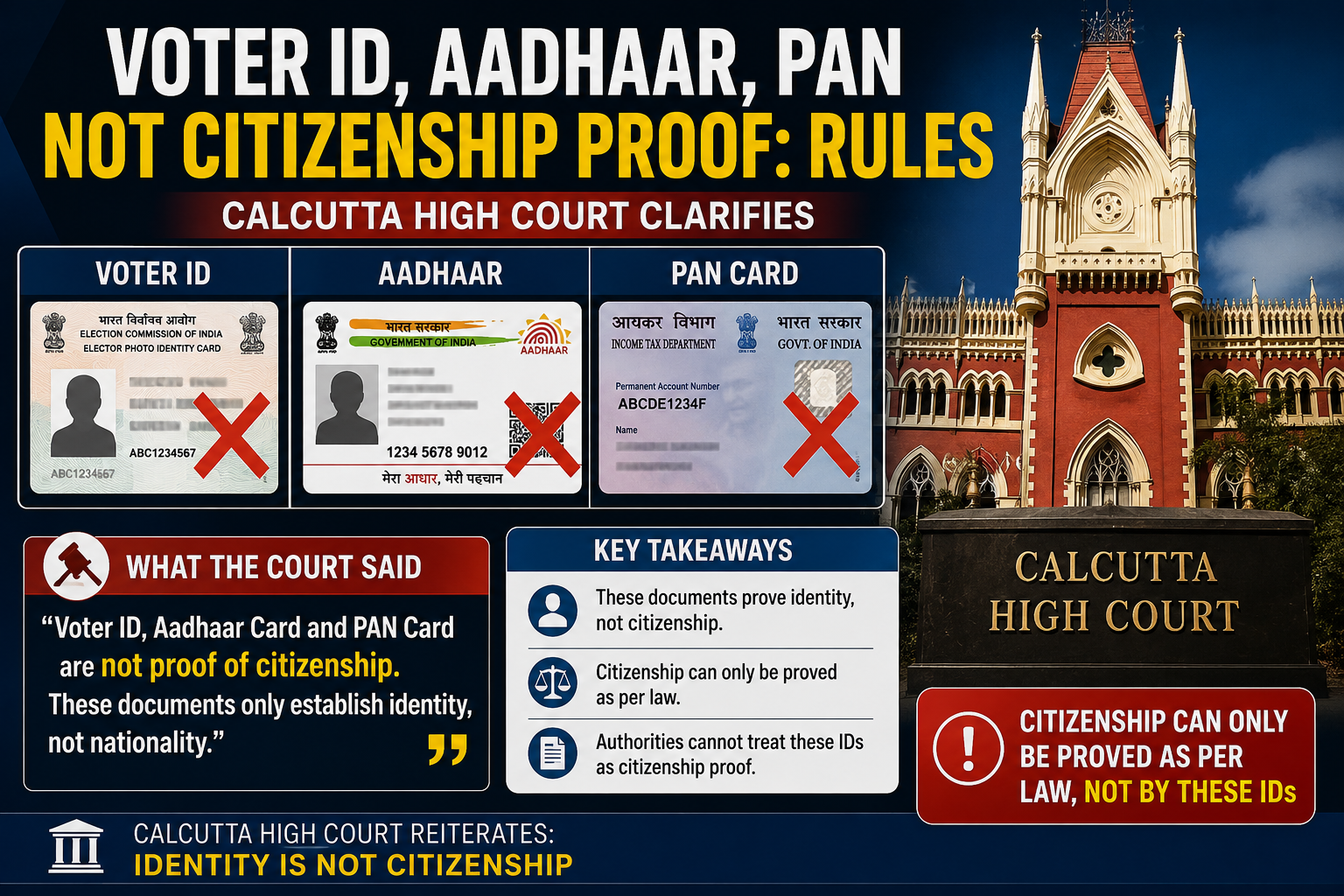
Voter ID Aadhaar PAN not citizenship proof—this striking legal clarity emerged directly from the Calcutta High Court in a recent high-profile hearing that has caught nationwide attention. For decades, millions of Indians have carried these three everyday identification cards in their wallets, assuming they double as rock-solid proof of being an Indian national. However, a division bench comprising Justice Debangsu Basak and Justice Ajay Kumar Gupta has officially put that misconception to rest, ruling that relying on these popular identity documents alone is legally insufficient to establish citizenship when challenged in a court of law.
The landmark observation arrived during the hearing of a habeas corpus petition filed by a petitioner named Suman Molla. Molla approached the court seeking the release of his relative, Nasir, who had been transferred to a detention facility following the deletion of his name from the electoral rolls during the Special Intensive Revision (SIR) exercise in West Bengal. To argue that Nasir was a rightful Indian citizen and not a foreign national, the petitioner produced an array of official documents: a voter identity card, an Aadhaar card, a PAN card issued by the Income Tax Department, land records, and a bank passbook.
Despite this stack of paperwork, the High Court bench dismissed the petition, reiterating that none of these individual documents—or even a collection of them—acts as conclusive evidence of Indian citizenship under prevailing laws.
Understanding the Calcutta High Court Ruling
The judicial rationale behind this ruling rests on the fundamental distinction between identity cards, welfare tools, voting eligibility, and actual legal nationality. Every document served to the bench fulfills a specific administrative role, but none was created by statute to certify citizenship.
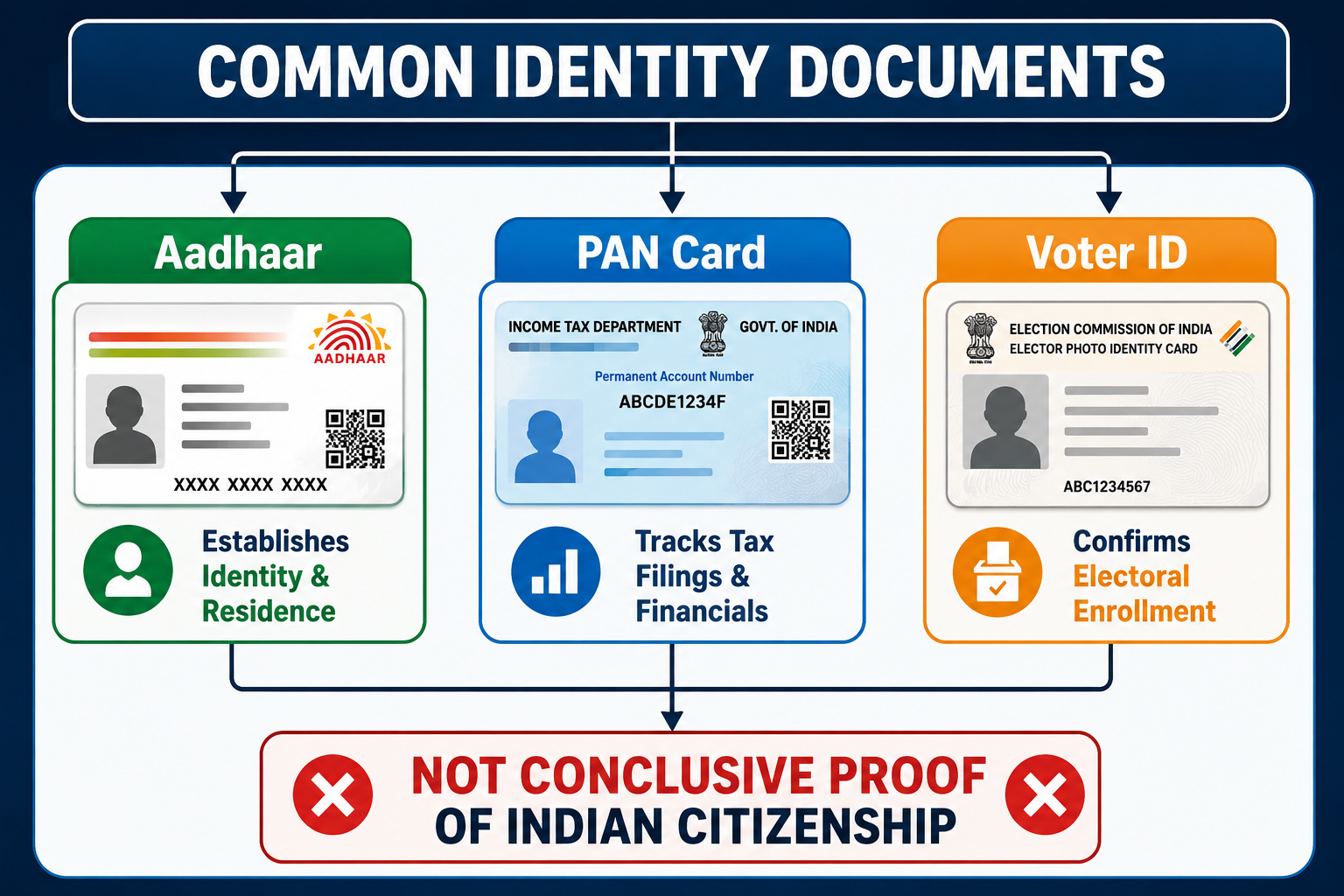
Why Everyday Documents Fall Short
Aadhaar Card: Designed strictly as a biometric identity tool to verify residency for governance and welfare distribution. It verifies who you are and where you live, not your nationality.
PAN Card: Issued by the Income Tax Department to track financial transactions and taxation. Foreign nationals legally residing or earning income in India can also obtain a PAN card.
Voter ID Card: Confirms that an individual’s name is enrolled on an electoral list, granting them voting rights for a specific period. However, as demonstrated in this case, electoral rolls are regularly updated, revised, or corrected through processes like the Special Intensive Revision (SIR).
Bank Accounts and Land Records: Opening a bank account or holding property in India establishes financial and asset presence within the country, but the court noted that neither of these financial footprints proves nationality.
The Legal Burden of Proof: Immigration and Foreigners Act, 2025
A pivotal element of the court’s decision hinges on Section 16 of the Immigration and Foreigners Act, 2025, which explicitly covers the legal “Burden of Proof.”
When an administrative authority or law enforcement agency questions whether a person is or is not a foreigner, the statutory responsibility to prove citizenship rests entirely on the individual, not on the state.
“Writ petitioner and the detainee are unable to discharge the burden of proof as mandated by the Immigration and Foreigners Act, 2025,” the bench observed while upholding the detention order.
In Nasir’s case, he was detained on June 18, 2026, following an inquiry by authorities that identified him as a Bangladeshi national. Under the relevant Ministry of Home Affairs guidelines issued on May 2, 2025, a detainee is granted a standard window of 60 days to produce valid legal evidence establishing their Indian nationality. Because the petitioner failed to present documents recognized by citizenship legislation within that frame, the court declined to intervene with the detention order.
Discrepancies and Judicial Observations in the Case
Beyond the legal debate over identity cards, the court highlighted severe inconsistencies in the petitioner’s claims that ultimately undermined the credibility of the plea.
Key Inconsistencies Highlighted by the Court
Conflicting Relationships: In a preliminary complaint filed with local police, Suman Molla listed himself as Nasir’s cousin. However, in the writ petition submitted before the High Court, he claimed to be Nasir’s uncle.
Age Mismatch: The petition asserted that Molla had raised Nasir following the death of Nasir’s father in 1980. Upon reviewing official records, the court discovered that the petitioner was 38 years old, whereas the detainee was 46 years old—making the claim physically impossible.
Refusal of Parentage Verification: During a court-permitted phone call, Nasir claimed his late parents were buried in India. When the bench offered to arrange a DNA test with the mortal remains of the parents to help establish their Indian roots, both the petitioner and the detainee refused to identify the burial locations. This refusal led the court to draw an adverse inference regarding the claim that his parents were Indian citizens.
What Actually Proves Indian Citizenship?
Because no single everyday identity card automatically grants unconditional citizenship, Indian law determines nationality strictly through the framework of the Citizenship Act, 1955. The required proof varies depending on how an individual acquired their status:
Citizenship by Birth: Established through an official government-issued Birth Certificate, alongside legal documentation verifying the citizenship status of the parents in accordance with the law applicable at the time of birth.
Citizenship by Descent: Requires official records proving that at least one parent was an Indian citizen at the time of the applicant’s birth, along with legal proof of parentage.
Citizenship by Registration or Naturalisation: Verified via an official Certificate of Registration or Certificate of Naturalisation granted by the Central Government.
Passports: A passport issued under the Passports Act, 1967, serves as a standard international travel document accepted globally as evidence of nationality. However, Indian courts maintain that even a passport remains subject to verification under domestic legal challenges regarding the underlying basis of citizenship.
Key Takeaways for Citizens
This ruling highlights a fundamental principle of Indian law: identity, residency, and tax registration are distinct from legal nationality. While cards like Aadhaar, PAN, and Voter ID remain essential for daily tasks, accessing government services, and voting, they do not replace formal citizenship documentation required under the Citizenship Act when nationality is questioned. Keeping proper civil records—such as official birth certificates and family lineage documents—remains the primary way to establish citizenship status under the law.
Frequently Asked Questions (FAQs)
1. Why did the High Court rule that Voter ID, Aadhaar, and PAN cards are not proof of citizenship?
The court clarified that these cards serve specific administrative functions—Aadhaar for identity and residency, PAN for tax tracking, and Voter ID for electoral enrollment. None of them are legally designed under the Citizenship Act, 1955, to conclusively prove an individual’s nationality.
2. Does an Indian passport conclusively prove Indian citizenship?
While an Indian passport is widely accepted as proof of identity and nationality for travel, domestic courts treat it as a document issued under the Passports Act, 1967. In formal legal disputes over nationality, the underlying legal basis under the Citizenship Act can still be verified.
3. Who bears the burden of proving citizenship if questioned by authorities?
Under Section 16 of the Immigration and Foreigners Act, 2025, the burden of proof lies on the individual whose citizenship is under question, requiring them to produce accepted civil and statutory documents to prove they are not a foreign national.