
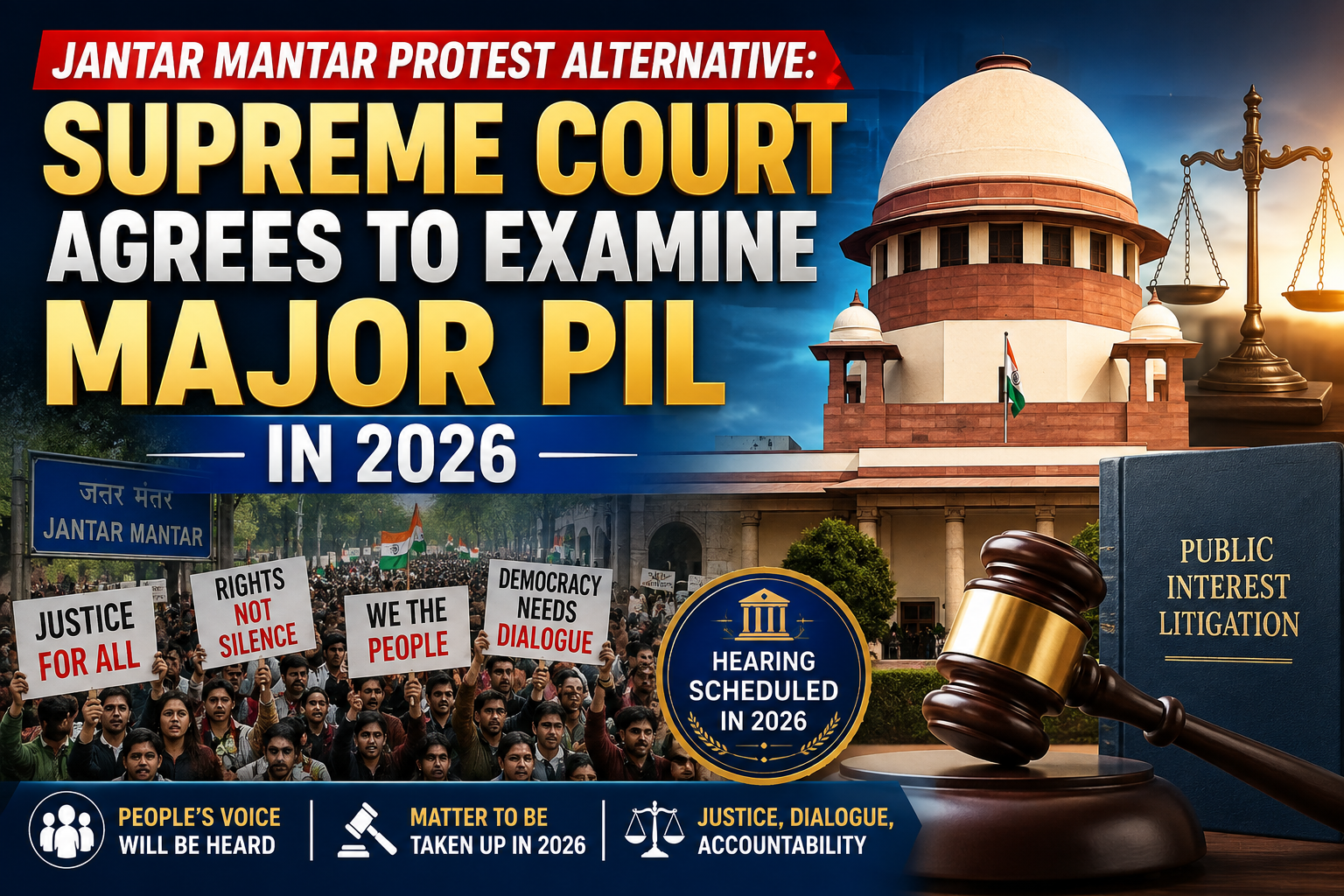
Jantar Mantar protest alternative options are now under active review by India’s highest court. The Supreme Court of India on Monday agreed to examine a Public Interest Litigation (PIL) arguing that the iconic site in the heart of the national capital is no longer suitable for large-scale demonstrations. The petition highlights serious day-to-day challenges faced by local residents, including restricted movement, disruption of essential supplies, and blocked access to emergency medical services.
A bench comprising Chief Justice of India Surya Kant, Justice Joymalya Bagchi, and Justice V. Mohana took note of the growing public inconvenience caused by frequent rallies. Recognizing the practical difficulties in the area, the court issued formal notices to the Central Government and other key administrative authorities, directing Solicitor General Tushar Mehta to seek urgent instructions on the matter.
Why Jantar Mantar Is Becoming Unusable for Rallies
For decades, Jantar Mantar has served as the default focal point for public demonstrations, political gatherings, and civil rights movements in New Delhi. However, the urban landscape around central Delhi has changed dramatically over the years. What was once an open space capable of absorbing large crowds now sits amidst heavy vehicular traffic, dense residential pockets, and vital commercial corridors.
Key Concerns Raised in the Petition:
Restricted Movement (Ingress & Egress): Blocked roads and police barricades frequently prevent local residents from leaving or returning to their homes easily.
Disruption of Essential Services: Supply chains delivering daily goods, groceries, and essential commodities are repeatedly delayed.
Medical Emergencies: Ambulances and emergency vehicles often get caught in gridlock during major demonstrations, posing severe risks to public safety.
Supreme Court’s Stand on the Matter
During the court proceedings, the Chief Justice pointed out that the petition brings up legitimate everyday concerns regarding public access and mobility around Parliament Street and surrounding neighborhoods.
“It has been stated in the plea that Jantar Mantar is not a proper site anymore for such protests due to ingress and egress issues, as well as the supply of medical essentials… I think this is important,” the Chief Justice noted while directing the authorities to take clear instructions.
The court explicitly stated that while the right to peaceful assembly is vital, it must be balanced against the basic rights of citizens residing in the area to live without constant disruption.
Recent Protests and Law & Order Concerns
The timing of the PIL comes on the heels of several intense public gatherings in central Delhi. Jantar Mantar recently witnessed massive student-led demonstrations concerning the NEET-UG paper leak controversy, which drew thousands of agitators to the site.
                   Recent Events at Jantar Mantar

  1. Student Protests     ⇔ Mass agitation over NEET-UG paper leaks.
  2. July 20 Clash        ⇔ Political rally resulted in severe police
                                        lathi-charge and tear gas deployment.
  3. Proposed Town Hall   ⇔ Plans for marches toward the PM's residence.
The petitioner’s counsel specifically referred to a major clash on July 20 involving the Cockroach Janata Party, where police used tear gas and lathi-charges to disperse crowds, resulting in critical injuries to several individuals. The counsel urged the court to intervene so that chaotic events like the July 20 incident do not repeat themselves during future political rallies.
Addressing concerns over upcoming political town halls and marches toward high-security zones like the Prime Minister’s residence, the bench expressed confidence in local law enforcement agencies, declining to intervene in daily policing decisions:
“They know how to handle it. If they cannot, come to us for mishandling. I am sure they will handle it,” observed the bench.
What Happens Next?
The Supreme Court has ordered the petition filed by petitioner Satish Chand Kaushik to be listed separately for detailed hearings. The government’s response, via Solicitor General Tushar Mehta, will dictate whether alternative venues—such as Ramlila Maidan or designated grounds on the outskirts of Delhi—will be proposed as primary zones for future demonstrations.
The outcome of this case could redefine how public protests are managed in India’s capital, setting a precedent that balances the freedom to demonstrate with urban living standards.
Key Takeaways
| Metric / Aspect | Details |
| Petitioner | Satish Chand Kaushik |
| Supreme Court Bench | CJI Surya Kant, Justice Joymalya Bagchi, Justice V. Mohana |
| Primary Issues | Traffic congestion, emergency access delays, residential inconvenience |
| Key Directives | Notices issued to Centre; instructions sought via Solicitor General |