
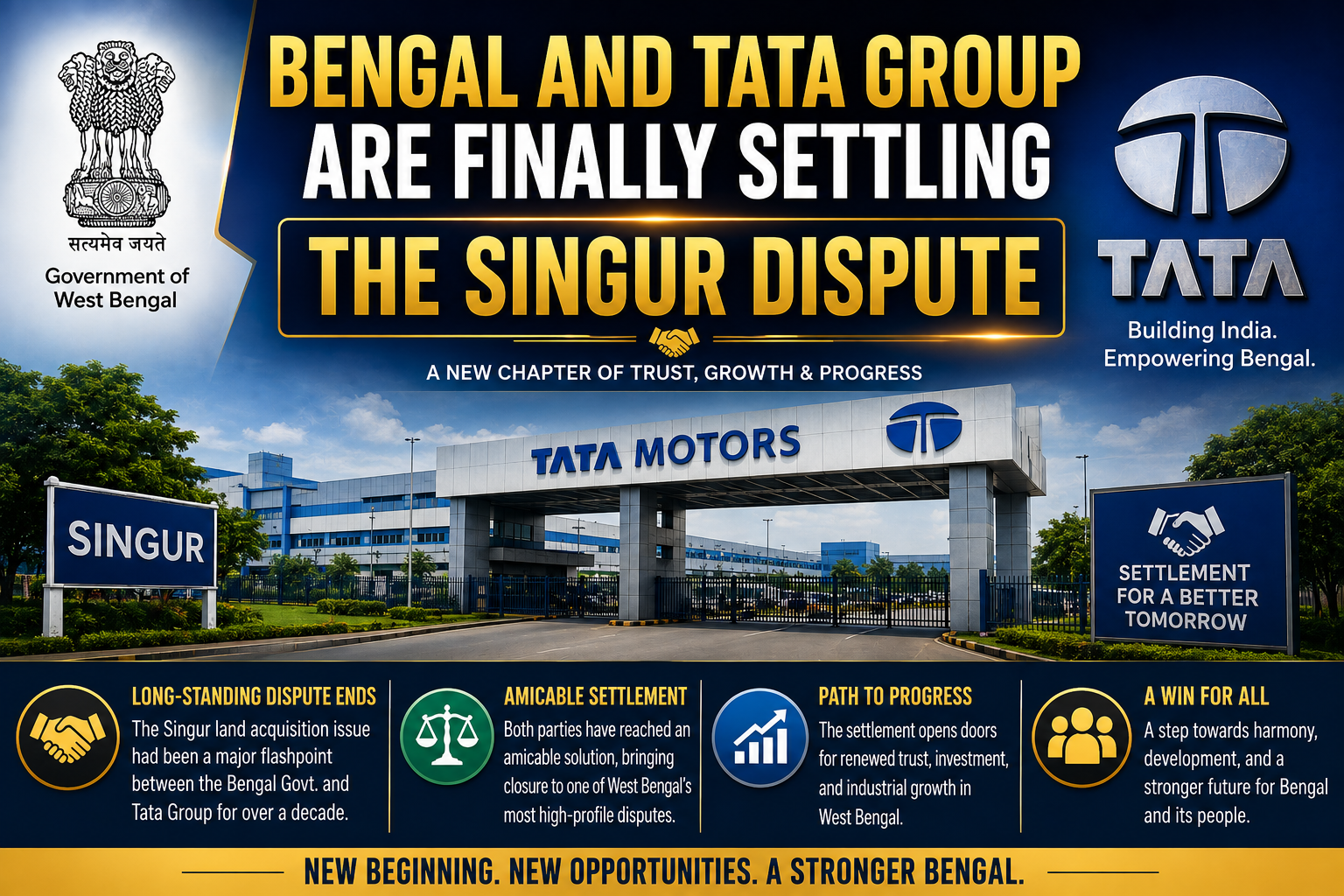
Bengal and Tata Group are talking again which is a deal. This is an attempt to fix one of Indias most famous business fights. For twenty years they have been in court and disagreeing over the old Nano car plant at Singur. Now the state leaders and the Tata Group are sitting down to talk.
They want to do more than just settle their arguments. They are looking for new ways to invest a lot of money in Eastern India.
Something big happened at the Calcutta High Court that shows things are changing. The Advocate-General, Surojit Nath Mitra, who speaks for the state government asked the court to put all the cases related to the fight on hold. The lawyers for Tata Motors agreed with this request. They asked the court to pause the cases without talking about the details of a settlement. Justice Aniruddha Roy said yes to this request, which means the state and the Tata Group can now have talks about a deal.
To get why this is important we need to look at how the fight started and how the government is changing its approach to the Tata Group and the old Nano car plant, at Singur.
The Road From Singur to Mumbai
The Singur saga began in 2008 when Tata Motors was forced to pull out of its nearly completed car factory. At the time, intense political protests against land acquisition stalled operations, prompting the company to relocate its Nano manufacturing line to Gujarat. The exit left a long-lasting impression on the state’s industrial climate and triggered a protracted legal battle.
In 2023, a three-member arbitral tribunal ruled in favor of Tata Motors, awarding the company ₹765 crore plus interest to cover capital losses and litigation costs. The previous administration challenged that decision in court, keeping the dispute frozen in litigation.
Today, top officials are shifting focus from courtrooms to boardrooms. Chief Minister Suvendu Adhikari is leading a fresh diplomatic push, sending senior bureaucrats to Mumbai for direct discussions with Tata executives. Commerce and Industry Minister Tapas Roy confirmed that broader discussions are underway to expand the group’s footprint across multiple sectors beyond automotive manufacturing.
Key Highlights of the Settlement Framework
| Parameter | Historical Background | Proposed Resolution |
| Primary Issue | Abandoned Nano plant land acquisition at Singur | Out-of-court composite compromise framework |
| Financial Factor | ₹765 crore arbitral award favoring Tata Motors | Settled compensation integrated into overall investment deal |
| Scope of Expansion | Limited to automotive manufacturing (Tata Motors) | Multi-sectoral expansion across Tata Group entities |
| Legal Status | Contested before the Calcutta High Court | Jointly adjourned to allow executive negotiation |
Why a Composite Compromise Makes Sense Now
A simple financial payout resolves an old debt, but a broader economic agreement creates long-term value for both parties.
Rebuilding Industrial Trust: Settling the Singur dispute directly removes a major historical roadblock, signaling to national and global investors that the region is open for enterprise.
Diversified Investments: The Tata Group operates across technology, steel, retail, hospitality, and renewable energy. A multi-sector partnership lets the state tap into modern growth industries.
Resolving Financial Liability: Reaching an out-of-court agreement allows the administration to clear pending legal damages while tying financial settlements directly to new job-creating projects.
What Comes Next?
As legal proceedings remain temporarily paused at the Calcutta High Court, follow-up ministerial meetings in Mumbai are expected to refine the specific terms of the settlement. Reaching a final consensus will require balancing financial adjustments, land reuse frameworks, and long-term investment commitments.
If successful, this diplomatic push will not only resolve a decade-and-a-half-old dispute over Singur land but also open an exciting new chapter of industrial growth, economic stability, and corporate partnership across Bengal.