
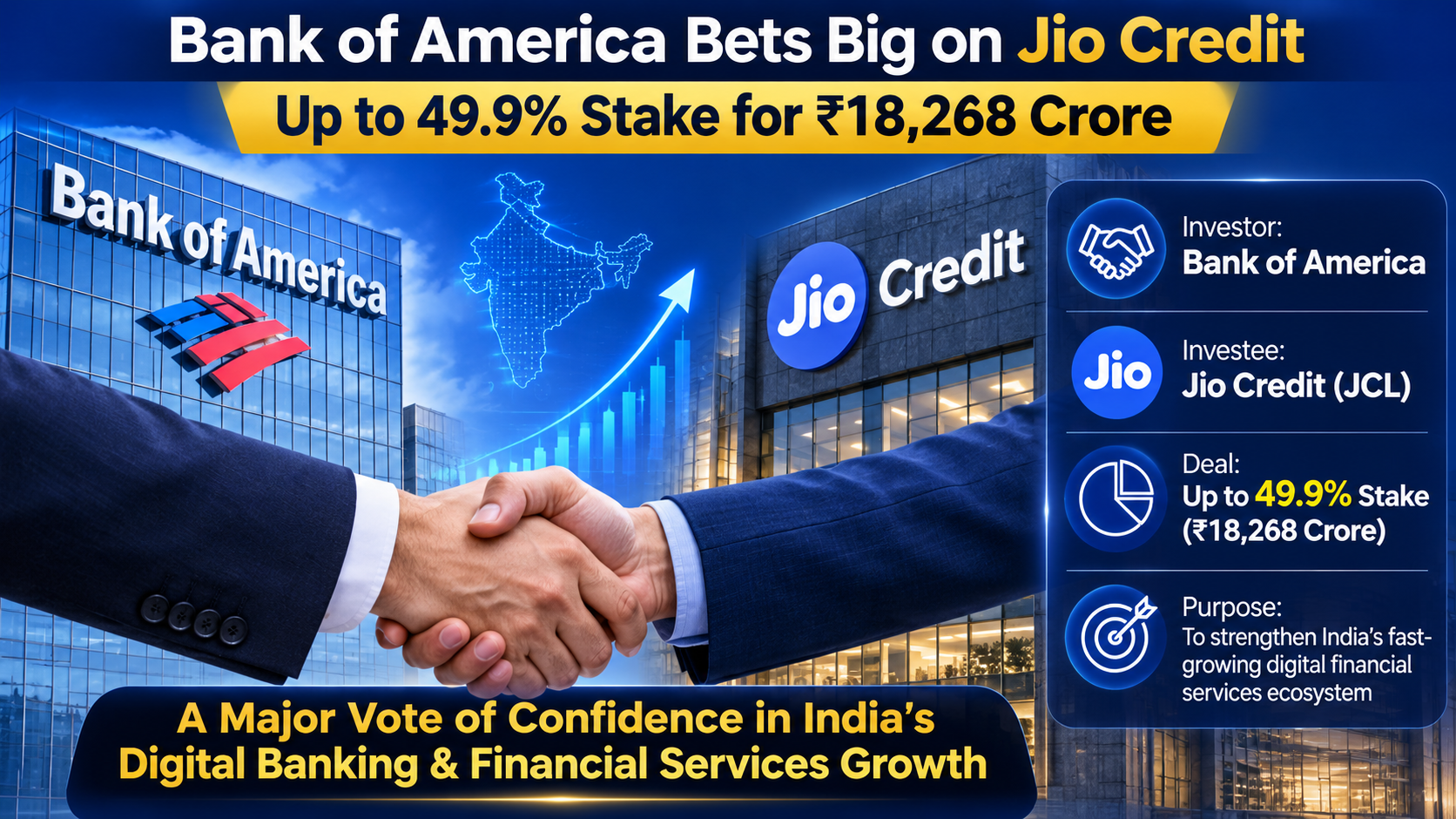
The Bank of America Jio Credit Deal is a big investment in Indias non-banking financial sector. This is one of the investments from a foreign company in recent years. Bank of America a banking company from Wall Street is going to buy up to 49.9 percent of Jio Credit Limited, which is a part of Jio Financial Services owned by Mukesh Ambani.
The deal is worth a lot of money around ₹18,268.22 crore which’s approximately $1.92 billion. This shows that big global companies believe in Indias credit market. The Bank of America and Jio Credit deal is a partnership that brings together Jio Credits size in India and Bank of Americas long history of banking experience.
Here is a detailed look at the deal:
* The structure of the transaction
* Why Bank of America and Jio Credit did this deal
* How the market reacted to the news
* What the Bank of America and Jio Credit deal means for the financial system, as a whole.

1. How the Deal Is Structured: Shares, Warrants, and Timeline
The transaction between Jio Financial Services and Bank of America’s wholly-owned US subsidiary, NB Holdings Corporation, is structured through a preferential allotment of equity shares and warrants on a private placement basis.
Rather than taking a direct 49.9% stake on day one, the agreement utilizes a phased equity expansion mechanism:
Initial Direct Equity Investment: BofA will immediately acquire up to 4,29,29,760 equity shares (face value ₹10 per share) at an aggregate cash consideration of up to ₹6,612.90 crore ($693 million). This initial allotment gives Bank of America a 26.50% post-issue equity stake in Jio Credit Limited.
Warrants Issuance for Future Ownership: JCL will issue up to 7,56,64,248 warrants to NB Holdings Corporation for a total consideration of up to ₹11,655.32 crore ($1.22 billion).
Payment Terms for Warrants: Bank of America will pay 25% of the total warrant value upfront at the time of subscription. The remaining 75% will be remitted as and when the warrants are exercised and converted into equity shares.
Conversion Window: Each warrant can be converted into one fully paid-up equity share of Jio Credit Limited within 18 months from the date of allotment.
Final Shareholding Pattern: Upon full exercise and conversion of the warrants within the 18-month window, Bank of America’s aggregate stake in Jio Credit will rise to 49.90%, establishing a near-equal joint venture with Jio Financial Services retaining the majority 50.10%.
This phased mechanism allows Bank of America to secure immediate governance rights while staggering its capital deployment as Jio Credit expands its loan book.
Transaction Breakdown at a Glance
| Parameter | Initial Tranche (Equity Shares) | Second Tranche (Warrants) | Total Combined Deal |
| Number of Securities | 4,29,29,760 Shares | 7,56,64,248 Warrants | 1,18,594,008 Securities |
| Capital Investment | ₹6,612.90 Crore ($693M) | ₹11,655.32 Crore ($1.22B) | ₹18,268.22 Crore ($1.92B) |
| Resulting Equity Stake | 26.50% | Up to 23.40% additional | 49.90% Maximum Stake |
| Payment Schedule | 100% Upfront at Allotment | 25% Upfront / 75% on Conversion | Phased over 18 Month |
2. Jio Credit’s Implied Valuation and Rapid Asset Growth
According to financial analysis based on the preferential allotment pricing, the total investment of ₹18,268 crore for a 49.9% stake pegs the overall enterprise valuation of Jio Credit Limited at roughly ₹36,600 crore ($3.8 billion).
What makes this valuation particularly notable is the young age of the target entity. Jio Credit was established following the demerger and listing of Jio Financial Services from Reliance Industries in 2023. Within less than two years of active operational buildup, Jio Credit built an Assets Under Management (AUM) portfolio exceeding $3 billion (over ₹28,500 crore) by the end of June.
Jio Credit’s expansion has been propelled by a digital-first strategy that taps directly into the vast consumer and vendor ecosystem of Reliance Industries, including Jio Infocomm’s 470 million telecom subscribers and Reliance Retail’s extensive vendor network.
By delivering embedded credit products—ranging from personal loans and consumer durable financing to merchant working capital lines and gold loans—Jio Credit has generated rapid loan originations while maintaining prudent risk controls.

3. Stock Market Reaction: Jio Financial Shares Surge
Following the board’s approval of the share subscription agreement and shareholders’ agreement between Jio Credit Ltd, Jio Financial Services, and NB Holdings Corporation, shares of Jio Financial Services (JIOF.NS) responded positively on the Indian stock exchanges.
During morning trade on the BSE, Jio Financial shares rallied 3.27% to hit an intraday high of ₹263.35. As traders took profits later in the session, the stock settled around ₹258.45, reflecting a net gain of 1.35%.
Jio Financial Services Ltd (BSE: 543940 / NSE: JIOFIN)
Intraday High: ₹263.35 (+3.27%)
Settlement Price: ₹258.45 (+1.35%)
Key Catalyst: Board Approval of ₹18,268 Cr BofA Investment
Stock analysts noted that the transaction provides three clear catalysts for investors:
Capital Adequacy Boost: An influx of ₹18,268 crore in fresh equity capital severely reduces balance-sheet funding constraints and lowers cost-of-capital expectations.
Global Institutional Validation: Bank of America’s endorsement validates JCL’s underwriting model, tech stack, and risk management framework.
Absence of Conflict: Jio Financial confirmed that the transaction is not a related-party deal, and none of its promoters or group companies hold any direct commercial interest in the subscribing entity.
4. Why Bank of America Is Betting Big on Indian Retail Credit
For Bank of America, led by Chief Executive Officer Brian Moynihan, this multi-billion dollar investment represents a direct, equity-based play on India’s booming retail credit landscape.
“By combining Jio Financial Services’ scale, local expertise and customer base with Bank of America’s global reach, digital experience and close to 250 years of leadership in banking, we can help expand access to financial services and support India’s continued economic growth,” stated BofA CEO Brian Moynihan.
Key Factors Driving Foreign Capital into Indian NBFCs
Rapid Credit Expansion: Non-bank credit in India is expanding at a compound annual growth rate exceeding 14% across core retail segments, including unsecured personal lending, gold-backed loans, micro-loans, and small-business credit lines.
Low Delinquency Rates: Indian retail borrowers have maintained robust repayment discipline post-pandemic. Non-Performing Asset (NPA) ratios across top-tier NBFCs remain near multi-year lows, driven by real-time credit bureau reporting and UPI-integrated auto-debit collection channels.
Regulatory Clarity: The Reserve Bank of India (RBI) has instituted scale-based regulatory frameworks for NBFCs, enhancing governance transparency and reassuring international financial institutions looking for long-term investments.
Massive Underpenetration: Despite rapid digitization, millions of small businesses and first-time borrowers across Tier-2 and Tier-3 Indian cities remain credit-underserved, creating an enormous long-term growth runway.
5. The Reliance ‘Joint Venture Strategy’ in Action
The deal with Bank of America is not an isolated transaction; rather, it fits cleanly into the broader strategic playbook refined by Mukesh Ambani across Reliance Industries and Jio Financial Services.
Instead of building every specialized vertical entirely from scratch, Jio Financial systematically pairs its unmatched distribution reach and local infrastructure with the deep domain expertise of top-tier global institutions.
Jio Financial’s Global Joint Venture Portfoli
Wealth & Asset Management (BlackRock): Jio Financial partnered with world-leading asset manager BlackRock to launch 50:50 joint venture entities focused on digital-first asset management and wealth advisories in India.
Insurance Broking & Underwriting (Allianz SE): Jio Financial inked strategic agreements with German insurance leader Allianz SE to tackle general and health insurance distribution across India.
Credit & Consumer Lending (Bank of America): By partnering with BofA for Jio Credit, JFS secures international liquidity, sophisticated structured finance capabilities, and global risk management technology.
This JV framework allows Jio Financial to scale faster than legacy Indian lenders while keeping its capital structure resilient.
6. How BofA’s Deal Compares to Other Foreign Banking Bets in India
Bank of America’s ₹18,268 crore transaction is the latest in a string of major strategic investments by global banking majors seeking exposure to India’s high-yielding credit market.
Over the past 18 to 24 months, several Tier-1 global institutions have executed similar high-value transactions:
MUFG & Shriram Finance: Japan’s Mitsubishi UFJ Financial Group (MUFG) injected significant capital into Shriram Finance to deepen its footprint in Indian commercial vehicle and retail financing.
Emirates NBD & RBL Bank: Dubai-based banking giant Emirates NBD moved to acquire a controlling 60% stake in private sector lender RBL Bank (RATB.NS) to establish a full-service banking franchise in India.
Sumitomo Mitsui (SMBC) & Yes Bank: Japan’s SMBC expanded its cross-border lending capabilities in South Asia by acquiring a strategic minority stake in Yes Bank (YESB.NS).
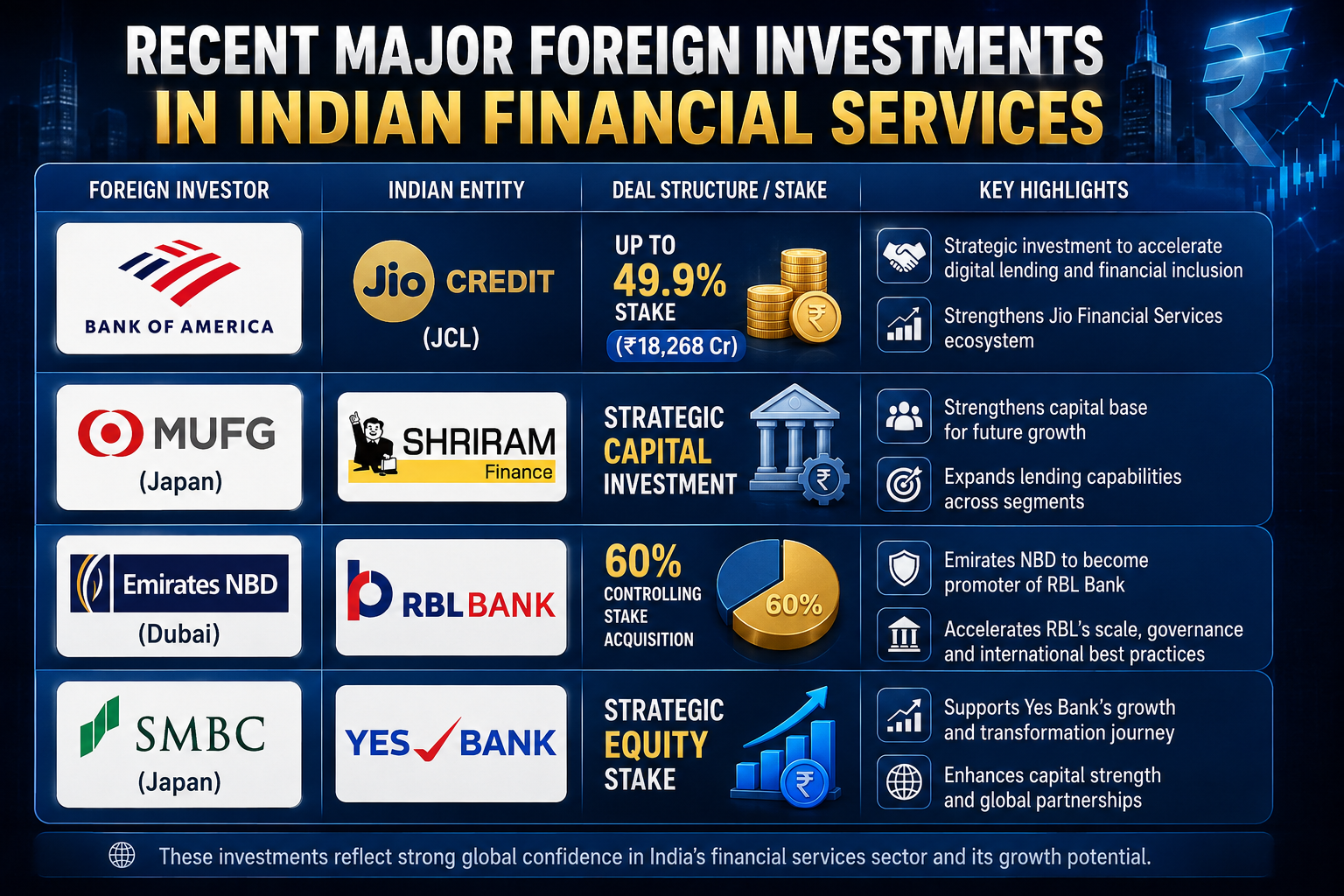
Among these transactions, the Bank of America-Jio Credit agreement stands out because it combines a greenfield digital credit provider with a major US bulge-bracket bank, setting up a direct challenge to incumbent private banks like HDFC Bank, ICICI Bank, and Axis Bank.
What Happens Next? Regulatory Approvals and Market Impact
While the boards of Jio Financial Services and Jio Credit Limited have formally approved the execution of the Share Subscription Agreement and Shareholders’ Agreement, the transaction remains subject to customary closing conditions.
Because Bank of America is a foreign institutional investor acquiring a substantial stake in an Indian non-banking financial company, the deal will require formal statutory clearance from:
The Reserve Bank of India (RBI) under foreign investment rules for non-bank lenders.
The Competition Commission of India (CCI) for antitrust review.
Foreign Exchange Management Act (FEMA) Compliance for inbound foreign direct investment (FDI).
Industry observers expect regulatory filings to proceed smoothly over the coming months. Once approved, the first tranche of ₹6,612.90 crore will be disbursed immediately, giving Jio Credit the capital buffer needed to aggressively grow its loan book through 2026 and beyond.
Key Takeaways for Investors and Borrowers
For Jio Financial Shareholders: The deal crystallizes a multi-billion dollar valuation for JCL, provides non-dilutive capital at the parent company level, and installs a world-class banking partner.
For Indian Borrowers: Increased capital availability at Jio Credit will likely translate into more competitive interest rates on personal loans, merchant credit lines, and digital consumer finance products.
For the Indian NBFC Sector: The transaction proves that global capital remains ready to fund well-governed, tech-enabled Indian lenders capable of serving the nation’s expanding middle class.