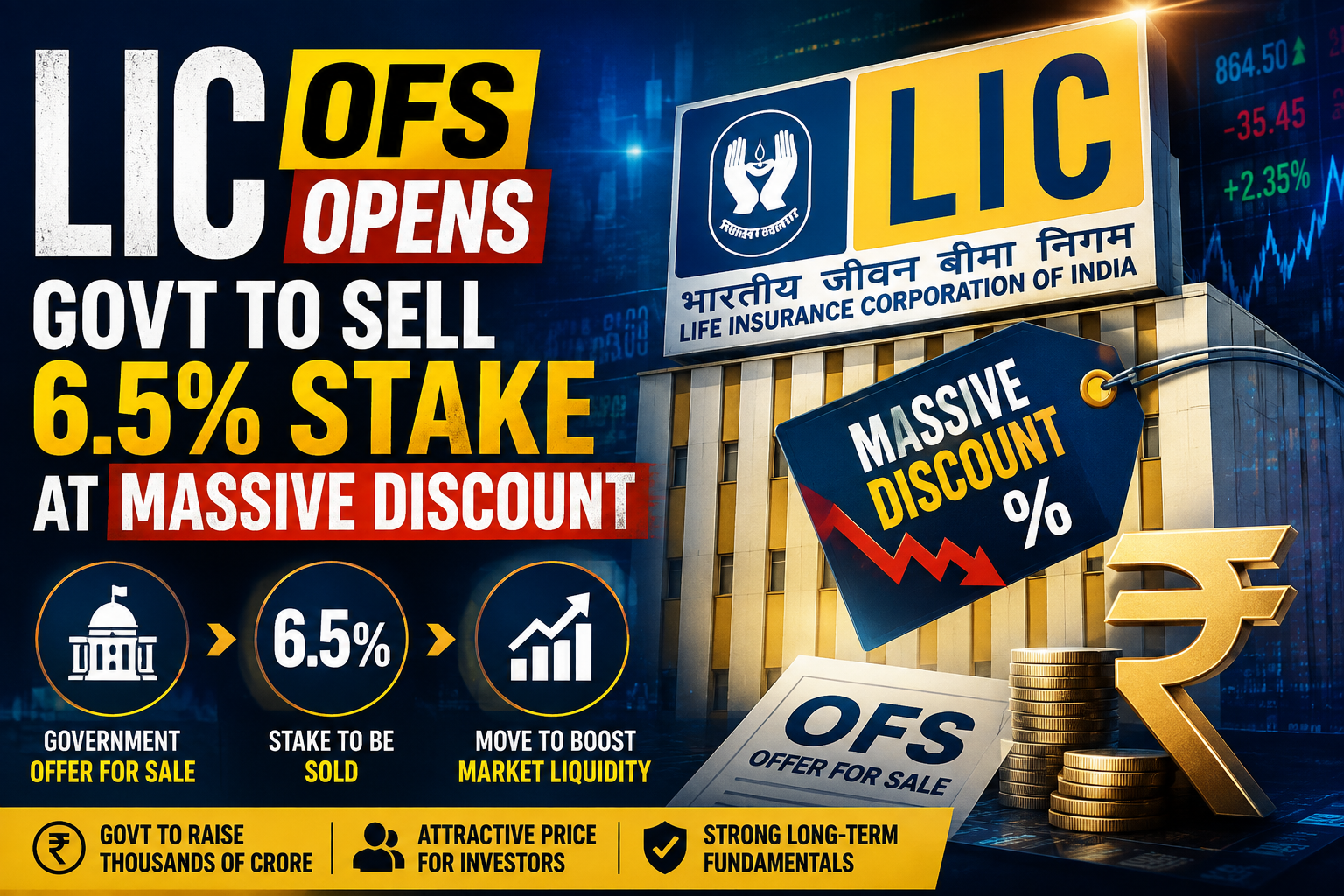
The government of India is selling some of its shares in LIC OFS opens of India today. They want to sell, up to 6.5 percent of the Life Insurance Corporation of India. This is a deal and the government hopes to get around ₹31,000 crore from it. The sale will last for two days.
When the news came out the price of Life Insurance Corporation of India shares went down by 9 percent on the National Stock Exchange.
The government is doing this so that Life Insurance Corporation of India can follow the rules set by the Securities and Exchange Board of India. These rules say that a certain percentage of shares must be owned by the public. By selling these shares Life Insurance Corporation of India will meet this requirement ahead of time.
Key Highlights of the Offer for Sale
Base Issue Size: 2.5% equity stake.
OFS Green Shoe Option: Additional 4% equity stake in case of oversubscription.
Floor Price: ₹382 per share (set at a 10% discount to Monday’s closing price).
Target Funds Raised: Approximately ₹31,000 crore to ₹31,400 crore.
Non-Retail Bidding Date: Tuesday, August 4, 2026.
Retail Bidding Date: Wednesday, August 5, 2026.
Current Government Holding: 96.5%.
Bidding Timeline: Dates for Non-Retail and Retail Investors
The two-day window for the offer follows a standard institutional-first allotment schedule:
| Investor Category | Bidding Open Date | Key Guidelines |
| Non-Retail (Institutional) | Tuesday, August 4, 2026 | Bidding opens on day one for mutual funds, foreign portfolio investors, and corporate entities. |
| Retail Investors | Wednesday, August 5, 2026 | Individual investors can bid directly or choose the “Cut-off” price option on day two. |
Understanding Floor Price vs. Issue Price in an OFS
For everyday retail market participants, understanding the technical pricing terms in an Offer for Sale is critical before placing bids.
What is the Floor Price?
The floor price is the absolute lowest rate set by the seller (in this case, the Indian Government) below which no bids will be accepted by the stock exchanges. With the floor price fixed at ₹382 per share, any retail or institutional bid below ₹382 will be automatically rejected. This price represents roughly a 10% discount compared to Monday’s closing price of ₹424.35 on the BSE and ₹428.50 on the NSE.
What is the Issue Price?
The issue price (or discovered price) is the final allotment price calculated at the close of the entire bidding window. Depending on total demand from institutional and retail buyers, the final price can match the floor price or be higher, but it can never fall below ₹382. Retail bidders also have the option to bid at the “Cut-off Price,” meaning they agree to buy the shares at whatever final price is discovered at the end of the process.
Why Is the Government Diluting Its Stake in LIC?
The primary driver behind this massive offer for sale is regulatory compliance. SEBI rules dictate that listed public sector companies must maintain a minimum public shareholding (MPS) of at least 10%.
When LIC made its historic stock market debut in May 2022, the government sold a 3.5% stake through an Initial Public Offering (IPO) at a price band of ₹902 to ₹949 per share, raising roughly ₹21,000 crore. That left the government holding a massive 96.5% equity stake.
Although SEBI granted LIC time until May 16, 2027, to reach the 10% public float threshold, this 6.5% dilution through the OFS will effectively push public ownership past 7%, bringing LIC significantly closer to its long-term requirement ahead of schedule.
Impact on Stock Price: Why Did Shares Tumble 9%?
Following the official announcement, LIC shares faced sharp selling pressure on the stock exchanges. Early trade on the NSE saw the share price slide by as much as 8.86%, reaching a low of ₹390.50.
Market Reaction Insight: When a major promoter or government owner offers a massive block of equity shares at a direct 10% discount to the prevailing market price, the spot price usually adjusts downward quickly to align closer to the floor price. This short-term drop reflects immediate supply expansion in the market rather than a structural decline in the company’s core business performance.
Market Experts Take on the Issue
Financial analysts view this update as a liquidity-enhancing step for the broader market rather than a negative shift in company fundamentals.
Liquidity and Price Discovery
Harshal Dasani, Business Head at INVAsset PMS, noted that this OFS serves primarily as a liquidity and market-deepening exercise. Increasing the number of freely traded shares (free float) in the open market usually encourages broader institutional participation, improves daily trading volume, and establishes a healthier long-term valuation mechanism for the stock.
Understanding Key Supply Risks
The main short-term risk for existing shareholders does not stem from LIC’s operational metrics, but rather from market absorption. Absorbing over 82.22 crore new shares requires substantial capital outflow from institutional desks. Until the market completely digests this fresh influx of shares, the stock may remain bound within a narrow trading range.
It is also important to note that all proceeds from this OFS will go directly to the Government of India’s overall disinvestment target (which has already brought in ₹21,082 crore this fiscal year across seven PSUs and SUUTI remittances). The funds raised will not enter LIC’s corporate balance sheet or change its earnings trajectory. Once the initial supply overhang clears, the stock will return to moving based on its core business fundamentals, premium growth, investment yields, and net value updates.
Disclaimer: The information provided above is for educational purposes only. We strongly advise investors to consult with SEBI-certified financial experts before making any investment decisions.