
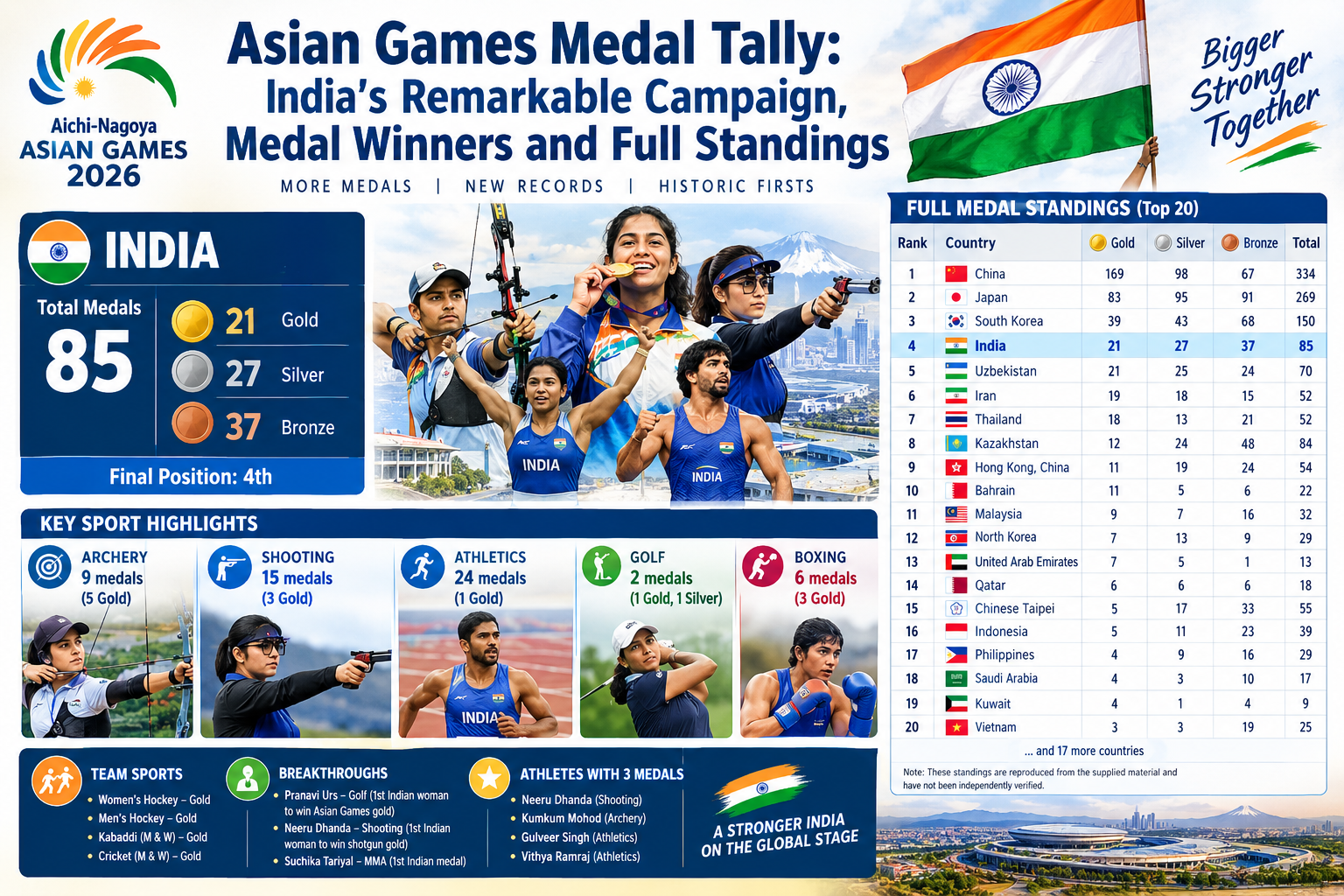
The Asian Games medal tally is a measure that people watch closely. It shows how athletes do how strong national sports programmes are and how competitive Asia’s biggest sports nations are becoming. According to the results provided India finished in place at the Asian Games 2026 held in Aichi‑Nagoya. India won 85 medals in total with 21 gold medals, 27 silver medals and 37 bronze medals.
The campaign included a mix of well‑known champions, new athletes and historic firsts in archery, shooting, athletics, boxing, wrestling, golf and team sports. India finished fourth behind China, Japan and South Korea. Uzbekistan came in fifth even though Uzbekistan matched India’s number of gold medals.
The results also show India’s progress in sports where India has historically found it hard to win medals. For example Pranavi Urs made history in golf and Mirabai Chanu added an Asian Games silver medal to her career achievements. These performances stand out beyond the medal count.
The meaning of a medal tally is more than just the final ranking. The number of gold medals the breadth of performance across sports and the rise of medal‑winning athletes all help explain how India’s sports programme is growing.
Note: This article follows the figures and athlete results in the supplied material. The event status, competition results and individual entries should be verified against records, before publication.
Asian Games Medal Tally 2026: India’s Overall Performance
Based on the table that was given India ended up in fourth place collecting a total of 85 medals. These medals were divided into 21 gold, 27 silver and 37 bronze.
| Category | India’s reported tally |
|---|---|
| Gold | 21 |
| Silver | 27 |
| Bronze | 37 |
| Total medals | 85 |
| Final position | 4th |
These numbers show that India is one of the sports countries in Asia. Even though it did not reach the three the medal count indicates that Indian athletes performed well in many different sports both in solo and team events.
The report also looks at India’s 106 medals from Hangzhou 2023 when the country won 28 gold medals. Compared with that the 2026 count is lower both in the number of medals and in the number of gold medals.
This difference is important because gold medals are valued the most in the ranking. A nation may earn medals in total than another country yet still rank below it if it has fewer gold medals.
India’s 27 silver medals also played a role in the final ranking. The table shows that India was ranked higher, than Uzbekistan even though both nations won 21 gold medals. The extra six silver medals that India earned compared with Uzbekistan’s 25 explain why India finished ahead.
Full Asian Games Medal Table 2026
The following standings reproduce the country rankings and medal counts provided in the supplied material.
| Rank | Country | Gold | Silver | Bronze | Total |
|---|---|---|---|---|---|
| 1 | China | 169 | 98 | 67 | 334 |
| 2 | Japan | 83 | 95 | 91 | 269 |
| 3 | South Korea | 39 | 43 | 68 | 150 |
| 4 | India | 21 | 27 | 37 | 85 |
| 5 | Uzbekistan | 21 | 25 | 24 | 70 |
| 6 | Iran | 19 | 18 | 15 | 52 |
| 7 | Thailand | 18 | 13 | 21 | 52 |
| 8 | Kazakhstan | 12 | 24 | 48 | 84 |
| 9 | Hong Kong, China | 11 | 19 | 24 | 54 |
| 10 | Bahrain | 11 | 5 | 6 | 22 |
| 11 | Malaysia | 9 | 7 | 16 | 32 |
| 12 | North Korea | 7 | 13 | 9 | 29 |
| 13 | United Arab Emirates | 7 | 5 | 1 | 13 |
| 14 | Qatar | 6 | 6 | 6 | 18 |
| 15 | Chinese Taipei | 5 | 17 | 33 | 55 |
| 16 | Indonesia | 5 | 11 | 23 | 39 |
| 17 | Philippines | 4 | 9 | 16 | 29 |
| 18 | Saudi Arabia | 4 | 3 | 10 | 17 |
| 19 | Kuwait | 4 | 1 | 4 | 9 |
| 20 | Vietnam | 3 | 3 | 19 | 25 |
| 21 | Singapore | 2 | 9 | 7 | 18 |
| 22 | Tajikistan | 2 | 5 | 9 | 16 |
| 23 | Jordan | 2 | 3 | 6 | 11 |
| 24 | Myanmar | 2 | 1 | 2 | 5 |
| 25 | Macao, China | 1 | 4 | 1 | 6 |
| 26 | Kyrgyzstan | 1 | 3 | 10 | 14 |
| 27 | Mongolia | 1 | 1 | 3 | 5 |
| 28 | Sri Lanka | 1 | 1 | 1 | 3 |
| 29 | Pakistan | 0 | 2 | 8 | 10 |
| 30 | Iraq | 0 | 2 | 3 | 5 |
| 31 | Turkmenistan | 0 | 2 | 0 | 2 |
| 32 | Afghanistan | 0 | 1 | 2 | 3 |
| 33 | Lebanon | 0 | 1 | 2 | 3 |
| 34 | Oman | 0 | 1 | 1 | 2 |
| 35 | Cambodia | 0 | 0 | 4 | 4 |
| 36 | Nepal | 0 | 0 | 2 | 2 |
| 37 | Bangladesh | 0 | 0 | 1 | 1 |
| 37 | Brunei Darussalam | 0 | 0 | 1 | 1 |
| 37 | Laos | 0 | 0 | 1 | 1 |
| 37 | Syria | 0 | 0 | 1 | 1 |
Note: These standings are reproduced from the supplied material and have not been independently verified. Some country totals and rankings in the source may require correction before publication.
Archery Emerges as One of India’s Strongest Medal Sports
Archery was one of the performing sports in the results provided. India won nine medals, including five gold ones.
The compound events had good results. Indias womens compound team won a gold medal. The mens compound team also came first. Chikitha Taniparthi and Sahil Jadhav won another gold in the mixed compound team event.
These results showed how strong India is in team-based compound archery. Winning in areas is important because it means success is not just because of one person or one single result.
The recurve events were another part of the campaign. Kumkum Mohod won the womens recurve gold. India also won the womens team title. The mixed recurve team got silver. The mens individual and team events added podium finishes.
According to the information given India won medals in all five recurve events. This was the Asian Games campaign for India in this area.
The results also had impacts on qualifications. The information says that the mixed compound win by Chikitha Taniparthi and Sahil Jadhav along with Kumkum Mohods recurve win helped secure spots for LA 2028.
For archery the bigger meaning is about combining personal skill with team work. Keeping up these performances will need training more chances to compete and better support for all the athletes, in different areas.
Shooting Produces Landmark Gold Medals
Shooting was another contributor to Indias medal total adding 15 medals in total. India earned three gold medals, eight silver medals and four bronze medals through shooting events.
One of the impressive results came from the mixed team 10m air pistol event. Suruchi Singh and Kamaljeet won gold medals in this event. Their performance was described as an Asian record achievement in the provided material.
Neeru Dhanda delivered a breakthrough in shotgun shooting winning the womens trap title. According to the source Neeru Dhanda became the Indian woman to win an Asian Games shotgun gold medal. The performance was reported to have set another record.
Later Neeru Dhanda teamed up with Kynan Chenai to win the mixed team trap gold medal. This gave India another landmark result in a discipline where both team coordination and individual consistency’re essential.
India also collected medals in rifle and skeet competitions. Elavenil Valarivan won a silver medal in the womens 10m air rifle event. Additionally Indian athletes secured silver medals in both the mens and womens rifle team events. Indias shooters also reached the podium in skeet competitions.
The distribution of medals across pistol, rifle and shotgun events suggests that Indias shooting strength extends beyond a category. The challenge for the future will be to maintain that breadth while turning silver medal finishes, into gold medals.
Athletics Delivers the Largest Medal Contribution
Athletics was Indias source of medals in the table provided, with 24 medals in total: one gold, nine silver and 14 bronze.
The gold medal came in the womens 4x400m relay. The team of Kiran Pahal, Poovamma MR, Prachi Choudhary and Vithya Ramraj won the gold on the day of the competition.
Even though athletics only had one gold in the breakdown the overall contribution was very big. The 24 medals showed that athletes reached the podium in distance running hurdles, relays jumps, throws and combined events.
Vithya Ramraj was one of the performers in the campaign. The report says she broke PT Ushas 42-year- national record in the womens 400m hurdles. She also won medals in the womens. Mixed 4x400m relays.
Gulveer Singh had a good campaign in distance running. He won silver in the mens 10,000m and 1,500m. Then got bronze in the 5,000m. Getting three medals in tough track events showed his ability to run different distances.
Other good results included Ancy Sojans silver in the womens jump Sarvesh Kushares silver in the mens high jump and Murali Sreeshankars silver in the mens long jump.
Tajinderpal Singh Toor got silver in the shot put. Yash Vir Singh won silver in the mens javelin throw. Baranica Elangovans bronze in the womens pole vault was called Indias Asian Games medal in that event.
Sawan Barwals silver in the marathon, which was done with a record was another big result in long-distance running.
The analysis is simple: athletics had the medals but the number of gold medals was not high in the numbers given. Increasing the number of athletes who make it to the finals and get on the podium could be important, for Indias results.
Pranavi Urs Creates History in Golf
I was amazed when Golf delivered one of Indias distinctive achievements.
I watched as Pranavi Urs won the womens gold becoming the first Indian woman to win an individual Asian Games golf title according to the supplied report. I was thrilled when Pranavi Urss victory also ended Indias reported 24-year wait for an Asian Games golf title.
I saw Pranavi Urs then join Aditi Ashok and Diksha Dagar to win silver in the womens team event.
I think the two results were important for reasons. The individual title represented a breakthrough for Pranavi Urs while the team silver demonstrated that Indias womens golfers could compete collectively against strong opposition.
Golfs contribution to the medal tally was smaller than that of athletics or shooting but I believe the historic nature of the results gave the sport considerable significance.
The next step will be to build on this performance through international competition, development opportunities and preparation, for future major events and I am hopeful that this momentum will continue.
Mirabai Chanu Returns to the Asian Games Podium
Weightlifting added another important milestone through Mirabai Chanu’s silver medal.
The supplied report describes it as her first Asian Games medal and India’s first medal in weightlifting at the Games since Bangkok 1998.
For an athlete who has already established herself on the international stage, the result added another achievement to her career. For Indian weightlifting, it represented a breakthrough after a prolonged period without an Asian Games podium finish.
Weightlifting is a discipline in which small differences in performance can determine final positions. Continued progress will depend on technical consistency, strength development, injury management and preparation against the strongest international competitors.
Chanu’s medal also illustrates how a single athlete can bring attention to a sport while helping sustain interest among younger competitors.
Boxing Records a Strong Campaign
I was thrilled that India captured three boxing gold medals in the supplied results and also earned three bronze medals.
Lovlina Borgohain won the womens 75kg title. Lovlina Borgohains achievement placed Lovlina Borgohain among a group of Indian women who have won Asian Games boxing gold following Mary Kom.
Parveen Hooda secured gold in the womens 65kg category and Ankush Panghal won the mens 80kg title.
India also received bronze medals through Narender Berwal in the mens category and Kapil Pokhariya in the mens 90kg event alongside Priya Ghanghas in the womens 60kg category.
The results represented India’s successful Asian Games boxing campaign, by gold medals according to the supplied account.
Boxing success depends on factors, including tactical awareness, defensive discipline, physical conditioning and the ability to adapt during bouts. Winning titles across mens and womens categories suggests a spread of competitive ability.
The long‑term objective should be to turn this performance into a programme rather than relying on a small number of standout competitors.
Wrestling Adds Gold Medals and Depth
Wrestling brought six medals in the table that was provided including two gold, two silver and two bronze.
Aman Sehrawat got gold in the mens 57kg category. Sujeet Kalkal won the mens 65kg title. These wins were among Indias important wrestling results.
Nitesh Kumar got silver in the mens Greco-Roman 97kg category. Antim Panghal took silver in the womens 53kg event. Sunil Kumar and Deepak Punia earned bronze medals.
The table that was provided calls this the best Asian Games wrestling campaign for India since 1962.
Wrestling has always been a sport that gives medals for India but staying on top needs growth in all weight categories and styles. The fact that there are medals in mens, womens and Greco-Roman events is very important.
Progress, in the future will rely on training chances to compete and help for athletes who are moving from local competitions to international events.
Team Sports Deliver Major Celebrations
India reported success that reached beyond single sports.
Hockey
The womens hockey team won its first Asian Games title since 1982 and the Indian mens hockey team defended its crown successfully.
Both of these results were said to secure qualification for the 2028 Olympics in Los Angeles.
This makes the hockey achievements especially important because the benefits go beyond the medal count.
Direct qualification gives teams certainty for long‑term preparation letting them plan training and competition schedules with a major international target ready.
Kabaddi
India kept both the mens and womens kabaddi titles.
The double win reinforced India’s strength in a sport that relies on coordination, defensive organisation and quick decision making.
Winning both titles also showed consistency between the mens and womens teams.
Cricket
India won gold in both the mens and womens cricket events according to the given results.
Cricket added two gold medals to India’s count.
These titles were valuable not for the final standings but also for keeping cricket visible, in a multi‑discipline international event.
Taken together hockey, kabaddi and cricket gave India some of its prominent team achievements.
Breakthrough Medals in Emerging and Less-Familiar Sports
Some of India’s most interesting results came in disciplines that receive less attention than athletics, shooting or hockey.
Suchika Tariyal won bronze in women’s traditional MMA in the sport’s reported Asian Games debut. This was described as India’s first Asian Games medal in mixed martial arts.
Rowing also produced a historic result. Satnam Singh and Salman Khan won bronze in the men’s double sculls, securing India’s first medal in that event according to the supplied report.
Roshibina Devi won silver in women’s 60kg wushu sanda. The result added to her record as the first Indian to win medals in the sport at three consecutive Asian Games.
India also earned bronze in the men’s sepaktakraw quadrant event, marking the country’s first medal in that category in the supplied account.
These results matter because sporting success cannot be measured only through established medal-winning disciplines. Breaking into new events can encourage participation, strengthen coaching structures and give developing athletes a clearer competitive pathway.
However, a first medal is the beginning of a process, not a guarantee of future success. Continued investment and regular exposure to international competition will determine whether these achievements can be repeated.
Squash, Sailing, Badminton and Table Tennis Add to the Total
India’s performance across other sports contributed further depth to the medal tally.
In squash, Anahat Singh won silver in the women’s singles event. The supplied report identifies her as the first Indian woman to win an Asian Games singles squash silver.
India also earned bronze in the men’s and women’s team events and in mixed doubles. These results demonstrated a broad presence across multiple squash categories.
Sailing contributed three medals: one silver and two bronze. India’s medal winners included Prince Kurisinkal Noble and Manu Francis in the men’s skiff, Harshita Tomar and Shital Verma in the women’s skiff, and Nethra Kumanan in the women’s dinghy.
Badminton added bronze in the men’s team event. Table tennis produced another podium finish through Diya Chitale and Manush Shah in mixed doubles.
These sports may not have produced the largest individual medal totals, but together they helped strengthen India’s overall position.
India’s Medal Tally by Sport
The sport-wise figures below reproduce the totals provided in the source. They offer a useful overview of the disciplines identified as contributing to India’s reported 85-medal haul.
| Sport | Gold | Silver | Bronze | Total |
|---|---|---|---|---|
| Archery | 5 | 2 | 2 | 9 |
| Shooting | 3 | 8 | 4 | 15 |
| Boxing | 3 | 0 | 3 | 6 |
| Wrestling | 2 | 2 | 2 | 6 |
| Cricket | 2 | 0 | 0 | 2 |
| Hockey | 2 | 0 | 0 | 2 |
| Kabaddi | 2 | 0 | 0 | 2 |
| Athletics | 1 | 9 | 14 | 24 |
| Golf | 1 | 1 | 0 | 2 |
| Squash | 0 | 2 | 3 | 5 |
| Sailing | 0 | 1 | 2 | 3 |
| Weightlifting | 0 | 1 | 0 | 1 |
| Wushu | 0 | 1 | 0 | 1 |
| Badminton | 0 | 0 | 1 | 1 |
| Kurash | 0 | 0 | 1 | 1 |
| Mixed martial arts | 0 | 0 | 1 | 1 |
| Rowing | 0 | 0 | 1 | 1 |
| Sepaktakraw | 0 | 0 | 1 | 1 |
| Soft tennis | 0 | 0 | 1 | 1 |
| Table tennis | 0 | 0 | 1 | 1 |
| Reported total | 21 | 27 | 37 | 85 |
Athletics accounted for the largest number of medals, while shooting and archery supplied substantial totals and multiple golds. Boxing, wrestling and team sports also contributed important victories.
The medal distribution suggests that India’s campaign relied on a combination of high-volume sports, such as athletics, and disciplines where a smaller number of events produced several gold medals.
Data note: The source’s sport-wise totals should be reconciled with its individual results list. Some entries, event names and medal counts may contain inconsistencies.
What the Results Say About Sport
The medal numbers provided show three main ideas.
First Indias success was seen in types of sports. Traditional areas like wrestling, shooting and boxing had results. New areas like golf, rowing MMA and sepaktakraw also had results. More types of sports that win medals can make a countrys sports program not rely on a few sports.
Second the mix of gold, silver and bronze medals is important. India has 37 bronze medals which shows they often get on the podium.. They have 27 silver medals and 21 golds. This shows that with a good total they might not end up in the top three. Improving the ability to win gold medals of just silver or bronze could help in future big competitions.
Third individual achievements matter as much as the overall count. Gold medals in golf records in shooting and progress, in womens sports show signs of improvement. These achievements can also help athletes by giving them role models. They can also bring attention to sports that don’t get much coverage.
At the time one competitions medal count alone does not show real long-term progress. A better look would also check the quality of the teams they face how many people take part how hard it is to qualify how athletes grow and how they do in competitions.
India’s Reported 85-Medal Campaign
The supplied Asian Games medal tally shows India in place with 21 gold, 27 silver and 37 bronze medals making a total of 85 medals. The reported performances cover athletics, archery, shooting, boxing, wrestling, golf, hockey, kabaddi, cricket and several newer medal‑winning sports.
The notable themes are the success in archery and shooting the big contribution from athletics the historic achievements in golf and the continued strength of Indian team sports. Breakthrough results in rowing MMA and sepaktakraw also appear in the account.
India’s position behind China, Japan and South Korea highlights the challenge of competing with Asia’s sporting nations. The supplied figures also show how silver and bronze medals can boost a countrys total while leaving room to improve conversion.
Before this report is published as an account of the Asian Games 2026 the event details, medal table and athlete‑by‑athlete results should be checked against official records. Once verified the final standings will provide a basis, for assessing India’s performance and identifying the disciplines most likely to shape India’s future campaigns.
Frequently Asked Questions
How many medals did India win at the Asian Games 2026?
According to the supplied material, India won 85 medals: 21 gold, 27 silver and 37 bronze.
What was India’s position in the Asian Games 2026 medal tally?
The supplied table places India in fourth position, behind China, Japan and South Korea.
Which sports contributed the most medals for India?
Athletics reportedly contributed 24 medals, the highest total for any sport. Shooting contributed 15, while archery added nine.
Who were India’s standout athletes in the supplied report?
Neeru Dhanda, Kumkum Mohod, Gulveer Singh and Vithya Ramraj were identified as athletes who each won three medals. Pranavi Urs, Mirabai Chanu, Lovlina Borgohain and Aman Sehrawat were also highlighted for their reported achievements.
Which country topped the supplied Asian Games medal table?
China was listed first, with 169 gold, 98 silver and 67 bronze medals, for a total of 334. These figures are reproduced from the supplied material and require independent verification.
Why is the gold medal count important?
Under the standard medal-table ranking system, countries are ordered primarily by gold medals, followed by silver and then bronze when gold totals are equal. This explains why a country with fewer total medals can finish above another country with a larger overall haul.
Disclaimer: This article is for informational and editorial purposes. All event-specific figures and results are based on the supplied material and should be verified against official sources before publication.