
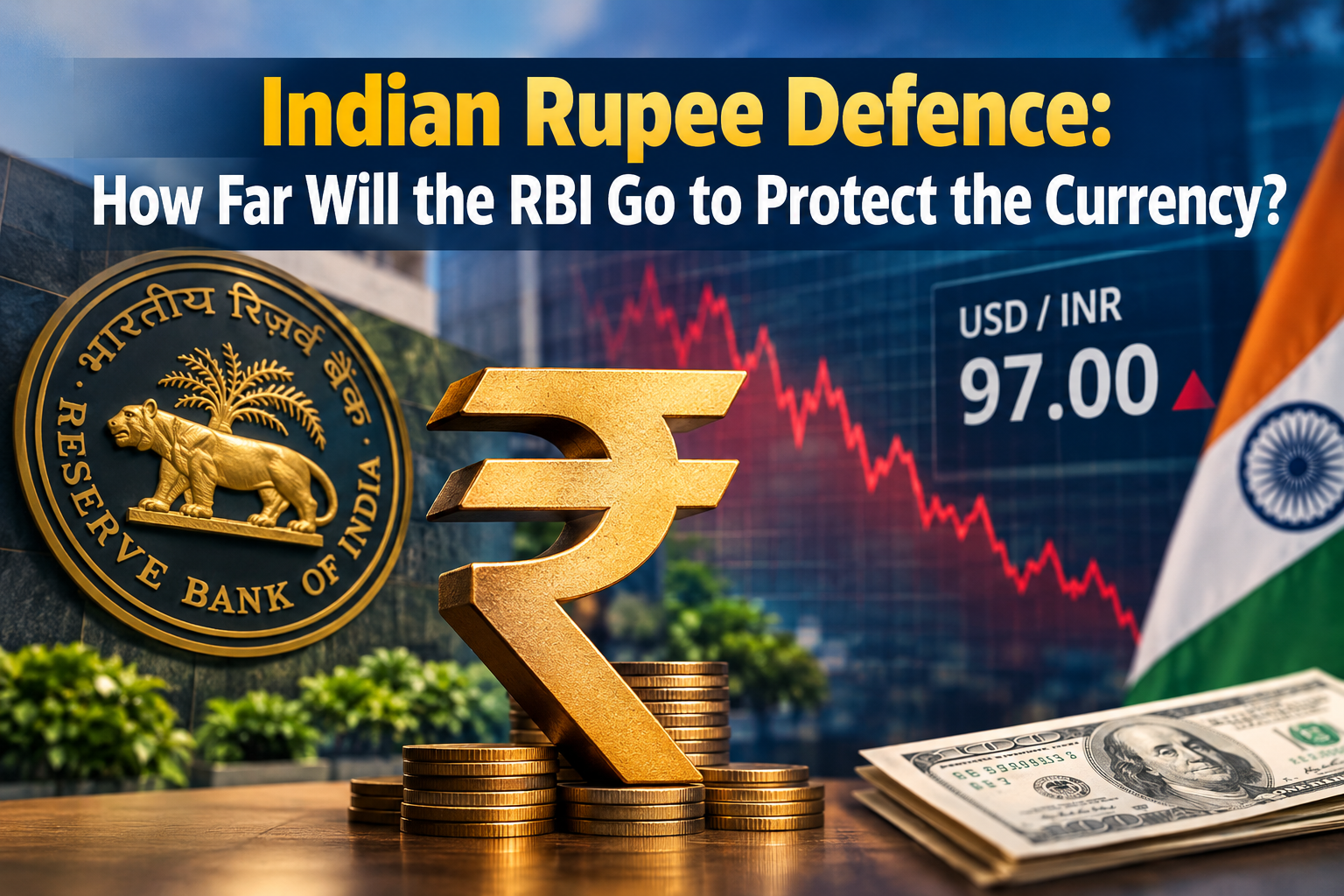
Indian Rupee Defence has become a major concern for India’s financial markets as the Reserve Bank of India (RBI) introduces fresh measures to slow the currency’s decline against the US dollar. With the rupee trading close to a record low, elevated crude oil prices and continued foreign investor outflows are putting additional pressure on India’s external finances.
The central bank has responded with a series of measures aimed at reducing excessive dollar demand, including a dedicated dollar window for state-owned oil refiners and tighter rules governing foreign-exchange derivatives. These steps follow a recent interest rate hike, suggesting that the RBI is prepared to use several policy tools to maintain stability in the currency market.
However, the bigger question is whether these measures can provide lasting support to the rupee or simply delay further weakness. India’s currency is facing pressure from factors that monetary policy alone cannot control, particularly international energy prices, global investor sentiment and the strength of the US dollar.
For the RBI, the challenge is not just to prevent the rupee from reaching another record low. It must also protect foreign-exchange reserves, maintain confidence in the Indian economy and ensure that businesses can continue to manage their currency risks without facing excessive costs.
Why Is the Indian Rupee Under Pressure?
The rupee has been losing strength lately and it’s not one reason. It’s a mix of things happening at home and abroad. The report says the rupee has fallen by 7% this year making it one of the weakest currencies in Asia.
Three main things are pushing it down: oil prices, foreign investors pulling out money and the constant need for dollars.
Higher Oil Prices Mean More Dollar Demand
India buys a chunk of the oil it uses from other countries.. Most of these purchases are paid for in US dollars. So when oil prices go up Indian companies need dollars to pay for the same amount of oil.
If oil prices jump suddenly refiners have to find dollars to cover their bills. That adds demand for dollars in the foreign exchange market, which can make the rupee weaker.
It gets worse when there’s tension in oil-producing regions. Like in the Middle East. If conflict grows shipping routes could be blocked production could. Supplies could get shaky. That means India’s oil bill might go up more.
Here’s the catch: a weaker rupee makes imported oil even more expensive in rupees. So it’s a cycle. Higher oil prices need dollars and a weak rupee makes oil even costlier. It’s hard to break.
This doesn’t just affect oil. Fuel and transport costs go up which then affects the price of everything. Food, clothes, services. That makes it harder for the RBI to keep inflation under control.
Foreign Investors Are Pulling Money Out
Another big factor is foreign investors taking their money out of India.
When they sell stocks or bonds and move that money to other countries they need dollars to do it. That increases demand for dollars again. How big the effect is depends on how much money’s leaving, when it’s leaving and whether other foreign money is coming in to balance it.
Global interest rates what people think about US interest rate moves and how risky investors feel about markets all play a role in these decisions.
If investors think dollar-based investments are safer or more profitable they may pull money out of emerging markets like India. Even if India’s economy is doing okay. That’s a problem.
The RBI can step in. It can. Sell dollars in the market or change rules to try to stabilize things. But it can’t force investors to keep their money in India. That’s not under its control.
Why ₹97 per Dollar Is a Watch Point
The rupee closed near 96.9650 per dollar on Friday. Close to its record low.
Now traders and analysts are keeping an eye on the ₹97-, per-dollar level. The report says this level has become important for the RBI’s efforts to support the currency.
But here’s the key: this doesn’t mean the RBI has promised to keep the rupee at ₹97. India doesn’t fix its exchange rate. The rupee is allowed to move based on market forces. The RBI can act if things get too wild or messy.. It’s not committed to holding the rate at any specific number.
So the real goal may just be to slow down a drop not to lock the rupee at a certain level forever.
RBI Introduces Fresh Measures to Defend the Rupee
The latest steps are part of an effort to ease stress on the foreign-exchange market. Of using just one method of action the RBI is looking at many different ways that demand for dollars can increase.
Dollar Window for State-Owned Oil Refiners
One of the important changes is the creation of a dollar window for state-owned oil refiners.
Oil companies are some of the users of foreign currency because they need dollars to pay for energy from other countries. Letting state-owned refiners use a dollar window could help them handle their immediate money needs.
This setup might also stop these companies from fighting for dollars in the market at the same time especially when demand is high.
If this idea works well it could ease some short-term pressure on the rupee. Make it easier to handle important payments, for oil.
The real help will depend on how many dollars are given through this facility how long it lasts and how the payments are made. A special window can. Control demand, but it can’t change the fact that India still needs to pay for imported energy.
A New Foreign-Exchange Risk Reserve
The RBI has also brought in a foreign-exchange risk reserve rule for derivative deals.
According to the report banks must keep a reserve with the bank. This reserve must be 20% of the value of each foreign-exchange derivative transaction that is over $2 million.
This rule is meant to affect how people trade in the currency derivatives market. In that market businesses, banks and other users make financial agreements to either protect themselves or take risks based on how exchange rates change.
When banks have to set aside money for the reserve it becomes more expensive to do these covered transactions. They can’t use that money for things so the cost goes up.
The RBI wants to stop much speculative trading. It also hopes to lower some of the pressure on the rupee by reducing demand that comes from these trades.
This idea is similar to what China’s central bank uses to manage activity, in the yuan market.
The real effect will depend on how banks and their customers react. If banks pass the cost to their clients then companies that use derivatives for real hedging. To protect against currency swings. Might end up paying more too.
Restrictions on Rebooking Cancelled Forward Contracts
The RBI has also made rules stricter when it comes to cancelled contracts.
Under the measures announced in the report cancelled forward contracts cannot be rebooked. These kinds of restrictions can stop people from cancelling and entering the market again and again. This can help reduce transactions that lead to changes in prices or risky bets, in the market.
Forward contracts are often used by companies to fix exchange rates for money they need to pay or receive. For instance an importer who expects to pay a supplier in dollars after a months may use a forward contract to avoid not knowing how much it will cost in rupees.
Rules that stop rebooking can decrease some kinds of market activity but they can also make it harder for businesses to change their plans if real business situations change.
The success of this policy will therefore depend on finding the balance between stopping bad trading habits and keeping the ability for companies to deal with real foreign currency risks.
Lower Limit for Derivative Transactions Without Underlying Exposure
Another change is that the RBI has lowered the permitted limit for foreign‑exchange derivative transactions that do not have proof of an underlying exposure. The limit falls from $100 million to $5 million as shown in the report.
An underlying exposure is usually a financial or commercial need, for example an import payment, an overseas investment or a foreign‑currency liability.
By tightening the limit the RBI wants to stop derivative positions that are not backed by matching underlying exposures.
This move could cut demand in the market. It will also make it harder for big positions to magnify short‑term currency swings.
Still derivative markets do have commercial uses and not every transaction that lacks a directly matched underlying exposure is speculative. The actual effect will depend on the regulatory definitions, exemptions and compliance rules.
For banks and businesses the new rules could force changes, to trading practices, risk‑management systems and treasury operations.
Why the RBI Is Taking Such a Strong Position
The newest measures follow earlier steps that were taken to support the rupee.
I see that the RBI had limited banks daily net open foreign‑exchange positions to $100 million and had also put limits on some non‑deliverable rupee derivative contracts that it offered to clients. The report notes that this latter limit was later rolled back.
These actions show that the RBI is ready to change market rules when it thinks currency movements or trading activity need a hand.
The broader strategy seems to have three goals. First the RBI wants to cut the demand for dollars in the market. Second the RBI wants to stop trading practices that can make short‑term volatility grow. Third the RBI wants to keep foreign‑exchange resources so it can answer to ongoing external pressure.
The RBI is also weighing currency stability against the state of the economy. Higher interest rates can help the currency in some cases because they raise returns on assets but they can also raise borrowing costs, for businesses and households.
This is why the RBI cannot rely on hikes alone. Rules, liquidity management and direct foreign‑exchange operations give the RBI tools but each has its own costs.
Indias Foreign-Exchange Reserves: A Key Line of Defence
Foreign-exchange reserves are very important for the RBIs ability to deal with times when the currency’s under pressure.
According to the report a programme for people living abroad deposited a record $133 billion which helped increase Indias foreign-exchange reserves to $800 billion in early September. The report also says that about $51 billion was used over four weeks as the pressure on the currency grew stronger.
These numbers need to be understood in the context of the time period being reported and the specific reserve actions being talked about. Getting money from deposits the level of reserves and changes in reserves are not the things and each number has its own meaning.
Still the drop in reserves shows the cost of keeping up with the pressure.
When the RBI sells dollars and buys rupees it can add foreign currency to the market and take some rupees out of circulation. This can help reduce the pressure on the currency.
There are limits to how much the RBI can do. If people keep needing dollars for a long time selling dollars over and over can slowly use up the amount of foreign currency available for other needs.
So the central bank has to decide when it’s worth acting how much action is needed and how much reserve to keep for possible future problems.
A good reserve position can make people feel more confident and protect the country from problems.. It does not mean that there is no need for steady flow of money into the country affordable costs for imports and a good balance, with the rest of the world.
Can the RBI Stop the Rupee From Falling
The latest measures could help the rupee in the term especially if market participants cut speculative positions and the dollar window lessens immediate demand from oil refiners; I think this is hopeful.
A mix of derivative rules and direct currency‑market management may also discourage one‑way bets against the rupee.
However stopping a sharp decline is different from creating a lasting recovery.
The rupees direction will keep depending on factors beyond the RBIs direct control.
International crude oil prices: A sustained rise in oil prices would raise Indias import bill and the demand for dollars. Lower prices could ease that pressure.
Foreign portfolio investment: Renewed overseas investment in markets could support capital inflows while continued selling could keep the currency under pressure.
US dollar strength: Changes in US expectations and global demand, for safe‑haven assets can affect emerging‑market currencies, including the rupee.
Inflation and interest rates: The RBI must consider the effect of tightening on inflation credit demand and economic growth while managing currency volatility.
Market confidence: Clear communication and credible policy implementation can help reduce uncertainty although confidence ultimately depends on economic and financial conditions.
The coming sessions may show whether the new measures are sufficient to stabilise trading around lows. A sustained recovery however would require a supportive combination of external and domestic conditions
How Tighter Forex Rules Could Affect Indian Businesses
While the RBIs measures are aimed at stabilising the currency market their impact will not be limited to traders.
Indian businesses that import materials purchase energy from overseas suppliers or borrow in foreign currencies could face higher costs when managing their exposure.
Importers May Face Higher Hedging Costs
A company that needs to pay $1 million to a supplier in three months faces uncertainty over the future rupee-dollar exchange rate.
If the rupee weakens before the payment date the company will need rupees to purchase the same amount of dollars.
A forward contract can reduce this uncertainty by locking in an exchange rate in advance. However if regulatory changes increase the cost of providing or accessing contracts the importer may have to pay more to protect itself against currency fluctuations.
The supplied report notes that the cost of hedging dollars for one year has risen by than 100 basis points over the preceding two months. It attributes this increase partly to the RBIs dollar sell/buy swap operations and the resulting liquidity conditions.
That figure relates to the reported period. Should not be interpreted as a universal increase in every companys hedging cost.
For businesses with profit margins, even a relatively small increase in financing or hedging expenses can affect profitability.
Exporters Could Face a Set of Risks
Exporters earning dollars may benefit from a weaker rupee because their foreign-currency revenues translate into more rupees.
However the benefit is not automatic. Exporters that import components pay foreign-currency expenses. Have already locked in exchange rates may see smaller gains.
Companies also need to manage the timing of receipts and payments. Greater uncertainty in the currency market can make budgeting, pricing and cash-flow planning more difficult.
For these businesses predictable access to hedging instruments is important even when the RBI is attempting to discourage excessive speculative trading.
Banks and Treasury Departments Face Additional Compliance Work
Banks will need to assess how the new rules affect their positions, funding requirements and customer transactions.
Corporate treasury departments may also need to review existing hedging arrangements, documentation procedures and internal risk limits.
Smaller companies, without treasury teams could be particularly affected if compliance becomes more complicated or the cost of obtaining currency protection increases.
The policy challenge is to reduce market activity without making essential currency-risk management unnecessarily difficult.
RBIs Next Challenge: Protecting the Rupee Without Hurting Growth
The RBI is facing a balancing act.
On one side a quick fall in the rupee can raise import costs increase inflation risk and shake confidence in the rupee.
On the side the RBIs strong intervention and tighter financial‑market rules can cost businesses and lower flexibility in the foreign‑exchange market.
More interest‑rate hikes can also affect activity.
Higher borrowing costs can hurt investment cut consumer spending and reduce demand for credit.
This is especially important because exchange‑rate pressure does not always show that the domestic economy is weak at heart.
A country can see its currency fall even while its economy grows especially when global capital flows and energy prices go against it.
The RBI must therefore tell the difference between market pressure and a lasting external imbalance.
If the main problem is short‑term volatility, then intervention and specific regulatory measures may give relief.
If high oil prices and capital outflows last for months a stronger adjustment, in the balance may be needed.
The success of the RBIs approach will depend on whether the RBI can buy time for market conditions to get better without draining many reserves or putting too much strain on real business activity.
What Investors Should Watch in the Coming Weeks
Investors should look beyond the rupee’s daily movement when assessing the effectiveness of the RBI’s actions.
Several indicators deserve attention.
1. Foreign-exchange reserves: Weekly reserve data can provide insight into changes in India’s external buffer. However, valuation changes and other transactions can also influence the reported figures, so a decline should not automatically be attributed entirely to intervention.
2. Crude oil prices: Oil is a major component of India’s import requirements. A sustained fall in prices could reduce pressure on the trade balance and the demand for dollars.
3. Foreign investor flows: Trends in foreign portfolio investment can help explain whether overseas investors are returning to Indian assets or continuing to reduce exposure.
4. Rupee volatility: The speed and size of exchange-rate movements may reveal whether the new restrictions are reducing disorderly trading or merely changing where transactions take place.
5. Currency hedging costs: Changes in forward premiums and the pricing of hedging instruments can indicate how the new rules and liquidity conditions are affecting businesses.
6. RBI communication: Any further clarification on the duration, implementation or adjustment of the measures could influence market expectations.
For equity investors, the effects will differ by sector. Oil importers, airlines and companies with significant foreign-currency liabilities may face greater pressure from a weaker rupee, while some exporters could benefit from favourable currency translation. The actual impact will depend on each company’s business model, cost structure and hedging arrangements.
Investors should avoid treating a single exchange-rate level as a reliable signal to buy or sell assets. Currency movements are only one part of the broader investment picture.
Thoughts: The RBI Can Buy Time but The RBI Cannot Control Every External Pressure
Recent Indian Rupee Defence measures show that the RBI is ready to adopt a wider strategy for managing currency‑market stress.
The dollar window for state‑owned oil refiners the new foreign‑exchange risk reserve and tighter derivative rules could lower some sources of dollar demand and curb excessive trading activity.
Yet these steps cannot alone reverse the forces that drive the rupee lower. Oil prices, international capital flows and global dollar demand will continue to be influences on the currency.
The RBI must also preserve the confidence of businesses that rely on foreign‑exchange markets to manage commercial risks. If hedging becomes more expensive the cost of defending the currency could spread to importers, exporters and ultimately consumers.
The realistic expectation is that the new measures may help slow volatility and create room for external conditions to improve. Whether the new measures can support a recovery will depend on what happens next in global energy markets investment flows and Indias balance of payments.
For now the key question is not simply whether the RBI can defend the rupee near ₹97 per dollar. The key question is how long the RBI can maintain that defence without placing pressure, on RBI reserves or the wider economy.
Disclaimer: This article is for informational and educational purposes only. It is not investment advice. Exchange rates, reserve figures and policy details should be verified against the latest RBI releases and market data before publication or use in financial decisions.