
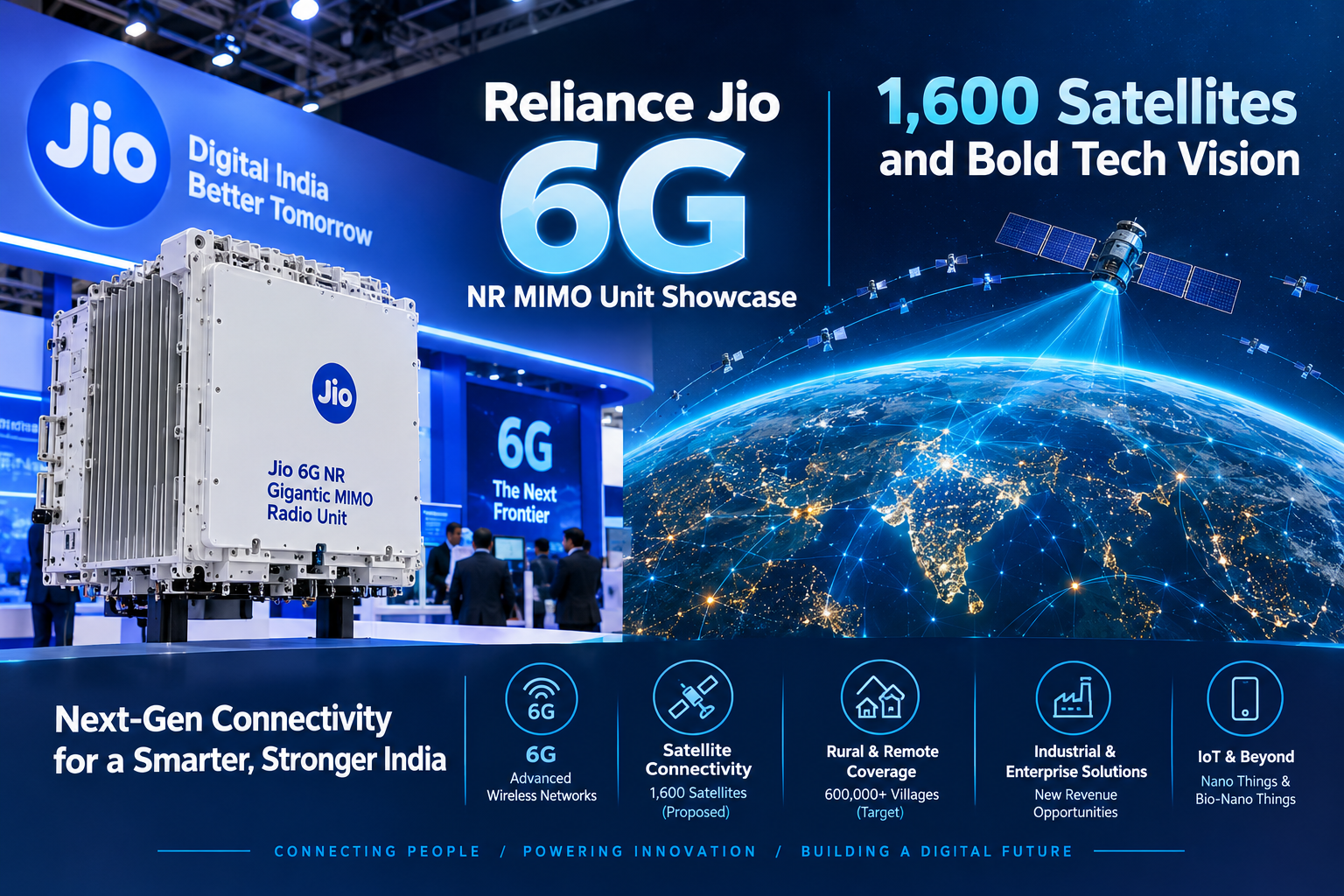
I was excited when Reliance Jio 6G became a milestone in India’s telecommunications field after the company displayed its 6G New Radio Gigantic MIMO Radio Unit at the India Mobile Congress 2026 in New Delhi. With this next‑generation radio Jio shared a bold plan for satellite connectivity that would use about 1,600 low‑Earth‑orbit satellites and 23 new ground stations across India.
I see these announcements as pointing to two directions that could guide India’s digital future: quicker more powerful wireless networks and a way to connect remote spots where normal mobile towers or fiber cables cannot reach.
I think for Jio this chance is more than launching another mobile generation. The company wants to use its experience with 4G and 5G create ideas for future telecom rules and look for fresh business chances in satellite links, business services and new digital tools.
Still I believe it is vital to separate what is a demo what is a long‑term plan and what is already sold to customers. Jio’s 6G radio display is a step, in research while the satellite network and ground stations are still only proposed and not yet a working national satellite system.
Reliance Jio 6G Radio Showcased at India Mobile Congress 2026
At the India Mobile Congress 2026 held at the Yashobhoomi Convention Centre in New Delhi Jio displayed its 6G NR Gigantic MIMO Radio Unit. This show put Jio in the group of telecom companies pushing for next‑generation wireless.
MIMO means Multiple‑Input Multiple‑Output. It is a technology that uses antennas for both sending and receiving signals. When advanced MIMO systems are designed and set up correctly they can let networks serve people use spectrum better and boost capacity.
The phrase “Gigantic MIMO” refers to an advanced antenna‑based radio design aimed at future network needs. The best performance will rely on factors like the technical design, the spectrum that is available the network structure and the commercial 6G standards that are chosen.
What makes Jio’s showcase important is that Jio tries to build and show technology on its own of depending fully on equipment, from foreign suppliers.
India has a telecom market yet creating the core technology for future mobile networks is a different kind of challenge. Companies need to spend money on research, engineering, testing and intellectual property long before services go live.
Thus Jio’s 6G radio demonstration is the early stage of a much longer journey to develop new technology.
Why Jio Is Investing in 6G Technology
Every generation of networks has brought new abilities. While 4G made internet, video streaming and digital payments a normal part of life 5G has opened up more possibilities for fast connections, industrial uses and smart devices.
6G is expected to take these steps. Even though the final details and how it will work commercially are still being worked out around the world future networks are likely to look into more speed smarter ways to manage the network, better mixing of sensing and communication and support for more connected devices.
For Jio getting involved early could give benefits.
First the company might have a say in how future technologiesre built and set as standards. Second it could create products that do not need equipment makers. Third if the technology works well it could offer telecom equipment and solutions to customers in countries.
These ideas are important because Jio has already made and used its 5G radio and network solutions. Experience in building, testing and running telecom equipment can help with research but 6G will need more work and checking.
There is also a plan. Countries that add technology to global standards might get more value through patents making equipment and selling technology.
For India the aim is not just to use 6G when it’s available. It is also to be part of making the technology that future networks, over the world might use.
Jio Has Submitted More Than 934 Technical Contributions for 6G
Jios 6G ambitions go past radio demonstrations. The report shows that Jio has submitted than 934 technical contributions to international standardisation bodies working on the 6G framework.
These contributions show that Jio is trying to join discussions and technical processes that might shape network standards.
Jio’s situation is important to understand that a technical contribution is not the same as an approved standard, a granted patent or a successful product. Contributions can be evaluated, revised, combined with proposals or rejected during the standardisation process.
Jio has also said that Jio has filed patents for its G research. Patent applications can safeguard inventions. The number of filings alone does not prove the commercial value or technical importance of a company’s intellectual property.
In the run success will depend on whether Jios research yields valuable patents, accepted technical solutions, reliable equipment and products that customers want to buy.
Indias ambition to lead in 6G
During IMC 2026 Akash Ambani, Chairman of Jio Platforms Limited talked about the country’s ambition to play a leading role in the 6G ecosystem.
He mentioned Prime Minister Narendra Modi’s target for India to contribute 10% of 6G patents. Ambani said that Jio plans to contribute a portion to that target and highlighted Jio’s pre‑6G patent activity.
The target shows a national ambition to strengthen India’s position in advanced telecommunications research.
For Jios ambition to become real patent filings must be backed by research funding, engineering talent, university‑industry collaboration, advanced testing facilities and domestic manufacturing capabilities.
Indian companies must also compete in a market where established telecom equipment makers and research organisations have many years of experience building network technologies.
Jios progress matters not for its own business but also, for India’s broader effort to build a stronger domestic telecommunications industry.
What Could Jio 6G Mean for Nano and Bio-Nano Devices?
One of the forward-looking ideas in Jios 6G vision is the Internet of Nano Things and the Internet of Bio-Nano Things.
These ideas build on the concept of the Internet of Things or IoT which today includes things like meters, industrial sensors, security cameras and wearable electronics.. The Internet of Nano Things takes it further. It refers to networks made up of tiny devices that can sense, process or share information. The Internet of Bio-Nano Things goes deeper looking at connected systems that use biological materials or bio-inspired designs at the nanoscale.
These technologies could one day be used in monitoring, advanced medical sensing, highly specific industrial measurements and collecting biological data.. They are still in the research phase. Moving them into real-world use is not about having better wireless networks. It involves challenges like device size how power they need, whether they are safe, for the human body how accurate their data is, how secure they are and whether they can communicate reliably.
A future 6G network might help support some of these applications.. Having 6G alone won’t automatically make every nanoscale or biological device commercially successful.
The bigger picture is that future telecommunications networks could support a broader range of connected systems than just today’s smartphones and standard IoT devices. The world of connectivity is about to grow in ways we are only beginning to imagine.
New Business Opportunities Beyond Mobile Connectivity
The case for 6G in business will come down to whether telecom operators can create services that bring in money beyond mobile plans. For Jio there are possible areas where 6G could help. These include connecting industries making digital experiences more immersive building networks for businesses and offering services for smart infrastructure.
Immersive tech could include augmented reality, virtual reality and other experiences that need fast stable connections and quick network responses. In settings 6G could support connected machines, remote monitoring and communication between devices that work together.
Companies might also want networks, stronger reliability and custom network setups. This could open up chances for telecom companies that can mix radio technology with software, cloud platforms and support services for businesses.
These are just possibilities. They are not certain to become income sources. How big these markets grow will depend on how much customers want them the cost of equipment how well the technology performs and whether there are applications to use it.
Jio’s biggest challenge will be turning its research and network investments into products. These products must solve problems, for both businesses and everyday users.
Jio’s Proposed 1,600-Satellite Network: A Major Connectivity Ambition
Alongside its 6G radio demonstration Jio showed a related plan for increasing connectivity using satellite infrastructure.
According to the report the plan includes about 1,600 Earth orbit satellites and 23 ground stations in India.
The project was introduced under the name “Sovereign Satellite Connectivity” at India Mobile Congress 2026.
The main concept is to use satellite communications along with existing land-based networks. Of relying completely on mobile towers and fiber connections the company wants to reach areas where setting up regular infrastructure is hard, costly or takes too long.
This could be very important for villages, islands, border posts and sea areas.
It is important to note that the satellite constellation and ground stations are parts of Jios plan. The announcement should not be seen as proof that all 1,600 satellitesre, in place or that the whole country already has satellite coverage.
Why does Jio need satellite connectivity?
Mobile networks need a lot of stuff like towers, antennas, fibre‑optic cables and power systems. I find that, in places where few people live or where the land is hard to build on it is hard to justify spending money on those things.
In areas, remote villages and islands putting up and keeping traditional infrastructure costs a lot. If a disaster strikes those land‑based networks can break so extra ways to communicate become very useful.
Satellite connectivity gives another route to connect these places with the communications network.
If Jio’s new satellite system works well it could give people in hard‑to‑reach spots the connection that ground systems alone cannot bring.
It could also give communication services to companies that work far from big city centers.
Satellite communications are not free of problems. The costs of launching building the satellites coordinating the spectrum setting up ground stations, managing capacity and getting approvals all add up. The success of this plan will hinge on how these hurdles get solved.
23 Ground Stations Could Connect Satellites to India’s Network
The plan to set up 23 ground stations is a part of Jios satellite connectivity architecture.
Ground stations give a link between satellites and land‑based systems. Depending on how the system’s built ground stations can route traffic connect satellite networks to the internet and help run the network. I think this makes the whole system stronger.
The satellite constellation alone cannot give a consumer connectivity service just by putting satellites in orbit. The satellite constellation also needs ground infrastructure, network management systems, the right spectrum arrangements and links to the communications ecosystem.
Jio’s idea to mix satellite connectivity with its land‑based network is an important part of the overall plan.
This integration could help Jio manage connectivity in places. Terrestrial networks can serve spots where towers and fibre work well while satellites can reach places where normal infrastructure’s hard to build. I think this will help people.
The real performance and coverage will depend on the constellation design, where ground stations sit how much capacity satellites have which spectrum is available and how the satellite and land systems are linked.
So the proposed 23 ground stations should be seen as a piece of the planned network architecture not as a promise of connectivity, across the whole country.
Jio’s Vision: Connectivity Across More Than 600,000 Villages
The satellite connectivity display outlined an ambition to achieve 100% coverage across land and maritime areas and extend connectivity to more than 600,000 villages.
Remote settlements are an important focus because conventional network expansion can be commercially challenging in areas with limited population density.
The potential applications also extend beyond household internet access.
Jio highlighted several possible user groups and sectors, including:
- Rural communities: Internet access for education, communication, digital services and local businesses.
- Remote enterprises: Connectivity for industrial facilities, infrastructure projects and locations far from major cities.
- Aviation and maritime operations: Communication services for aircraft, vessels and operations beyond conventional terrestrial coverage.
- Government services: Connectivity for public infrastructure and operations in remote areas.
- Defence: Potential communication support for authorised operations, subject to applicable security and regulatory requirements.
- Disaster response: Alternative communication links when terrestrial networks are disrupted.
- Direct-to-device connectivity: The possibility of connecting compatible devices through satellite-based services, depending on the technology and service design.
These are potential applications identified by the company’s vision. Their availability, performance and suitability will depend on the services eventually developed and approved.
The 600,000-village figure represents the stated ambition for coverage, not confirmation that every village will receive a particular speed, capacity or service level.
What Does Sovereign Satellite Connectivity Mean?
I think the term **“sovereign satellite connectivity”** stands out as the point in Jio’s presentation.
In this context sovereignty means the ambition to keep control over the technology, infrastructure and operations that support connectivity inside India.
I see a vision that keeps the whole value chain inside the country covering design, engineering, integration, testing, launch, deployment and operations.
This approach could bring strategic advantages if approach were implemented on a large scale.
Domestic capability may help develop engineering skills create opportunities for Indian suppliers and improve control over critical infrastructure. Domestic capability could also strengthen the country’s ability to develop services that meet its geographical and security needs.
Building a domestic value chain requires expertise across satellite manufacturing, launch systems, electronics, ground infrastructure, software, spectrum management and ongoing network operations.
I believe the extent to which Jio can localise each part of the proposed system will be a factor in determining its long‑term significance, for India’s technology industry.
How Jio’s 6G and Satellite Plans Fit Together
I see that at glance a 6G radio and a satellite constellation may appear to be separate projects. In practice 6G radio and satellite constellation reflect a business objective: expanding the reach and capabilities of telecommunications infrastructure.
The 6G initiative focuses on the evolution of technology while the satellite proposal focuses on extending network access to places where terrestrial infrastructure may be insufficient. I find this distinction useful.
6G initiative and satellite proposal are ambitions but 6G initiative and satellite proposal are not interchangeable technologies. I think it is important to keep them distinct.
A 6G radio does not automatically provide satellite connectivity and a satellite network does not automatically offer every capability expected from terrestrial 6G networks. Both systems require their engineering, spectrum arrangements, network integration and commercial planning.
6G radio and satellite network have potential value, in how different connectivity technologies can complement one another. I see synergy there.
A future network ecosystem could combine mobile infrastructure, satellite links, fibre networks, cloud platforms and intelligent network management. The exact architecture will depend on standards and commercial requirements. I imagine possibilities.
For Jio the opportunity is to build expertise across layers of this ecosystem rather than compete only on mobile data prices. I think this is a move.
What Could These Developments Mean for Consumers?
For consumers the most immediate question is whether these announcements will bring better connectivity.
The potential benefits are significant for people who live or work in places with weak mobile coverage.
Satellite services could eventually offer communication options in remote regions while advances in wireless technology could increase capacity and support new digital applications over time.
Businesses may benefit from connectivity in locations where traditional networksre unavailable or unreliable. Rural schools, healthcare facilities, transport operators and local enterprises could also benefit if affordable and suitable services become available.
However there is no reason to expect a nationwide shift, to 6G simply because a radio unit has been showcased.
Commercial 6G deployment will require research, standardisation, testing, spectrum planning, equipment development and substantial investment. Satellite connectivity will likewise depend on the implementation of the proposed infrastructure and the launch of approved services.
For consumers the practical benefits will ultimately be measured by coverage, affordability, reliability and the usefulness of the services provided.
The Business Opportunity: Can Jio Build a New Revenue Stream?
Jios announcements also bring up a business question: can the company turn its investments in next-generation connectivity into sustainable revenue?
The Indian telecom market has always depended a lot on subscriptions and data usage.. With advanced network technologies new opportunities could appear in areas like enterprise connectivity, infrastructure services, specialised communication and telecom equipment.
Jio has experience running a network. That experience could help the company test. Deploy new solutions. If its radio technology becomes competitive in the market Jio might look at selling equipment and network solutions to operators in countries.
Satellite connectivity could open up options. Potential customers might include businesses, maritime companies, aviation firms and organisations that need communication in remote regions.
Still these possibilities should not be mistaken for confirmed revenue forecasts.
Building satellites, launching them setting up ground stations and keeping network capacity running all demand a lot of capital. Jio would have to balance these costs, against customer demand, service pricing and the revenue it can generate over time.
Competition is also a factor. Global satellite communication providers and established telecom equipment makers are already working on technologies and services.
So Jio’s term commercial success will come down to how well it executes, how it prices its services how it performs technically and how well it wins customers in India and abroad.
Key Challenges Jio Must Address
Despite the promise of next-generation wireless technology and satellite connectivity, several challenges could influence the pace of development.
1. High investment requirements
Researching 6G equipment and building a large satellite network require substantial investment. Costs extend beyond initial development to include testing, launches, maintenance, upgrades and network operations.
2. International competition
Jio will compete in a global technology environment where companies and research institutions are already working on future wireless standards, satellite networks and advanced radio equipment.
3. Standards and interoperability
6G systems must evolve alongside international standards. Equipment must be tested and validated to ensure that it can work reliably within the wider network ecosystem.
4. Spectrum and regulatory approvals
Satellite and terrestrial communications require appropriate spectrum arrangements and regulatory permissions. The final operating model will depend on the relevant approvals and technical conditions.
5. Commercial demand
New technology does not automatically create a profitable market. Jio must demonstrate that customers are willing to pay for the capabilities its future services provide.
6. Affordability and coverage quality
Expanding connectivity is only part of the challenge. Services must also be affordable and reliable enough to meet the needs of rural consumers, businesses and public institutions.
These factors will determine whether Jio’s ambitions translate into a competitive and sustainable communications business.
What to Watch Next
The next big changes will be the things Jio does after its IMC 2026 event.
For its 6G project the main signs to look for will be technical shows, new patents, involvement in global standards and work on testing new radio systems.
For connecting via satellites the focus will be on finalizing the plan getting permission from regulators arranging radio frequencies plans to send up satellites building ground stations and details about the services that might be provided.
Investors and people who follow the industry should also pay attention to information about spending money, business deals and possible companies that might use the services.
These changes will help to show how fast the plans can move forward and if they are likely to create money.
Until more details come out it makes sense to see the announcements as a sign of Jios long-term plan rather than, as proof of quick business results.
Final Thoughts
Reliance Jio 6G and the companys planned satellite connectivity network show an effort to grow India’s place in the next wave of telecommunications.
The display of the 6G NR Gigantic MIMO Radio Unit signals that Reliance Jio cares about radio technology and wants to help set the rules for future networks. With over 934 contributions and pre‑6G patent work Reliance Jio shows how much it values research and intellectual property.
At the time the plan for about 1,600 satellites and 23 ground stations shows a wider aim to bring connectivity outside the limits of usual infrastructure.
Both initiatives could bring chances for technology, better rural connectivity, more business services and better telecom gear. They could also help India grow stronger in the global telecom world.
The big question now is how to execute. The 6G programme must move from show‑cases to standard, tested and ready technology.
The satellite plan must go through planning, rules, building infrastructure and starting services.
If Reliance Jio can meet these challenges its investments could make India’s communications system stronger. Spread farther across the country.
For now the announcements show a path, for Reliance Jio but the real effect will be seen in the technology it brings out and the services customers can use.