
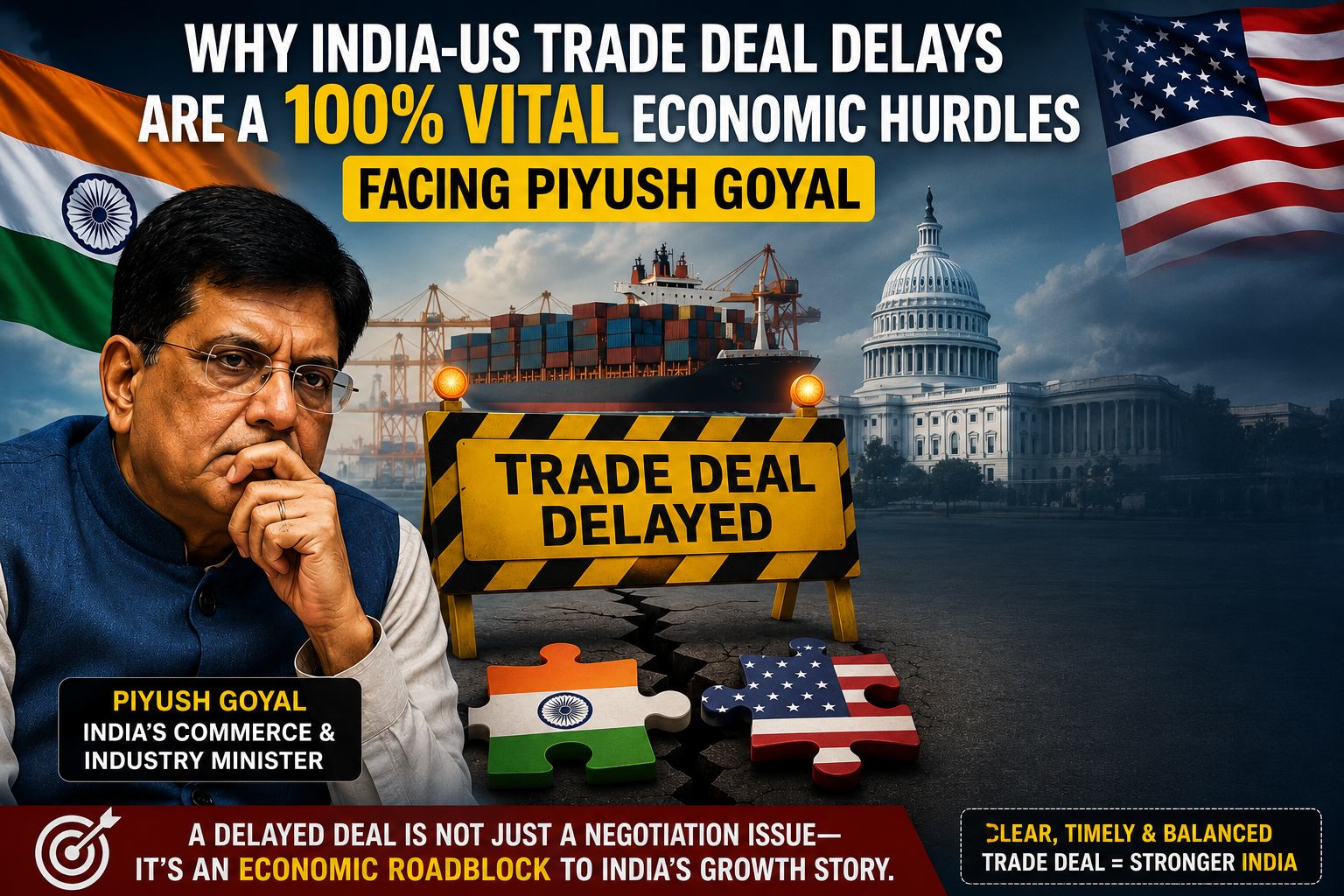
India-US trade deal delays have taken center stage in global economics as Commerce and Industry Minister Piyush Goyal made a definitive stance in London. The long-awaited bilateral trade agreement (BTA) between New Delhi and Washington, which many expected to be a done deal by now, remains in a state of suspended animation. While US officials claim the pact is “99 percent complete,” India is holding its ground, refusing to put pen to paper until it secures a concrete, competitive tariff advantage over its global competitors.
Speaking at the India Global Forum (IGF) UK-India Week event during a three-day official visit to London, Minister Goyal was remarkably transparent about the core friction points. “The day that happens, the deal is on,” Goyal stated, emphasizing that a free trade agreement is fundamentally flawed if it does not grant Indian exporters a distinct market access edge over rival nations.
The Core Challenge Behind India-US Trade Deal Delays
The primary catalyst for the India-US trade deal delays stems from a rapidly shifting American tariff landscape that completely upended a previously agreed-upon framework.
To understand the current deadlock, one must look back at the timeline of negotiations:
February 2025: India and the US formally launch BTA negotiations with an ambitious goal to finalize a comprehensive pact by Fall 2025.
February 2026: Both nations announce the contours of a first-phase interim trade deal.
The Original Deal: Under this February framework, the US agreed to reduce sweeping 50% tariffs on Indian goods down to 18%. Because India’s regional competitors (such as ASEAN nations, Bangladesh, and Sri Lanka) faced US tariffs ranging between 19% and 20%, New Delhi secured a vital competitive edge.
However, this carefully negotiated math didn’t last long. On February 20, 2026, the US Supreme Court struck down President Donald Trump’s sweeping global tariffs. This judicial shockwave forced the White House to pivot, implementing a temporary, uniform 10% tariff on imports from all countries under Section 122 of the Trade Act for a 150-day period.
How the Uniform Tariff Leveled the Playing Field (In the Wrong Way)
When Washington dropped the blanket tariff to 10% for everyone, India’s anticipated advantage vanished instantly. Instead of enjoying an exclusive 18% rate while neighbors paid 20%, India suddenly found itself paying the exact same 10% levy as Vietnam, Thailand, Malaysia, China, Bangladesh, and Sri Lanka.
“The whole deal was centered around that competitive advantage that we got with 18 percent over our neighbors and competing countries,” Goyal explained. “With the US Supreme Court striking down Trump’s sweeping tariffs and now with the additional temporary levy expiring on July 24, we obviously have to have some reason to be able to enter into force that agreement that we have already agreed upon.”
The July 24 Deadline and the Section 301 Wildcard
The temporary 10% tariff regime is set to expire on July 24, 2026. After this date, most US imports will revert to standard Most Favoured Nation (MFN) tariff rates, restoring the trade environment that existed before April 2025.
Both Indian and American teams are racing against this ticking clock to salvage and recalibrate the agreement. US Trade Representative (USTR) Jamieson Greer recently held intense, two-day ministerial talks with Piyush Goyal in New Delhi to find alternative legal mechanisms.
| Key Timeline Event (2026) | Economic & Political Impact |
| February 6-7 | Framework for Phase 1 finalized; India promised 18% tariff edge. |
| February 20 | US Supreme Court strikes down Trump’s sweeping tariffs. |
| March 11-12 | USTR launches Section 301 probes into 60 economies, including India. |
| June 2-4 | Chief negotiator-level discussions held in New Delhi. |
| June 17 | PM Modi and President Trump meet at G7 Summit in France. |
| July 24 | Expiration date for the temporary 10% US tariff regime. |
Compounding the India-US trade deal delays are two Section 301 investigations launched by the USTR in March. These probes target nearly 60 economies, focusing on alleged excess industrial capacity and forced labor concerns in global supply chains. Because India is included in these investigations, New Delhi views them as a calculated move by Washington to maintain bargaining leverage. Once the temporary tariff expires on July 24, Section 301 will be the only tool left for the US administration to unilaterally impose heavy tariffs.
What India Offered on the Negotiation Table
The tragedy of the current impasse is how close the two economic giants actually were to a historic breakthrough. Suggesting that the deal was nearly finalized, US Ambassador Sergio Gor noted in Mumbai on June 3 that both sides were simply trying to iron out a remaining “1 percent” of sticking points.
Under the agreed-upon, yet currently stalled February framework, India had made massive concessions to secure American market entry. New Delhi proposed to drastically lower trade barriers by eliminating or reducing tariffs on a massive array of US industrial and agricultural products, including:
Dried Distillers’ Grains (DDGs) and red sorghum for animal feed
Tree nuts, fresh fruits, and processed fruit items
Soybean oil, premium wines, and spirits
Furthermore, India expressed a massive, long-term commitment to purchase $500 billion worth of American energy products, commercial aircraft, aircraft parts, precious metals, coking coal, and advanced technology products over the next five years.
The Stakes: A Changing Bilateral Trade Balance
The urgency to resolve these India-US trade deal delays is underscored by the massive financial numbers at play. The United States stands as India’s second-largest trading partner, and despite the highly volatile tariff environment of the 2025-2026 fiscal year, bilateral commerce has remained remarkably resilient.
According to recent data from the commerce ministry, India’s outbound shipments to the US managed a marginal growth of 0.92%, reaching $87.3 billion during the last fiscal year. Concurrently, Indian imports of American goods surged by a massive 15.95%, climbing to $52.9 billion. Consequently, India’s traditional trade surplus with the US contracted from $40.89 billion in FY 2024-25 to $34.4 billion in FY 2025-26.
India-US Trade Snapshot (FY 2025-26)
├── Indian Exports to US: $87.3 Billion (▲ 0.92%)
├── Indian Imports from US: $52.9 Billion (▲ 15.95%)
└── India's Trade Surplus: $34.4 Billion (▼ from $40.89B)
With India buying significantly more from the US than before, New Delhi feels it has earned the right to demand ironclad market protections for its own exporters.
What Lies Ahead for the Trade Pact?
The diplomatic gears are turning at the highest levels to overcome the ongoing India-US trade deal delays. A critical meeting between Prime Minister Narendra Modi and President Donald Trump on June 17, held on the sidelines of the G7 summit in France, injected fresh political momentum into the stalled talks. This was quickly followed by Ambassador Greer’s high-stakes visit to New Delhi.
Yet, a clause built into the original February framework offers a legal escape hatch that both sides are now trying to navigate: “In the event of any changes to the agreed upon tariffs of either country, the United States and India agree that the other country may modify its commitments.”
India is invoking this exact principle. If Washington cannot find the appropriate legal tools and domestic legal backing to give Indian goods a structural advantage over ASEAN and regional peers, India will likely recalibrate its own market access offers.
As July 24 rapidly approaches, the ball remains squarely in Washington’s court. Trade teams from both nations are working around the clock to finalize the fine print, but Piyush Goyal’s message remains unwavering: India will not sacrifice its competitive edge for a rushed signature.