
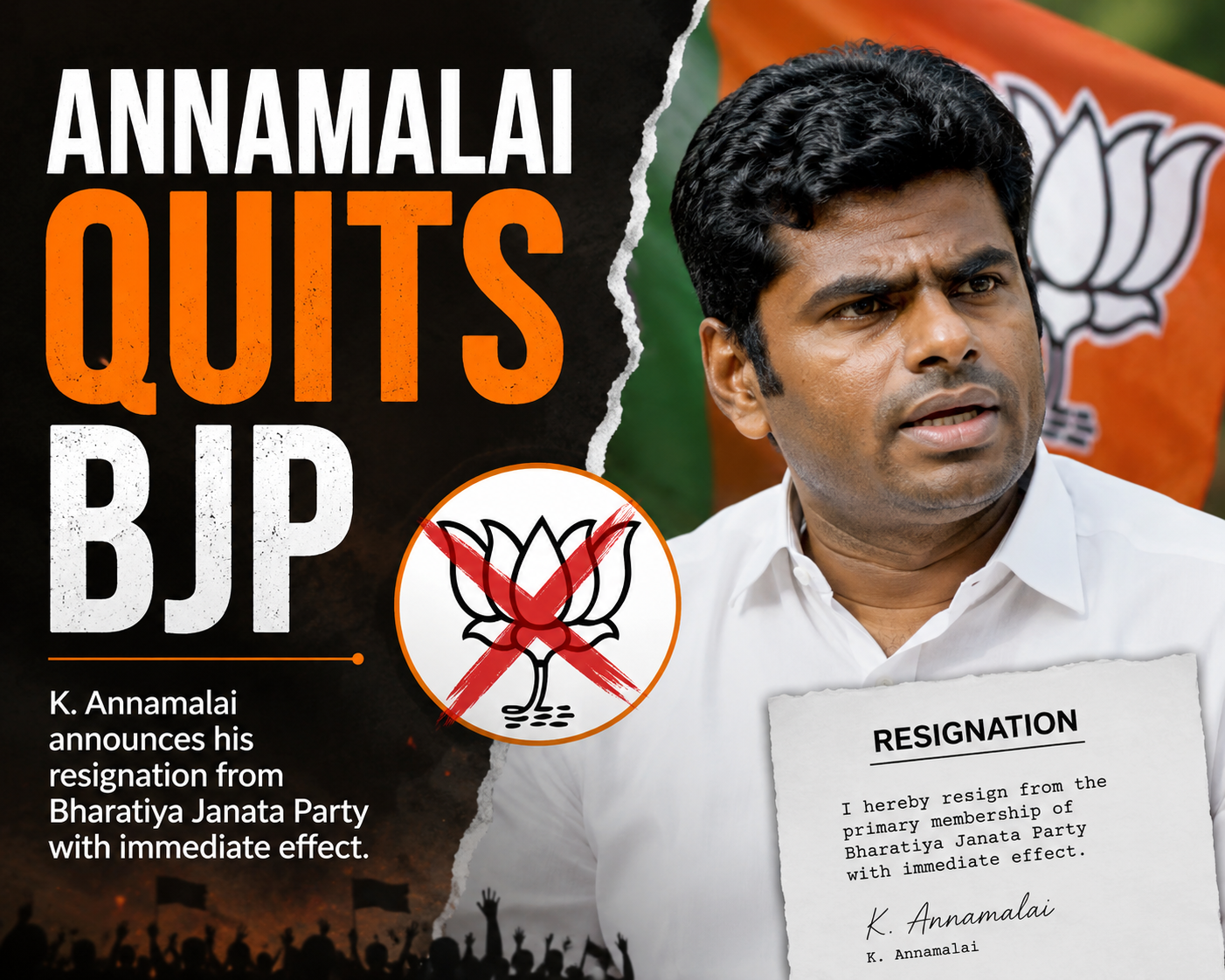
state chief K. Annamalai quits BJP following election setbacks to launch his own independent people’s movement sources. Explore the reasons behind his dramatic exit. This startling development comes just one month after the 2026 Tamil Nadu Assembly elections, in which the BJP-AIADMK alliance failed to make any significant impact, and the BJP managed to secure only a single seat in the 234-member House.
For a leader who was once projected as the future of the right-wing movement in Dravidian territory, this exit marks a dramatic shift in his career. According to highly placed sources, Annamalai feels there is no longer any viable future or independent growth opportunity for him within the national party framework. Instead of accepting a comfortable Rajya Sabha seat or a minor ministerial berth in Delhi, he is taking the ultimate gamble: launching an independent people’s movement that will eventually morph into a full-fledged regional political party.
The Breaking Point: Why Annamalai Quits BJP
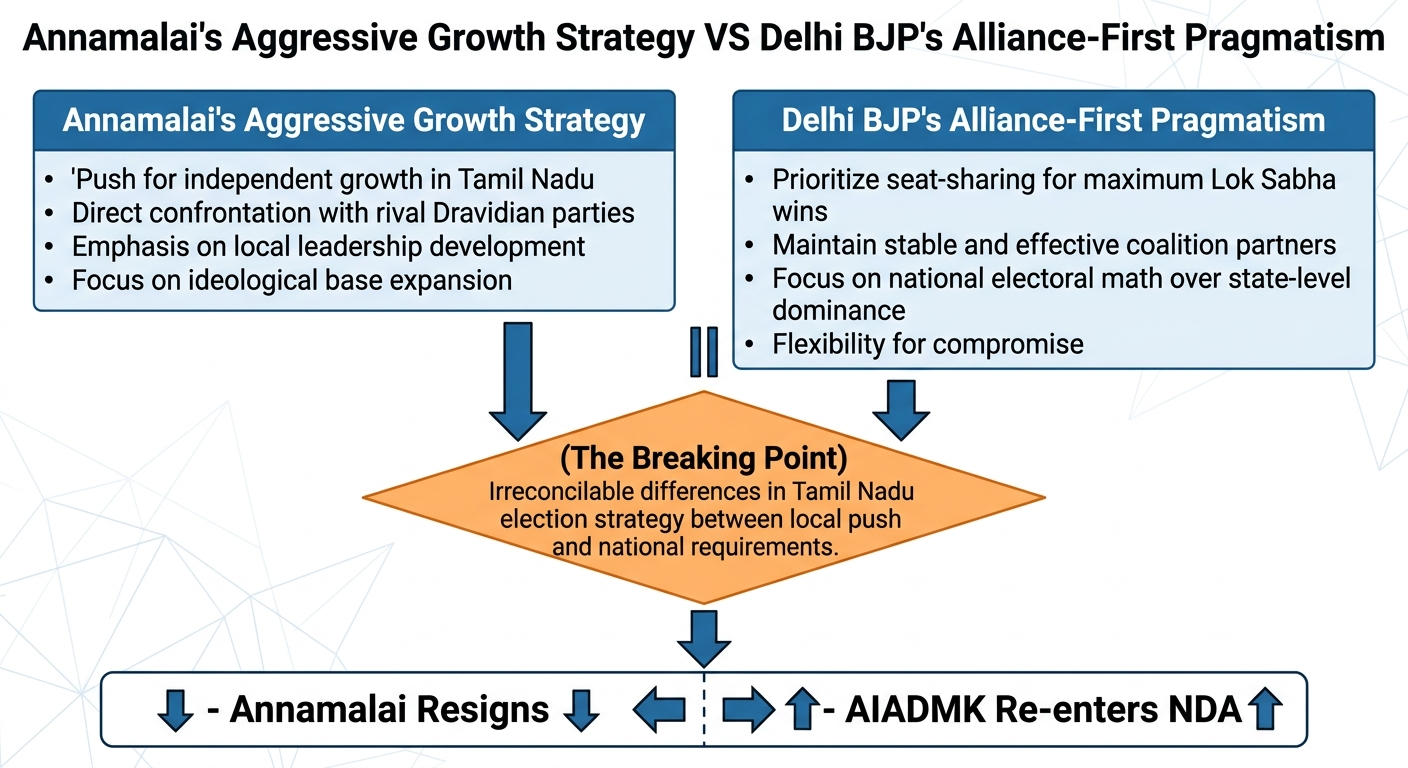
To understand why Annamalai decided to quit, we have to look closely at the internal friction that has been brewing over the last year. Annamalai’s political philosophy has always been aggressive, uncompromising, and deeply critical of established Dravidian heavyweights. This attitude brought him into direct conflict with the AIADMK and its general secretary, Edappadi K. Palaniswami (EPS).
1. The Clash with AIADMK and EPS
Annamalai firmly believed that the BJP could only grow in Tamil Nadu by acting as a distinct, independent third force. He openly targeted both the ruling DMK and the opposition AIADMK, leading to a prolonged and public spat with EPS. This friction peaked in April 2025, when the AIADMK briefly walked out of the National Democratic Alliance (NDA), blaming Annamalai’s abrasive leadership style.
2. Sidelined by the National Leadership
Terrified of losing a major regional ally for the state elections, the BJP central leadership chose alliance pragmatism over Annamalai’s long-term vision. They brought the AIADMK back into the NDA fold, but it came at a heavy price: EPS allegedly demanded a leadership change in the Tamil Nadu BJP. Consequently, Annamalai was replaced as state president in 2025.
3. The 2026 Election Boycott
Feeling betrayed and restricted, Annamalai stepped away from the limelight. He resigned as the party’s election in-charge for six key constituencies under the pretext that his father was unwell. He refused to contest the 2026 Assembly elections and stayed away from the core campaign trail. The subsequent poor electoral performance of the party only validated his belief that the traditional alliance model was dead water.
Decoding the New People’s Movement
Annamalai is not launching a political party overnight. Recognizing the logistical challenges and the deep-seated structural machinery required to fight Dravidian giants, he is executing a calculated, phased strategy.
Phase 1: The Grassroots Foundation
The first step is the launch of a massive people’s movement. This movement will focus heavily on civil society, rural outreach, and clean governance. It will leverage his existing non-profit leadership initiative, “We The Leaders,” as an initial framework to mobilize youth.
Phase 2: Building a Volunteer Cadre
The primary objective of the movement is to enroll thousands of like-minded individuals who are disillusioned with traditional caste-based and cinema-driven politics. Annamalai wants to build an army of professional volunteers—engineers, doctors, retired bureaucrats, and social activists—who can run a decentralized network across all 234 constituencies.
Phase 3: The Transition to a Political Party
Once the volunteer network is verified, active, and financially stable, the movement will formally transform into a political party. Inside sources suggest this new outfit could test its waters very early by contesting upcoming Assembly by-elections in Tamil Nadu, serving as a litmus test for his personal brand value.
The Rajinikanth Connection: A Nostalgic Branding Masterstroke
One of the most fascinating aspects of Annamalai’s upcoming venture is the branding strategy. Highly placed sources have revealed that the name of this new people’s movement is highly likely to be a phrase popularized by none other than Tamil cinema icon Rajinikanth.
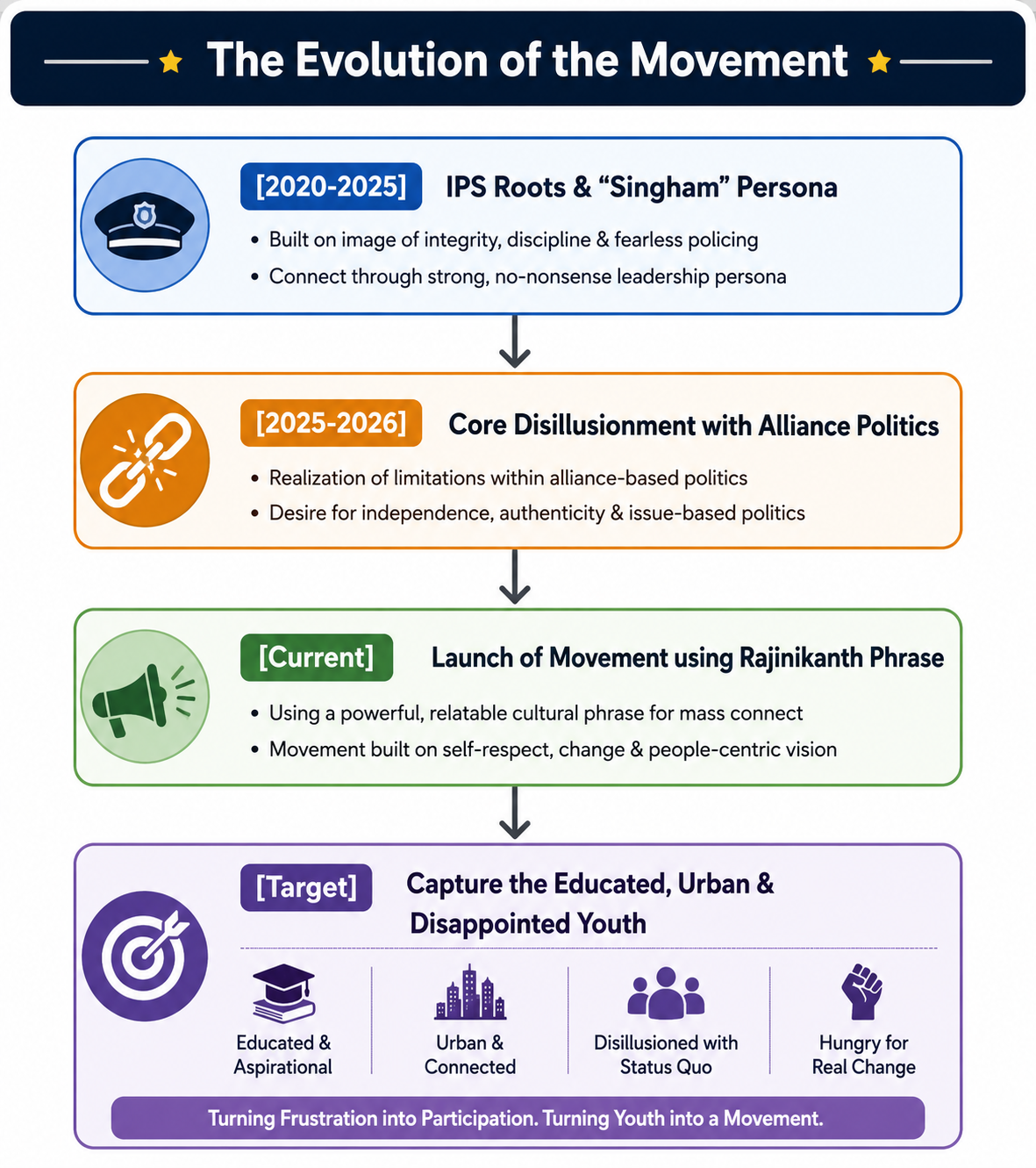
This is a deeply calculated psychological move. Back in 2019, when Annamalai first contemplated leaving the Indian Police Service, he traveled to Chennai and met Rajinikanth, expressing a desire to join the megastar’s highly anticipated political party. However, Rajinikanth eventually backed out of his political entry due to health concerns, leaving a massive vacuum of disappointed, ideologically neutral voters who wanted an alternative to the DMK and AIADMK.
By adopting a Rajinikanth-esque phrase or philosophy for his movement, Annamalai is attempting to tap into that lingering sentiment. He aims to position himself as the true spiritual heir to the clean, system-altering politics that Rajinikanth once promised but never delivered.
Target Audience: Capitalizing on the TVK and Vijay Factor
The Tamil Nadu political market has already been disrupted by superstar Vijay’s entry and his party, Tamilaga Vetri Kazhagam (TVK). Vijay’s meteoric rise has completely altered the voting dynamics, particularly among the youth and first-time voters. However, political analysts believe that Annamalai sees a distinct market gap left behind by Vijay.
The Fragmented Youth Vote
While Vijay’s TVK commands a massive, emotional mass following heavily rooted in cinema fan clubs, there remains a massive section of educated, urban, and semi-urban youth who look for intellectual depth, administrative experience, and structural policy knowledge.
The Intellectual Contrast
Annamalai—an engineer with an MBA from the prestigious IIM Lucknow and a proven track record as an upright IPS officer—contrasts sharply with the cinematic appeal of Vijay. His strategy rests on the assumption that within the next 12 to 24 months, a significant portion of the educated population will experience disillusionment with the populist approach of TVK.
| Target Category | Tamilaga Vetri Kazhagam (TVK) | Annamalai’s Proposed Movement |
| Primary Base | Mass Public, Cinema Fan Clubs, Rural Youth | Educated Urban/Semi-Urban Youth, Professionals |
| Core Appeal | Cinematic Charisma, Populist Welfare | Administrative Competence, Institutional Reform |
| Ideology | Broadly Dravidian-Centric, Cultural Pride | Rationalist Governance, Nationalist-Spiritual Blend |
Signaling Independence: The Public PivotThe signs of Annamalai’s exit have been visible to keen political observers for weeks. When he arrived at the Chennai domestic airport recently to board a flight to New Delhi for his final meeting with party leadership, reporters noticed something highly unusual: the vehicle he arrived in did not display the BJP flag.
Furthermore, Annamalai has already started asserting his independent ideological stance, even when it directly clashes with the policies of the central government.
“The premature implementation of the three-language policy by the CBSE is causing immense and unnecessary hardship for our students well before its scheduled formal rollout in the 2029-30 academic year. Local sensitivities and student readiness must take precedence over rushed bureaucratic execution.”
— K. Annamalai in a recent public statement
This public critique of a core central government policy was a clear statement of intent. It proved that Annamalai is no longer willing to carry the political baggage of Delhi directives that do not align with the ground realities of Tamil Nadu.
What Lies Ahead for Tamil Nadu Politics?
As Annamalai prepares to meet BJP National President Nitin Nabin for what insiders call a “courtesy call to say goodbye,” Chennai is already covered in posters ahead of his birthday on June 4. Slogans like “Our Leader, Come and Lead Us” underscore the grassroots expectations riding on his shoulders.
Can an ex-cop without the backing of a national giant or a cinema production house survive in the cutthroat political ecosystem of Tamil Nadu? It will be an uphill battle. The Dravidian roots run incredibly deep, and the financial muscle required to fight elections independently is monumental. However, by breaking away from the BJP, Annamalai has finally shed the “outsider” tag that his opponents used against him for years.
He is no longer an envoy of a Delhi-based party; he is an independent leader trying to script an authentic Tamil narrative. Whether this bold move turns him into a political kingmaker or a cautionary tale remains to be seen, but one thing is certain: Tamil Nadu’s political arena has just become a lot more unpredictable.
Disclaimer: This information is based on various inputs from news agency.