
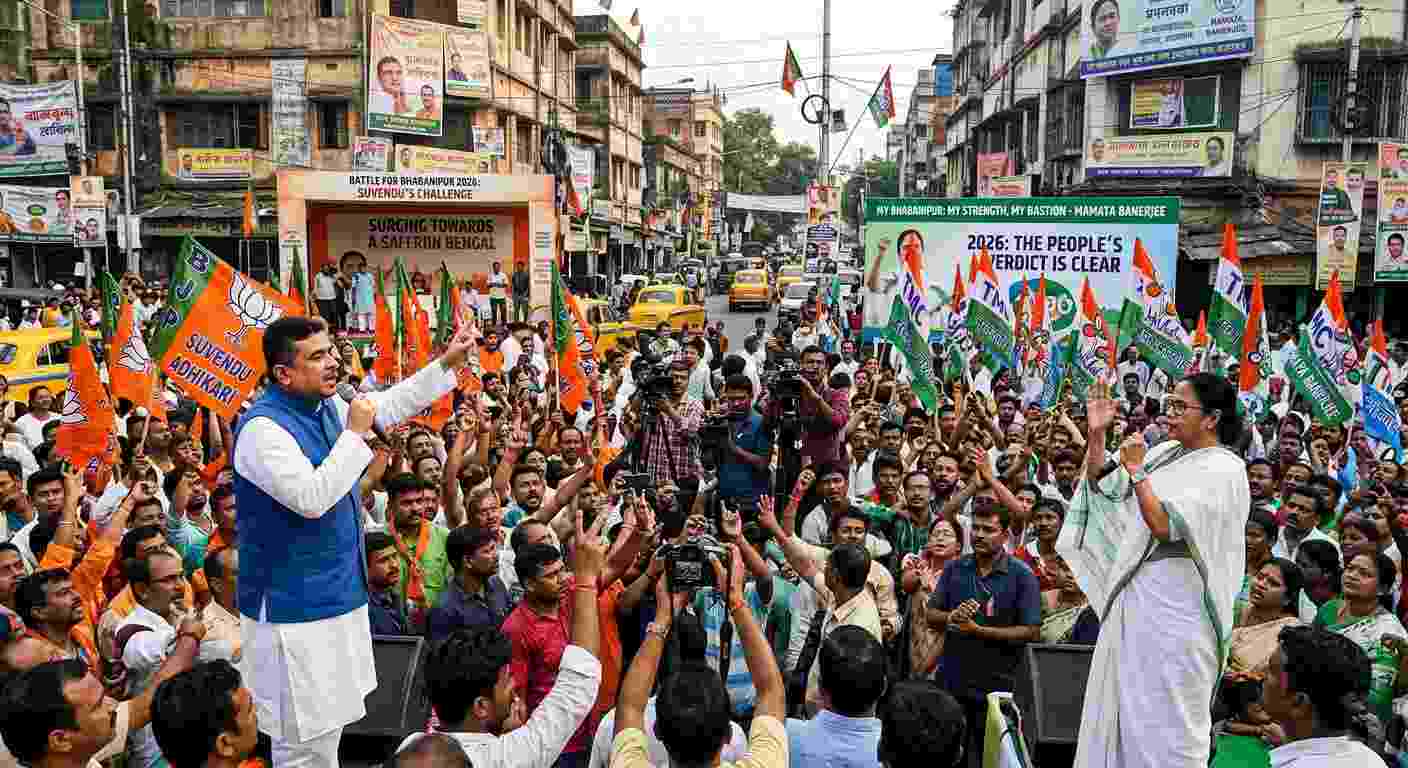
Battle for Bhabanipur: In a move that signals a “no-holds-barred” approach to the 2026 West Bengal Assembly elections, the Bharatiya Janata Party (BJP) has set the stage for the ultimate political rematch. On Monday, March 16, 2026, the saffron party released its first list of 144 candidates, headlined by a bombshell announcement: Suvendu Adhikari, the Leader of the Opposition, will from both his stronghold of Nandigram and Chief Minister Mamata Banerjee’s home turf, Bhabanipur.contest
The decision transforms the 2026 election from a standard democratic exercise into a high-stakes prestige battle. For Adhikari, it is an opportunity to prove his 2021 victory in Nandigram was no fluke. For Banerjee, it is a fight to protect the very heart of her political identity in South Kolkata.
The Nandigram Legacy: Where the Rivalry Began
Battle for Bhabanipur: Suvendu Adhikari Challenges Mamata Banerjee in Her Bastion as BJP Unveils 2026 Strategy : To understand the weight of this announcement, one must look back to 2011. Nandigram was the crucible of the anti-land acquisition movement that catapulted Mamata Banerjee to power, ending 34 years of Left Front rule. At her side during those fiery protests was Suvendu Adhikari, then a trusted lieutenant and the face of the movement in the Medinipur belt.
However, the camaraderie dissolved in 2020 when Adhikari defected to the BJP. In the 2021 elections, Banerjee famously accepted his challenge, leaving Bhabanipur to fight him in Nandigram. In a cliffhanger that went down to the final round of counting, Adhikari emerged victorious by a razor-thin margin of 1,956 votes. Although the Trinamool Congress (TMC) swept the rest of the state, the loss in Nandigram remained a personal bruise for the Chief Minister, who later returned to the Assembly via a massive by-election win in Bhabanipur.
A Rematch on New Turf: Why Bhabanipur?
Battle for Bhabanipur: Suvendu Adhikari Challenges Mamata Banerjee in Her Bastion as BJP Unveils 2026 Strategy By fielding Adhikari in Bhabanipur, the BJP is flipping the script of 2021. Instead of the Chief Minister challenging the rebel in his backyard, the rebel is now taking the fight to the “pocket borough” of the Queen.
Adhikari has been uncharacteristically blunt about his goal. On multiple occasions, he has been heard saying:
“I defeated her in Nandigram; this time I will defeat her in Bhabanipur as well. I will make her a ‘former’ Chief Minister by a margin of 50,000 votes.”
The strategy is clear: force the TMC leadership to pivot their resources toward defending a seat they usually consider “safe,” thereby thinning their campaign presence in other vulnerable districts.
The Voter List Controversy: A New Flashpoint
The lead-up to this announcement has been marred by a fierce row over the electoral rolls. According to data from the Special Intensive Revision (SIR) released by the Election Commission last week, Bhabanipur has seen some of the most significant voter deletions in the entire state.
| Constituency | Voters (Jan 2025) | Deletions Recorded |
| Bhabanipur | 2,06,295 | 44,787 |
| Nandigram | 2,78,212 | 10,599 |
The fact that Bhabanipur logged nearly four times more removals than Nandigram has provided Adhikari with political ammunition. He argues these were “ghost voters” or “infiltrators” that padded the TMC’s margins. Mamata Banerjee, conversely, has launched a sit-in protest (dharna), accusing the EC of “disenfranchising genuine Bengali voters” to help the BJP. She recently declared, “I will win from Bhabanipur even if only one voter is left.”
Beyond the Headlines: The BJP’s First List
While the Adhikari-Banerjee showdown dominates the narrative, the BJP’s first list of 144 candidates reveals a broader strategy of fielding established heavyweights and vocal critics of the state government:
- Dilip Ghosh: The former state president, known for his aggressive rhetoric, returns to Kharagpur Sadar.
- Agnimitra Paul: The prominent woman leader and fashion designer-turned-politician will contest from Asansol Dakshin.
- Swapan Dasgupta: The former Rajya Sabha MP has been fielded from Rashbehari in South Kolkata.
- Shankar Ghosh: The party’s articulate voice from North Bengal will contest from Siliguri.
- Women Representation: The list includes 10 women candidates, including figures like Madhavi Mahalder (Kultali) and Savitri Barman (Sitalkuchi).
The list was finalized at a meeting of the party’s central election committee in Delhi, chaired by Prime Minister Narendra Modi and attended by Home Minister Amit Shah and Defence Minister Rajnath Singh.
The Road Ahead: Two Phases to Decide Bengal’s Fate
The Election Commission has shortened the polling window this year, opting for a two-phase election to minimize the logistical strain and potential for prolonged violence.
- Phase 1: April 23 – Focusing on North Bengal and the Medinipur districts (including Nandigram).
- Phase 2: April 29 – Covering Kolkata (including Bhabanipur), South 24 Parganas, and Hooghly.
- Counting Day: May 4 – The day the state will know if the “Daughter of Bengal” retains her throne or if Adhikari succeeds in his quest to add the word “former” to her title.
As the temperature in Bengal rises—both meteorologically and politically—the battle for Bhabanipur represents more than just a seat in the Assembly. It is a referendum on the last five years of governance, the impact of the SIR voter revision, and the enduring power of political symbols in the state.
Nandigram was 2021’s epicentre; in 2026, the tectonic plates of Bengal politics have shifted to the streets of South Kolkata.