
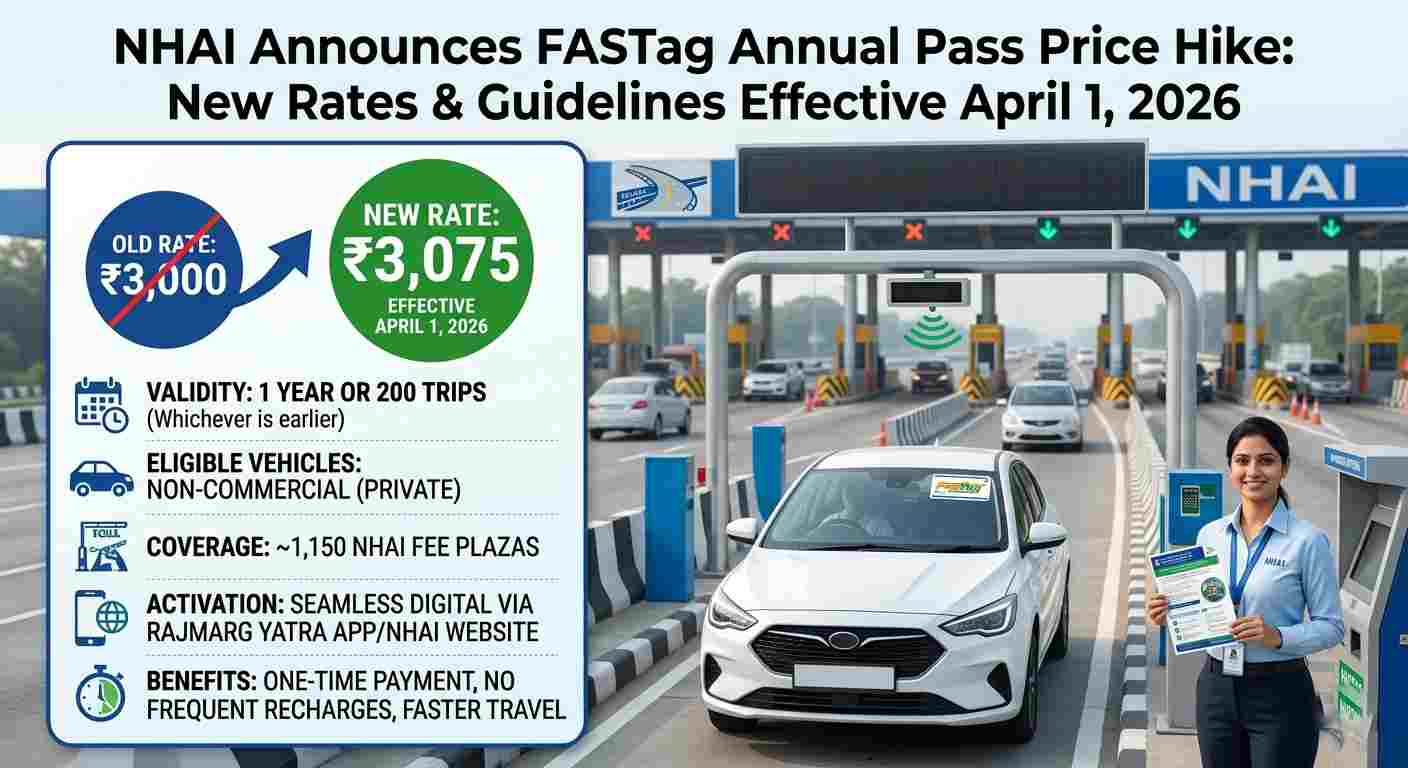
NHAI Announces FASTag Annual Pass Price Hike:The landscape of highway travel in India is set for a minor financial adjustment as the National Highways Authority of India (NHAI) officially announced a revision in the FASTag Annual Pass fees. Starting April 1, 2026, private vehicle owners who frequent the nation’s vast network of expressways and highways will need to shell out slightly more to maintain their unlimited-access privileges.
This update, released on March 15, 2026, marks the first significant price adjustment since the highly successful launch of the annual pass scheme in mid-2025. Here is a comprehensive breakdown of everything you need to know about the new rates, the activation process, and the long-term benefits of the program.
The New Price Structure: A Marginal Increase for FY 2026-27
NHAI Announces FASTag Annual Pass Price Hike: New Rates and Guidelines Effective April 1, 2026
In a move to align with the National Highways Fee (Determination of Rates and Collection) Rules, 2008, the NHAI has decided to increase the annual pass fee by ₹75.
Current Rate (until March 31, 2026): ₹3,000
Revised Rate (from April 1, 2026): ₹3,075 The ₹3,075 fee will be applicable for the entire 2026-27 Financial Year. While any price hike is often met with scrutiny, the NHAI emphasizes that this 2.5% increase is a routine regulatory adjustment intended to support the maintenance of the high-speed corridors that have revolutionized Indian logistics and personal travel.
What is the FASTag Annual Pass?
Launched on August 15, 2025, the FASTag Annual Pass was introduced as a “game-changer” for frequent commuters. Unlike the standard “pay-as-you-go” FASTag model, where money is deducted per crossing, the Annual Pass allows for a one-time lump-sum payment.
Key Features:
Validity: One full year from the date of activation.
Trip Cap: The pass covers up to 200 toll plaza crossings or one year, whichever comes first.
Vehicle Type: Exclusively available for non-commercial (private) vehicles.
Network Reach: Accepted at approximately 1,150 fee plazas across the National Highway and Expressway network.
For the average road tripper or the suburban commuter who crosses multiple tolls daily, this pass offers significant financial relief compared to standard rates, which can often exceed ₹100–₹200 per single trip in high-demand corridors.
Why the Popularity? Over 5.6 Million Users and Counting
According to the Ministry of Road Transport & Highways, the program has seen a “surging” adoption rate. Currently, there are over 56 lakh (5.6 million) active users of the annual pass.
The primary driver behind this growth is the elimination of recharge fatigue. Users no longer need to worry about maintaining a minimum balance or facing the embarrassment of a “blacklisted” tag at a toll booth due to insufficient funds. The “set it and forget it” nature of the annual pass provides peace of mind for 365 days.
How to Activate Your Pass: A Streamlined Digital Process
The NHAI has ensured that the transition to the new fee cycle is seamless. There is no need to purchase a new RFID tag; the pass is digitally linked to your existing FASTag.
Step-by-Step Activation:
Step 1: Download the Rajmarg Yatra App (available on iOS and Android) or visit the official NHAI website.
Step 2: Enter your vehicle details and linked FASTag ID.
Step 3: Pay the one-time fee of ₹3,075 (from April 1 onwards).
Step 4: Wait for 2 Hours. The system integrates the pass with your tag almost instantly, becoming active for use within a 120-minute window.
Pro Tip: If your current pass is expiring soon, it is highly recommended to renew it before March 31 to lock in the old rate of ₹3,000 for the upcoming year.
Eligibility and Restrictions
While the pass is a boon for many, it is essential to understand the fine print to ensure you are eligible:
Non-Commercial Only: This facility is strictly for white-plate private vehicles. Commercial vehicles, trucks, and multi-axle transporters continue to operate under the standard per-trip or monthly local pass schemes.
Valid FASTag Required: Your vehicle must already have a functional, KYC-compliant FASTag. The annual pass is an “add-on” service, not a replacement for the tag itself.
Geographic Coverage: While it covers 1,150 plazas, users should check the Rajmarg Yatra app to ensure their frequent routes are included in the national NHAI network, as some state-run highways might have different collection systems.
The Strategic Vision: Digital India on the Move
The revision of fees under the National Highways Fee Rules, 2008, is part of a broader strategy to make Indian highways self-sustaining. The revenue generated from these passes goes directly into the upkeep of the 1.4 lakh+ km of National Highways.
By encouraging the use of the Annual Pass, the government is also reducing the “processing time” at toll plazas. Even with FASTag, occasional balance issues can cause minor delays. A pre-paid annual pass ensures a 100% success rate at the sensor, contributing to the “Zero Waiting Time” goal at toll plazas.
Summary Table: FASTag Annual Pass at a Glance
| Feature | Details |
| New Price | ₹3,075 (Effective April 1, 2026) |
| Old Price | ₹3,000 (Until March 31, 2026) |
| Validity | 1 Year or 200 Trips |
| Eligible Vehicles | Non-Commercial (Private) |
| Plazas Covered | ~1,150 (NHAI & Expressways) |
| Activation Portal | Rajmarg Yatra App / NHAI Website |
| Activation Time | 2 Hours post-payment |
Conclusion: Is it Worth the Increase?
While an increase in costs is never ideal for consumers, the ₹75 hike is relatively minor when weighed against the convenience and potential savings. For a frequent traveler, 200 trips at a standard rate could cost anywhere between ₹10,000 and ₹30,000 annually. At ₹3,075, the cost per trip under the annual pass breaks down to approximately ₹15.37, making it arguably the most cost-effective way to travel in India today.
As we move into the 2026-27 Financial Year, the FASTag Annual Pass remains a cornerstone of the Ministry’s effort to provide “greater convenience and cost-effective travel options” to the Indian public.