
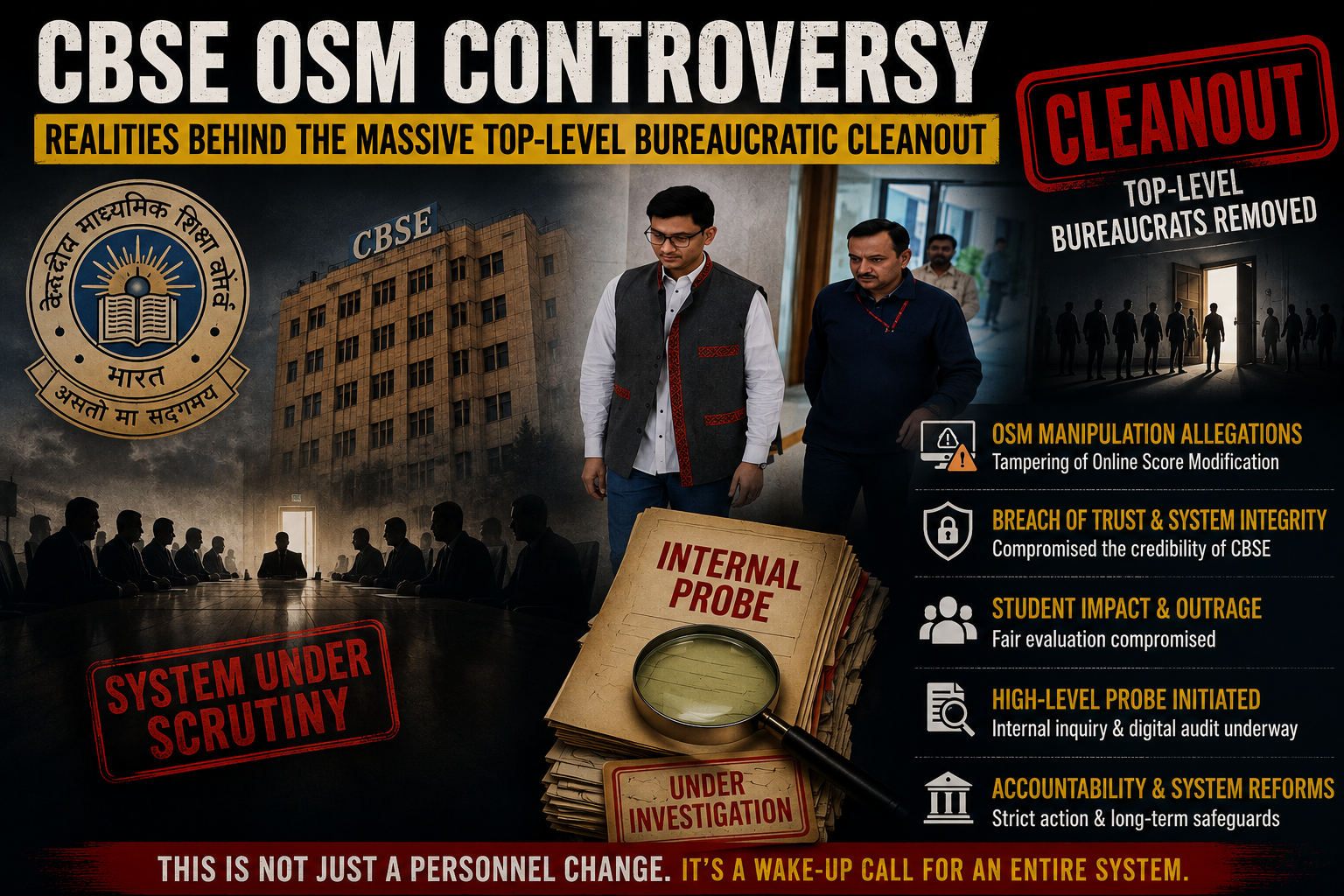
The CBSE OSM Controversy has completely exploded into one of the most severe administrative and structural crises ever seen in India’s national education ecosystem. In an unprecedented late-night crackdown that has sent shockwaves through the highest echelons of the civil services, the Central Government has summarily stripped the top leadership of the Central Board of Secondary Education (CBSE) of their duties. This dramatic purge comes on the heels of systemic malfunctions, contractual anomalies, and data security compromises linked to the newly deployed Digital Scanning and On-Screen Evaluation (OSM) platform.
For weeks, millions of Class 12 students, their families, and digital security analysts have warned of deep structural issues within the electronic grading portal. The administrative collapse finally forced the Appointments Committee of the Cabinet (ACC), chaired by Prime Minister Narendra Modi, to intervene directly, replacing the board’s top leadership while a high-level independent inquiry begins a deep-dive probe into the procurement pipeline.
Below, we break down the seven shocking realities behind this institutional crisis, tracing how a flawed digital transition compromised the academic futures of thousands of students and triggered a major political showdown in Parliament.
1. The Late-Night Bureaucratic Purge: Heads Roll at the Top
Old Guard (Shunted Out)       ⇔        New Leadership (Appointed)
______________________________________________________________________
Rahul Singh (Chairperson)     ⇒   Lokhande Prashant Sitaram (IAS, 2001 Batch)
Himanshu Gupta (Secretary)  ⇒   Varun Bhardwaj (IIS, 2008 Batch)
The immediate catalyst for this public scandal is the sudden removal of CBSE Chairperson Rahul Singh and Board Secretary Himanshu Gupta. Both senior officers have been abruptly transferred away from the education board right in the middle of processing the high-stakes board examination results.
Lokhande Prashant Sitaram (IAS, 2001 batch, AGMUT cadre), who was serving as an Additional Secretary in the Ministry of Home Affairs, has been swiftly appointed as the new Chairperson of the CBSE.
Varun Bhardwaj (IIS, 2008 batch), formerly a Director within the Ministry of Education, steps in as the new Secretary.
The terms of departure for the outgoing leadership show just how serious the situation is. Former Secretary Himanshu Gupta has been prematurely sent back to his parent cadre under explicit “administrative grounds” coupled with an “extended cooling off” condition. This effectively locks him out of any central government assignments until after December 12, 2030. Meanwhile, Rahul Singh has been moved to a lateral position as an Additional Secretary within the Ministry of Agriculture and Farmers Welfare. This immediate cleanout highlights the government’s desperate attempt to restore public trust as the CBSE OSM Controversy deepens.
2. Digital Disasters on the Ground: Mix-Ups, Blurred Sheets, and Grade SwapsAt the heart of this controversy is the catastrophic failure of the digital evaluation portal on an operational level. The system, designed to move past physical paper routing to speed up grading and improve accuracy, instead delivered a series of technical breakdowns:
Handwriting Mismatches: Students who applied for scanned copies of their evaluated papers to check for grading fairness were shocked to find sheets written in handwriting that clearly was not their own.
Identity Cross-Contamination: The digital portal routinely uploaded wrong portfolios, attaching Student A’s roll number identifier to Student B’s scanned exam script.
Severe Legibility Issues: Many uploaded sheets were badly blurred, unreadable, or missing entire pages. This made it impossible for students to verify if their answers had even been looked at by an examiner.
Widespread Payment Failures: The infrastructure struggled with high user traffic, locking students out of verification requests due to continuous portal crashes and broken payment gateways.
While senior board officials initially tried to downplay the issue as a minor technical glitch, they eventually had to admit that at least 20 clear cases of total answer-sheet mismatches were explicitly verified in the early rounds of review. This admission confirmed what families had feared: the digital platform was systematically misallocating grades on a massive scale.
3. Sarthak Sidhant: The 17-Year-Old Whistleblower Shaking Parliament
In a historic moment for parliamentary oversight, the most damaging evidence against the education board didn’t come from an internal auditor or an opposition lawmaker. Instead, it was brought forward by Sarthak Sidhant, a 17-year-old student from Jharkhand whose academic life was upended by the faulty online evaluation system.
Student Whistleblower: Sarthak Sidhant (17, Jharkhand)
                         │
                        ▼
           (Presents Evidence)
Parliamentary Standing Committee on Education
                         │
                        ▼
               (Cites Anomalies)
• Vendor Selection Loopholes  • Data Vulnerabilities  • Arbitrary Procurement
Appearing directly before the Parliamentary Standing Committee on Education, Sidhant delivered a comprehensive, data-driven presentation detailing the technical and structural flaws embedded within the board’s digital evaluation process. The teenager highlighted the clear gaps in how vendors were selected, raised serious concerns over student data protection, and challenged the board’s complex, expensive re-evaluation fee structure.
His testimony completely dismantled the board’s standard defense of “isolated glitches.” It proved that a student with no inside access could easily spot deep systemic risks in the software infrastructure, leaving the parliamentary panel furious and putting the board on the defensive.
4. The Hidden Tender Modification: Removing the Vendor Blacklist Clause
As investigative journalists and legislative committees dug into the root cause of the breakdown, attention shifted to the original procurement process that put the digital system in place. The board had awarded the contract for digital scanning and on-screen evaluation to Hyderabad-based vendor Coempt Edu Teck, tasking them with handling millions of high-stakes student answer sheets.
A paper trail exposed a highly questionable change in the legal terms governing the agreement. When the CBSE first issued the public tender on August 28, 2025, the document featured a strict enforcement framework designed to protect the public interest:
 2025 Draft Tender Terms                         2026 Final Contract Realities
____________________________________________________________________________________
✔ Performance Bank Guarantee Forfeiture  ⇔   ✔ Performance Bank Guarantee Forfeiture
✔ Compulsory Vendor Blacklisting Clause  ⇔  ✘ BLACKLISTING CLAUSE TOTALLY REMOVED
✔ Immediate Contract Termination         ⇔  ✔ Immediate Contract Termination
This initial draft empowered an independent board committee to recommend forfeiting the Performance Bank Guarantee (PBG), terminating the deal, and permanently blacklisting the vendor if any major operational failures or security breaches occurred.
However, by the time the final contract was signed, the critical blacklisting clause had been completely removed. This structural change gave the tech vendor a massive legal safety net, ensuring that no matter how bad the system’s operational failure was, they could never be barred from bidding on future government education contracts.
5. The Final Contract Loopholes: Financial Fines Over Absolute Accountability
The final six-page contract signed between the board and the technology vendor reveals a flawed enforcement structure that favored minor financial penalties over real, systemic accountability. Instead of holding the service provider strictly responsible for system failures, the contract reduced historic institutional errors to basic, hourly service-level penalties:
System Outages: The vendor faced a penalty of ₹1 lakh for every 15 minutes of delay in fixing critical software issues flagged by the board.
Delayed Diagnostics: A fine of ₹1 lakh was set for every 60 minutes of delay if the vendor failed to submit a comprehensive root-cause analysis or a corrective action plan following a system crash.
The Missing Threat: While the board retained the right to seize security deposits and cancel the contract in extreme scenarios, the complete removal of the blacklisting threat turned these penalties into minor, predictable business costs for a multi-million rupee project.
This weak penalty framework explains why the platform launched with so many unresolved technical flaws. The vendor faced no existential commercial risk for delivering a broken product, leaving students to pay the price for a rushed digital rollout.
6. A Political Firestorm Breaks Out in Parliament
What began as a localized wave of student complaints quickly escalated into a national political crisis. The systemic failures of the CBSE OSM Controversy became a primary weapon for Opposition lawmakers, who argued that the digital breakdown reflected a broader pattern of poor oversight in central administrative bodies.
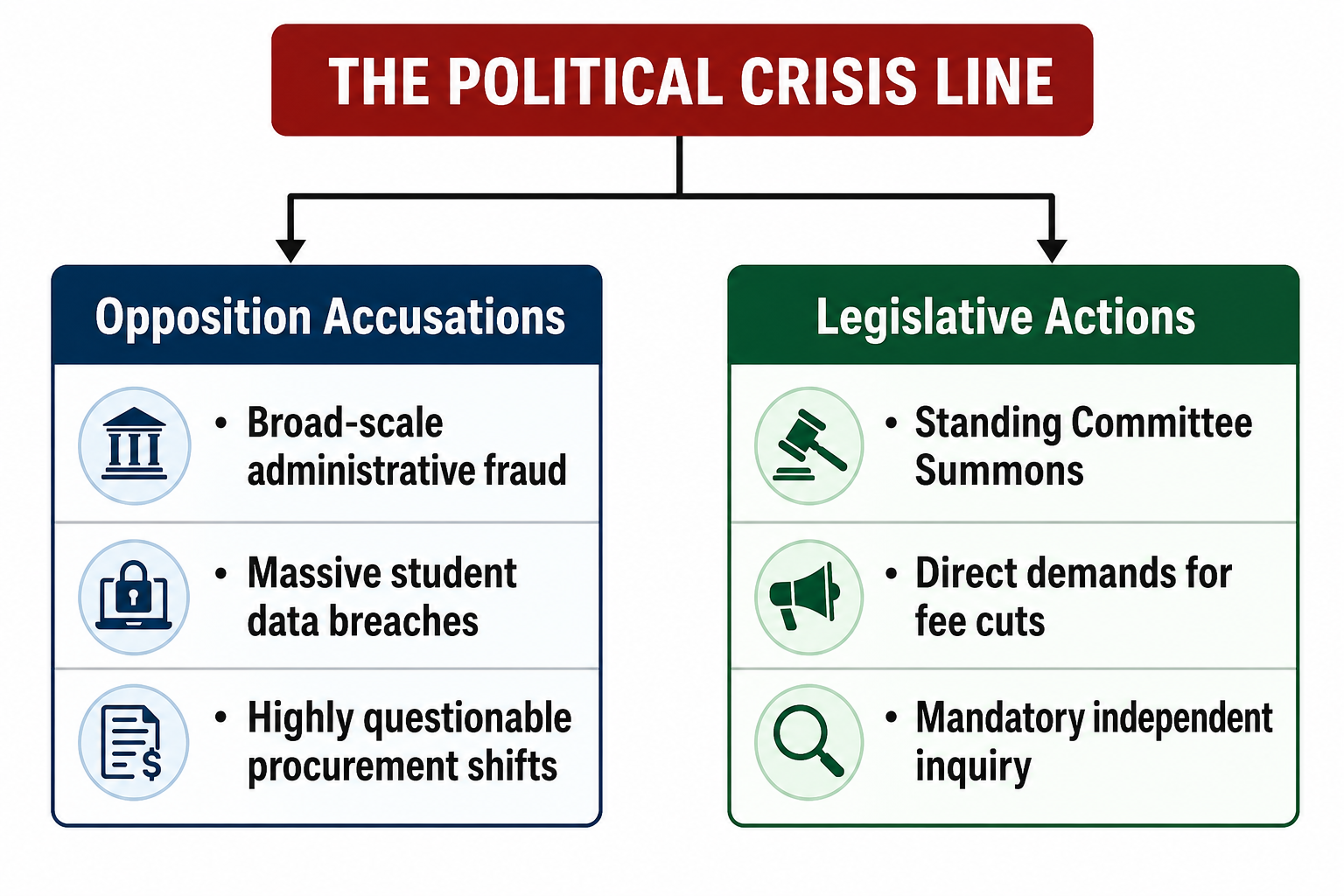
Senior leaders, including the Congress party’s Rahul Gandhi, launched a direct attack on the government’s management of the education board. Opposition frontliners accused the administration of overlooking clear red flags in procurement, point-blank highlighting mobile-phone scanning methods, leaked student data, and unreadable answer sheets as evidence of widespread systemic failure.
The Parliamentary Standing Committee on Education responded by issuing immediate summons to senior Ministry officials and the Education Secretary. The committee demanded a full accounting for the erratic grading outcomes, while also calling for an immediate reduction in the high re-evaluation fees charged to families just to have their erroneously processed papers re-checked.
7. Cyber Warfare on the Portal: 1.5 Million Attacks in Two MinutesAdding another dangerous layer to the crisis, the CBSE’s newly launched re-evaluation and verification portal faced massive, coordinate cyberattacks the moment it went live to address student grievances.
According to official updates shared by the board on X (formerly Twitter), the system was hit by a massive Distributed Denial-of-Service (DDoS) attack that flooded the network infrastructure with 1.5 million hits within a two-minute window. Concurrently, automated systems logged over 100,000 unauthorized file access attempts, as malicious actors actively tried to break through backend databases and steal confidential student dossiers.
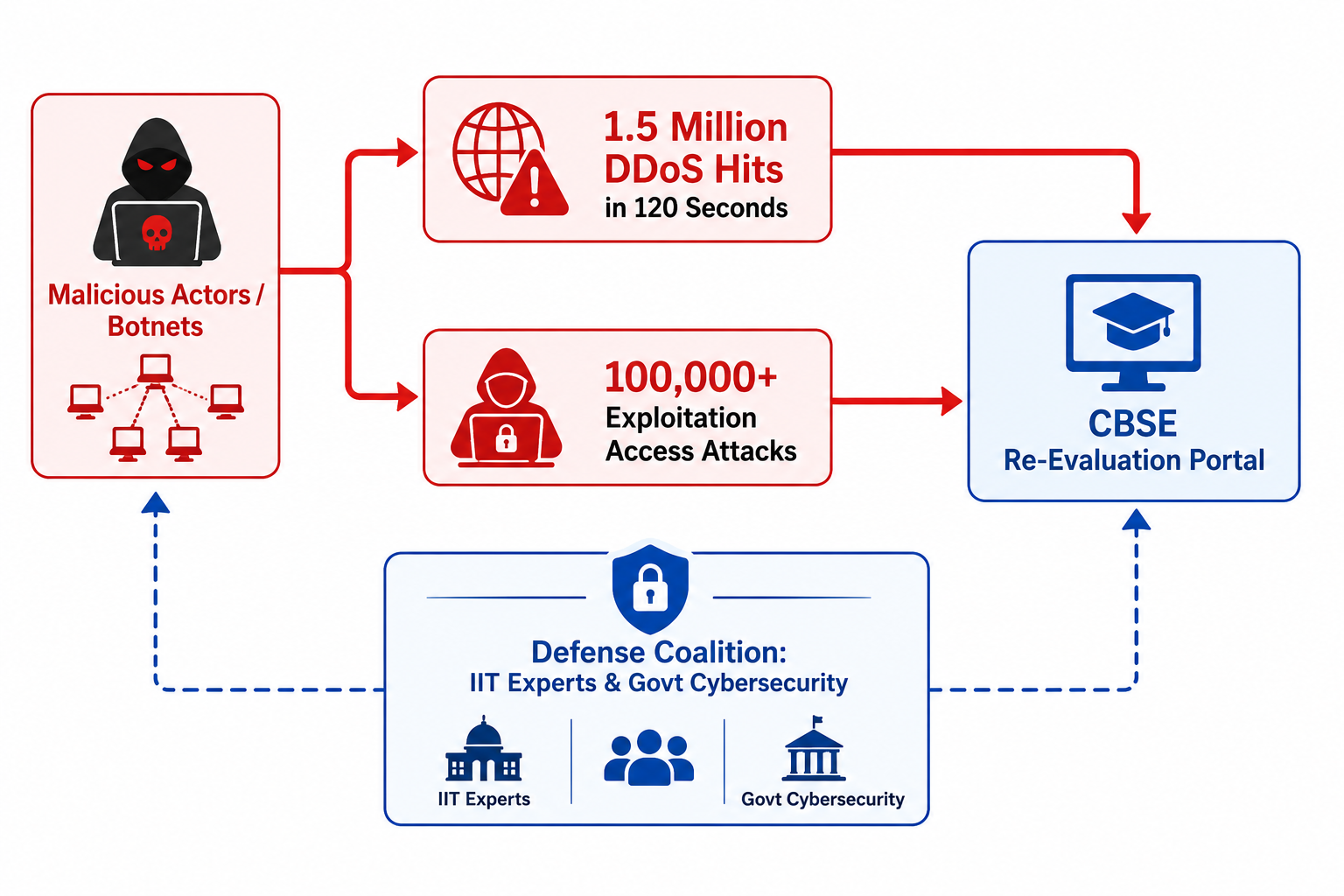
In response to this severe security threat, the board set up an emergency cybersecurity command unit, drawing in top-tier technical talent from elite Indian Institutes of Technology (IITs) and specialized central cyber-defense agencies.
Remarkably, despite the massive wave of malicious traffic, the portal’s security framework held the line. Operating continuously from 7:00 AM onwards, the platform successfully processed more than 18,000 valid re-evaluation applications by mid-afternoon, while simultaneously managing over 8,000 active, verified users at any given moment. To help frustrated applicants navigate the heavily targeted portal, technical teams extended user session timeouts, keeping the platform active around the clock until its hard deadline at midnight on June 6, 2026.
What Lies Ahead: The Roadmap for Institutional Reform
To prevent further damage to its reputation, the Department of Personnel and Training (DoPT) has set up a strict, one-member independent investigative committee to uncover the truth behind the procurement failure.
       ONE-MEMBER INVESTIGATIVE TIMELINE
                                         │
                                        ▼
               Chairperson: Ms. S. Radha Chauhan
        (Chairperson, Capacity Building Commission)
                                         │
                                         ▼
   Mandate: Probe Procurement, Tenders, & System Flaws
                                         │
                                        ▼
     Deadline: 30 Days (Direct Submission to DoPT)
Headed by Ms. S. Radha Chauhan, the current Chairperson of the Capacity Building Commission, the committee has been given a strict 30-day deadline to submit its final findings. Her investigation will focus directly on:
Reconstructing the exact timeline of the contract negotiations.
Identifying who authorized removing the vendor-blacklisting protection clause.
Evaluating the software vulnerabilities that allowed sheet mix-ups and exposed student data to cyber threats.
The ongoing crisis serves as a stark warning for public sector institutions rushing to digitize their operations. True modernization requires more than just replacing paper with screens; it demands absolute transparency in procurement, rigorous stress-testing of software, and unyielding data protection standards.
Until Ms. Chauhan’s investigation report is made public, the new leadership team of Sitaram and Bhardwaj faces the monumental task of rebuilding trust with millions of anxious students, ensuring that the integrity of India’s national examination system is permanently restored.