
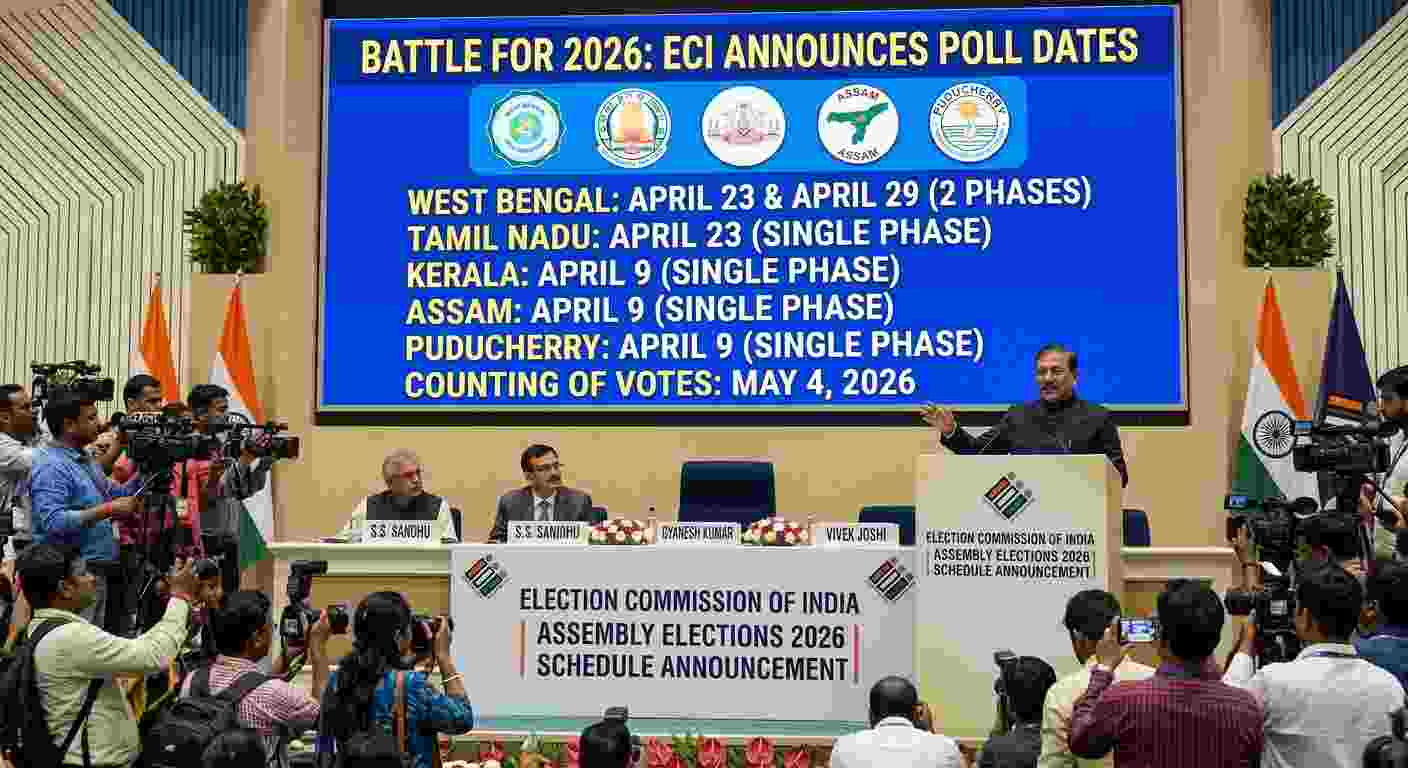
ECI Announces Assembly Election Dates:The democratic machinery of India is set to shift into high gear as the Election Commission of India (ECI) officially announced the schedule for the 2026 Assembly Elections on Sunday. In a high-stakes press conference held at Vigyan Bhavan, New Delhi, Chief Election Commissioner (CEC) Gyanesh Kumar, flanked by Election Commissioners S.S. Sandhu and Vivek Joshi, outlined the roadmap for four major states—West Bengal, Tamil Nadu, Kerala, and Assam—and the Union Territory of Puducherry.
With the terms of these legislative assemblies expiring between May and June 2026, over 17.4 crore eligible voters are expected to exercise their franchise across 824 constituencies. The announcement has immediately triggered the Model Code of Conduct (MCC), effectively putting a freeze on new government policy announcements in the poll-bound regions.
The Master Schedule: April 9 to May 4
Battle for 2026: ECI Announces Assembly Election Dates for West Bengal, Tamil Nadu, Kerala, Assam, and Puducherry
The 2026 electoral exercise will be conducted in a staggered manner throughout April, with a unified Counting Day on May 4, 2026. Notably, the ECI has opted for a significantly condensed schedule compared to previous years, particularly in West Bengal.
| State/UT | Polling Date(s) | Phases | Total Seats |
| Assam | April 9 | Single Phase | 126 |
| Kerala | April 9 | Single Phase | 140 |
| Puducherry | April 9 | Single Phase | 30 |
| Tamil Nadu | April 23 | Single Phase | 234 |
| West Bengal | April 23 & April 29 | Two Phases | 294 |
West Bengal: A Departure from the 8-Phase Marathon
Battle for 2026: ECI Announces Assembly Election Dates for West Bengal, Tamil Nadu, Kerala, Assam, and Puducherry
The biggest headline of the day is the drastic reduction in polling phases for West Bengal. In 2021, the state witnessed a marathon eight-phase election that spanned over a month. This time, the ECI has consolidated the process into just two phases.
Phase 1: April 23, 2026 (152 Seats)
Notification Date: March 30
Last Date for Nomination: April 6
Scrutiny: April 7
Withdrawal: April 9
Districts Covered: Major portions of North Bengal and parts of South Bengal, covering 152 constituencies.
Phase 2: April 29, 2026 (142 Seats)
Notification Date: April 2
Last Date for Nomination: April 9
Scrutiny: April 10
Withdrawal: April 13
Focus: Remaining 142 seats, including the high-profile urban clusters.
When asked about this change, CEC Gyanesh Kumar stated that after detailed deliberations on security and logistics, the commission found it “necessary to bring down the phases to an extent where it is convenient for everybody,” while promising a violence-free environment.
Political Context and Key Battlegrounds
1. West Bengal: Bengali ‘Asmita’ vs. Anti-Incumbency
The Trinamool Congress (TMC), led by Chief Minister Mamata Banerjee, is seeking a fourth consecutive term. The campaign has already been charged by the Special Intensive Revision (SIR) of electoral rolls. While the BJP alleges that the revision has finally purged “infiltrators” and “fake voters,” the TMC has labeled the exercise an assault on Bengali identity. The Matua factor and Bengali sub-nationalism (Bengali Asmita) are expected to be the central pivots of the campaign.
2. Tamil Nadu: The Dravidian Fortress
In Tamil Nadu, the ruling DMK-led alliance faces a challenge from a resurgent AIADMK and an increasingly vocal BJP. Chief Minister M.K. Stalin’s government is leaning on its “Dravidian Model” of social justice and industrial growth. Meanwhile, the opposition is highlighting issues of law and order and corruption.
3. Kerala: Can the LDF Break the Pendulum Again?
Kerala traditionally alternates between the Left (LDF) and the Congress-led UDF. However, after the LDF broke this tradition in 2021, Pinarayi Vijayan’s government is eyeing a historic “hat-trick.” The UDF, however, is banking on strong anti-incumbency sentiments regarding the cost of living and unemployment.
4. Assam and Puducherry: The NDA Strongholds
In Assam, Chief Minister Himanta Biswa Sarma remains the face of the BJP’s “development and identity” narrative. The opposition, a fragmented Congress-led bloc, aims to capitalize on issues like flood management and citizenship reform anxieties. In Puducherry, the AINRC-BJP coalition will defend its turf against the DMK-Congress alliance.
Logistics: A Mammoth Task
The ECI has provided staggering figures to illustrate the scale of this election:
Polling Stations: Approximately 2.18 lakh booths will be established.
Personnel: Over 2.5 million election officials and security personnel will be deployed.
Voters: Roughly 17.4 crore citizens are eligible to vote.
Innovation: A renewed focus on the Voter Verifiable Paper Audit Trail (VVPAT) and Electronic Voting Machines (EVMs) to ensure transparency.
The Model Code of Conduct (MCC)
With the schedule out, the MCC is now in effect. This means:
No New Projects: Governments cannot announce new financial grants or projects that might influence voters.
Official Machinery: Ministers are prohibited from combining official visits with electioneering.
Hate Speech: The ECI has warned against speeches that aggravate communal or linguistic tensions, citing strict penalties for violations.
Final Thoughts: The Road to May 4
As the sun sets on the announcement day, the political landscape of India enters a fever pitch. Prime Minister Narendra Modi’s recent rally in Kolkata and the opposition’s motion regarding the CEC’s impartiality have already set a confrontational tone.
The next few weeks will see a blitz of rallies, digital campaigns, and door-to-door canvassing. All eyes are now on April 9, when the first votes will be cast in Assam, Kerala, and Puducherry, marking the beginning of a month-long festival of democracy.