
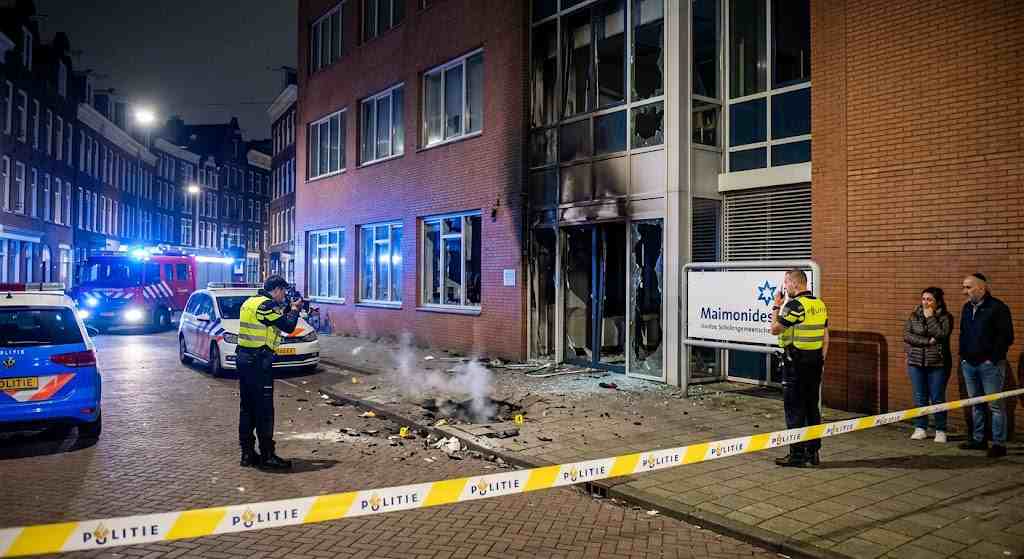
Explosion Rocks Amsterdam Jewish School: A pre-dawn explosion damaged a Jewish school in Amsterdam on Saturday, March 14, 2026, marking the latest in a series of violent attacks targeting Jewish institutions across Europe and North America. Amsterdam Mayor Femke Halsema has condemned the incident as a “cowardly act of aggression” and a deliberate assault on the city’s Jewish community.
The blast occurred early Saturday morning at a school located in the Buitenveldert district, an upmarket residential neighborhood on the south side of the Dutch capital. While the explosion caused visible damage to the exterior of the building, authorities confirmed that the structural impact was limited and, fortunately, no injuries were reported.
A Community Under Siege
Surge in Antisemitic Violence: Explosion Rocks Amsterdam Jewish School in ‘Targeted’ Attack : The attack in Amsterdam did not happen in a vacuum. It follows a week of escalating tensions and violence that has left Jewish communities globally on high alert. Mayor Halsema, in a strongly worded statement, emphasized the unacceptable nature of the current climate.
“A school must be a place where children can attend classes in complete safety. Amsterdam must be a place where Jews can live in safety,” Halsema stated. “The Jewish community in Amsterdam has been increasingly often confronted with antisemitism, and this is unacceptable.”
Police and fire services arrived on the scene shortly after the detonation. Investigators are currently reviewing CCTV footage which reportedly shows a lone individual placing an explosive device against the school’s wall before fleeing.
Coordination and Arrests in Rotterdam
Surge in Antisemitic Violence: Explosion Rocks Amsterdam Jewish School in ‘Targeted’ Attack : On Friday, March 13, an explosion at the entrance of a synagogue in the port city sparked a fire. While that blaze was quickly extinguished and resulted in no injuries, it prompted an immediate security lockdown of religious sites across the Netherlands.
Dutch police moved swiftly, arresting four suspects later that day. The suspects—young men aged 17, 18, and two aged 19—were apprehended after police spotted a vehicle driving “suspiciously” near another synagogue. The driver reportedly matched the description of a perpetrator seen at the earlier Rotterdam blast.
A group calling itself the Islamic Movement of the Companions of the Right (IMCR) has claimed responsibility for the Rotterdam attack in videos posted to social media. The same group also claimed credit for a bombing earlier this week in Belgium.
The Belgian Connection
On Monday, March 9, a synagogue in Liège, Belgium, was struck by an explosion around 4:00 a.m. local time. The blast shattered windows of the historic 19th-century building and those of surrounding residential structures.
Belgian Prime Minister Bart De Wever and Interior Minister Bernard Quintin both labeled the event a “despicable antisemitic act.” Federal prosecutors in Belgium are investigating the incident as a potential terrorist attack, with growing concerns that these events are part of a coordinated network of “terror cells” operating within Europe.
| Location | Date (March 2026) | Target | Outcome |
| Liège, Belgium | Monday, March 9 | Synagogue | Windows shattered; No injuries. |
| West Bloomfield, MI | Thursday, March 12 | Synagogue/Preschool | Truck ramming; Suspect dead; Security guard injured. |
| Rotterdam, NL | Friday, March 13 | Synagogue | Arson/Explosion; 4 suspects arrested. |
| Amsterdam, NL | Saturday, March 14 | Jewish School | Exterior damage; Suspect on CCTV; No injuries. |
Tragic Violence in Michigan, USA
The wave of violence crossed the Atlantic on Thursday, March 12, when a 41-year-old Lebanese-born U.S. citizen, Ayman Mohamad Ghazali, launched a violent assault on Temple Israel in West Bloomfield, Michigan.
Ghazali reportedly waited in the synagogue’s parking lot for over two hours before ramming his truck through the front doors and driving 40 feet down a hallway. The vehicle, loaded with fireworks and flammable liquids, caught fire. Ghazali exchanged gunfire with security guards before taking his own life.
While no congregants were killed, one security guard was injured, and over 60 law enforcement officers required treatment for smoke inhalation. This attack has been particularly noted for its personal motive; sources indicate Ghazali’s brothers—reportedly members of a Hezbollah rocket unit—were killed in recent Israeli airstrikes in Lebanon.
Geopolitical Context: The 2026 Iran War
The sudden surge in antisemitic violence is widely viewed by security experts as a domestic spillover of the “2026 Iran War.” This conflict began on February 28, 2026, when the United States and Israel launched Operation Epic Fury, a series of massive airstrikes across Iran that killed the Iranian Supreme Leader and several high-ranking officials.
The fallout has been catastrophic:
- Retaliation:Iran responded with hundreds of drones and missiles targeting U.S. and Israeli assets across the Middle East.
- Lebanon Escalation:The conflict expanded into the 2026 Lebanon War, with Israeli airstrikes targeting Hezbollah infrastructure.
- Global Impact:Oil prices have surged, and international trade through the Strait of Hormuz has been severely disrupted.
In the wake of these military actions, radical groups and “lone wolf” actors have increasingly targeted Jewish civilian infrastructure in Europe and the U.S., citing the Middle East conflict as justification.
European Leaders Vow to Protect Jewish Life
The European Union and local national governments are facing immense pressure to bolster security. A recent Eurobarometer survey conducted in January 2026 revealed that 55% of Europeans now consider antisemitism a major problem in their country, a significant increase from previous years.
European Parliament President Roberta Metsola emphasized that “Europe must be a place where Jewish people can live openly, freely, and without fear.” Following the Amsterdam attack, Dutch Prime Minister Rob Jetten echoed these sentiments, promising to meet with community leaders to discuss expanded protection.
In Belgium, there are ongoing debates about deploying soldiers to guard sensitive religious and educational sites. In the Netherlands, surveillance has already been significantly increased at all Jewish schools and synagogues following the Friday and Saturday incidents.
Moving Forward
As police in Amsterdam continue to hunt for the individual seen on camera at the Buitenveldert school, the emotional toll on the community remains high. For many, these are not just “material damages” but a fundamental threat to the sense of safety and belonging.
“We can repair the doors and the walls,” said one community leader in Rotterdam following the Friday arrests. “But we cannot easily repair the fear in our children’s hearts when they see their school or their place of worship under attack.”
The investigation remains ongoing, and authorities have urged anyone with information regarding the Amsterdam or Rotterdam suspects to come forward.