
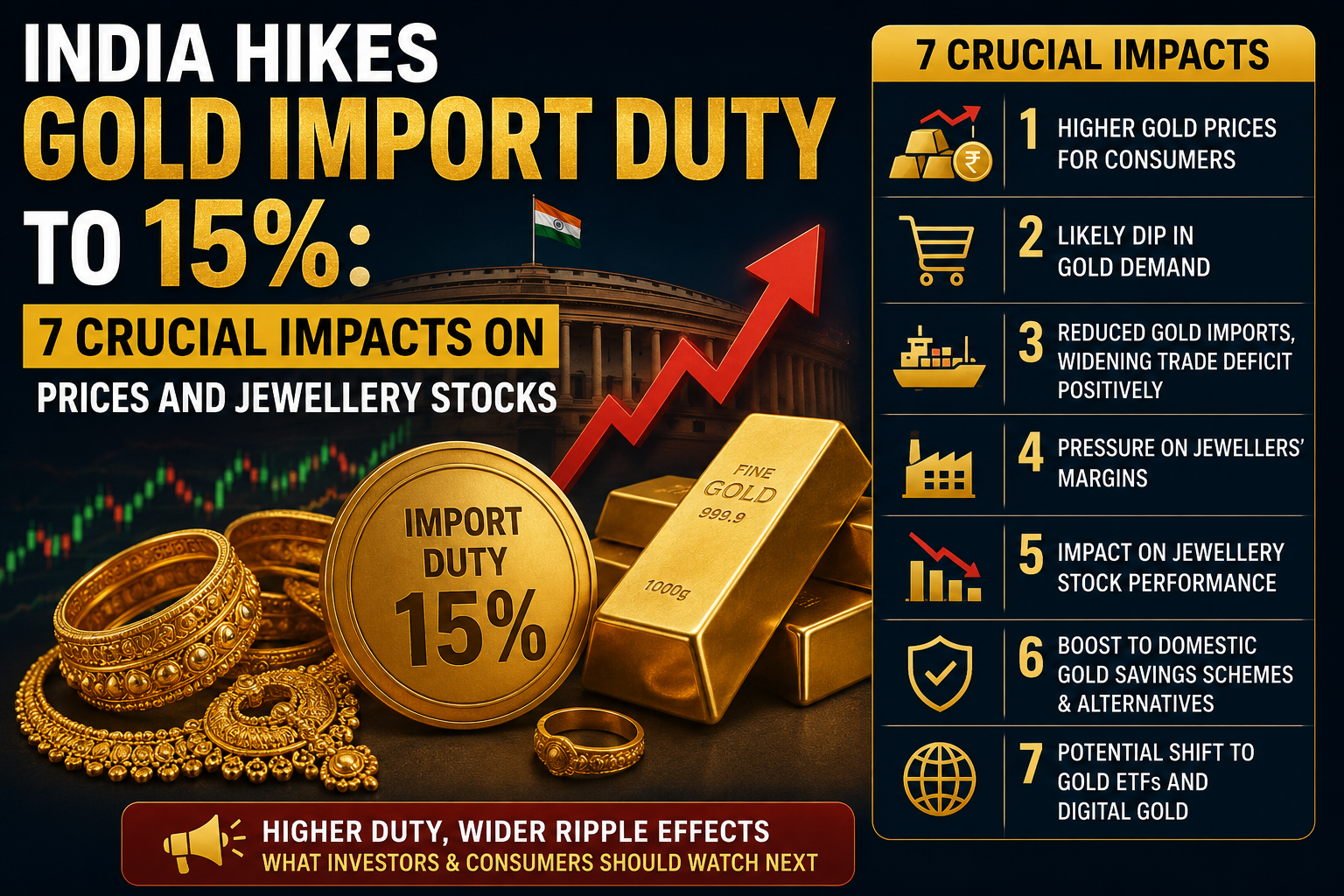
The Indian government has sent shockwaves through the bullion market by significantly raising the Gold Import Duty from 6% to a staggering 15%. This bold fiscal move, announced on Wednesday, May 13, 2026, aims to stabilize a wobbling rupee and safeguard the nation’s foreign exchange reserves amidst escalating geopolitical tensions in West Asia.
If you are a retail investor, a bride-to-be, or a stock market enthusiast, this Gold Import Duty hike is the single most important economic update you need to understand today. From the immediate crash in jewellery stocks like Titan and Kalyan Jewellers to the sudden spike in domestic 24K prices, the landscape of luxury consumption in India has shifted overnight.
The Breakdown: Why the Gold Import Duty Jumped Today
For the past year, India has been grappling with a widening Current Account Deficit (CAD). Despite a slight dip in the physical volume of gold imported, the soaring global prices of the yellow metal meant that India’s import bill hit an all-time high of $71.98 billion in the 2025-26 fiscal year.
To put the brakes on this dollar outflow, the Ministry of Finance issued Customs Notification No. 16/2026. The new tax structure is broken down as follows:
| Component | Old Rate | New Rate |
| Basic Customs Duty (BCD) | 5% | 10% |
| Agriculture Infrastructure & Development Cess (AIDC) | 1% | 5% |
| Total Effective Gold Import Duty | 6% | 15% |
This 9% absolute increase in the Gold Import Duty is a “pre-emptive strike” according to North Block officials. With the Iranian conflict putting pressure on global energy supply chains, the government is prioritizing “Oil over Gold.”
Stock Market Reaction: Titan and Kalyan Jewellers Feel the Heat
The equity markets reacted with predictable volatility. Jewellery stocks, which were already reeling after Prime Minister Narendra Modi’s public appeal to avoid non-essential gold purchases, saw a sharp sell-off.
Titan Company: Shares traded with a heavy negative bias, hovering around ₹4,053.80.
Kalyan Jewellers: The biggest loser of the day, with shares sliding nearly 6% to hit ₹340.55.
Senco Gold & Thangamayil: Both saw intraday cuts ranging from 0.5% to 3%.
Why are investors panicking?
The logic is simple: higher prices usually lead to lower volumes. In a price-sensitive market like India, a sudden 9% jump in the base cost (before GST and making charges) could lead to a massive slump in discretionary spending during the upcoming wedding season.
The Consumer’s Burden: How Much Will Your Gold Cost Now?
If you were planning to visit your local jeweller today, be prepared for “sticker shock.” Because India imports almost all of its gold, the Gold Import Duty hike is passed directly to the consumer.
On the Multi Commodity Exchange (MCX), gold prices surged over 6% immediately following the news. In Delhi, 10 grams of gold jumped by ₹1,500 in a single session.
The Math of the Hike:
If the base price of gold is ₹1,54,750 per 10 grams:
Under the 6% Duty: You paid roughly ₹9,285 in tax.
Under the 15% Duty: You now pay ₹23,212 in tax.
Net Increase: A direct hit of nearly ₹14,000 per 10 grams just from the duty change!
The Smuggling Shadow: A Dangerous Side Effect?
While the government’s intent is to save forex, industry experts like Surendra Mehta of the IBJA warn of a darker consequence. Historically, whenever the Gold Import Duty crosses the 10-12% threshold, the “grey market” or gold smuggling becomes highly lucrative.
In mid-2024, the government had slashed duties to 6% specifically to kill the smuggling trade. By reverting to 15%, there is a high risk that illegal channels will once again flourish, potentially hurting organized players who follow the law and pay the full 15% duty plus 3% GST.
The Silver Lining: Organised Retail and Recycling
Interestingly, the new notification offers a concessional rate for gold and silver recovered through recycling. This is a clear nudge from the government: Stop buying fresh gold; start recycling what you have.
Analysts suggest that while the short-term sentiment is bearish, mega-brands like Titan (Tanishq) might actually gain market share in the long run. When prices are volatile and duties are high, consumers often flee “unorganized” local smiths in favor of “organized” retailers who offer transparent buyback schemes and hallmarking guarantees.
Conclusion: A Year of “Gold Discipline”
The hike in Gold Import Duty is more than just a tax—it is a nationalistic economic policy. With the Rupee hitting record lows of 95.63 against the Dollar, the administration is asking citizens to treat gold as a strategic reserve rather than a common commodity.
For now, the message to the Indian public is clear: If you don’t need it for a wedding, don’t buy it. For the markets, all eyes will remain on the West Asia crisis, as any further escalation could see even more stringent measures to protect India’s economic borders.
Disclaimer: This information is based on various inputs from news agency.