
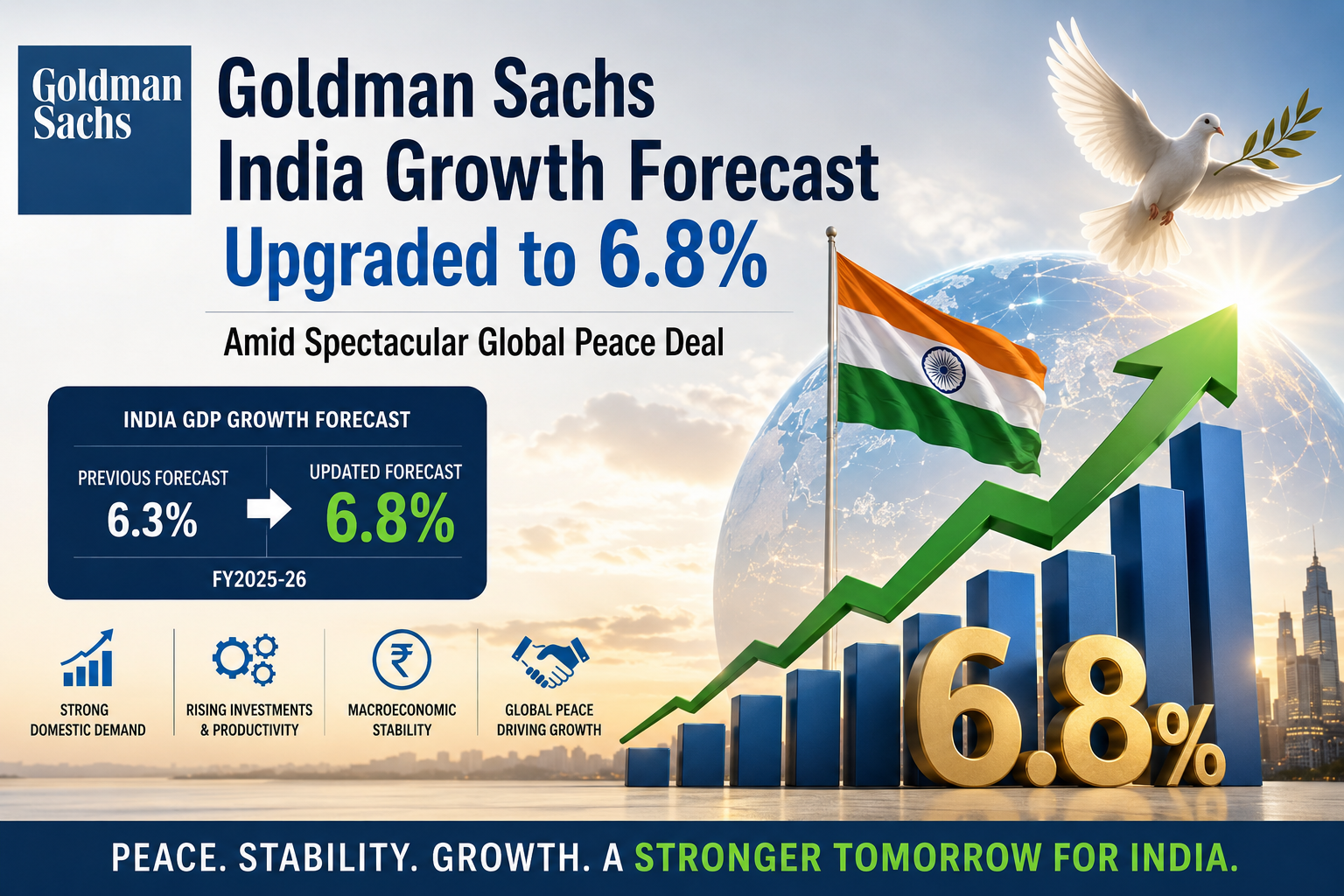
The Goldman Sachs India Growth Forecast has officially been revised upward, signaling a powerful wave of economic optimism across the South Asian nation. In an exhaustive research note titled “India: Improved macro outlook after the US-Iran deal,” the global investment banking giant significantly upgraded its economic growth projections for India. Driven by a landmark peace agreement between the United States and Iran, which has cooled down severe geopolitical frictions in West Asia, the Indian macroeconomic landscape is undergoing a massive positive transformation.
By systematically breaking down supply chain constraints, reducing the fiscal burden of energy imports, and stabilizing the domestic currency, this unexpected diplomatic breakthrough is providing India’s financial architecture with an incredibly well-timed booster shot. Investors, policymakers, and corporate leaders are closely dissecting these new numbers, which indicate that the Indian economic machine is weathering global volatility far better than its emerging market peers.
Decoding the Big Numbers: GDP Upgrades and Inflation Cool-Offs
The core of the revised report highlights a substantial jump in India’s projected economic performance. Goldman Sachs has raised its Calendar Year (CY) 2026 gross domestic product (GDP) growth forecast for India by 30 basis points, pushing it up to 6.8% year-on-year, compared to its previous estimate of 6.5%.
Looking at the Indian fiscal calendar format, the agency expects the country’s economy to clock a comfortable 6.5% growth rate for Fiscal Year 2026-27 (FY27), recovering swiftly from the shadow of the Middle East conflict which had previously threatened to choke key trade routes.
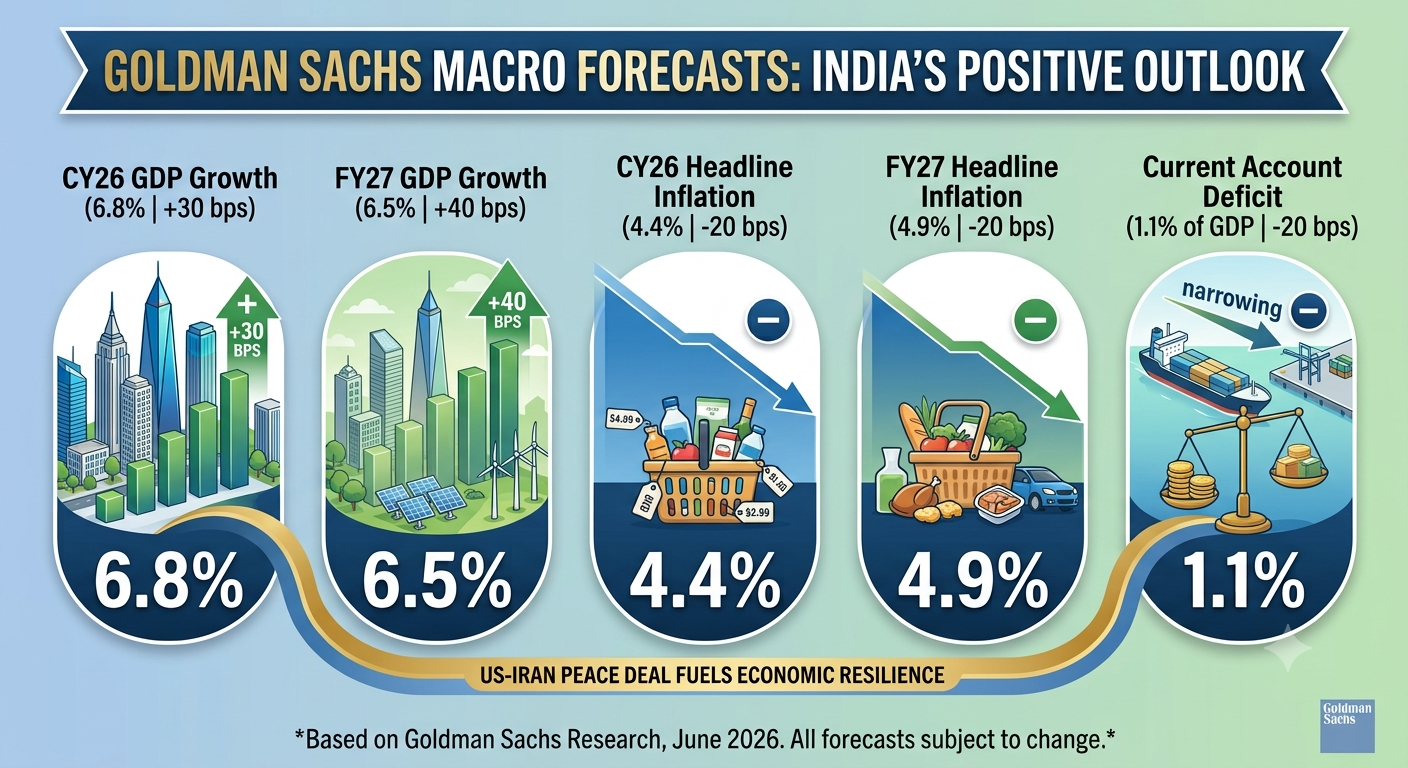
Simultaneously, the investment bank has delivered excellent news on the inflation front. Headline consumer inflation projections have been slashed significantly:
CY26 Inflation is now expected to drop to an average of 4.4%.
FY27 Inflation estimates have been trimmed down to 4.9% from the earlier projected 5.1%.
This dual benefit of rising growth and falling prices marks a crucial structural victory for India, positioning it as a highly resilient destination for global capital.
The Strait of Hormuz Relief and the Crude Oil Windfall
To fully comprehend why this upgrade is so significant, one must examine the critical geography of India’s energy trade. The Strait of Hormuz has long acted as a vital economic artery for India, accounting for nearly 20% of the country’s total global trade and over 60% of its total petroleum energy imports. When tensions between Israel, the United States, and Iran reached a boiling point earlier this year, the threatened closure of this maritime choke point sent shockwaves through the local markets.
For three consecutive months, the Indian basket of crude oil traded precariously above the $100 per barrel mark, threatening to blow a massive hole in India’s fiscal deficit. However, the diplomatic breakthrough between Washington and Tehran has completely shifted the narrative.
By June, the Indian basket of crude collapsed to $86.31, eventually hitting a highly favorable $70.71 per barrel. Goldman Sachs’ commodities team has consequently updated its global oil projections, locking in an expectation of an $82 per barrel average for the remainder of CY26 and a highly manageable $75 per barrel average across CY27. This dramatic price correction drastically lowers India’s import bill, saving billions of dollars in foreign exchange reserves.
Heavy Industry and Capital Goods Power House Growth
Despite the intense supply chain disruptions that characterized the early months of 2026, India’s core economic sectors showcased spectacular resilience. Real GDP growth for the first quarter of CY26 arrived at 7.8% year-on-year, outperforming Goldman Sachs’ baseline projections by a staggering 50 basis points.
This massive economic momentum was largely spearheaded by two primary engines:
1. Robust Investment Activity
Gross Fixed Capital Formation (GFCF)—a critical metric tracking infrastructure creation and factory equipment investments—surged to a six-quarter high of 10.8% year-on-year. Even when shipping lanes were troubled, corporate India and the public sector continued to pour immense capital into building out domestic capacity.
2. A Resilient Auto Sector and Service Dominance
The manufacturing domain found its saving grace in phenomenal domestic automobile production. Meanwhile, the services sector proved to be an absolute powerhouse, with Services Gross Value Added (GVA) expanding by an astonishing 9.9% year-on-year. This charge was heavily supported by a post-winter boom in the hospitality sector, interstate trade, logistics, and corporate transportation.
High-frequency data points are already validating this optimism. For instance, port cargo traffic across India’s major maritime hubs touched a stellar four-month high in May, recovering instantly from the sluggish drops recorded during the peak conflict months of March and April.
Fiscal Relief: Fertilizer Subsidies and Easing Expenditures
Beyond the direct drop in fuel prices, the US-Iran peace deal has triggered a positive domino effect across global agricultural commodity markets. One of the biggest wins for the government’s balance sheet is the sharp correction in global urea prices.
During the height of the Middle East crisis, import tenders for fertilizers had skyrocketed, raising serious alarms inside the Ministry of Finance regarding a bloated national subsidy bill. Recent global import tenders have cleared at rates significantly below those conflict-driven highs.
   US-Iran Peace Deal
          │
          ▼
   Lower Crude Oil & Petrochem Prices
          │
          ▼
   Slashed Global Urea & Fertilizer Costs
          │
          ▼
   Reduced Government Subsidy Bill
          │
          ▼
   Greater Fiscal Room for Infrastructure Spending
Combined with affordable crude, this urea correction dramatically eases near-term fiscal pressures on the central government. With expenditure commitments safely under control, the state now possesses much greater fiscal flexibility to redirect capital into long-term asset creation, rural developmental programs, and digital infrastructure without worrying about expanding the fiscal deficit.
External Balances, Remittances, and the CAD Advantage
On the external economic front, India is currently sitting in a highly enviable position. Thanks to lower global energy pricing, Goldman Sachs has revised India’s total oil import bill for CY26 downward from an initial $220 billion to $215 billion, giving the nation a immediate $5 billion breather.
Simultaneously, incoming private transfers have defied all geopolitical gravity. Despite months of severe regional instability in the Middle East, remittance inflows from non-resident Indians working in Gulf economies stayed exceptionally strong. Goldman Sachs has consequently nudged its annual remittance inflow estimate up to a record-breaking $140 billion.
“The combination of a compressed national import bill and soaring, rock-solid remittance inflows has allowed us to narrow our India Current Account Deficit (CAD) forecast to just 1.1% of GDP for CY26, down from 1.3%.” — Goldman Sachs Research Note
Additionally, the overall Balance of Payments (BoP) surplus is now expected to touch a healthy 0.7% of GDP, giving the Reserve Bank of India (RBI) an even deeper war chest of foreign currency reserves to defend the Indian Rupee against any sudden global financial shocks.
Emerging Speedbumps: Heatwaves and Core Inflation Risks
While the overarching macroeconomic picture looks incredibly bright, the Wall Street investment bank explicitly stated that India is not entirely out of the woods just yet. There remain a few near-term tactical domestic headwinds that require careful observation.
The Rural Consumption Dilemma
The immediate threat to the domestic economy does not stem from geopolitical conflicts, but rather from local weather anomalies. Intense heatwaves and unpredictable summer weather patterns, verified by forecasts from the India Meteorological Department (IMD), present an ongoing challenge to the rural landscape.
If severe weather patterns damage crop yields, rural wages and disposable incomes could face temporary compression. This would naturally put pressure on fast-moving consumer goods (FMCG) sales and entry-level two-wheeler purchases across rural belts during the second and third quarters of the year.
The Monetary Policy Matrix
Another fascinating perspective in the report involves the trajectory of corporate input costs. While petroleum has cooled down, global prices for industrial polymers and advanced petrochemical products have remained relatively sticky.
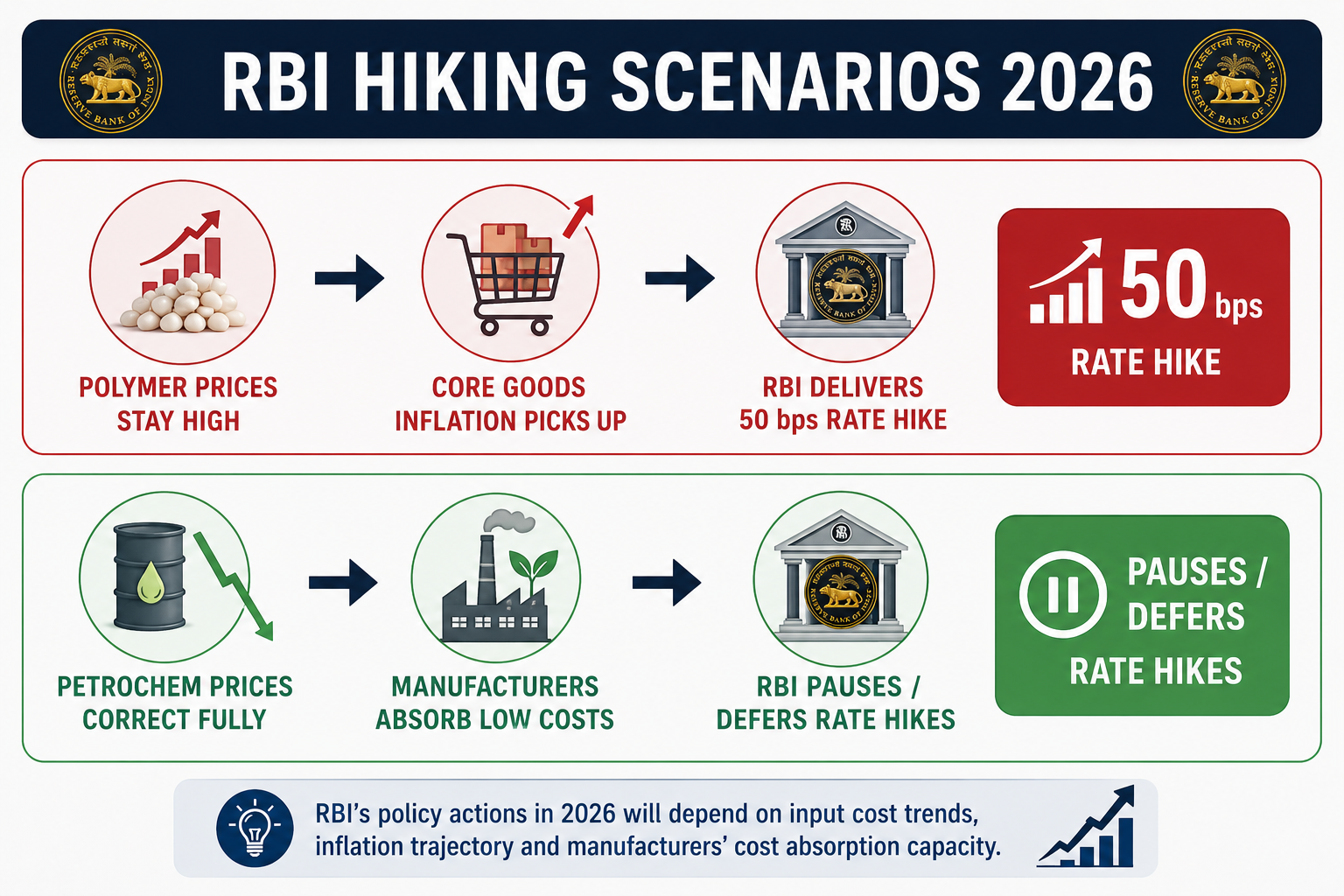
If the pass-through from these elevated polymer prices to core consumer goods proves to be limited, the rise in core retail inflation will remain mild. If the recent correction in petrochemical prices sustains, manufacturing firms will face minimal pressure to hike their final product sticker prices. Under this specific cooling scenario, there is a very strong probability that the Reserve Bank of India may completely defer its planned policy tightening cycle altogether, keeping corporate borrowing costs highly competitive.
Conclusion: The Long-Term Structural Shift
The updated economic assessment underscores a fundamental truth about the modern Indian economy: its structural foundation has become remarkably resilient to external global shocks. The post-pandemic era has seen India consistently leading the pack among major large economies, routinely printing growth prints above the 7% threshold.
While FY27 may technically mark the first fiscal year where growth settles just a notch under 7% at 6.5%, this must be viewed in the context of an aggressive global slowdown and a high base effect from previous years. Bolstered by massive infrastructure building, a soaring services sector, stable external balances, and a much-needed geopolitical breather in West Asia, India’s macroeconomic landscape looks exceptionally well-poised for sustained long-term expansion.