
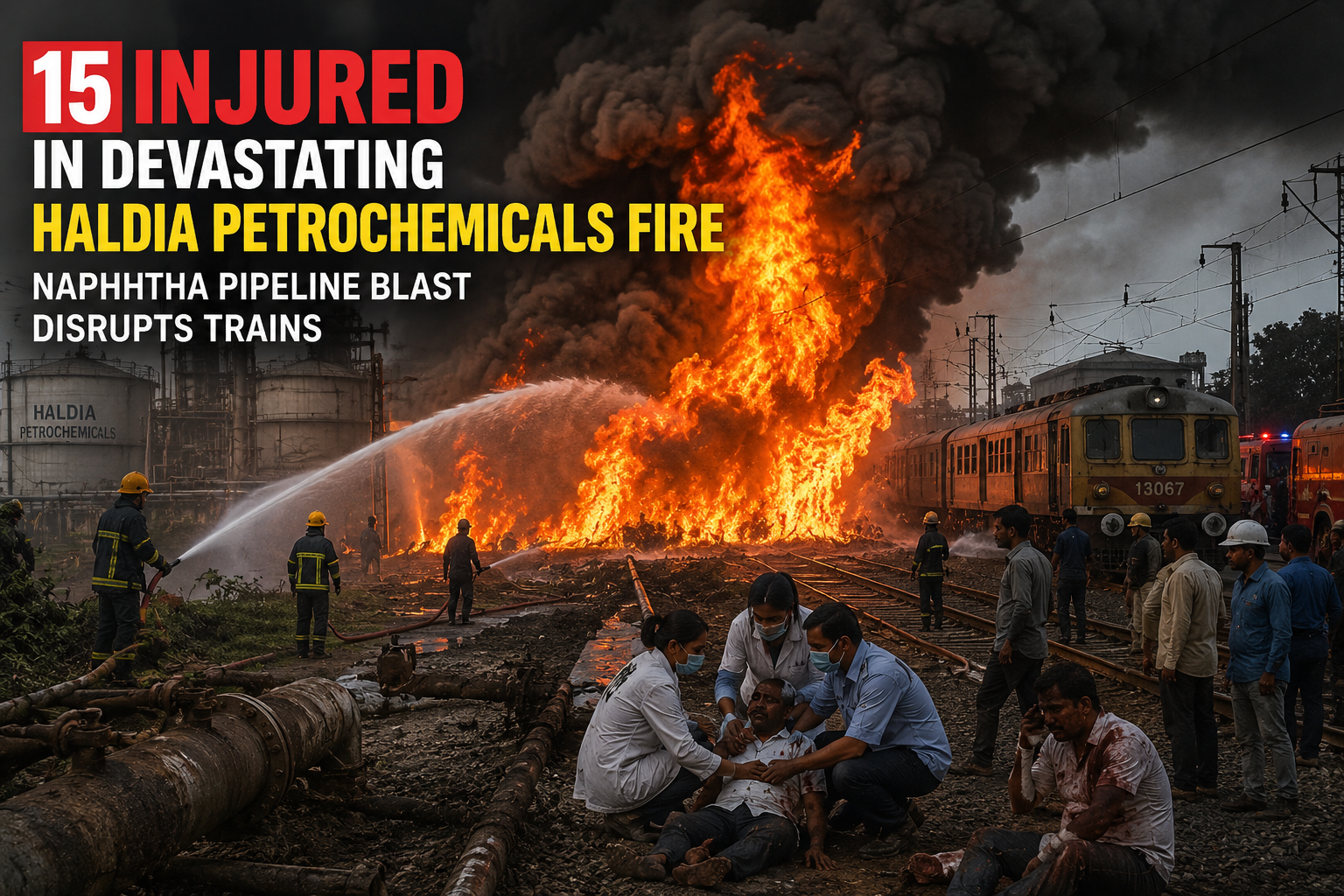
A catastrophic Haldia Petrochemicals fire broke out early Tuesday morning in West Bengal’s Purba Medinipur district, leaving at least 15 people injured and causing widespread panic across the industrial town. The blaze, which erupted from a critical naphtha-carrying pipeline, quickly escalated into a major emergency, engulfing nearby residential pockets, destroying local infrastructure, and completely paralyzing regional railway services.
Emergency response teams, local residents, and factory authorities rushed to the scene as massive plumes of thick, toxic black smoke filled the morning sky. Preliminary investigations point toward a highly dangerous culprit: an unauthorized fuel theft attempt that went horribly wrong.
The Timeline of the Disaster: How the Fire Unfolded
The quiet dawn hours in the industrial hub of Haldia were shattered when a massive explosion rocked the pipeline network. While initial reports from local factory sources placed the time of the incident between 4:00 AM and 5:00 AM, local administrative officials and residents noted that the first signs of the fire were spotted as early as 2:45 AM.
Timeline of the Haldia Pipeline Incident:
[02:45 AM] - First sparks and flames spotted near Chiranjibpur.
[04:00 AM] - Massive explosion erupts; flames breach the containment zone.
[04:30 AM] - 12 Fire tenders arrive; emergency evacuation begins.
[06:00 AM] - Overheads tracks damaged; Haldia-Mecheda rail line suspended.
The fire spread with terrifying speed. Because naphtha is an incredibly volatile and lightweight hydrocarbon liquid, it doesn’t just burn—it flows and vaporizes simultaneously, creating a moving wall of fire. Within minutes, the blazing liquid breached the facility perimeter and leaked into Chiranjibpur, a heavily populated residential area located in Ward 13 of the Haldia Municipality.
Before families could fully comprehend what was happening, the traveling fire engulfed several nearby houses, forcing terrified residents to flee into the dark streets with whatever possessions they could carry.
Casualties and Medical Emergency: Workers and Residents in Critical Condition
The human toll of the accident has been heavy. At least 15 individuals have sustained severe burn injuries. Among those caught in the initial blast wave were factory workers on the graveyard shift, contract laborers handling early morning maintenance, and local residents whose homes were directly in the path of the encroaching fire.
Emergency Response and Hospitalization
Initial Rescue: Local residents and refinery safety teams showed immense bravery, entering the smoke-logged zones to drag the injured out of the heat.
Haldia Sub-Divisional Hospital: All 15 victims were initially rushed to this local facility for immediate stabilization.
Tamluk Medical College and Hospital: As the severity of the burn injuries became clearer, five victims were urgently transferred to this specialized facility.
Critical Status: Medical bulletins indicate that at least two of the transferred patients remain in highly critical condition, fighting for their lives with extensive third-degree burns.
The factory management released a brief press note confirming the injuries:
“We are deeply aware of an incident that occurred at our Haldia facility, in which a few people have reportedly sustained injuries. Ensuring the safety and recovery of these individuals remains our absolute top priority, and we are making sure all injured persons receive the best possible medical treatment.”
The Ground Battle: 12 Fire Tenders Fight Toxic Smoke
Taming a chemical fire requires completely different tactics than fighting a standard structural fire. Water alone cannot easily douse a naphtha fire; instead, it often spreads the floating burning liquid further.
A massive fleet of 12 fire tenders—drawn from both the state fire services and the specialized internal safety divisions of Haldia Petrochemicals Limited and the nearby Haldia Refinery—were deployed to combat the disaster.
Firefighting Resource Allocation:
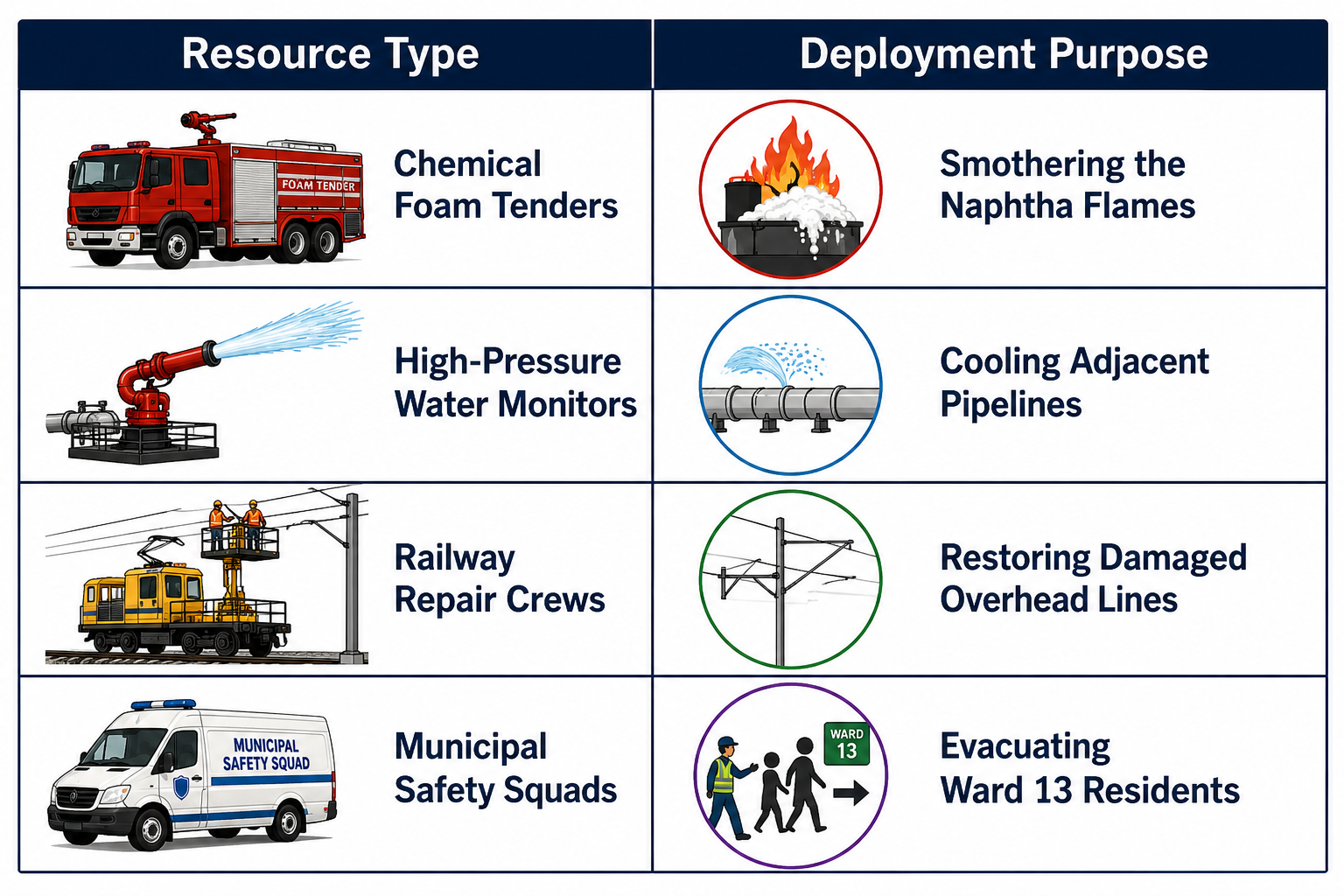
Firefighters donning specialized heat-resistant gear battled the intense thermal radiation for hours. The main goal was two-fold: first, to cut off the supply of naphtha by isolating the valves on the damaged pipeline, and second, to constantly spray the surrounding high-pressure chemical lines with water to prevent a chain-reaction explosion across the massive industrial complex.
Rail Infrastructure Damaged: Major Commuter Routes Paralyzed
The geographical placement of the pipeline network runs parallel to key logistical channels, including the regional railway tracks. As the naphtha fire grew out of control, the extreme heat rose directly into the overhead railway infrastructure.
Impacts on Transport Systems:
Overhead Wire Melting: The intense heat melted and snapped the vital overhead railway equipment (OHE) along the tracks, cutting off power to electric trains.
Haldia-Mecheda Route Closed: All train movements on this vital economic corridor were completely suspended by railway authorities as a precautionary safety measure.
Commuter Delays: The popular morning Haldia-Howrah Local was halted, stranding thousands of daily wage earners, office commuters, and students traveling toward Panskura and the Kolkata metropolitan area.
Freight Standstill: Industrial freight trains carrying raw materials to and from the port city were locked in place, causing a temporary logistical logjam.
The Investigation: Did Fuel Theft Spark the Blaze?
While the official inquiry is still ongoing, a startling revelation emerged from the corporate desk of Haldia Petrochemicals Limited. In an official statement distributed to global news networks like Reuters, the company pointed directly toward illegal activity as the likely trigger for this tragedy.
“Preliminary information suggests that the incident may have occurred in the vicinity of an unauthorized naphtha theft point located in the plant vicinity,” HPL stated openly.
The company further clarified that its primary manufacturing operations have surprisingly remained unaffected by the pipeline fire, because the disaster occurred at an external pipeline node. Alarmingly, the management revealed that this specific location had been targeted by local fuel theft syndicates in the past.
Understanding the Danger of Naphtha
To understand why this theft attempt turned so lethal, one must look at the science of the chemical involved. Naphtha is not crude oil, nor is it standard fuel oil. It is a highly volatile, light hydrocarbon mixture produced during the oil refining process. It serves as the fundamental feedstock for a facility’s ethylene cracker—in this case, HPL’s massive 700,000 ton-per-year cracker unit.
Because it has a incredibly low flash point, even a tiny spark caused by a crude metal tool hitting a high-pressure pipe during an illegal siphoning attempt is more than enough to trigger a massive, explosive fuel ignition. HPL emphasized that they had previously cautioned and warned local community leaders about the extreme life-threatening dangers of unauthorized handling of these highly volatile petroleum products.
Economic and Corporate Footprint of Haldia Petrochemicals
To contextualize the scale of this event, Haldia Petrochemicals Limited is not a minor regional player; it is one of the foundational pillars of the industrial economy of Eastern India.
HPL Corporate Profile at a Glance:
- Majority Owner: The Chatterjee Group (TCG) (US-based Private Equity Firm)
- Flagship Infrastructure: 700,000 Ton-Per-Year Ethylene Cracker Unit
- Primary Raw Material: Volatile Naphtha Liquid Hydrocarbons
- Core Output: Plastics, Polymers, and Chemical Feedstock for India
Any extended shutdown of this facility could trigger a massive supply chain shockwave across India’s domestic plastics, packaging, and automotive component manufacturing sectors. Thankfully, because safety isolation valves worked correctly, the core refinery and manufacturing plant sections were shielded from the pipeline fire, preventing a multi-billion dollar economic freeze.
What Lies Ahead: Safety Audits and Legal Actions
As the smoke finally clears over the Haldia sky, the focus is rapidly shifting from active firefighting to legal accountability and industrial safety reform. The local police department has cordoned off the entire Chiranjibpur pipeline node, transforming it into an active forensic crime scene.
Moving forward, the state administration and HPL will need to address several critical issues:
1. Tightening Pipeline Security Corridors
Industrial pipelines spanning miles across open terrain are inherently vulnerable. Moving forward, drone surveillance, pressure-drop sensors, and increased joint policing between corporate security forces and the West Bengal police will be necessary to deter fuel theft syndicates.
2. Relocating Encroaching Settlements
The fact that a pipeline fire instantly destroyed residential homes highlights the dangerous proximity of civilian townships to heavy chemical corridors. Urban planners must enforce strict buffer zones to ensure families do not live within the blast radius of hazardous material lines.
3. Upgrading Community Early Warning Systems
When an industrial accident happens at 3:00 AM, relying on visual smoke cues is a recipe for disaster. Local municipalities need to install loud acoustic sirens and automated SMS alert networks to wake up and evacuate sleeping residents before toxic gases or spreading flames reach their doorsteps.
A senior police official monitoring the secured site summed up the current state of affairs grimly: “The area has been safely secured, and emergency cooling operations are finishing up. The absolute, undeniable cause of this disaster will only be known once our forensic teams analyze the tap points on the pipeline. We will not spare anyone whose greed put these fifteen lives in jeopardy.”
For now, the people of Haldia are left waiting for updates from the hospital wards, hoping that the workers and neighbors currently in critical condition pull through.