
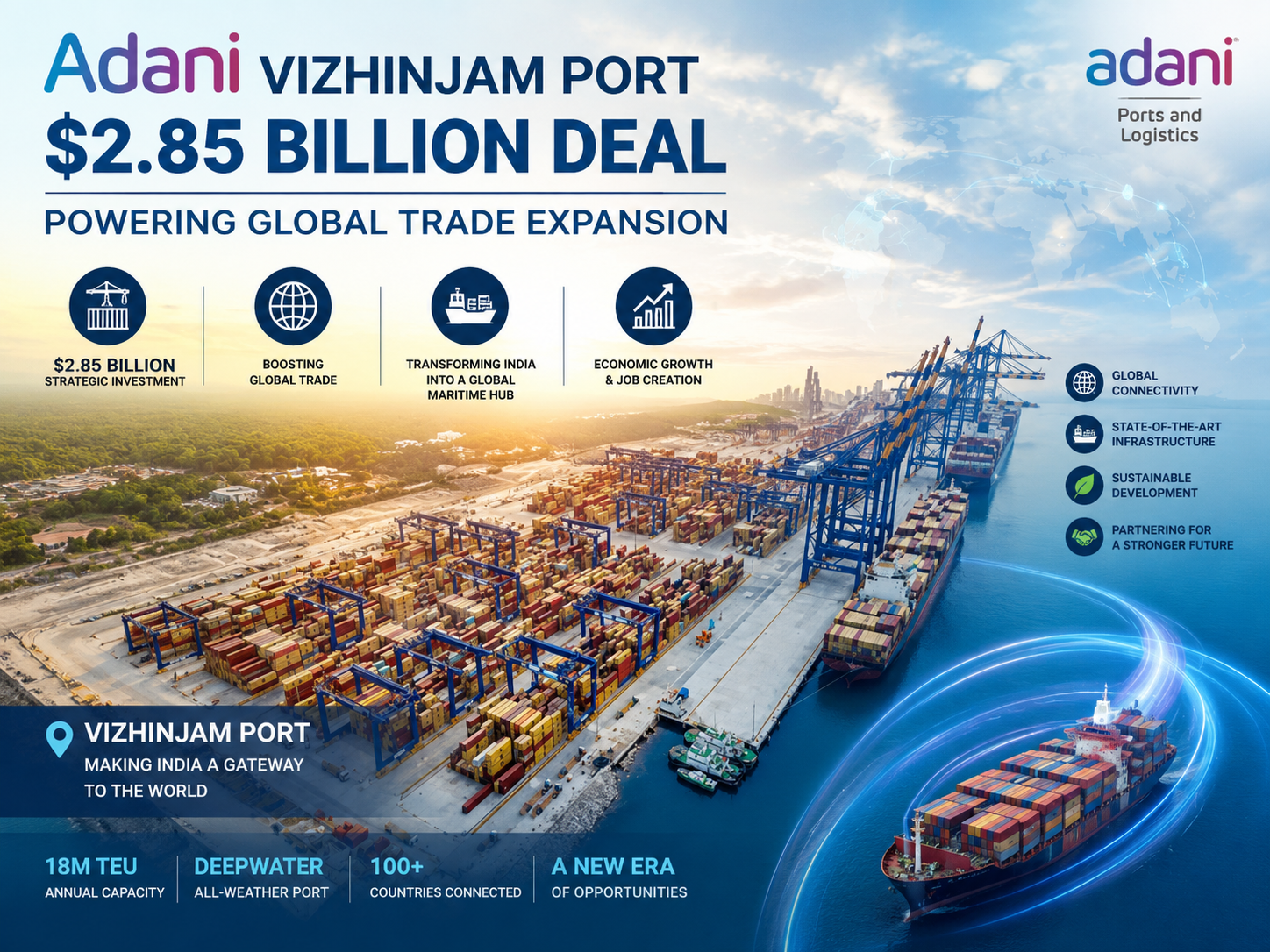
The Adani Vizhinjam Port investment marks a historic turning point for maritime logistics in South Asia. In a major move to transform global shipping dynamics, Adani Ports and Special Economic Zone Ltd (APSEZ) has officially finalized a definitive agreement with Mundi Limited—a subsidiary of the Mediterranean Shipping Company (MSC) Group. Under this agreement, MSC’s highly regarded terminal investment arm, Terminal Investment Limited (TiL), will acquire a 49% equity stake in Adani Vizhinjam Port Private Limited (AVPPL).
Valued at an impressive $2.85 billion (approximately ₹13,220 crore), the deal represents the single largest foreign private investment in India’s port infrastructure history. The partnership is set to unlock unprecedented cargo volumes, optimize maritime supply chains, and firmly anchor India as a vital transshipment hub in the highly competitive Indian Ocean region.
Anatomy of the $2.85 Billion Mega Deal
The transaction is structured strategically to ensure immediate commercial integration alongside long-term infrastructure scaling. TiL’s total investment of $1.397 billion directly aligns with its proportionate 49% share of the port’s total valuation.
To maintain financial flexibility and track operational milestones, the capital injection will be executed in two distinct, phased tranches:
Tranche 1 ($539 Million): Upfront payment allocated specifically for the immediate acquisition of the 49% equity stake in AVPPL.
Tranche 2 ($858 Million): Structured investment deployed concurrently with the port’s ongoing massive expansion phase. This capital will be infused through direct project debt and equity participation, scheduled for completion by December 2028.
Like standard cross-border corporate agreements of this scale, the transaction is currently awaiting customary regulatory approvals from relevant authorities before final closure.
A Record-Breaking Operational Flight Path
Despite being commissioned recently in December 2024, Vizhinjam Port has rapidly broken historical domestic operating records. It is officially India’s first deep-draft mega transshipment port, and its performance data shows a spectacular growth trajectory that has completely outpaced standard market projections.
Rapid Volume Escalation
During the financial year 2026 (FY26), the automated port successfully handled 1.3 million TEUs (Twenty-foot Equivalent Units) and welcomed 615 vessels, setting an initial national record as the fastest Indian port to hit the 1 million TEU milestone.
The momentum did not slow down. Within just 18 months of open commercial operations, Vizhinjam surpassed the 2 million TEU mark and serviced more than 950 vessels. By June 2026, the facility celebrated the arrival of its 1,000th vessel.
Handling Maritime Giants
Vizhinjam’s unique natural infrastructure has allowed it to easily handle ultra-large vessels that previously could not dock at Indian ports due to draft limitations. To date, the port has accommodated:
Over 70 Ultra Large Container Vessels (ULCVs)—the highest frequency across any single port facility in India.
283 mega-vessels exceeding 300 meters in total length.
98 vessels requiring specialized, deep-draft clearances greater than 16 meters.

Technical Architecture: Designed for Modern Maritime Needs
What makes this port a highly prized asset for global shipping lines like MSC is its geographical location and engineering framework. Vizhinjam is located just 10 nautical miles away from the primary East-West international shipping lane that connects Europe, the Persian Gulf, and East Asia. This proximity means mega-carriers only face minimal deviation times from their main routes to drop off or pick up cargo.
| Architectural Metric | Specifications & Current Standing | Future Expansion (Target: Dec 2028) |
| Natural Draft Depth | 18 to 20 meters (Accommodates largest ULCVs) | Maintained naturally without heavy dredging |
| Breakwater Infrastructure | 2.9 kilometers | Reinforced for extended basin protection |
| Berth Length | 800 meters | Expanded to support multiple simultaneous mother vessels |
| Container Handling Capacity | 1.6 million TEUs | 5.7 million TEUs (A 3.5x Capacity Leap) |
| Automation Equipment | 8 Quay Cranes / 24 Automated Yard Cranes | Scaled proportionally to meet new 3.5x demand |
In addition to deep waters, the port features highly advanced technological integration. As India’s premier fully automated maritime gateway, it utilizes sophisticated container handling mechanisms, an advanced proprietary IT core platform, and an artificial intelligence-driven, indigenous Vessel Traffic Management System (VTMS). Together, these features streamline vessel turnaround times and maximize safety.
Strategic Implications: Why MSC and Adani Deepend Their Alliance
The agreement represents the third major corporate collaboration between APSEZ and the MSC Group. The two conglomerates already operate highly successful joint venture container terminals at Mundra (Container Terminal No. 3) on the west coast and Ennore Port on the east coast.
For APSEZ, partnering with the world’s largest container shipping line provides substantial commercial and operational advantages:
“I am delighted to expand APSEZ’s long-standing partnership with MSC to Vizhinjam, as we prepare for the port’s next leg of journey. I am confident that our association will deliver enhanced supply chain efficiencies at a global scale and improve India’s access to key global mature and developing markets.”
— Ashwani Gupta, Whole-time Director and CEO, APSEZ
1. Guaranteed Cargo Volume Visibility
By bringing MSC’s terminal arm in as an equity owner, Adani ensures a steady stream of cargo traffic. TiL manages an extensive portfolio of over 100 container terminals across five continents, handling a massive global throughput exceeding 70 million TEUs per year. This deep integration means MSC will route a significant portion of its mainline Indian Ocean cargo directly through Vizhinjam, ensuring high capacity utilization right from the start.
2. Capturing Regional Transshipment Market Share
Historically, a major portion of India’s international transshipment cargo had to be routed through competing foreign hubs in Southeast Asia or Sri Lanka due to a lack of domestic deep-draft ports. Vizhinjam changes this equation completely. The port is uniquely positioned to capture a higher share of Bangladesh and regional relay cargo, offering a faster and more cost-effective alternative for global trade lines.
3. Strengthening East Africa Trade Corridors
The partnership provides a strong geographical launchpad to service growing trade networks along the East African coast. By acting as a central relay station, Vizhinjam allows shipping lines to bundle regional cargo onto mega-vessels, maximizing economies of scale on long-haul routes.
APSEZ’s Broader Vision: The Road to 1 Billion Tonnes
This transaction fits perfectly into APSEZ’s broader strategy to evolve from a port operator into a globally integrated transport and logistics leader. Currently, Adani Ports commands a 27% market share of India’s total port volumes across its vast ecosystem of 15 domestic ports and terminals.
[Current Capacity: 653 Million Tonnes] ───► [Target by 2030: 1 Billion Tonnes Throughput]
To support this ambitious growth, the company has built a comprehensive “shore-to-door” logistics model:
Marine Power: A diversified fleet of 136 specialized vessels.
Inland Infrastructure: 12 strategically located multi-modal logistics parks and over 3.1 million square feet of dedicated warehousing space.
Surface Transport: More than 25,000 trucks operating on a unified, proprietary digital optimization platform.
Global Footprint: Operational international ports spanning Australia, Colombo (Sri Lanka), Israel, and Tanzania.
As global supply chains continue to realign, this landmark deal between Adani and MSC provides India with a world-class maritime gateway capable of anchoring the future of global sea trade.