
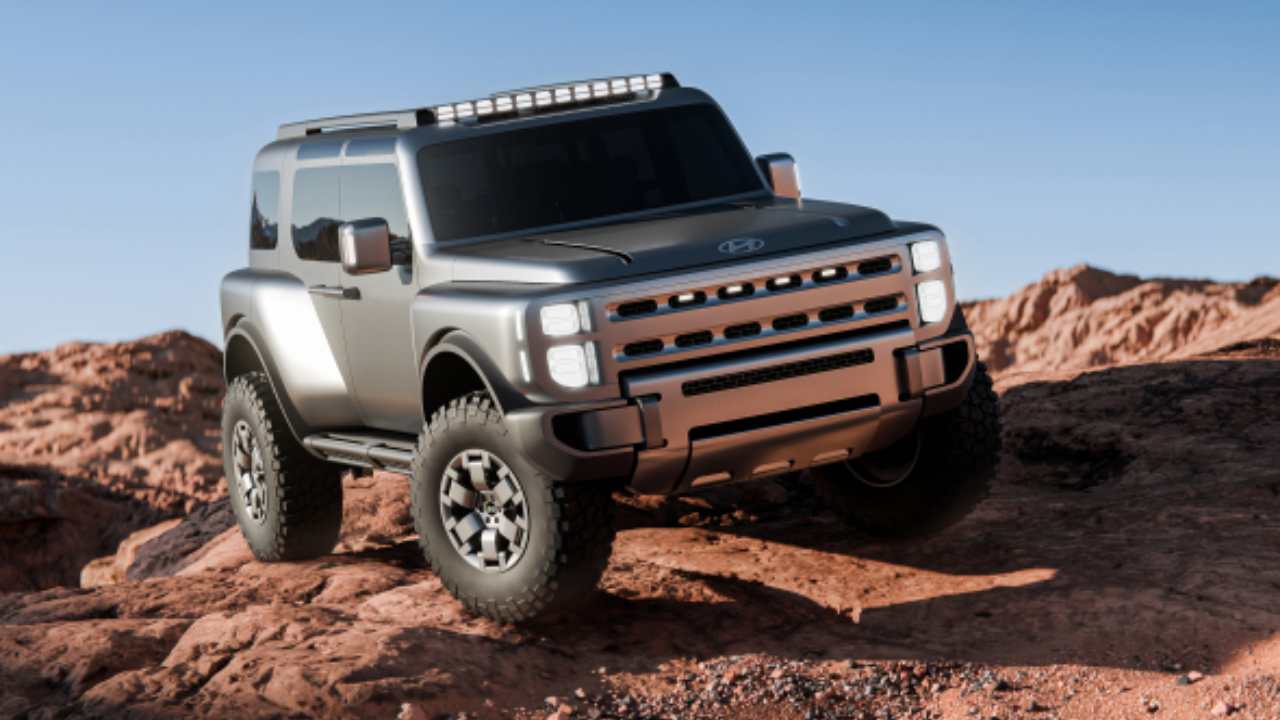
Hyundai Boulder:Hyundai has officially stepped out of its “urban crossover” comfort zone and into the grit and grime of serious off-roading. At the 2026 New York International Auto Show, the South Korean giant pulled the wraps off the Hyundai Boulder Concept—a vehicle that isn’t just a design study, but a declaration of war against established off-road icons.
The Boulder represents a tectonic shift for Hyundai. It introduces the brand’s first-ever body-on-frame architecture, a platform designed to withstand the brutal stresses of rock crawling and desert racing. While the SUV itself is a concept, the DNA under its “Liquid Titanium” skin is destined for a production pickup truck by 2030 and potentially a “Thar-style” rugged SUV for markets like India.
Hyundai Boulder: Quick-Look Specifications & Launch Toolbar
| Feature | Details |
| Platform | All-new Body-on-Frame Architecture |
| Design Language | ‘Art of Steel’ (Boxy & Rugged) |
| Production Timeline | Pickup variant by 2030 (USA); Monocoque Off-roader (India) |
| Key Tech | Real-time AI Off-road Guidance System |
| Exterior Highlights | Suicide Doors, Morse Code DRLs, 37-inch MT Tyres |
| Estimated Price (Production) | $45,000 – $60,000 (Global) / ₹ 25 – 35 Lakh (India Spec) |
The ‘Art of Steel’: A Design Built for the Wild
The Hyundai Boulder doesn’t just look tough; it looks industrial. Moving away from the fluid, aerodynamic lines of the Ioniq series, the Boulder adopts the ‘Art of Steel’ philosophy. This design language, led by the North American design team in Southern California, celebrates the strength and sculptural beauty of high-tensile steel.
The Front Fascia
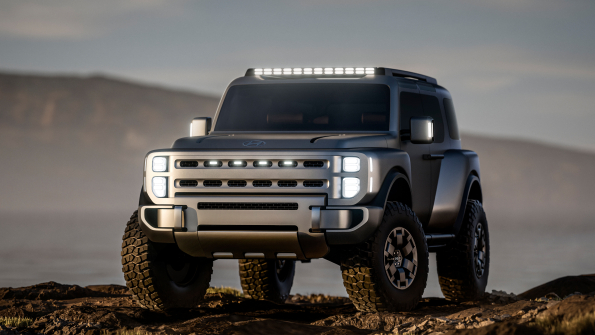
The face of the Boulder is dominated by an upright, blunt nose. The grille features two rows of “pill-shaped” openings. Look closely, and you’ll notice the DRLs are arranged to spell the letter ‘H’ in Morse code. Flanking the grille are vertically stacked LED headlights that provide a wide, piercing throw for night-time trail runs.
Side Profile & Accessibility
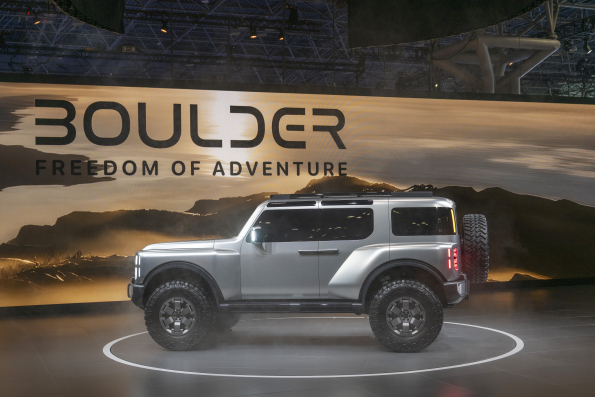
The side profile is perhaps the most radical part of the concept. It features suicide doors (coach-style), which eliminate the B-pillar when both doors are open, creating a massive aperture for easy entry or loading gear. Other notable features include:
Massive Ground Clearance: Necessary for the 37-inch mud-terrain tires.
Functional Side Steps: Integrated into the chassis for durability.
Safari-style Windows: Fixed upper windows on the roof to let in more natural light during expeditions.
The Rear Innovation
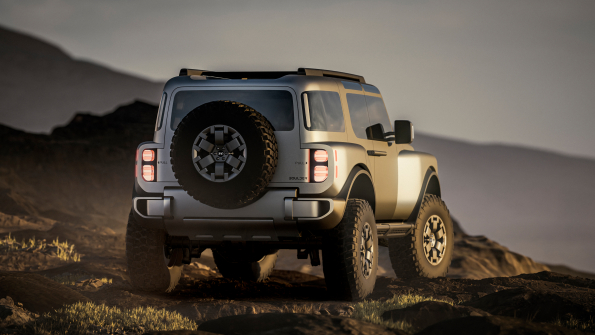
The rear is designed for maximum utility. It features a double-hinged tailgate, allowing users to open it from either the left or right side depending on the obstacles behind the vehicle. Additionally, the rear windscreen can be rolled down electrically, allowing long items like surfboards or timber to stick out without needing to keep the tailgate open.
Interior: Where Luxury Meets Durability
Step inside the Boulder, and you’ll find a “blank canvas” designed for the outdoor lifestyle. The cabin is finished in a rugged beige-and-black theme, using high-wear materials on grab bars and touchpoints.
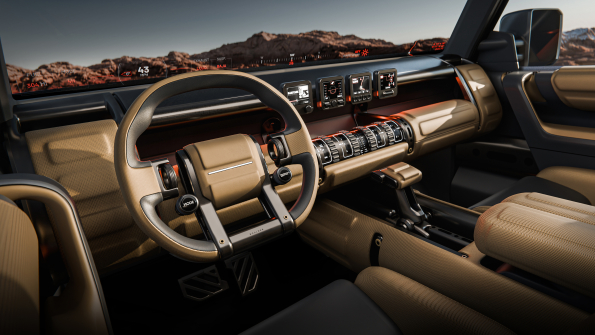
The Quad-Screen Command Center
The centerpiece of the dashboard is a set of four dedicated screens. These aren’t just for Netflix; they relay critical off-road telemetry:
Pitch & Roll Clinometers
Drivetrain Status (Locking diffs, Transfer case)
Topographical Navigation
Real-time External Camera Feeds
The AI ‘Spotter’ System
Perhaps the most futuristic feature is the software-driven real-time off-road guidance system. This acts as a digital “spotter.” By using external sensors and cameras, the system analyzes the terrain ahead and provides the driver with the optimal line to take over rocks or through deep ruts, displayed via a massive Head-Up Display (HUD) that spans the entire width of the windshield.
Performance: The Body-on-Frame Revolution
For decades, Hyundai has relied on monocoque (unibody) designs for its SUVs like the Tucson and Santa Fe. While comfortable, these lack the sheer “torture-test” durability of a body-on-frame setup.
The Boulder Concept’s new platform is a “love letter” to off-road enthusiasts. It allows for:
Higher Towing Capacities: Essential for the US pickup market.
Greater Articulation: Allowing wheels to move independently over uneven rocks.
Modularity: Hyundai confirmed this architecture will underpin a mid-size pickup truck by 2030, aimed squarely at the Toyota Tacoma and Ford Ranger.
What Does This Mean for the Indian Market?
While the full-sized, body-on-frame Boulder might be too large for Indian city streets, Hyundai has dropped a massive hint for the Indian audience.
The company confirmed that by 2030, it will launch a “muscular monocoque SUV with off-road capabilities” specifically for India. This suggests a vehicle that sits between a soft-roader (like the Creta) and a hardcore off-roader (like the Mahindra Thar). It will likely borrow the Boulder’s “Art of Steel” styling—the boxy silhouette, the Morse code lights, and the rugged interior—but on a platform more suited for Indian fuel efficiency and road conditions.
The Verdict: A New Era for Hyundai
The Hyundai Boulder Concept is a clear signal that the brand is no longer content with being the “sensible choice.” They want a piece of the lifestyle adventure market. By combining their legendary tech (like the AI Spotter) with old-school ruggedness (body-on-frame), Hyundai is positioning itself to be a formidable player in the 4×4 space.
As SangYup Lee, Head of Hyundai Global Design, put it: “The Boulder is for those who want to explore the unknown without leaving the future behind.”
Stay tuned to AutoPulse Global for more live updates from the 2026 New York Auto Show!
Expected Pricing & Competition (Estimated 2030 Figures)
Target Price (USA): Starting at $45,000
Target Price (India Spec): ₹ 25,00,000 – ₹ 35,00,000
Key Rivals: Jeep Wrangler, Ford Bronco, Toyota 4Runner, and the Mahindra Thar (Global-spec).
Final Specifications List
Body Style: 2-Door / 4-Door Convertible Roof Concept
Engine Type: Expected Hybrid / Full Electric AWD
Wheels: 18-inch Alloys with 37-inch Mud-Terrain Tyres
Transmission: Multi-mode Transfer Case with Low-Range
Special Features: Fold-out tray tables, Liquid Titanium paint, Morse code DRLs.