
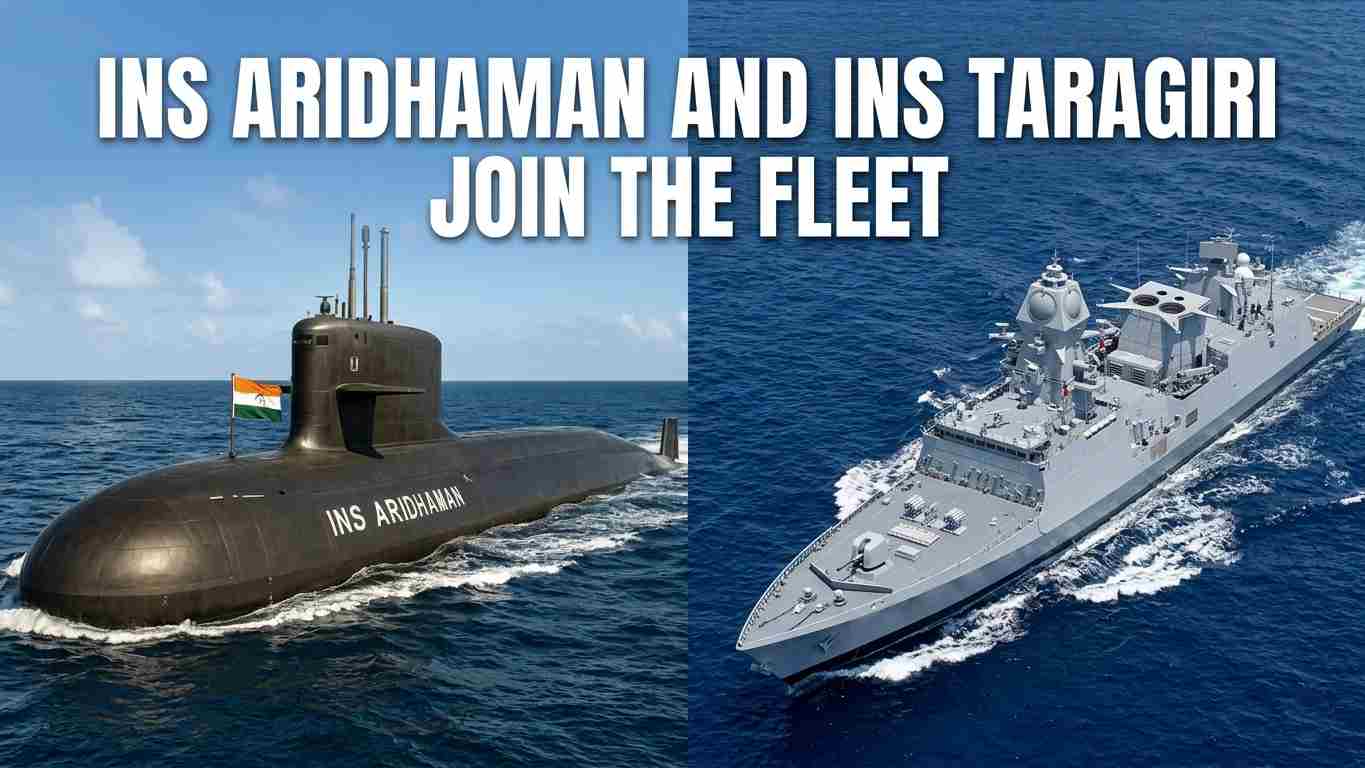
Visakhapatnam, April 3, 2026 –INS Aridhaman and INS Taragiri :In a move that significantly bolsters India’s maritime dominance and nuclear deterrence, Defense Minister Rajnath Singh presided over the commissioning of two formidable naval assets: the nuclear-powered ballistic missile submarine INS Aridhaman (S4) and the advanced stealth frigate INS Taragiri (F41).
While the induction of the stealth frigate was celebrated with ceremonial flair, the commissioning of the nuclear submarine was conducted with the characteristic discretion reserved for India’s most sensitive strategic programs. These inductions mark a watershed moment for the “Aatmanirbhar Bharat” (Self-Reliant India) initiative in the defense sector.
1. INS Aridhaman: The Silent Guardian of the Deep
The star of the day was undoubtedly INS Aridhaman, the third indigenously built nuclear-powered ballistic missile submarine (SSBN) of the Arihant class. Following in the wake of INS Arihant (commissioned in 2016) and INS Arighat (commissioned in August 2024), the Aridhaman represents a major evolutionary step in India’s underwater strike capability.
A Masterpiece of Indigenous Engineering
Built under the highly classified Advanced Technology Vessel (ATV) project at the Ship Building Centre (SBC) in Visakhapatnam, the Aridhaman is roughly 90% indigenous. Displacing approximately 7,000 tonnes—about 1,000 tonnes more than its predecessors—this vessel is a technical marvel that solidifies India’s place among the elite group of nations capable of designing and operating nuclear submarines (joining the US, Russia, UK, France, and China).
Key Specifications and Lethality
The “Destroyer of Foes” (as its name implies) brings significantly more “firepower” to the table:
Enhanced Missile Capacity: Unlike the Arihant and Arighat, which feature four vertical launch tubes, the Aridhaman is equipped with eight launch tubes.
Strike Range: It can carry up to 24 K-15 ‘Sagarika’ missiles (range: 750–1,500 km) or 8 long-range K-4 ballistic missiles (range: 3,500 km). Plans are already in motion to arm it with the future K-5 missile, boasting a range of 6,000 km.
Endurance: Powered by an 83 MW pressurized light-water reactor, the submarine can remain submerged almost indefinitely, limited only by crew supplies and maintenance needs. It can reach underwater speeds of 45 km/h (24 knots).
Strategic Importance
As a key component of India’s nuclear triad (the ability to launch nuclear strikes from land, air, and sea), INS Aridhaman provides the country with a credible “second-strike” capability. In the event of a first strike against the mainland, a hidden nuclear submarine provides a guaranteed retaliatory option, acting as a powerful deterrent against adversaries.
2. INS Taragiri: The New Vanguard of Stealth
Simultaneously, the Indian Navy welcomed INS Taragiri, the fourth stealth frigate of the Project 17A (Nilgiri-class). Built by Mazagon Dock Shipbuilders Limited (MDL) in Mumbai, this 6,670-tonne warship is designed for multi-dimensional maritime warfare.
Stealth and Sophistication
INS Taragiri is built with a focus on low detectability. Its design features:
Reduced Radar Cross-Section (RCS): A sleeker hull and integrated equipment make it difficult for enemy radars to track.
Advanced Combat Suite: Integrated through a state-of-the-art Combat Management System (CMS-17A), the ship carries BrahMos supersonic cruise missiles, Barak-8 surface-to-air missiles, and an advanced anti-submarine warfare suite.
Propulsion: It utilizes a CODOG (Combined Diesel or Gas) system, allowing for high-speed transit and long-endurance patrols.
Economic and Industrial Impact
With indigenous content exceeding 75%, the construction of INS Taragiri has engaged over 200 MSMEs across India. Defense Minister Rajnath Singh hailed it as an “embodiment of the ‘Make in India’ spirit,” highlighting that the ship was built within significantly reduced timelines compared to previous classes.
3. Geopolitical Implications: Securing the Indo-Pacific
The dual commissioning comes at a time of heightened maritime tension and evolving security dynamics in the Indo-Pacific. Defense Minister Rajnath Singh emphasized that a “strong and capable Navy is a necessity, not an option.”
“We must not limit ourselves to merely securing our own shores, but also ensure the protection of those critical sea lanes, choke points, and digital infrastructure that are linked to our national interests,” Singh stated during his address.
The addition of these vessels sends a clear signal: India is committed to maintaining a “credible posture” to deter potential adversaries and protect global trade routes. As INS Aridhaman disappears into the depths for its inaugural patrol and INS Taragiri joins the Eastern Fleet, the Indian Navy’s transition into a blue-water force capable of long-range power projection is well and truly underway.
INS Aridhaman and INS Taragiri Comparison of India’s SSBN Fleet
| Feature | INS Arihant (S2) | INS Arighat (S3) | INS Aridhaman (S4) |
| Commissioned | 2016 | August 2024 | April 3, 2026 |
| Displacement | 6,000 Tonnes | 6,000 Tonnes | 7,000 Tonnes |
| Launch Tubes | 4 | 4 | 8 |
| Primary Missile | K-15 (750 km) | K-15 / K-4 (3,500 km) | K-4 / K-5 (Planned) |
| Indigenous % | ~70% | ~70% | ~90% |
The Road Ahead
The Indian Navy continues its ambitious fleet expansion. Following INS Aridhaman, a fourth SSBN (code-named S4*) is already undergoing sea trials, and more Project 17A frigates like INS Mahendragiri are expected to join the fleet later this year. With these advancements, India is not just defending its borders but is shaping the future of maritime security in the 21st century.