
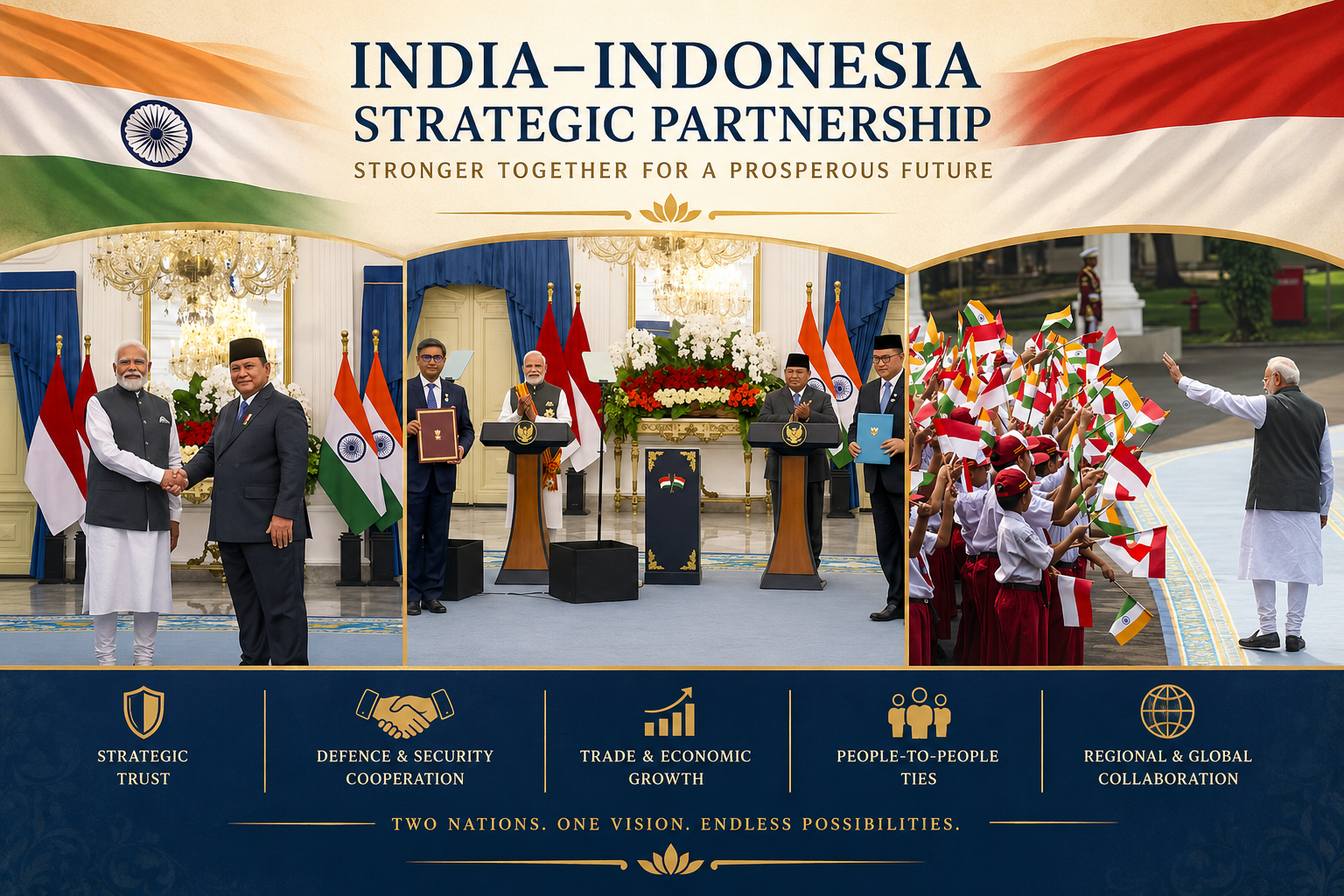
The India-Indonesia Strategic Partnership has entered a definitive golden era. Marking an extraordinary chapter in Asian geopolitics, Prime Minister Narendra Modi wrapped up a historic three-day state visit to Jakarta from July 6-8, 2026. At the special invitation of the newly inaugurated Indonesian President Prabowo Subianto, the visit did not just reinforce traditional ties—it radically reimagined the security, economic, and cultural architecture of the Indo-Pacific region.
From the thunderous applause at the Indonesian Parliament to the prestigious conferment of Jakarta’s highest civilian award upon PM Modi, the diplomatic visit was packed with heavy-duty outcomes. Moving forward with his trademark mantra of “Reform, Perform, and Transform,” PM Modi positioned India’s rising self-reliance as a massive multiplying force for the entire ASEAN zone.
Here is an in-depth, step-by-step breakdown of the major breakthroughs, structural agreements, and geopolitical shifts that emerged from this monumental bilateral summit.
1. A Historic First: PM Modi Addresses the Indonesian Parliament
In a deeply symbolic gesture reflecting mutual democratic respect, Narendra Modi became the first Indian Prime Minister to address the Parliament of Indonesia in Jakarta. Speaking before Speaker Puan Maharani and the assembled lawmakers, Modi struck a chord by weaving historical civilizational threads with future-ready ambitions.
He highlighted shared civilizational philosophies, drawing a direct parallel between India’s vision of “Vasudhaiva Kutumbakam” (The World is One Family) and Indonesia’s state motto “Bhinneka Tunggal Ika” (Unity in Diversity).
The Ganga-Mahakam Vision: A newly outlined strategic roadmap bridging India’s sacred Ganga river ecosystem with Indonesia’s vital Mahakam river basin, symbolizing a fresh dawn in bilateral maritime and economic connectivity.
The Prime Minister explicitly aligned India’s long-term blueprint of Viksit Bharat 2047 with Indonesia’s economic north star, Indonesia Emas 2045 (Golden Indonesia), proving that both nations are tracking identical timelines for global superpower status.
Honoured to address the Indonesia Parliament. Do watch.
https://t.co/zapE5i8onx— Narendra Modi (@narendramodi) July 7, 2026
2. Defence and Maritime Security Take a Lethal Leap
Perhaps the most scrutinized aspect of this visit was the massive upgrade to the defence pillar of the India-Indonesia Strategic Partnership. Navigating a complex geopolitical climate in the South China Sea, New Delhi and Jakarta dropped all diplomatic hesitation to ink actionable military supply chains.
The BrahMos and Astra Missile Deals
Building on the momentum of the 3rd Defence Ministers’ Dialogue held in late 2025, the two leaders formalized deep-tier missile cooperation. India will supply its cutting-edge BrahMos supersonic cruise missiles and Astra Beyond-Visual-Range (BVR) air-to-air missiles to the Indonesian Armed Forces. This marks an unprecedented level of defence integration between the two maritime neighbors.
Key Maritime Agreements Signed:
BAKAMLA RI & Indian Coast Guard: The finalization of an Implementing Arrangement alongside the renewal of the MoU on Maritime Safety and Security Cooperation.
IFC-IOR Integration: Indonesia has officially positioned an International Liaison Officer (ILO) at the prestigious Information Fusion Centre-Indian Ocean Region in Gurugram, India, to boost real-time Maritime Domain Awareness (MDA).
The MRO Hub & Ship-Building: Both nations agreed to establish advanced Maintenance, Repair, and Overhaul (MRO) facilities in Indonesia for shared military hardware, backed by robust technology transfer in naval shipbuilding.
3. Securing the Future: Critical Minerals and Steel Supply Chains
As Western supply chains look to decouple from singular manufacturing hubs, India and Indonesia have stepped up to create a resilient, diversified alternative. The economic talks yielded critical breakthroughs aimed directly at securing raw materials for the green energy transition and heavy manufacturing.
| Agreement / MoU | Participating Entities | Core Strategic Objective |
| Critical Minerals & Rare Earths MoU | NFTDC, Midwest Ltd. & PT. Perusahaan Mineral Nasional (PERMINAS) | Securing raw material supply chains for EV batteries and high-tech manufacturing. |
| Steel Supply Chain Partnership | Ministry of Steel (India) & Indonesian Authorities | Technological exchange and stabilization of foundational steel raw materials. |
| Stainless-Steel Joint Venture | Steel Authority of India Ltd. (SAIL) & PT. Krakatau Steel | Exploring a state-of-the-art Stainless-Steel Slab Manufacturing Facility inside Indonesia. |
4. Financial Integration: Local Currency Trading and Digital Networks
To shield their booming domestic economies from external currency volatility, the Reserve Bank of India (RBI) and Bank Indonesia successfully moved forward with operationalizing Local Currency Transaction (LCT) guidelines. This mechanism allows bilateral trade to be settled directly in Indian Rupees (INR) and Indonesian Rupiah (IDR), bypassing third-party global currencies.
The Digital Network Boom: ION and QR Linkages
In a stunning export of India’s world-class Digital Public Infrastructure (DPI), the summit celebrated the launch of the Indonesia Open Network (ION). Based completely on India’s revolutionary Open Network for Digital Commerce (ONDC) architecture, ION will empower Indonesian MSMEs to seamlessly digitize and access broader markets.
Furthermore, cross-border QR payment linkages are being fast-tracked, allowing tourists, students, and traders to make instant payments using domestic apps when traveling between the two nations.
5. A Bold, Clear Message on Geopolitics and a Free Indo-Pacific
Without naming specific aggressive neighbors, PM Modi used the Indonesian Parliament as a grand stage to deliver a clear, unwavering message on global governance. The joint statement fiercely reaffirmed both countries’ commitment to a “Free, Open, Transparent, Rules-Based, and Inclusive Indo-Pacific.”
Key Strategic Alignments:
1. Strict adherence to the 1982 UNCLOS (United Nations Convention on the Law of the Sea).
2. Unwavering support for ASEAN Centrality and the synergy between the ASEAN Outlook on the Indo-Pacific (AOIP) and India’s Indo-Pacific Oceans Initiative (IPOI).
3. Active exploration of the India-Indonesia-Australia trilateral framework to protect vital choke points like the Malacca Strait.
6. Cultural Resurgence: The UNESCO Prambanan Project and Tagore-Dewantara Year
The bilateral relationship is deeply rooted in thousands of years of shared heritage, and this visit gave those historical roots a magnificent modern update.
PM Modi and President Prabowo officially inaugurated the restoration and conservation works at the iconic UNESCO World Heritage Prambanan Temple Compounds in Yogyakarta, a massive project supported entirely by the Archaeological Survey of India (ASI).
To make this historical link accessible to the public, the National Museum of India gifted a flawless replica of the historic Nalanda Copper Plate (circa 860 CE)—written in Devanagari script and Sanskrit language—to be permanently displayed at the Muara Jambi museum.
The Tagore-Dewantara Year (2026–2027)
To honor the profound intellectual legacies of India’s Nobel laureate Rabindranath Tagore and Indonesia’s educational pioneer Ki Hajar Dewantara, the two nations officially designated 2026–2027 as the “Tagore–Dewantara Year of India–Indonesia Cultural and Educational Diplomacy.” This will mark exactly 100 years since Tagore’s historic voyage to the Indonesian archipelago in 1927, kicking off a year-long calendar of academic mobility, student exchanges, and joint research.
7. Strategic Infrastructure: The Sabang Port Breakthrough
For years, geopolitical analysts have pointed out the immense strategic potential of connecting India’s Andaman and Nicobar Islands with Indonesia’s Sumatra island. During this visit, that vision finally turned into concrete policy.
President Prabowo warmly welcomed India’s direct investment and technical partnership in the integrated development of the Sabang Port.
This multi-dimensional megaproject will include:
Advanced marine-tourism and cruise facilities to exploit the beauty of the Andaman Sea.
Heavy-duty maritime industries, specifically focused on commercial shipbuilding and ship-repair docks.
Comprehensive shore-based support services tailored for offshore energy exploration.
To drive this infrastructure push, the 3rd Joint Task Force Meeting on Andaman-Aceh Connectivity is locked in to convene in the latter half of 2026 to execute a time-bound plan of action.
Ground Realities: Health, Pharma, and Global Counter-Terrorism
Beyond high-profile military and infrastructure deals, the joint statement laid out an exhaustive blueprint for human security.
Healthcare Transformation
The signing of the Implementation Arrangement on Professional Health Workforce Development will now allow Indian and Indonesian medical professionals to participate in advanced clinical fellowships and hands-on specialized training. Furthermore, the Red and White Cooperative Network in Indonesia will now serve as a logistical highway to distribute high-quality, affordable Indian pharmaceuticals across the archipelago.
Zero Tolerance for Terror Financing
The two leaders issued an uncompromising, zero-tolerance condemnation of global terrorism. The upcoming 3rd India-Indonesia Security Dialogue (IISD) will establish strict bilateral mechanisms to combat online radicalization, block digital terror recruitment platforms, and strictly enforce the Anti-Money Laundering and Countering Financing of Terrorism (AML/CFT) standards mandated by the FATF.
Conclusion: A New Era of Global South Leadership
As Prime Minister Modi concluded his state visit, he left behind an architectural framework for a partnership that changes the balance of power in Asia. By blending India’s manufacturing, technological, and space prowess (which includes a newly minted space-port collaboration between ISRO and BRIN at the Biak facilities) with Indonesia’s vast natural wealth and pivotal oceanic location, the two democracies have created an unbreakable alignment.
With an open invitation extended to President Prabowo Subianto to visit New Delhi in the near future, the India-Indonesia Strategic Partnership is no longer just a bilateral agreement—it is the central anchor of stability, economic growth, and cultural pride for the modern Indo-Pacific region.