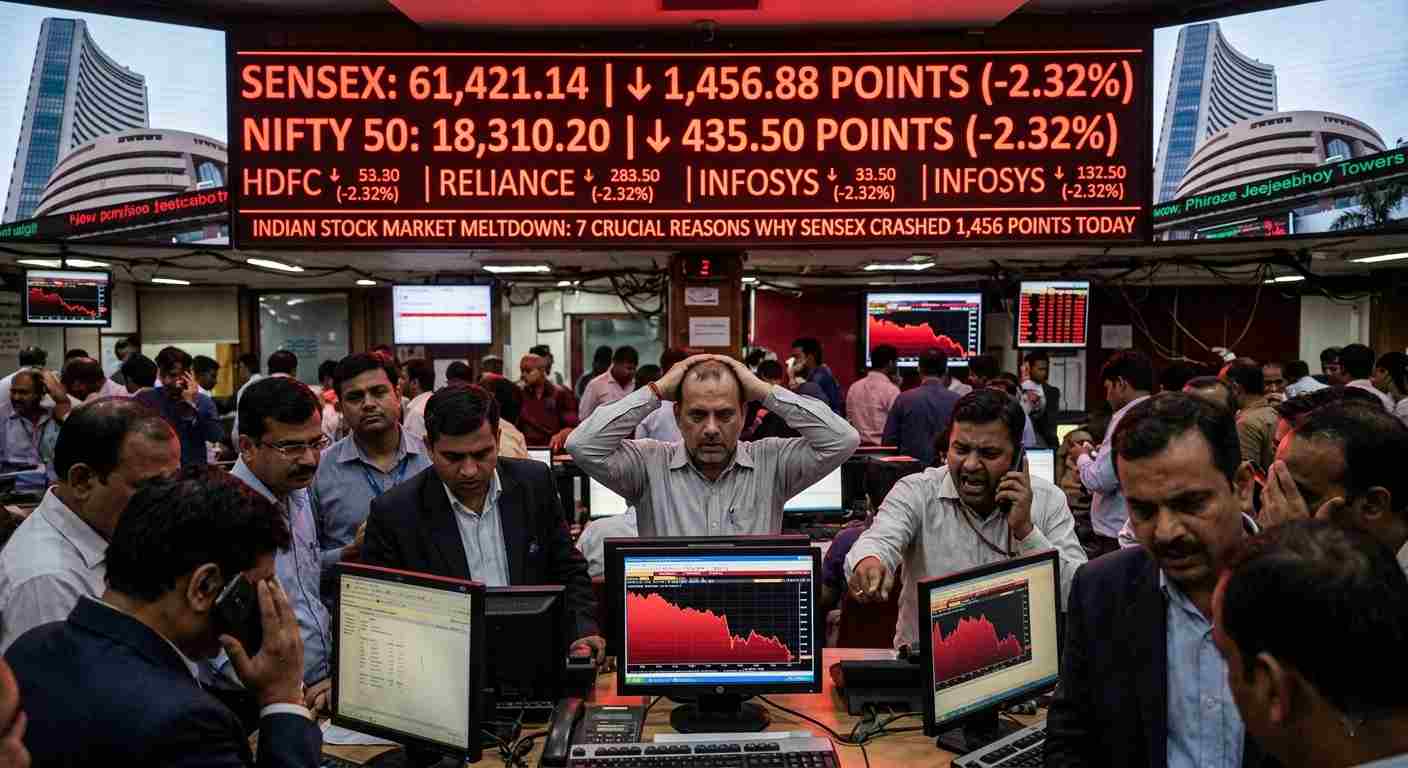
The Indian Stock Market witnessed a massive wave of panic selling on Tuesday, May 12, 2026, as the benchmark indices suffered their worst single-day rout in recent months. Investors were left shell-shocked as the Indian Stock Market ecosystem saw nearly ₹16.77 lakh crore of wealth vanish in just four trading sessions. The Sensex plunged over 1,400 points, while the Nifty 50 breached critical support levels to end below 23,400.
The Market Carnage: Key Indices at a Glance
By the closing bell, the screens were dominated by a sea of red, reflecting a “triple hit” of soaring oil prices, a record-low Rupee, and relentless foreign fund outflows.
SENSEX: Tanked 1,456.04 points (1.92%) to settle at 74,559.24.
NIFTY 50: Dropped 436.30 points (1.83%) to close at 23,379.55.
India VIX: The fear index surged and remained elevated above 19, indicating heightened market anxiety.
Market Breadth: Extremely weak, with 3,219 shares declining compared to only 875 advances on the NSE.
Top 7 Reasons Behind the Indian Stock Market Crash
1. Crude Oil Surge and Geopolitical Gridlock
Brent crude prices jumped 3% to reach $107.40 per barrel. Stalled negotiations between the US and Iran, combined with continued disruptions in the Strait of Hormuz, have fueled fears of a prolonged energy crisis. For the Indian Stock Market, high oil prices are a major headwind as they spike inflation and worsen the current account deficit.
2. Rupee Hits Fresh Record Low
The Indian Rupee touched a new lifetime low against the US Dollar on Tuesday. A weakening currency makes imports more expensive and triggers further capital flight, making investors risk-averse toward Indian equities.
3. Unabated FII Outflows
Foreign Institutional Investors (FIIs) continued their aggressive selling spree. On Monday alone, FIIs offloaded stocks worth ₹8,437.56 crore. This persistent exit by global funds has created a massive liquidity vacuum that domestic institutions are struggling to fill.
4. The OpenAI “Confidence Shock” in IT Stocks
The Nifty IT index was among the biggest sectoral laggards. Sentiment was dampened after OpenAI announced a new venture, “OpenAI Deployment Company,” aimed at helping organizations build AI systems for everyday work. This triggered fears about the traditional business models of Indian IT giants, leading to sharp falls in Tech Mahindra (-4.21%) and HCL Technologies (-4.01%).
5. Sectoral Bloodbath in Realty and Financials
Selling was broad-based, but Realty was the worst-hit sector, dropping over 4.2%. Financial and consumer durable stocks also faced heavy liquidations as investors feared a “tougher macroeconomic environment” ahead.
6. Midcap and Smallcap Meltdown
The broader market faced even deeper cuts. The Nifty Smallcap 100 crashed 3.17%, while the Midcap 100 tumbled 2.54%. Stocks like JSW Energy fell over 6% after their Q4 profits dropped 9%, failing to meet investor expectations.
7. Policy Austerity Concerns
Analysts suggest the decline is driven by more than just profit-booking; it is a “confidence shock”. Recent policy messaging and “austerity-oriented commentary” have led investors to believe that the government and central bank are preparing for difficult economic times.
Stock Highlights: Gainers and Losers
Despite the carnage, a few stocks managed to swim against the tide.
| Top Nifty 50 Losers | % Change | Top Nifty 50 Gainers | % Change |
| Adani Ports | -4.32% | ONGC | +4.70% |
| Shriram Finance | -4.31% | Hindalco | +1.86% |
| Tech Mahindra | -4.21% | State Bank of India | +0.26% |
| HCL Technologies | -4.01% | Bharti Airtel | +0.17% |
ONGC emerged as the top gainer after the government slashed royalty rates on crude oil and natural gas production to encourage domestic output. Conversely, Adani Ports and IT heavyweights dragged the benchmarks down.
The Groww Block Deal: US Investors Divest Stake
Groww (Billionbrains Garage Ventures) Performance & Block Deal Summary
| Metric | Details |
| Q4 Net Profit (PAT) | ₹686.35 Crore (122.06% YoY increase) |
| Q4 Revenue from Operations | ₹1,505.36 Crore (87.93% YoY increase) |
| Q4 EBITDA | ₹939 Crore (141.78% increase) |
| EBITDA Margin | 62.35% (vs 48.47% in the year-ago period) |
| Active Users Growth | 19.9% YoY increase |
| Block Deal Stake Sold | 4.71% Equity (approx. 29.52 crore shares) |
| Total Deal Value | ₹5,325.77 Crore |
| Major Sellers | Peak XV Partners, Ribbit Capital, and Y Combinator |
| Selling Price Range | ₹180.01 – ₹181.34 per share |
Outlook for the Indian Stock Market
With the India VIX sitting high at 19, volatility is expected to remain a permanent resident in the coming sessions. Market participants will closely monitor global crude prices and the Rupee’s movement. For now, the Indian Stock Market remains in a cautious “wait-and-watch” mode as it navigates these global and domestic stormy waters.
Disclaimer : Financial markets are subject to high risk. Please consult with a certified financial advisor before making any investment decisions.