
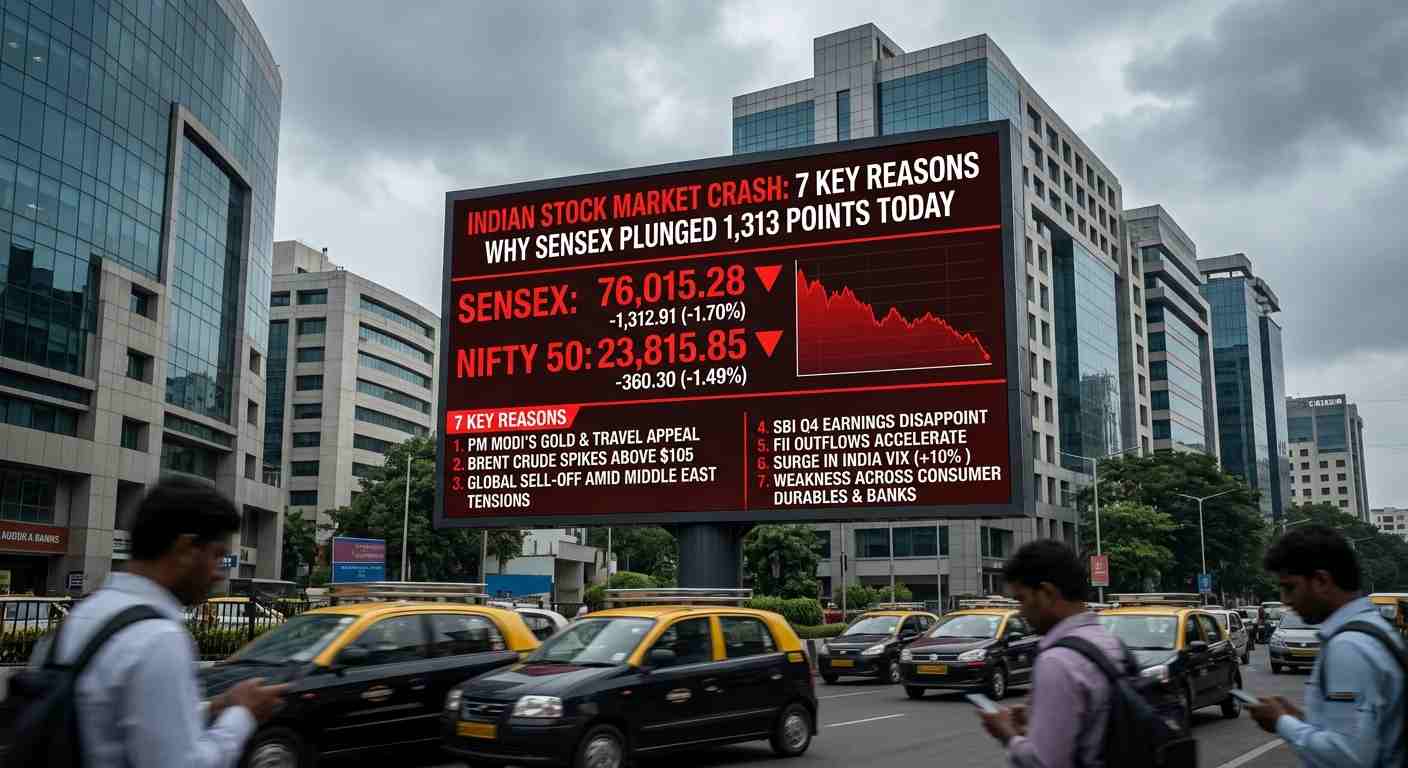
Indian Stock Market investors faced a brutal session on Monday, May 11, 2026, as the benchmark indices witnessed a massive sell-off. The Indian Stock Market was gripped by panic, leading to the Sensex crashing over 1,300 points, while the Nifty 50 struggled to hold the 23,800 mark. From geopolitical tensions in the Middle East to domestic policy shifts, a “perfect storm” of negative cues wiped out nearly ₹6 lakh crore of investor wealth in a single day.
Market Summary: The Bloodbath in Numbers
The carnage was widespread, leaving very few sectors untouched. By the closing bell, the shutters came down on a deep red session:
SENSEX: Closed at 76,015.28, down by 1,312.91 points (1.70%).
NIFTY 50: Settled at 23,815.85, losing 360.30 points (1.49%).
India VIX: The “fear gauge” surged over 10%, indicating extreme volatility ahead.
Market Wealth: BSE-listed companies saw a market capitalization erosion of approximately ₹5.66 lakh crore.
Why did the Indian Stock Market Crash Today?
1. PM Modi’s “Gold & Travel” Appeal Shakes Consumer Stocks
The biggest domestic trigger was an unexpected appeal by Prime Minister Narendra Modi. In a move to protect foreign exchange reserves, the PM urged citizens to avoid “non-essential gold purchases” and “foreign travel” for at least one year.
This sent shockwaves through the jewellery and aviation sectors. Titan Company, the Nifty’s top loser, plummeted nearly 7%. Other jewellers like Kalyan Jewellers and Senco Gold also faced double-digit intraday cuts. Similarly, InterGlobe Aviation (IndiGo) fell 5% as investors feared a slump in international ticketing.
2. Crude Oil Hits $105 Amid Middle East Tensions
The Indian Stock Market is highly sensitive to energy prices. Brent Crude jumped above $105 per barrel after Iran rejected a US peace proposal, instead demanding war reparations and full sovereignty over the Strait of Hormuz. For a country like India, which imports over 80% of its oil, this spike raises immediate concerns about inflation and a widening Current Account Deficit (CAD).
3. SBI’s Disappointing Q4 Earnings
The banking heavyweight, State Bank of India (SBI), dragged the Nifty Bank lower. Although the bank reported a profit of ₹19,684 crore, its Domestic Net Interest Margin (NIM) contracted by 21 basis points to 2.93%. This margin compression signaled to investors that the era of “easy banking profits” might be hitting a ceiling, leading to a 4.4% drop in its stock price.
4. Global Sell-off & FII Exit
Asian markets were mostly lower following the US-Iran stalemate. Furthermore, data showed that Foreign Institutional Investors (FIIs) have turned net sellers, offloading equities worth over ₹4,100 crore in the previous session. When the “big boys” exit, retail sentiment usually follows suit.
Sectoral Performance: Winners and Losers
While the overall Indian Stock Market was bleeding, a few defensive pockets managed to stay green.
| Sector | Performance | Top Draggers/Gainers |
| Consumer Durables | -3.7% | Titan, Kalyan Jewellers |
| PSU Banks | -3.0% | SBI, Bank of Baroda |
| Oil & Gas | -2.5% | Reliance Industries |
| FMCG | +0.8% | Tata Consumer, HUL |
| Pharma | +1.2% | Sun Pharma, Max Healthcare |
The Bright Spot: Tata Consumer Products
Bucking the trend, Tata Consumer Products soared 8% to become the top Nifty gainer. The company reported a stellar 20% jump in net profit (₹491 crore) for Q4 FY26, driven by margin improvements and strong demand for its pantry staples.
Midcap and Smallcap Carnage
The broader Indian Stock Market didn’t escape the heat. The Nifty Midcap 100 fell 1.05%, while the Smallcap 100 dropped 1.13%.
Urban Company shares crashed 11% after reporting widened losses due to heavy investments in its new “InstaHelp” service.
JSW Energy fell after reporting a 9% decline in net profit (₹371 crore) citing rising fuel and financing costs.
What Should Investors Do Now?
The sudden spike in the India VIX suggests that the Indian Stock Market will remain volatile in the coming sessions. The combination of high oil prices and the government’s push to curb “non-essential” spending marks a shift in the economic narrative.
Key Levels to Watch:
Nifty Support: 23,750 is a crucial psychological level. If broken, we could see a slide toward 23,500.
Nifty Resistance: 24,100 remains the immediate hurdle for any recovery.
The Human Perspective:
Market crashes are often emotional. While the screens are red today, it is essential to remember that corrections are a healthy part of long-term bull markets. PM Modi’s appeal to “Buy Local” and “Reduce Gold” might hurt jewellery stocks today, but it aims to strengthen the Rupee in the long run. If you are a long-term investor in the Indian Stock Market, look for quality companies like those in the Pharma or FMCG sectors that showed resilience today.
Disclaimer: Financial markets are subject to high risk. Please consult with a certified financial advisor before making any investment decisions.